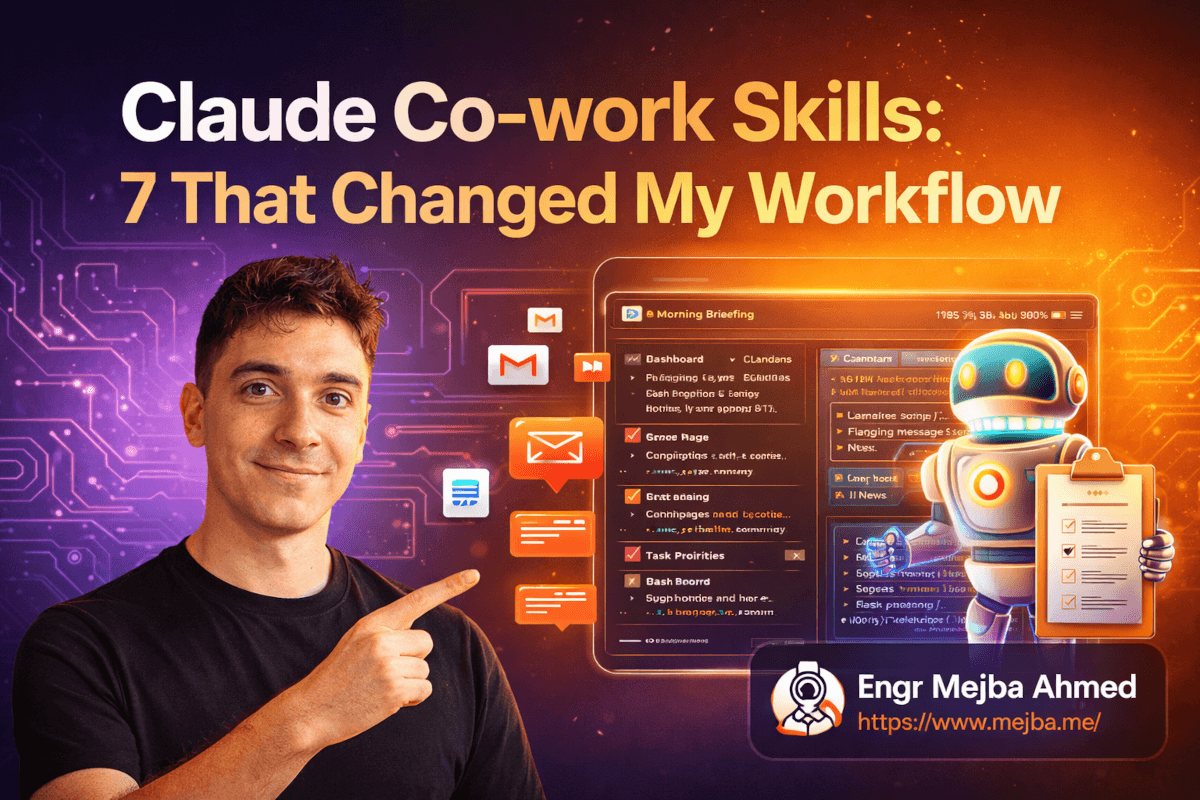
Skills are the difference between owning Claude Cowork and renting it. A Cowork session without skills starts from zero every time — you re-explain your standards, your formats, your edge cases, and you get output whose quality depends on how well you briefed it that particular morning. A skill is that briefing written down once, properly, as a packaged procedure the agent loads on demand. I have published 53 skills on my own marketplace, which means I have made most of the possible authoring mistakes already, and the seven below are the ones from my catalog that genuinely restructured how my operations work runs — plus the authoring lessons underneath them, which matter more than any individual skill.

How skills actually work in Cowork
Mechanically, a skill is a packaged set of instructions — procedures, constraints, output formats, reference material — that the agent pulls into context when a task matches it. The same skills concept spans the Claude ecosystem, which is the quiet superpower: a skill I wrote for terminal-side work runs in Cowork's desktop context too. What changes in Cowork is the shape of the work: operations tasks (research, documents, communication) rather than repository tasks, touching folders and connectors rather than git and test suites.
That reshaping is not free, and it is the first real lesson: a skill written with repository assumptions — run this command, check that file path — degrades in Cowork. The skills that transfer are procedure-and-judgment skills, where the value is how to think about the task, not which commands to run. All seven below are that kind. If skills as a concept are new to you, my complete guide to Claude skills is the foundation this post builds on.
The seven
1. SEO Content Optimizer & Writer
The workhorse. It encodes my actual editorial standard: search intent identified before a word is drafted, heading structure that answers the query, metadata constraints, and the specificity rules that keep output from reading like AI filler. The design decision that made it work: it contains rejection criteria — descriptions of bad output — not just instructions for good output. Agents follow "never do X, here is what X looks like" more reliably than aspirational style guidance. In Cowork, this runs against draft folders as a review-and-upgrade pass, which is also how it slots into my automated SEO content pipeline.
2. Competitive Intelligence & Market Research Agent
Research without a procedure produces confident mush. This skill forces a sequence — define the question, enumerate sources, extract claims with citations, separate observed facts from inferences, then and only then synthesize. The step that changed my mornings is the claims table: every assertion in the final brief traces to a source, which means I can spot-check a finished research deliverable in five minutes instead of re-doing it. Cowork plus a scheduled task makes this a standing weekly sweep of the niches my ventures compete in.
3. Email & Professional Communication Writer
Sounds trivial; is not. The skill carries my actual constraints: length caps by message type, no filler openers, how I decline things, when a message should be a call instead. The authoring insight: communication skills fail when written as tone adjectives ("professional, friendly") and succeed when written as concrete before/after examples. Ten examples of real messages I would and would not send taught it my register better than any description could. Drafts, never sends — the byline rule from my other pipelines applies to my outbox too.
4. Brand Voice Discovery & Content Guardian
The consistency layer over everything content-shaped. Where the email skill handles one channel, this one encodes the voice itself — vocabulary I use and avoid, claim-verification habits, the canonical facts about my work that must never drift. Every content skill in my stack references this standard rather than duplicating it. That layering is the single most useful architecture decision in my whole catalog: voice lives in one place, so changing it is one edit, not fifty-three.
5. Meeting Minutes & Action-Item Generator
The highest ratio of tedium-removed to authoring-effort in the list. Transcript in; decisions, owners, and deadline-bearing action items out, in a fixed format my tools can parse. The two rules doing the work: unattributed action items are flagged, not guessed ("someone should" is a red flag string, literally), and anything ambiguous lands in an explicit "needs clarification" block instead of being silently resolved. Guessing wrong on an owner costs more than asking; the skill knows that.
6. Data Analyst & Insight Dashboard Builder
Spreadsheets and exports in the operations folder used to wait for "when I have time." This skill turns them into summaries with the three things I actually want: what changed, what is anomalous, what deserves a decision. The design constraint that keeps it honest: every insight must name the cells or rows it derives from. Same principle as the research skill's claims table — traceability is what turns agent output from "interesting" into "checkable," and checkable is the bar for anything that informs a business decision.
7. Workflow Orchestrator & Multi-Tool Automation Agent
The meta-skill: it encodes how I decompose multi-step work — stages, file handoffs between them, verification points, and where human gates belong. When Cowork faces a compound task ("research this, draft that, prepare the report"), this skill is why the result arrives as staged artifacts instead of one tangled session. It is the operations twin of the pipeline discipline I use on the engineering side, and the reason my scheduled tasks fail locally instead of catastrophically.
What makes a skill Cowork-friendly
Patterns across the seven, condensed:
- Procedures over commands. Judgment transfers between surfaces; tool invocations do not.
- Rejection criteria included. Show the agent bad output explicitly. This is the highest-leverage authoring trick I know.
- Traceability required. Research cites, analysis names its cells, minutes flag their guesses. Checkability is the feature.
- One concern per skill, layered. Voice is one skill referenced by many, not boilerplate pasted into each.
- Gates written in. The skill itself says where a human approves. Automation ends where the byline begins.
And the process rule above all of them: every one of these seven earned its packaging by being a manual brief I had repeated at least three times. Skills written speculatively — for tasks you imagine having — rot unused. The full set of authoring lessons, including the testing loop I run before anything ships to my marketplace, is in what I learned building Claude Code skills and my skill testing and optimization workflow.
Start with one
A note on testing before you ship anything to a scheduled task: run a new skill attended for a full week first, on real inputs, and read every output. Skills fail quietly — a format drifts, an edge case gets guessed at — and the time to catch that is while you are still looking. Only what has survived a week of supervised runs earns a place in the recurring rotation.
Do not install seven skills this week. Pick the task you have manually briefed most often this month, write that briefing down with rejection criteria and one gate, and run it through Cowork for a week. One skill that encodes real repetition beats a library of speculative ones — that is the actual lesson of the fifty-three I have shipped.
All seven skills in this post, and the rest of my catalog, live on my agent skills marketplace — browse the full set there if you would rather adapt working skills than start from a blank file.