Prompting is labor. Skills are capital. That distinction is the entire reason Claude Skills matter, and it is strange to me how little coverage they get compared to shinier features. A prompt is effort you spend again every single time; a skill is a procedure you write once, version, share, and invoke forever. I currently maintain 53 skills on my agent skills marketplace and run about 35 of them in my own ~/.claude/skills directory daily, so what follows is not a feature-announcement summary. It is what shipping that many of them teaches you.
What a Skill Literally Is
Strip away the branding and a Claude skill is a folder containing a SKILL.md file:
---
name: seo-audit
description: Run a full technical SEO audit of a site: crawlability,
  schema, sitemaps, hreflang. Use when the user asks for an SEO audit,
  indexation investigation, or search visibility review.
---

Instructions:
1. Collect the site's routes, templates, and any GSC exports provided.
2. Run each sub-check and rank findings by indexation impact.
3. Output findings with the file and line that causes each issue.
...
Two parts: frontmatter that tells Claude when the skill applies, and a body that tells it how to do the job. Skills live in ~/.claude/skills (available everywhere) or a project's .claude directory (versioned with the repo). You invoke one explicitly with /seo-audit, or Claude loads it automatically when your request matches its description.
That is the whole mechanism. The consequences are bigger than the mechanism suggests.
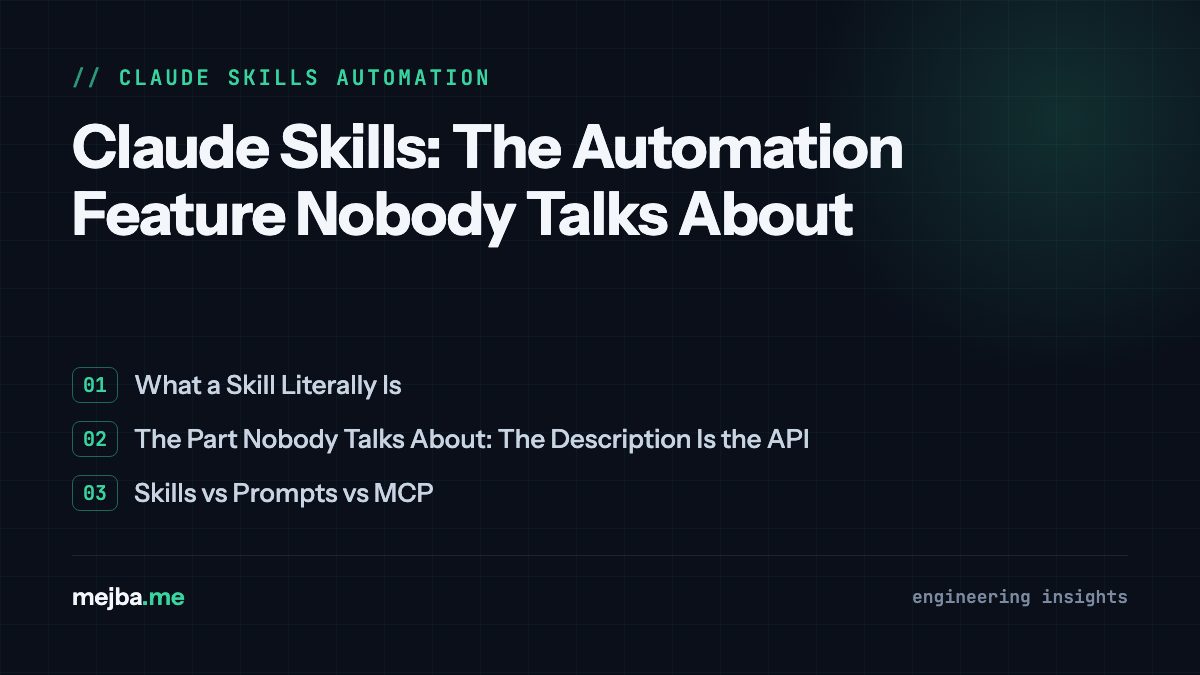
The Part Nobody Talks About: The Description Is the API
Here is the lesson that took me the longest to learn, and I learned it by shipping skills that did not fire. Claude decides whether to load a skill by reading its description, not its body. The body can be a masterpiece of process documentation; if the description does not match how users actually phrase the task, the skill sits there unused, and the model improvises instead.
Almost every "my skill doesn't trigger" complaint I have received about marketplace skills traces back to this. The description was written like a summary ("Handles SEO tasks") instead of like a routing rule ("Use when the user asks for an SEO audit, indexation investigation, or search visibility review").
This is also why my SEO tooling is thirteen narrow skills (seo-audit, seo-schema, seo-hreflang, seo-sitemap, and so on) rather than one mega-skill. Narrow descriptions route correctly. A skill that claims to do everything matches everything weakly and nothing well. When I split my original monolithic SEO skill into the family, misfires largely disappeared. Treat the description field the way you would treat a function signature in a public API, because that is what it is.
Skills vs Prompts vs MCP
The three get confused constantly, and the confusion causes people to build the wrong thing:
| Prompt | Skill | MCP server | |
|---|---|---|---|
| What it is | One-shot instruction | Versioned procedure | Live connection to a system |
| Persistence | Gone after use | Permanent, editable file | Runs as a process |
| Best for | Genuinely one-off tasks | Repeatable workflows with judgment | Stateful integrations (DBs, browsers, design tools) |
| Cost of reuse | Full rewriting every time | /name |
Context overhead every session |
The test I use: if I have typed substantially the same instructions three times, that is a skill now. If the task needs live data from an external system, that is MCP. If it is truly novel, it stays a prompt. Most people over-invest in the first column and never discover the second.
Real Skills From My Own Stack
Concrete beats abstract, so here is a sample of what runs on my machine and what each automates:
- skill-creator — the meta-skill: it interviews me about a workflow and drafts the SKILL.md. Most of my newer skills started here; I wrote up what building dozens of them taught me in lessons from building Claude Code skills.
- handoff — writes a structured continuation document at the end of a session so the next session starts with full context instead of archaeology. Multi-day work stopped degrading when this became automatic.
- caveman — a token-diet skill that compresses verbose context. Unglamorous, directly measurable savings.
- tdd — enforces test-first on features. Not because I lack discipline, but because encoded discipline survives deadlines and moods.
- the seo family — thirteen auditors that found the cause of my own site's deindexing crash, a story I told in full in my Claude Code SEO audit.
Notice what these have in common: none of them are "chat better." Every one encodes a procedure I used to perform manually, with my standards baked in.
Writing Your First Skill (Do This Today)
- Pick a task you performed at least three times this month. Not your hardest task; your most repeated one.
- Do it manually once more, narrating. Write down every step, including the checks you do implicitly ("verify the file exists before editing"). The implicit checks are the valuable part.
- Create
~/.claude/skills/your-skill/SKILL.mdwith a routing-rule description and your steps as the body. - Run it on a real case immediately. The first run always reveals a step you forgot you do.
- Edit the file, not your prompts. From now on, every improvement is permanent. This is the compounding step, and it is the entire reason skills beat prompting.
For a broader map of the ecosystem around this, my complete guide to Claude Skills covers formats and capabilities in more depth.
When a Skill Is the Wrong Tool
Honesty section. Skills are wrong for: genuinely one-off work (writing the skill costs more than the task), anything requiring live external state (that is MCP's job), and processes you have not stabilized yet. A skill is frozen judgment; freezing judgment you have not formed yet just automates your confusion. Stabilize the workflow manually first, then encode it. And once you have a stack of skills that work, they become surprisingly packageable, which is a commercial story of its own that I told in Claude Code skills businesses pay for, and an architectural one in my three-layer agentic OS.
Install one of my 53 production skills from the agent skills marketplace — SEO auditors, design critics, workflow glue — and read its frontmatter before you read its body. The description is what decides whether your own version ever fires, and copying a routing rule that already works beats guessing at one.