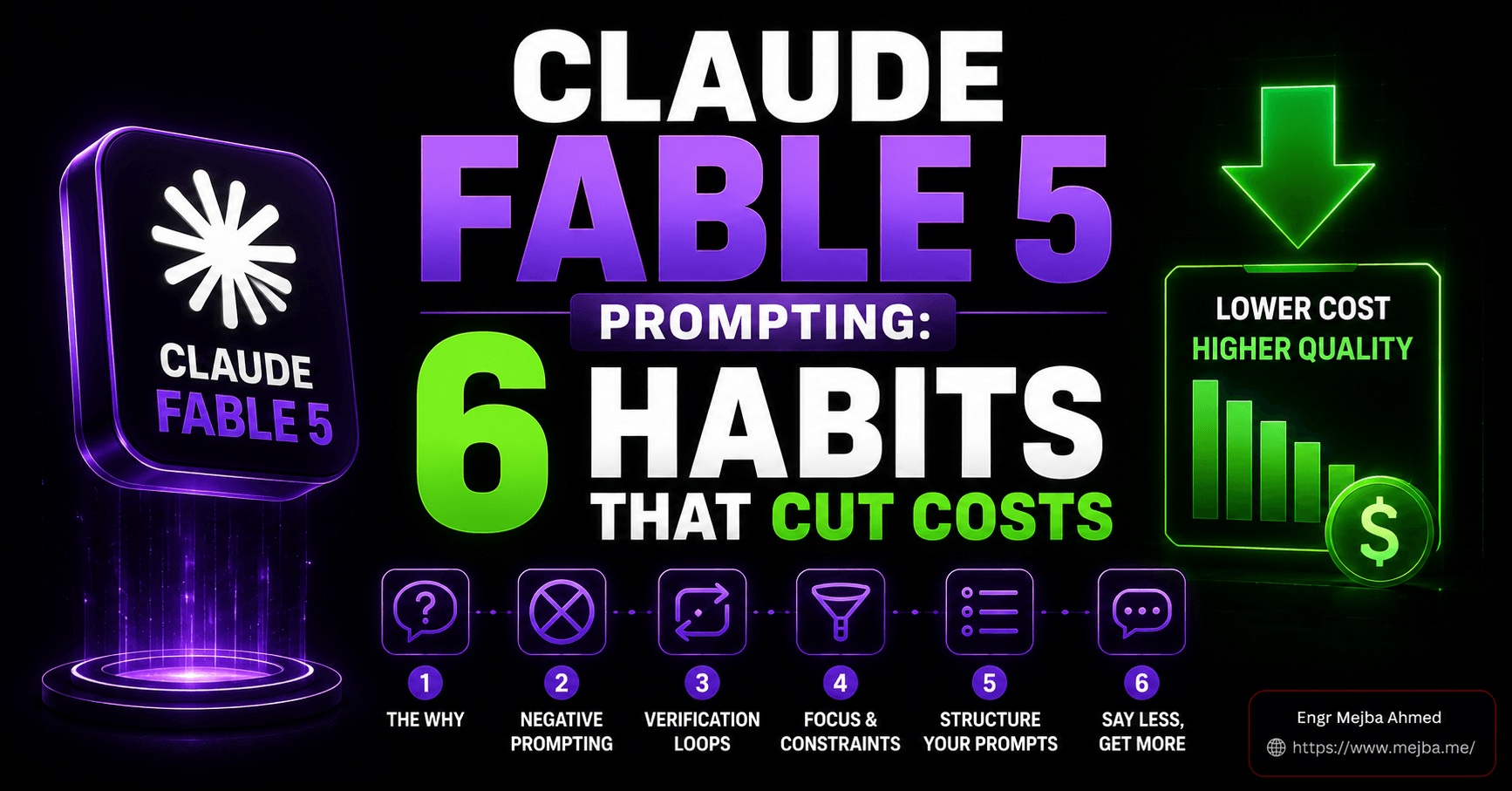
Claude Fable 5 Prompting: 6 Habits That Cut Costs
The most expensive prompt I sent last week was 41 words long, and only the first nine of them did any work.
I was wiring a new capture flow into my second brain — the Obsidian-plus-Claude-Code setup I run my whole life through — and I fired off one of those bloated, belt-and-suspenders instructions I'd gotten in the habit of writing during the Opus 4.7 era. "Do this, but don't do that, and make sure you also consider this, and explain your reasoning at each step so I can follow along, and be thorough." You know the shape. The instruction where you try to pre-empt every way the model could go wrong by stacking rules on top of rules.
On Opus that prompt was merely inefficient. On Claude Fable 5 it was a small fire. Because Fable 5 bills $10 per million input tokens and $50 per million output — and that "explain your reasoning at each step" line didn't just pad the response, it may have quietly bounced the request to a different model entirely. I'll get to why. The short version is that good Claude Fable 5 prompting isn't a style preference on this model. It's the difference between a tool that earns its price and one that drains your account while you're not looking.
I've spent the days since Fable 5 came back rebuilding how I talk to it — across my AI operating system built on Claude Code, my daily client repos, and the second brain I run in Obsidian. Six habits did the heavy lifting. Every one of them makes the output better and the bill smaller at the same time, which is rarer than it sounds. This is that list.
If you want the companion piece — what to actually point Fable 5 at during the free window that ends July 7 — I mapped eight high-leverage workflows for the free window separately. That post is the to-do list. This one is the how-to-say-it. Read them together and you've got both halves.
Why Fable 5 punishes a sloppy prompt harder than any model I've used
Let me put real numbers on the thing before the habits, because the habits only make sense once you feel the cost mechanics in your gut.
Fable 5 is the most capable model Anthropic ships right now, and it's priced like it: $10 per million input tokens, $50 per million output tokens (Anthropic's pricing docs confirm the rate). That's roughly double Opus 4.8's $5-in / $25-out. So far, so "premium model is premium."
Here's the part that changes how you should prompt. The reasoning Fable 5 does — the internal thinking before it answers you — bills as output tokens, at that same $50 per million. Thinking tokens are the most expensive token class on the whole rate sheet. And you don't see them in the reply. A response that looks like 300 words on your screen might have burned ten times that in reasoning you never read.
Now layer effort levels on top. Fable 5's API exposes effort as low, medium, high (the default), xhigh, and max (Anthropic's effort docs lay out the tiers; in Claude Code the top rung shows up as the ultra/ultracode gear I dug into in my Opus 4.8 effort-levels review). Effort does not change the per-token rate — Fable 5 is $10/$50 at every level. What effort changes is how many tokens the model spends thinking before it replies. Crank effort to max and you haven't made each token pricier; you've told the model to buy a lot more of the most expensive tokens on the menu.
Put those two facts together and you get the whole thesis of this post: on Fable 5, the cost of a task is set less by what you ask for than by how you ask for it. A vague prompt makes the model reason in circles at $50 a million to figure out what you meant. A prompt that invites open-ended exploration makes it explore — expensively. A prompt with a reasoning-exposure request in it can knock you onto a different model without telling you loudly.
That's not a reason to avoid Fable 5. It's a reason to prompt it like the specialist it is. There's one habit in here — the fifth — that's genuinely Fable-specific and that most people are getting wrong right now, because the behavior it exploits didn't exist on older models. Keep it in the back of your mind; I'll close that loop.
Six habits. Ordered roughly by how much money each one saves per prompt.
Habit 1: Give it the "why", not just the "what"
The single highest-return change I made was also the least intuitive, because it means writing more to spend less.
Every request carries a reason behind it — the outcome you're actually chasing. Most prompts throw that reason away and hand the model only the mechanical instruction. "Write an email about the delay." "Refactor this class." "Summarize these notes." The model then has to reconstruct your intent from the bare task, and reconstruction is exactly the kind of open-ended reasoning that runs the meter on Fable 5.
Give it the why up front and you collapse that guessing. Compare:
Weak: "Write an email to the client about the timeline slipping."
Strong: "Write an email to a client who's the anchor customer for a much bigger rollout next quarter — the relationship matters more than this one deadline. The timeline's slipping two weeks. I want them to feel informed and in control, not managed. Keep it short and specific about the new dates."
The second version isn't longer for the sake of it. Every extra clause removes a branch the model would otherwise have had to explore on its own dime — the tone, the stakes, the length, the goal. Fable 5's semantic comprehension is sharp enough that when you hand it genuine context, it stops hedging across a dozen possible readings and commits to the right one. Sharper output, fewer reasoning tokens to get there. You paid a few input tokens at $10 a million to avoid a pile of output tokens at $50.
This compounds hard when the model is wired into a context system. In my second brain, "the why" is often a pointer: "This is for the Q3 partner review — pull the relevant context files and draft against what we agreed in the last sync." That one sentence tells Fable 5 which notes to load and what success looks like, and the context-beats-configuration principle I've written about does the rest. The model isn't reasoning in a vacuum. It's reasoning against your actual situation.
The rule I now follow: if I catch myself writing a bare imperative, I stop and add the clause that starts with "because." Nine times out of ten that clause is the most valuable thing in the prompt.
Habit 2: Tell it what NOT to do
Context tells the model where to go. Negative prompting tells it where the cliffs are — and Fable 5 is the first model where I've seen this land cleanly instead of getting half-ignored.
The failure mode negative prompting kills is unrequested initiative. You ask the model to investigate a bug and it "helpfully" refactors three unrelated files. You ask it to review a document and it rewrites half of it. Every one of those uninvited actions is output tokens you're paying for and cleanup work you didn't ask for — a double tax, cash and time.
So I now state the fence explicitly:
"Investigate why this endpoint returns a 500 and report what you find. Do not edit, delete, or 'fix' anything until I say go."
That last sentence saves me constantly. Without it, a capable model with an itch to be useful will start "improving" things, and on Fable 5 those improvements aren't free experiments — they're premium-priced ones. With it, the model does exactly the bounded task and stops, and I decide what's worth acting on.
A few negative prompts I keep on rotation because they earn their place:
- "Report findings only. Don't change files." — for any investigation or audit pass.
- "Don't add dependencies or new libraries unless there's no reasonable alternative, and flag it first if so." — stops scope creep in code tasks cold.
- "Don't rewrite sections that already work. Touch only what I named." — for editing, where models love to over-reach.
One nuance I learned the hard way: negative prompting works with positive framing, not instead of it. "Don't break the tests" is weaker than "keep every existing test green, and only after that add coverage for the new behavior." Give the model a target to hit and the fence not to cross. I dug deeper into that balance in my prompting rules that reduce guessing — the whole game is leaving the model as little room to invent as possible, because invention is where both bugs and token bills come from.
Habit 3: Let it act the moment it has enough — and match the effort to the task
This is the habit that most directly touches the meter, so slow down here.
Capable reasoning models have a tendency to over-prepare. Ask an open-ended question and they'll research exhaustively, weigh six options, build a plan for the plan — sometimes genuinely useful, often just expensive throat-clearing before an answer that was reachable three steps ago. On a model where thinking bills at $50 a million, that pre-amble is a line item.
So I now tell Fable 5, in plain words, to act as soon as it has enough:
"Gather what you actually need, then proceed. Don't over-research — once you have enough to act sensibly, act. If you hit a real fork you can't resolve, ask me one sharp question rather than guessing."
That single instruction cuts long, costly deliberation on tasks that didn't need it. Fable 5 follows short, clear direction well enough that "stop planning and move" genuinely lands — its reasoning is good enough to know when it has enough, if you give it permission to stop.
The other half of this habit is the effort dial, and it's where most of the money hides. Leave everything on the default high and you're overpaying on routine work and, occasionally, underpowering the hard stuff. My working map:
- Low / medium — lookups, renames, boilerplate, "where is X defined," a quick draft. Routine work has no business on high effort.
- High (default) — real feature work, multi-file changes, anything where you'd want a colleague to actually think.
- Xhigh / max — genuinely gnarly refactors, architecture calls, subtle debugging. Reach for these deliberately, not by habit.
Here's the reframe that saved me the most: you probably shouldn't be running Fable 5 for most of your work at all. The community claim floating around launch — that Fable 5 on low effort matches Opus 4.8 at its highest setting — I can't verify cleanly, and I'd treat any precise "Fable low equals Opus max" equivalence as marketing until you've tested it on your own tasks. But the shape of the advice is right regardless: Fable 5 is a scalpel, not a daily driver. In my own routing, it does maybe 5–15% of the work — the deep passes where its ceiling genuinely matters — and Opus 4.8 or cheaper models carry the routine load. Using Fable 5 for everything isn't dedication to quality. It's how you set money on fire. I laid out the broader routing math in my AI agent cost-optimization guide, and it applies double at these rates.
The discipline: pick the cheapest model and the lowest effort level that will actually do the job. Not the highest you can afford. The lowest that works.
Habit 4: Make it prove its work before it calls anything "done"
Every model occasionally declares victory it hasn't earned — tests "passing" that were never run, a fix "applied" to a file it misread, a summary confidently citing a source that says the opposite. On a cheap model that's an annoyance. On Fable 5 it's an annoyance you paid a premium for, and worse, it's the kind of error that costs you a second expensive round-trip to catch and correct.
So I bake verification into the instruction itself:
"Before you tell me this is done, verify it. Run the tests and show me the output. If you can't verify a claim, say so plainly instead of guessing — I'd rather hear 'I couldn't confirm the caching path' than a confident answer that turns out wrong."
Two things make this work. First, demanding evidence — actual command output, the specific line you changed, the quote from the source — not a summary of evidence. "The tests pass" is a claim. The pasted test runner output is proof. Force the proof.
Second, and this is the part that pairs beautifully with Fable 5's honesty tuning: explicitly give the model permission to say "I couldn't verify this." The newer Claude models are noticeably better at flagging the edge of their own knowledge when you invite it, and one honest "I'm not sure about this part" saves you the far more expensive discovery that it made something up and you shipped it. A model that admits doubt is cheaper than a model that fabricates confidently, every single time.
This isn't Fable-specific — verification loops improve every model, and I'd argue they're the highest-trust habit in this whole list. But it's more valuable on Fable 5 precisely because the cost of an unverified error is higher here. When the mistakes are expensive, the habit that catches mistakes early is worth the most.
If you'd rather have someone build these verification loops straight into your team's agents and skills — so the "prove it" step is baked into the system instead of retyped every prompt — that's exactly the kind of setup work I take on. You can see what I've built at fiverr.com/s/EgxYmWD.
Habit 5: Stop asking Fable 5 to show its reasoning
Here's the loop I opened at the top — the one habit that's genuinely specific to this model, and the one I see people getting wrong most.
Stop putting "explain your reasoning step by step" and "walk me through your thinking" and "show your chain of thought" into your Fable 5 prompts. Not because the advice is bad in general — it's been solid prompt-craft for years. Because on Fable 5, after its return, reasoning-exposure requests can trip the safety classifier.
Some context on why. Fable 5 came back online in early July under a substantially tightened safety layer, after the whole export-control saga I unpacked in my breakdown of Fable 5's return. The new classifier was built to shut down a specific jailbreak class — and reporting on the return notes it blocks the target technique in over 99% of cases, at the cost of a higher false-positive rate on ordinary requests (TechTimes covered the new classifier's behavior). Attempts to extract the model's internal workings sit uncomfortably close to the jailbreak patterns the classifier is tuned to catch.
When a request trips that classifier, Fable 5 doesn't just refuse. It reroutes the request to Opus 4.8. From the reporting, you're generally notified when this happens, and through the API the responding model is visible if you look — but inside a long agent run, or a chatty desktop session, it is genuinely easy to miss. You think you're getting Fable 5's ceiling. You're quietly getting a different model.
The economics of that reroute are a double-edged thing worth understanding. When you get bounced to Opus 4.8, you pay Opus's lower rate — so a downgraded response actually costs you less. That sounds like a win until you remember why you reached for Fable 5: you wanted its ceiling on a hard problem. Getting silently handed a less capable model on the exact task you were paying premium to nail is not a discount. It's a quality drop you didn't choose and might not notice.
So the fix is simple and it's free: strip reasoning-exposure requests out of your Fable 5 system prompts and user prompts. If you genuinely need to see the model's thinking, that's what verification output (Habit 4) is for — ask for evidence and results, not an exposed thought process. You get the accountability without waving a red flag at the classifier. I keep one version of my system prompt for Fable 5 with all "explain your reasoning" language scrubbed, and a different one for other models where it's still fine. Small change. It's the difference between running the model you're paying for and running a lookalike.
Habit 6: Say less, not more
The last habit is the one that ties the other five together, and it's the one that fights every instinct the Opus 4.7 era trained into us.
For years, getting good output meant more — more rules, more caveats, more explicit edge-case handling, longer and longer system prompts stacking instruction on instruction to fence the model in. Fable 5 breaks that reflex. It's intelligent enough that a tight, well-aimed prompt outperforms a verbose rulebook — and the verbose rulebook costs you input tokens on every single call and invites the model to reason across all that instruction at $50 a million on output.
Compare a real before-and-after from my own content pipeline. The old version was a fourteen-line list of rules about tone, structure, what to avoid, how to format, when to ask. The new version:
"Lead with the outcome. Keep it simple and specific. Only pause to ask me something when the work genuinely needs a decision I haven't made."
Three sentences. It produces cleaner drafts than the fourteen-line version did, because Fable 5 wasn't struggling to obey the rules — it was being distracted by them. Intelligence plus concision beats intelligence plus a wall of constraints.
The catch, and it's important so I don't contradict Habit 1: less isn't the same as vague. Habit 1 said give it context. Habit 6 says don't drown that context in rules. Those aren't in tension — the highest-value content (the why, the goal, the fence) stays; the low-value ceremony (obvious instructions, redundant caveats, defensive over-specification) goes. You're trimming ballast, not signal.
This is also what makes tight integration with skills and context files actually work. When your prompt is lean, the model has room to lean on your system prompt, your context files, and your skills instead of re-reading a bloated instruction every turn. Concision at the prompt level is what lets the system level do its job — the same shift I traced when prompt engineering gave way to loop engineering. Say less in the prompt so the architecture around it can say more.
Where I'd actually pump the brakes
I've spent this whole post handing you habits, so let me be straight about the friction, because a tidy six-step list that pretends there's no downside is just an ad.
The reroute is the thing to watch, and it's easy to lose track of. Habit 5 defuses the reasoning-exposure trigger, but the classifier is tuned tight enough that legitimate work — defensive security especially — can still bounce you to Opus 4.8 without a loud signal. If you're paying Fable 5 rates specifically for a hard task, actually check which model answered. If you can't tell from your surface, that's a reason to run high-stakes Fable 5 work somewhere the responding model is visible.
Most of these habits help every model — and that's the point, not a weakness. Context, negative prompting, verification, concision: none of that is Fable-exclusive. What's Fable-specific is how expensive it is to skip them here. The same sloppy prompt that wastes pennies on a cheap model wastes real money on Fable 5. The habits don't change. The stakes do.
The biggest lever isn't a prompting habit at all. It's not using Fable 5. I'll say it again because it's the one people resist: the correct amount of Fable 5 in your workflow is small. Route the routine 85–95% of your work to Opus 4.8 and cheaper models, and save Fable 5 for the passes where its ceiling genuinely changes the outcome. The best Claude Fable 5 prompting habit, in the end, is knowing when not to prompt Fable 5.
How I bake these six habits into the system, not the prompt
Habits you have to remember are habits you'll skip at 11pm on a deadline. So I stopped relying on memory and pushed all six down into the layer beneath the prompt.
Three places they live now:
In the system prompt. My Fable 5 system prompt has the invariants baked in: proceed once you have enough, verify before declaring done, say so if you can't confirm something, and — the Fable-specific one — zero reasoning-exposure language anywhere in it. I don't retype these. They're the floor every prompt starts from.
In skills. For repeatable jobs — a code-review pass, a research summary, a content draft — the verification loop and the negative-prompting fences live inside the skill definition itself. The skill is the habit, encoded once. When I invoke it, the "prove your work, don't touch what I didn't name" contract comes along automatically. This is the same second-brain-plus-skills architecture I've been building toward across my AI operating system on Claude Code.
In effort defaults per task type. Rather than picking an effort level by feel each time, I map task types to levels once and let the routing follow. Routine skills default low or medium; the deep-pass skills reserve high and above. The decision moves out of the moment and into the design.
The payoff is that the expensive mistakes — the runaway reasoning, the silent reroute, the confident fabrication, the fourteen-line prompt — stop being things I have to catch in real time. The system catches them, because I encoded the catch once. That's the actual destination of all six habits: not better prompts typed by a disciplined human, but a setup where the discipline is structural and the human gets to be a little sloppy without paying for it.
The real cost of a Fable 5 prompt
Go back to that 41-word prompt from the top. The waste wasn't really the 41 words. It was everything they set in motion: the open-ended reasoning at $50 a million, the "explain your reasoning" line that may have bounced me to a different model, the initiative I didn't fence off, the rules I stacked instead of the context I should have given. One lazy prompt, four separate leaks.
Fable 5 is the most capable model I've put my hands on, and it charges like it. That combination makes prompting stop being a soft skill and start being a cost control — the same instruction, worded two ways, can differ by an order of magnitude in what it burns and whether it even runs on the model you meant. The six habits aren't about squeezing a better sentence out of the model. They're about not paying premium rates for your own imprecision.
Here's your one thing to do today: take the single prompt or system prompt you send Fable 5 most often, and run it through the six. Add the why. Fence off what you don't want. Tell it to act and to verify. Strip out every "explain your reasoning." Then cut it in half. Send both versions at the same task and watch the token counter. The gap you see is the tax you've been paying — and now you know how to stop.
FAQ
Frequently Asked Questions
Everything you need to know about this topic
Claude Fable 5 costs $10 per million input tokens and $50 per million output tokens — roughly double Opus 4.8 — and its internal reasoning bills as output at that $50 rate. A vague or bloated prompt makes the model reason more before answering, so imprecise prompting directly inflates cost. Tight, context-rich prompts spend fewer of those expensive reasoning tokens.
Effort levels don't change the per-token rate — Fable 5 is $10/$50 at every level. What they change is how many tokens the model spends thinking before it replies. Higher effort (xhigh, max) can use far more tokens than the visible output suggests, so matching effort to task difficulty is a direct cost lever. See Habit 3 above for the full map.
Fable 5's tightened safety classifier reroutes flagged requests — including reasoning-exposure attempts and some legitimate defensive-security work — to Opus 4.8. Reporting says you're generally notified and the API shows the responding model, but it's easy to miss in a long session. You pay Opus's lower rate when downgraded, but you lose the Fable 5 ceiling you were paying for.
No — on Fable 5 specifically, "explain your reasoning" style requests can trip the safety classifier and get you rerouted to Opus 4.8. If you need accountability, ask for verification evidence (test output, the exact change, source quotes) instead of an exposed thought process. You get the same accountability without the reroute risk. See Habit 5 above.
In my own routing, roughly 5–15% — the deep passes where its ceiling genuinely changes the outcome. Route the routine 85–95% to Opus 4.8 and cheaper models. Using Fable 5 as a daily driver, given its rates, is the fastest way to drain a credit balance for quality you didn't need on most tasks.
Let's Work Together
Looking to build AI systems, automate workflows, or scale your tech infrastructure? I'd love to help.
- Fiverr (custom builds & integrations): fiverr.com/s/EgxYmWD
- Portfolio: mejba.me
- Ramlit Limited (enterprise solutions): ramlit.com
- ColorPark (design & branding): colorpark.io
- xCyberSecurity (security services): xcybersecurity.io