Last updated: July 10, 2026
A model that had been dark for 19 days doesn't usually come back with a government press cycle attached. This one did.
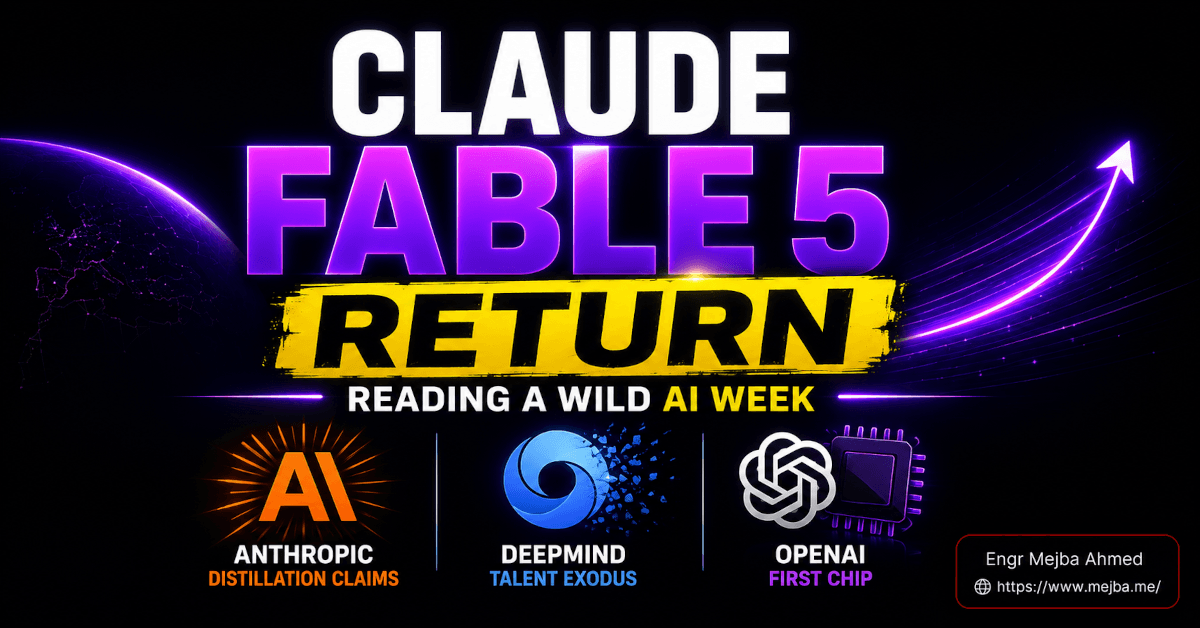
For most of late June I had four browser tabs open, each showing a different breadcrumb pointing at the same conclusion: the Claude Fable 5 return was being staged behind the scenes, even while Anthropic's own staff insisted — flatly, publicly — that the model was serving zero traffic. Bedrock listings. Update strings buried in a Claude Code release. Prediction-market odds that doubled in a week. Then, on June 30, the US Department of Commerce lifted the export controls, and Anthropic began restoring access on July 1. The breadcrumbs were real. So was the comeback.
That tension — real signals versus an official "nothing to see here" — is what made the week feel like an inflection point rather than another news dump. So I did what I did last time: I sat down and checked every claim against the open record before it earned a sentence here. The stuff I could confirm, I'll state plainly. The stuff that was circulating unverified, I'll flag as exactly that — leak, rumor, betting-market bet — and tell you why it still mattered. If you ship products on top of these models, the line between fact and chatter isn't a footnote. It's your roadmap.
My honest disclaimer up front, same as always: I have not run a private benchmark on a restricted frontier model that a handful of labs can touch and nobody else can. Neither has anyone writing the breathless threads you've seen. This is a builder's read of a genuinely strange stretch, grounded in the parts I verified and the parts I've actually shipped with. Let's separate them.
The Claude Fable 5 return: what's signal, what's noise
Quick timeline, because the order of events is the whole story. Claude Fable 5 — one of Anthropic's two frontier models alongside Mythos 5 — went live on June 9, 2026, across the Claude API, AWS, Amazon Bedrock, Google Cloud, and Microsoft Foundry. Three days later, on June 12, access vanished.
The stated reason was not, as I first read it, a routine red-team or security assessment of the model. It was a US export-control order. The Commerce Department directed Anthropic to restrict Fable 5 and Mythos 5 from foreign nationals — inside or outside the United States — citing national-security and export-control powers. The trigger, per reporting, was an Amazon report claiming researchers had found a way to bypass Fable 5's safeguards and coax it into identifying exploitable software flaws (a significance Anthropic disputed). Because the order took effect immediately and Anthropic had no reliable way to verify nationality in real time, it did the only thing it could: pull both models for everyone.
So the model existed, shipped publicly, and got yanked inside seventy-two hours by government directive. That part is verifiable. What happened next is the payoff.
For the full 19 days, Anthropic said — on the record — that it was serving no Fable or Mythos traffic, and that any report claiming the model was "back" was categorically false. Staff called the in-app sightings UI bugs rather than live inference. They were telling the truth. The company that owns the model was right, and the breathless "Fable 5 is BACK" threads were wrong — the model wasn't live during the shutdown.
But the breadcrumbs pointing at a comeback were also real:
- Decrypt reported leaked client-side code suggesting Anthropic was preparing to bundle Fable 5 access into Claude subscriptions, complete with strings hinting at weekly usage caps. That's not how you treat a model you're retiring.
- Amazon Bedrock listings for the model were spotted re-surfacing, consistent with infrastructure being staged for restoration.
- Claude Code update strings in a recent point release reportedly referenced Fable routing — plumbing, not proof.
- Prediction markets on a near-term return reportedly swung from roughly 45% to north of 90% inside a single week.
Here's how it actually resolved. The live-model sightings were UI bugs, exactly as Anthropic said. But the preparation signals were dead-on: on June 30 the Commerce Department lifted the controls — after Anthropic trained a new safety classifier that blocks the reported workaround more than 99% of the time — and access came back on July 1. It returned bundled into paid Claude plans (Pro, Max, Team, select Enterprise) with weekly usage limits, the subscription-and-caps shape the leaked code had hinted at. The one widely-bet prediction that missed: this was pitched as a US-only restoration, and it wasn't — Fable 5 came back globally.
Watch what a company under a government directive builds, not what it says. Companies under an export order say what they're allowed to say. The infrastructure told the truth: they staged subscription tiers and Bedrock rails for a model they were fighting to bring back, and they won.
Is Claude Fable 5 back? Yes. The US Department of Commerce lifted the export controls on June 30, 2026, and Anthropic restored access on July 1 after a 19-day shutdown. It came back bundled into paid Claude plans with weekly usage limits — the subscription-and-caps shape that leaked client-side code had hinted at — and it returned globally, not US-only as many had bet.
That's the featured-snippet version. Now the part that actually matters for you: a model that can be switched off by directive in seventy-two hours is not a utility. I made this exact argument when I wrote about export controls and why single-provider dependence is now an architecture decision — and the Fable 5 saga is that abstract risk turned concrete. If your product's core capability rode on one frontier model, you just watched that capability disappear for 19 days with three days' notice. It came back this time. Build the seam where you swap models now, while it's cheap, because the next order might not get lifted in three weeks.
Anthropic's distillation allegations: industrial-scale model theft
While the Fable 5 mystery was eating the timeline, the more consequential story almost slipped past. It shouldn't have.
On June 10, Anthropic sent a letter — first reported by Bloomberg — to US Senators Tim Scott and Elizabeth Warren, alleging that operators linked to Alibaba's Qwen lab ran what Anthropic called the largest known distillation campaign against Claude. The numbers, as Anthropic presents them: roughly 25,000 fraudulent accounts and nearly 28.8 million exchanges between April 22 and June 5, specifically targeting Claude's agentic reasoning, software-engineering, and long-horizon task capabilities.
Two things to hold at once. First, these are allegations — Anthropic's account, in a letter to lawmakers, not a court finding. Frame them that way. Second, the underlying mechanism is real, well-understood, and worth your attention regardless of who did what to whom.
Distillation, stripped of jargon, is teaching a weaker model to imitate a stronger one. You hammer the strong model with millions of prompts, harvest its outputs, and train your own model to reproduce those reasoning patterns. You don't get the weights. You get the behavior — which, for a lot of commercial purposes, is most of what matters. It's the AI equivalent of reverse-engineering a competitor's product by buying ten thousand units and taking them all apart.
What makes this version land harder is the scale and the pattern. Anthropic disclosed something similar back in February 2026 — operations it attributed to DeepSeek, Moonshot AI, and MiniMax, collectively around 24,000 fraudulent accounts and 16 million exchanges. The Alibaba operation, as alleged, dwarfs those combined. So the trendline, true or not in its specifics, is the story: frontier capability is leaking out the API faster than it can be fenced in, and the labs are escalating it from a fraud-and-abuse problem to a national-security one by routing the complaints through Congress.
My take as someone who builds on these models and follows the open-weight scene closely — and I've spent real time benchmarking the Chinese open releases, from Kimi K2.7 to the open coding models I actually run: the uncomfortable truth is that distillation is why the gap between closed frontier models and fast-following open ones keeps collapsing to months. When I put GLM, Qwen, and Claude Opus head to head, the open models punched far above what their training budgets should allow. Some of that is brilliant engineering. Some of it, if Anthropic's allegations across multiple labs hold up, is the strong model quietly tutoring the cheap one through the front door.
That's the geopolitical knot nobody has untied. You can't have an open API and a fully defensible capability moat at the same time. Every token you serve is a token someone can learn from. Anthropic going to the Senate instead of just patching its abuse detection tells you the company has concluded the technical fix isn't enough — that this is now policy turf. Whether Washington can or should police it is a genuinely open question. But the days of treating API access as a neutral commodity are over.
Google DeepMind's rough month: the talent is voting with its feet
If Anthropic looked like the lab on offense this week, Google DeepMind looked like the one absorbing the blows.
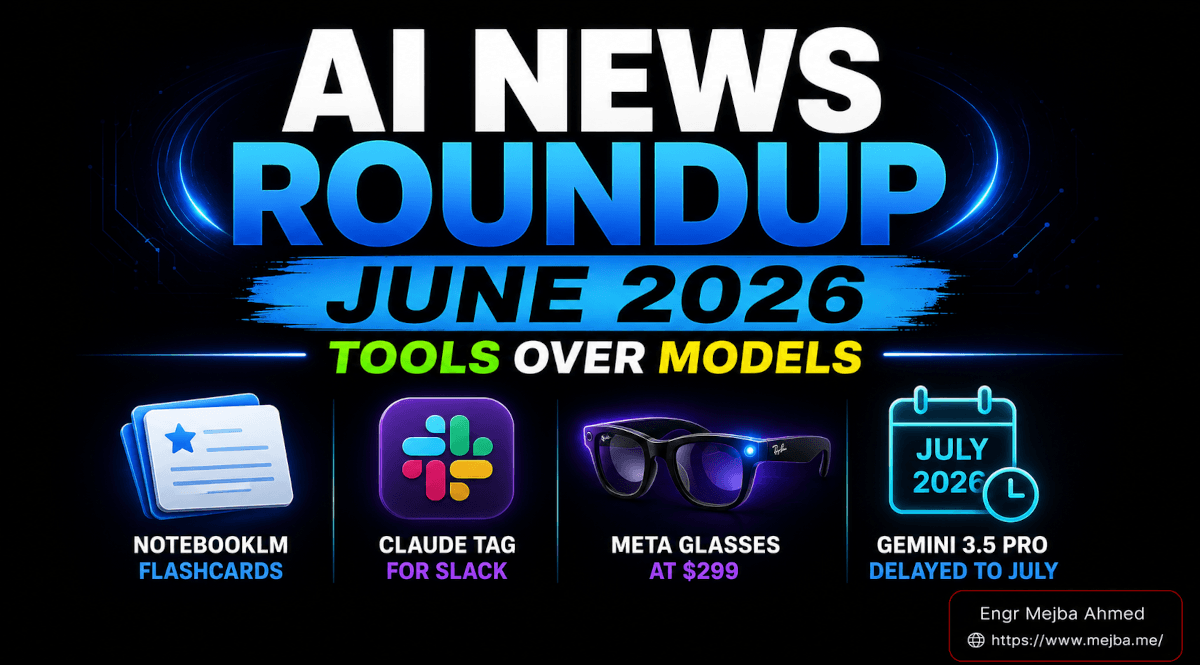
The reported headline: Gemini 3.5 Pro slipped to July. Google had teased a wide release around I/O in May, targeting June general availability, and pushed it — officially citing quality refinements after early enterprise testing. Reading between the lines of what's been reported, the checkpoints weren't landing where they needed to; some accounts describe builds underperforming the existing Gemini 3.1 Pro on the work that matters, alongside knowledge-cutoff gaps. I'd treat the specific "it's worse than 3.1" claim as reported-not-confirmed — internal checkpoint quality is exactly the kind of thing that leaks half-true — but a delay plus a quality justification is rarely a sign of a model sailing through.
The harder-to-spin part is the talent. In a single stretch this month, Google reportedly lost a cluster of senior researchers, and the destinations tell the story:
- Noam Shazeer — a co-author of the 2017 "Attention Is All You Need" paper, the document that arguably started this entire era — reportedly heading to OpenAI.
- John Jumper — the DeepMind scientist whose AlphaFold work shared the 2024 Nobel Prize in Chemistry — reportedly leaving for Anthropic.
- Jonas Adler and Alexander Pritzel, both Gemini researchers, also reportedly bound for Anthropic.
Markets noticed. Alphabet shares fell as much as roughly 7% intraday on June 22 — its worst day in over a year — as investors digested the departures. Estimates of the market value wiped out ran to a quarter-trillion dollars, though the exact figure varied by source and by the moment you measured it. Either way, it wasn't a rounding error. That's the market pricing in the possibility that the lab which gave us the transformer might be losing the people who can build the next one.
Here's why this matters even if you never touch Gemini: talent flow is the most honest leading indicator in this industry. Benchmarks get gamed, demos get staged, and press releases get written by the same three adjectives. But researchers with their pick of any lab on earth choosing where to spend the next three years of their lives? That's an unhedged bet on who they think will win. Right now, an unusual amount of that bet is landing on Anthropic. I've written before about the Anthropic-versus-OpenAI coding war, and this is the same contest viewed from the labor market instead of the leaderboard — and the labor market is currently more lopsided than the benchmarks suggest.
OpenAI's two-front week: a faster chatbot and its first silicon
OpenAI spent the week doing two very different things, and the quieter one is the one that'll still matter in five years.
On the visible front: GPT-5.5 Instant rolled out as ChatGPT's updated default. It's the conversational workhorse, not a frontier reasoning leap — better intent handling, cleaner constraint-following, more concise answers. In practice that means it does what you actually asked more often and pads less. Useful, unglamorous, exactly the kind of refinement that moves daily-driver quality without a headline.
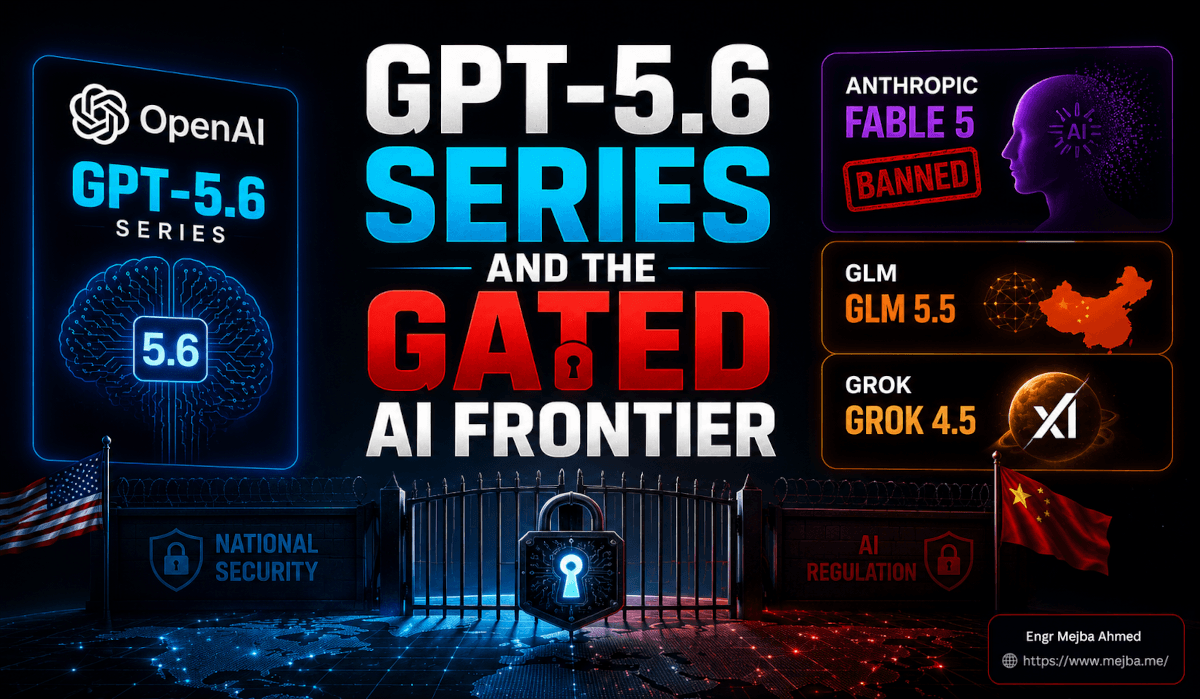
GPT-5.6, meanwhile, slipped to July. And the reason is the interesting part. Per reporting, the delay isn't a training problem — it's a government one. The Trump administration, through the Office of the National Cyber Director and the Office of Science and Technology Policy, reportedly asked OpenAI to roll the model out in phases and run additional safety checks before a public release, with enterprise early access going first. Sound familiar? It's the same pattern as the Fable 5 order: the frontier labs are now releasing on Washington's timeline as much as their own. Two of the three leading US labs had a flagship gated by the government in the same month. That's not a coincidence; that's the new operating environment.
Now the quiet bombshell. OpenAI and Broadcom unveiled Jalapeño, OpenAI's first custom inference chip — a reticle-sized ASIC built specifically for LLM inference, with the whole thing taken from design to tape-out in roughly nine months. Deployment is targeted for late 2026. The pitch is performance-per-watt: a chip tuned for the exact shape of OpenAI's own workloads instead of the general-purpose GPUs everyone fights over.
I want to be precise about why this is a bigger deal than the model news around it. Every serious AI company is currently strangled by the same constraint — Nvidia allocation. Compute is the real currency, and right now one vendor sets the price. A custom inference chip is OpenAI doing what Google did years ago with TPUs and Amazon with Trainium: vertically integrating to claw back margin and control. If Jalapeño actually hits its perf-per-watt targets in production, OpenAI stops renting its entire destiny from Nvidia. That reshapes the cost structure of every product they ship — and the nine-month design cycle, reportedly accelerated using OpenAI's own models to do chip-design work, is its own small story about where this is all heading. Models designing the silicon that runs the models. We're closer to that loop than most people realize.
The week in tooling: Claude in Slack, a self-improving coder, and a name correction
Underneath the frontier drama, the shipping that'll touch your week was happening at the product layer. Three launches stood out — and one of them needs a correction before the bad name spreads further.
Claude Tag landed in Slack. Anthropic put Claude into Slack as an always-on teammate you summon with a tag, running on Claude Opus 4.8. The distinction from a normal bot is that it's persistent and proactive — it follows threads across channels, builds context over hours or days, and acts on tasks asynchronously rather than answering one message and forgetting you exist. Anthropic claims 65% of its own product team's code is now generated by the internal version. I went deep on what this actually changes for teams in my breakdown of Claude Tag as a Slack teammate, so I won't repeat it all here — but the short version is that "AI in your Slack" went from gimmick to genuinely useful the moment it got persistent memory of your workspace.
Ornith-1.0 shipped, and it's the open-source release I'm most excited about. DeepReinforce open-sourced an MIT-licensed coding family spanning 9B to 397B parameters (with 9B dense, 31B, a 35B MoE, and a 397B MoE, built on Gemma 4 and Qwen 3.5 bases). The genuinely novel bit: the model learns its own RL scaffold during training instead of using a fixed human-designed harness — it jointly optimizes the training scaffold and the solution. The headline numbers coverage cites: the 397B posts 77.5 on Terminal-Bench 2.1 and 82.4 on SWE-Bench Verified, while the little 9B dense model reportedly beats Gemma 4-31B on both benchmarks despite being a third the size. MIT license, on Hugging Face, downloadable today. If those numbers hold up under real use — and I'll report back once I've run it against my own tasks — a 9B that punches at 31B-class coding is a big deal for anyone running models locally.
And the OCR correction. The source roundup I was working from credited a "new Claude OCR model" with structured extraction, bounding boxes, 170+ languages, and handwritten-math-to-LaTeX. That's a misattribution worth fixing: the model with 170-language coverage topping the OCR leaderboards this cycle is Mistral's OCR 4, not an Anthropic release. It reportedly tops OlmOCRBench at 85.20 and won human-preference comparisons at a 72% average win rate. Credit where it's due — and a reminder that these video summaries mangle names constantly. (For the same reason, I'm holding off on naming a specific Cursor "team leaderboard for plugins/skills" feature until I can confirm the exact product name; the capability is being discussed, but I won't print a name I can't verify.)
If you want the throughline across all three: the action this week wasn't only at the frontier. It was in the boring, load-bearing layer — agents that remember your workspace, open models that train themselves, and document extraction that finally handles your handwriting. That's the layer where most of us actually get work done.
Demis Hassabis on AGI: the target is flexibility, not benchmarks
One more thread worth pulling, because it reframes everything above. Demis Hassabis — Google DeepMind's CEO, and yes, the source video butchered his name into something unrecognizable — spent the week (again) describing what he actually thinks the target is.
His bar for AGI is deliberately high and, importantly, format-agnostic: a system that shows consistent, cross-domain brilliance — reasoning, creativity, planning, problem-solving — the way a capable human flexibly does, rather than a model that spikes on a benchmark and faceplants the moment the task shifts shape. He's been putting the timeline around 2030, with 2029 now in play, and recently described us as standing in "the foothills of the singularity."
I find his framing more useful than the timeline debate. Strip away the date and his point is this: a model that aces SWE-Bench but can't carry a goal across a messy, multi-day, real-world task is not general intelligence — it's a very good test-taker. And that lines up exactly with what I see when I build. The models that change my week aren't the ones with the highest benchmark; they're the ones that hold context, adapt when the task mutates, and stay useful across the whole sprawl of a real project. Hassabis is describing, in research language, the same thing every builder feels: flexibility beats peak performance. The leaderboard measures the spike. The work measures the flexibility.
Four threads I'm tracking into the back half of 2026
Strip away the noise and four things from this week are worth keeping a tab on. Here's my watchlist, ranked by how much it'll affect people who build:
- Does the Claude Fable 5 return hold — and on what terms? It's back, bundled into paid plans with weekly caps. Watch whether those caps loosen once the initial ramp ends, and whether a second export action ever recurs. The 19-day precedent is now part of your risk model whether you like it or not.
- How does Washington's grip tighten? Two of three leading US labs had a flagship gated by the government this month. If that becomes the norm, your model roadmap now has a regulatory variable in it that didn't exist last year. Plan for releases on Washington's clock.
- Whether the distillation fight changes API access. If Anthropic's Senate route gains traction, expect tighter onboarding, stricter rate limits, and more aggressive abuse detection across every major API — which will quietly raise friction for legitimate builders too.
- Whether the DeepMind exodus shows up in the models. Talent moves first, product follows months later. If Anthropic's next frontier release is unusually strong, you'll know where it came from. Watch the second half of 2026.
The meta-lesson I keep relearning: in a week this loud, the verifiable facts were quieter than the rumors, and the quiet facts — a custom chip, a talent migration, a government export order — will outlast every breathless "Fable 5 is BACK" thread by years. The chatter is designed to be loud. The signal almost never is.
So here's the one thing I'd do in the next 24 hours if you build on these models: open your architecture and find the single point where one provider's frontier model is load-bearing with no fallback. That's your Fable-5 risk. This week showed you exactly how fast it can vanish — and how much of your fate you're handing to a directive you don't control. Build the seam now.
FAQ
Frequently Asked Questions
Everything you need to know about this topic
Yes. The US Department of Commerce lifted the export controls on June 30, 2026, and Anthropic restored access on July 1 after a 19-day shutdown. Fable 5 returned globally, bundled into paid Claude plans (Pro, Max, Team, and select Enterprise) with weekly usage limits.
On June 12, 2026, the US Commerce Department issued an export-control order requiring Anthropic to restrict Fable 5 and Mythos 5 from foreign nationals, citing national-security concerns. The trigger was a report — attributed to Amazon researchers — that Fable 5's safeguards could be bypassed to identify exploitable software flaws. Because Anthropic couldn't verify nationality in real time, it suspended both models for everyone. The model had only been live since June 9, a roughly 72-hour public window before access was revoked.
Distillation is training a weaker model to imitate a stronger one by harvesting millions of its outputs. Anthropic alleges in a June 10 letter to US Senators that operators linked to Alibaba's Qwen lab used about 25,000 fraudulent accounts and 28.8 million exchanges to distill Claude's coding and agentic capabilities. These are Anthropic's allegations, not a proven finding.
Jalapeño is OpenAI's first custom inference chip, built with Broadcom — a reticle-sized ASIC designed specifically for LLM inference, taken from design to tape-out in roughly nine months, with deployment targeted for late 2026. It's a vertical-integration play to reduce dependence on Nvidia GPUs and improve performance-per-watt.
Google reportedly delayed Gemini 3.5 Pro to July and lost several senior researchers in a single month — including Noam Shazeer (to OpenAI) and John Jumper (to Anthropic) — contributing to a roughly 7% Alphabet share drop on June 22, its worst day in over a year. The talent flow is the most-watched signal here.
Build the seam before the next shutdown
The Fable 5 saga cost builders 19 days of access on three days' notice, then handed it all back on a government's timeline. If a single frontier model is load-bearing in your product with no fallback, closing that gap is the most valuable thing you can do this quarter. If you want a second set of hands designing the model-swap seam into an existing system, that's the kind of build I take on.