The automations businesses pay for are not the ones that demo well. After 8+ years and 1,500+ projects — my own platforms plus client work through my agency — the pattern is consistent enough that I'll state it as a rule: nobody buys architecture. They buy the removal of a specific, measurable clog in a pipe they already own. The impressive multi-agent system gets polite nods on a call. The boring workflow that answers leads in sixty seconds instead of two days gets a signature.
I'm going to walk through the five automations I see businesses actually open wallets for, and I'm going to ground them in systems I personally run in production, including two failures of my own that taught me more about this market than any win. If you're evaluating what to build — for your own business or to sell — this is the shortlist.
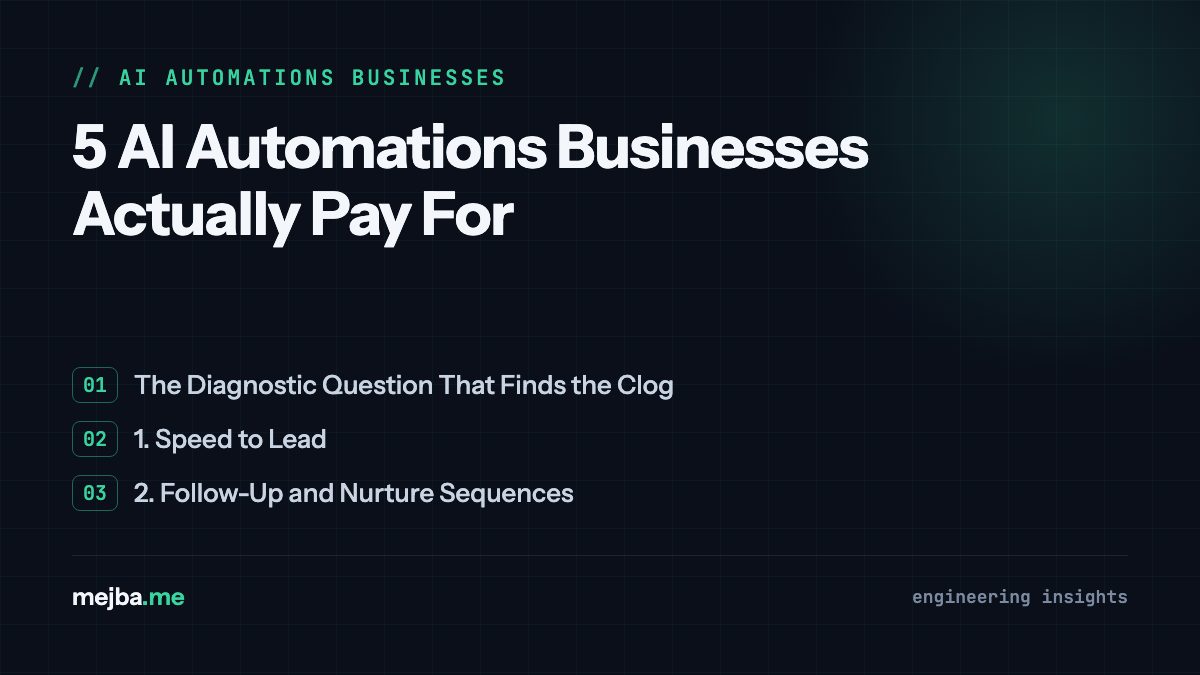
The Diagnostic Question That Finds the Clog
Before the list, the question I use to find what a business will pay for: "If 500 new customers showed up tomorrow, what breaks first?" Every owner answers instantly, and the answer is the product. A business is a series of connected pipes — leads in the top, revenue out the bottom, a clog somewhere in the middle. The right automation doesn't add a pipe. It clears the clog. Keep that frame; every item below is a named clog.
1. Speed to Lead
The most sellable automation in existence, because the math survives a napkin. The classic lead-response research found that contacting a lead within five minutes makes conversion dramatically more likely — the widely cited figure is 21 times better than waiting half an hour — and yet the median business still takes hours or days to respond, if it responds at all.
The build is not exotic: lead source (form, chat, call) feeds a qualification layer (an AI that asks two or three intent questions), which feeds routing (hot leads pushed to a human's phone with full context, an immediate personalized acknowledgment to the lead, a second touch if no human engages within minutes). You can assemble the basic version with n8n or Make plus a Claude API call and an SMS provider — I've written about wiring n8n and Claude Code together if you want the plumbing details.
Now the lesson I earned the hard way, which no listicle will tell you: the AI is the reliable part of this system. The plumbing is what fails. My own site runs a lead form for AI systems work. For a stretch of time it was silently broken — not erroring, silently swallowing submissions — because of two mundane bugs stacked on each other: a captcha value that never got set, and a caching middleware that stripped cookies from guest pages, which killed the session the form depended on. Every prospect who tried to reach me in that window hit a dead end, and no dashboard anywhere showed red. I found it, fixed it, and now treat the form itself as a monitored production system with an end-to-end test.
So when a client asks me to build speed-to-lead, the deliverable includes a synthetic submission that runs on a schedule and alerts if it doesn't arrive. Response speed is worthless if the lead never lands. That one clause in the scope is the difference between an automation vendor and someone who has operated these systems.
2. Follow-Up and Nurture Sequences
The sales-follow-up statistic everyone quotes — most deals need five-plus touches, most salespeople quit after four — matches what I lived as a consultant. The prospects who eventually signed often did so on the third or fourth follow-up, usually with an apology about a busy month. Persistence closes; humans are bad at persistence; sequences make persistence the default. That's the pitch, and it's true.
The engineering lesson comes from my own newsletter system, and it's the one I'd put in bold on the contract: any automation that sends messages needs idempotency guards before it needs intelligence. In June 2026 the cron entry on my production server disappeared during a hosting-side change. Scheduled jobs stopped. When I restored the cron, everything that had queued up was suddenly eligible to run at once — and without guards, a restored scheduler happily blasts your entire list with every send it thinks it missed. I purged the queue, then shipped guard conditions so a send can only ever fire once per issue per subscriber no matter how many times the job runs.
Nobody buys "idempotency guards" off a menu. But one duplicate-blast incident costs a business more subscriber trust than the entire automation saved that quarter. When you sell nurture sequences, you're really selling the guarantee that the machine never embarrasses the brand. Price accordingly.
3. Content and SEO Pipelines
Businesses pay for content operations once they've felt the gap between "we should publish more" and anyone actually doing it. The automations that stick are pipelines, not one-off generation: draft assistance feeding a review step, publishing triggering distribution, distribution triggering indexing.
This one I run on the site you're reading. When content changes here, model observers invalidate the relevant caches automatically; a scheduled job regenerates the sitemap every five minutes so search engines see changes without anyone remembering to click anything; and a scheduled Claude routine runs recurring SEO checks against the live site. The full setup is documented in my posts on automating SEO content work with Claude Code and running scheduled SEO checks with Routines.
The honest caveat I give buyers: fully autonomous content generation is the part of this category I now refuse to sell without a human review gate. I've cleaned up enough AI-generated confident nonsense — including on my own site — to know that the pipeline's value is in the operations around the content, not in removing the human from the content itself. The businesses that get burned are the ones who bought "AI writes your blog." The ones who win bought "publishing, distribution, and indexing happen without anyone pushing buttons." Same tooling, different promise, very different renewal rate.
4. Monitoring and Reporting on the Automations Themselves
This is the category nobody asks for by name and everybody renews. Here's the uncomfortable truth about the first three items: they all fail silently. The lead form dies without an error. The cron entry vanishes without a log line. The queue backs up quietly for days. My own June outage produced all three at once — jobs dead, newsletter stalled, nothing visibly on fire — and the fix ended with me adding alive-checks so that the absence of a scheduled heartbeat is itself an alert.
That experience turned into a deliverable I now attach to every automation engagement: a dead-man switch on every scheduled process, a daily digest that says "here is what your automations did yesterday" in plain language, and an alert channel for anomalies (lead volume suddenly zero, send rate suddenly doubled). It's cheap to build — a few scheduled checks and one summary job, the same pattern I use for recurring checks inside Claude Code during development — and it's the piece that makes clients trust everything else you shipped.
If you sell automation and you don't sell monitoring with it, you're renting out a car with no fuel gauge. It will run fine right up until the phone call.
5. Custom AI Operations Agents
The highest-ticket category: an agent wired into the business's actual tools — inbox, CRM, calendar, internal docs — handling a defined slice of operations. Triage, drafting, data entry between systems, first-pass research. This is where my agent-skills work pays off commercially, because the difference between a demo agent and a dependable one is exactly the discipline I use in my own skill library: narrow scope, documented failure modes, human checkpoints on irreversible actions. I keep a public list of the Claude Code skills businesses actually pay for, and the overlap with this category is nearly total.
My honest guidance if you're selling: do not lead with this one. It's the hardest to scope, the slowest to show ROI, and the most sensitive to the client's data hygiene. Land with speed-to-lead or monitoring, prove reliability for a quarter, and let the operations-agent conversation come to you. It always does.
The Selling Pattern Underneath All Five
Three rules that hold across every deal I've seen close:
Sell the outcome with their numbers. Walk the owner through their own lead count, their own response time, their own close rate. When the ROI is computed from the client's data instead of your slide deck, the price objection mostly dissolves.
Reliability is the product. Every automation above is technically easy and operationally hard. The market is full of people who can wire a webhook to an LLM. It is nearly empty of people who ship the guards, the monitors, and the end-to-end tests — because those only feel necessary after you've run these systems long enough to watch them fail. That's the moat, and it's built from scars, not tutorials.
Boring compounds. The five workflows here won't trend anywhere. They generate invoices in month one and renewals in month twelve, across industries that couldn't care less what model is underneath.
If there's a clog in your own pipeline you already know about — you answered the 500-customers question while reading — tell me what breaks first and I'll tell you honestly whether it's an automation problem and what I'd build.