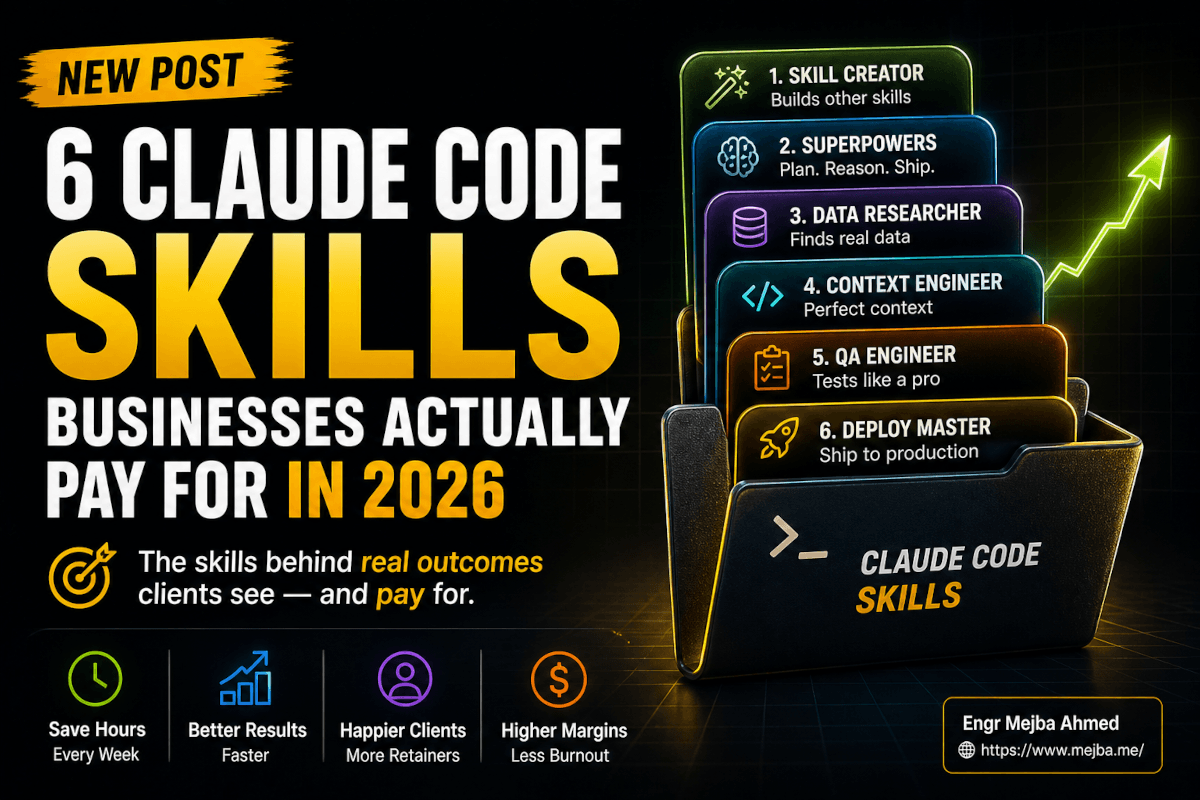
No business has ever paid me for a Claude Code skill. They pay for a technical SEO audit, a design system their team can maintain, an AI cost line that stops growing, and the skill is simply how I deliver those outcomes repeatably instead of reinventing the engagement each time. That distinction is the whole commercial insight. After 8+ years and 1,500+ projects, most of them through my agency Ramlit Limited, I maintain 53 skills on my agent skills marketplace, and a small subset of them keeps converting into actual invoices. These are the six, with what each one packages and where each one fails.
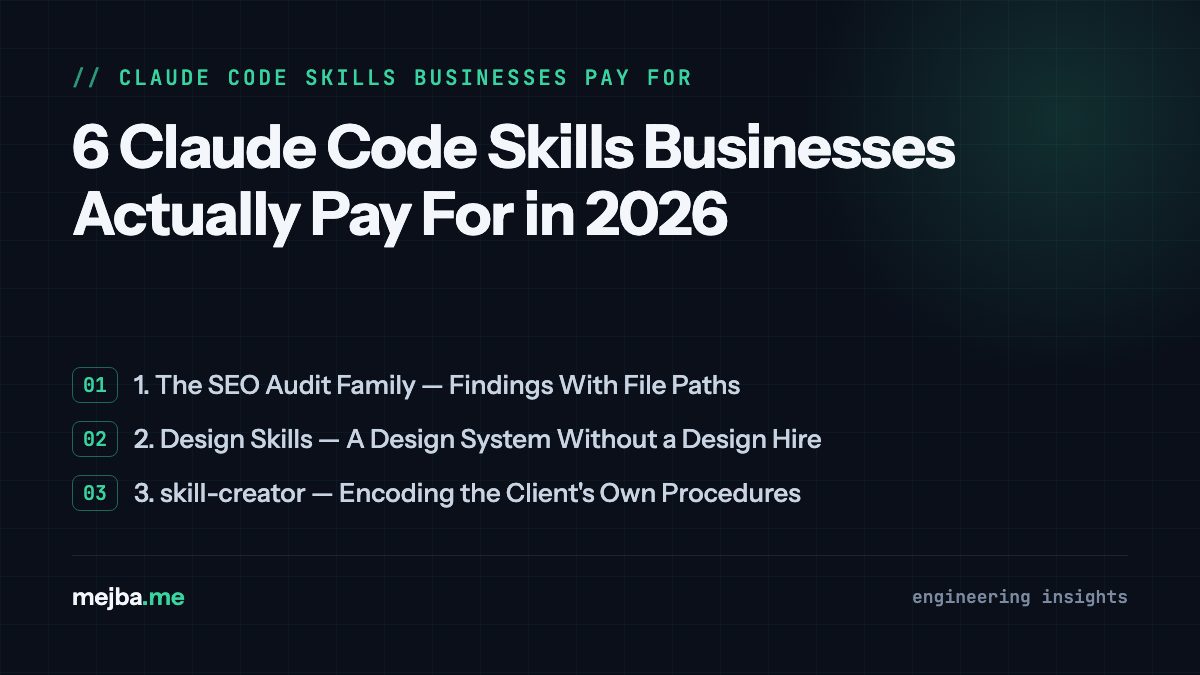
1. The SEO Audit Family — Findings With File Paths
The deliverable businesses buy: a technical SEO audit whose findings point at the exact template, route, or config causing each problem, not a 200-row CSV of symptoms. My seo-* skill family (audit, schema, sitemap, hreflang, technical, and friends) reads the client's actual codebase alongside their Search Console exports, which is the thing no SaaS crawler subscription can do.
What sells it is proof, and mine is uncomfortable but real: my own site lost most of its indexed pages in spring 2026, and this exact toolkit found the causes, including fabricated review schema and a locale-duplication mess. I wrote the full post-mortem in what a Claude Code SEO audit found on my own site. "I dug my own site out of a deindexing hole with this process" closes engagements that a feature list never would.
Where it fails: clients expecting overnight ranking recovery. Diagnosis is fast; Google is slow. I set that expectation in the first call, in writing.
2. Design Skills — A Design System Without a Design Hire
The deliverable: a token-based design system with measured accessibility, applied to an existing product, plus the conventions that keep it consistent after I leave. The frontend-design and impeccable skills do the direction and critique work; contrast gets computed rather than eyeballed, tap targets get measured, both themes get verified.
For small businesses this replaces a hire they were never going to make. The proof again is first-hand: my own blog's token-driven redesign shipped with contrast ratios in the commit message, a story I told in how Claude Code turned me into a UI designer.
Where it fails: brand identity. The skills execute and audit an identity superbly; they do not invent one. If the client has no brand foundation, that is a separate (human) conversation first.
3. skill-creator — Encoding the Client's Own Procedures
The most leveraged skill on this list is the one that builds other skills. Every business runs on procedures that live in one senior person's head: how quotes get drafted, how tickets get triaged, what a "done" release checklist contains. skill-creator interviews for that procedure and encodes it as a SKILL.md the whole team can invoke.
This is where an engagement shifts from "install tools" to "capture institutional knowledge," and it is the part clients did not know they were buying. The craft is in the trigger descriptions and the edge cases, which is learned the long way; I documented mine in lessons from building Claude Code skills.
Where it fails: unstable processes. Encoding a workflow the business changes monthly just automates churn. Stabilize first, encode second.
4. handoff — Continuity Across Sessions and People
The deliverable: long engagements that never restart from zero. The handoff skill writes a structured continuation document at the end of each working session: state, decisions, open items, exact resume point. The next session, possibly run by a different team member, starts warm.
Businesses feel this one immediately because its absence is what they hate about consultants: the expensive first hour of every meeting re-establishing context. It also de-risks me as a single point of failure, which procurement people notice.
Where it fails: it only works if it always runs. A handoff document that exists for 80% of sessions produces 20% archaeology. This is a hooks-and-habits problem, not a skill problem, so I wire it into the session workflow rather than trusting memory.
5. caveman — Making the AI Bill Boring
The deliverable: token cost control. When a team adopts Claude Code seriously, the first invoice from scale usage starts a conversation, and "turn it off" and "pay it" are not the only options. The caveman skill compresses verbose context and enforces token-diet habits: conclusions instead of dumps, filtered command output, lean session hygiene.
This is the least glamorous item here and the easiest ROI conversation I have, because the baseline is a number on an invoice and the after is a smaller number on the next one.
Where it fails: nothing rescues a workflow that loads entire codebases into context out of habit. Tooling helps; the habits have to be trained, which is why this ships with a working session for the team, not just an install.
6. tdd — A Quality Gate for AI-Generated Code
The deliverable: confidence in code the client's own team now generates with AI. The tdd skill enforces test-first on features, and I install it alongside the mechanical gates (formatters, static analysis at a strict level, pre-commit hooks that block rather than warn). Businesses adopting AI coding tools are quietly terrified of what is entering their codebase; a mandatory red-green loop converts that fear into process.
Where it fails: legacy codebases with no test infrastructure at all. There the first engagement is scaffolding testability; the skill comes after there is something for it to enforce.
How This Actually Packages
The pattern across all six engagements is identical, and it is the part I would tell anyone trying to build this practice:
- Install and configure: skills plus the project's CLAUDE.md conventions and permission allowlists, tuned to their stack.
- Run the first delivery together: the audit, the redesign pass, the first encoded procedure, with their team watching and interrupting.
- Leave documentation and gates, so the system survives me leaving.
- Optional retainer for evolution: new skills, new procedures, model changes. The economics of that structure are their own topic, covered in the AI agency retainer model for 2026.
Notice what is absent: nobody buys "access to AI." The market for raw prompting is zero because the marginal cost of typing a prompt is zero. What businesses pay for is judgment frozen into systems: which checks matter, which conventions hold, which failures to guard against. Skills are simply the container that makes judgment installable, a framing I unpacked in Claude Skills: the automation feature nobody talks about.
If your business wants any of these six outcomes (an audit with causes, a maintainable design system, captured procedures, session continuity, a controlled AI bill, or quality gates for AI-written code), that is precisely the work I take on through Ramlit. Tell me what you're trying to fix and I will tell you honestly which of these applies and which does not.