After a week of handing Perplexity Computer my actual to-do list, my verdict splits cleanly in two: it is the most capable agent orchestrator I've tested — and the least communicative. It will spin up parallel research threads, build an interactive dashboard, and mine fifty sources while you make coffee. It will also burn hundreds of credits executing the wrong interpretation of an ambiguous sentence, because it never once asks a clarifying question. Whether it's worth $200 a month comes down to one thing: how much of your week is made of work you can describe in a written brief.
I've spent 8+ years building software and, more recently, agent systems — I run multi-agent research pipelines through Claude Code daily on my own projects — so I tested this the way I'd evaluate any contractor: real tasks, tracked costs, honest notes on what I'd delegate again.
What Perplexity Computer Actually Is
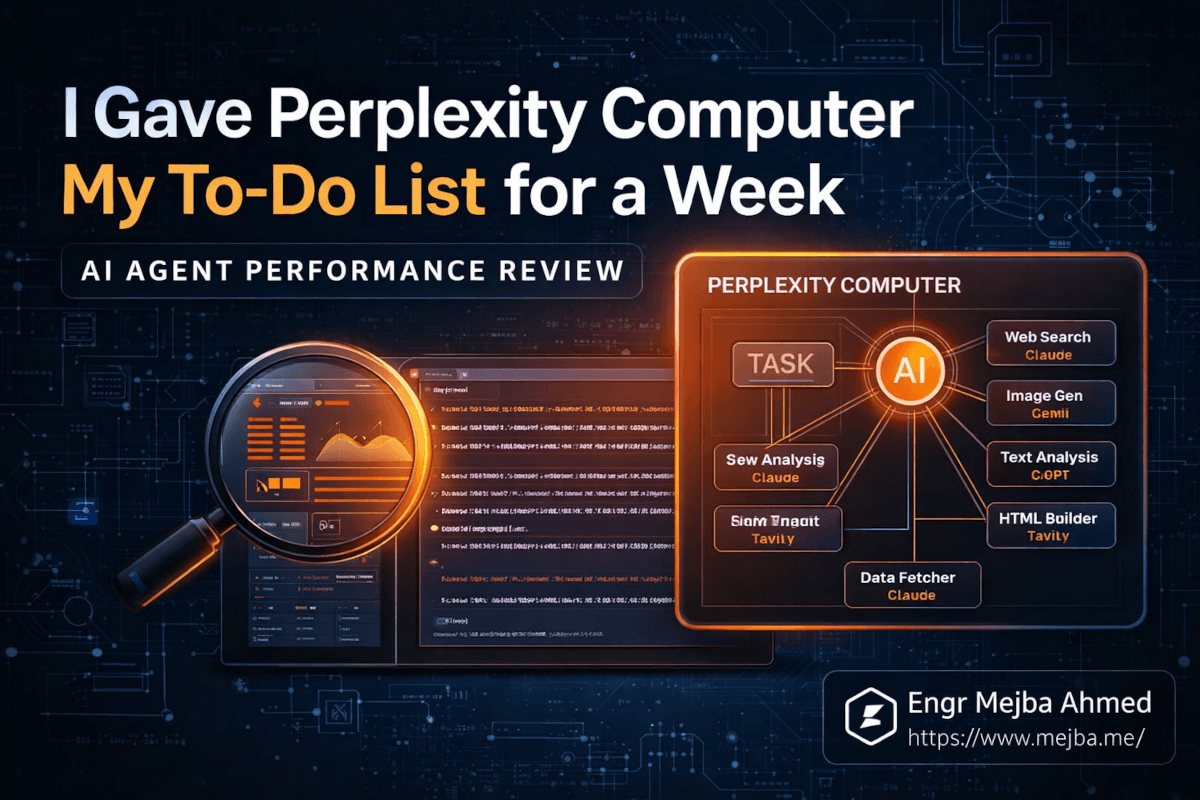
The name suggests hardware. It isn't. Perplexity Computer, launched February 25, 2026, is a cloud-based agent platform: you describe a multi-step task, and a central orchestrator — Claude Opus 4.6, per Perplexity — decomposes it and delegates to specialized sub-agents drawn from 19 coordinated models, including GPT-5.2, Gemini 3 Pro, Grok, and image/video models like Nano Banana and Veo 3.1. One sub-agent researches, another generates visuals, another assembles an HTML report, all in parallel.
The second pillar is integrations: over 400 managed OAuth connectors — Gmail, Slack, GitHub, Notion, Google Drive among them — that the agent uses when your task requires them. Unlike Zapier or Make, you don't build the workflow; you describe the outcome and the system figures out the plumbing.
Access requires Perplexity Max at $200/month (or $2,000/year), which includes 10,000 monthly Computer credits plus a one-time launch bonus — 20,000 credits standard, 35,000 under an early promotion — and a spending cap that defaults to $200 and can be raised to $2,000. Perplexity has said Pro-tier access is coming; as of this update it remains a Max feature.
Since my original test week, the platform has also stepped off the cloud: a Mac "Personal Computer" desktop app arrived in April 2026, and the Windows version began rolling out to Max subscribers on July 28, 2026 — a general-purpose agent that can work on local files and applications with per-action approval for sensitive operations.
What It Did With My List
Partnership research. Identify potential strategic partners for an automation business, research each, deliver an HTML presentation. The parallelization was genuinely fast — what costs a human researcher two or three hours of tab-switching happened in minutes, formatted cleanly enough to share. The miss: selection criteria were broad. It cast a wide net rather than asking what kind of partnership mattered, which is the difference between "companies with affiliate programs" and "companies whose customers overlap with yours."
Competitive intelligence dashboard. Research ten speech-to-text companies — pricing, ratings, user sentiment — and build an interactive dashboard. This was the standout: an actual working HTML dashboard with filterable competitor profiles and sentiment pulled from real user reviews, for roughly 400-500 credits. Not Tableau, but absolutely usable in a strategy meeting.
Investor pipeline. The task that had previously cost me six manual hours: fifty VC firms matched against stage, sector, and thesis, with recent portfolio adds and public partner commentary, compiled into a prioritized spreadsheet. Runtime: about twenty minutes. The best moment of the whole week came here — it surfaced a partner's detailed public thread about exactly the category I was researching, something I'd only have caught by luck, and bumped that firm up the ranking with the reasoning attached. Systematic coverage of public signals occasionally beats network serendipity.
Idea mining. Scanning high-engagement community posts about AI pain points produced one genuinely sharp insight: hallucination anxiety is spawning a market for trust infrastructure — verification layers, confidence scoring, human-in-the-loop checkpoints. Hours of scrolling compressed into minutes.
The Missing Conversation
Across every task, Perplexity Computer never asked a single clarifying question before executing. Hand the same brief to a sharp junior employee and you'd get thirty seconds of questions that save hours of misdirected work. This agent sprints on its first interpretation.
That design choice has a price tag. When a complex task consumes 200-500 credits, a wrong interpretation isn't just annoying — I burned roughly 200 credits on a research run because "high-growth SaaS companies" was read as "largest headcount" rather than "fastest revenue growth." A ten-second question would have prevented it.
The nuance most reviews miss: this is only a problem when your prompts are ambiguous. With explicit criteria, output format, and scope boundaries, results were consistently strong. The tool rewards brief-writing discipline — the same discipline I've had to build for my own multi-agent Claude Code architectures, where an under-specified task charter produces confident garbage at scale. Vague in, vague out; specification in, leverage out.
My working fix is a prompt template library: partnership research, competitive analysis, content opportunity scans. Each template took fifteen or twenty minutes to refine and pays for itself within two or three uses.
Is It Worth $200 a Month?
The math that matters: 10,000 monthly credits at 200-500 per complex task means roughly 20-25 substantial runs a month; simple queries cost 50-100. Compare against what you're replacing — a part-time research assistant, a freelance outbound specialist, or a competitive-intel subscription all cost several times more.
Subscribe if you already run brief-shaped work weekly — investor research, competitor monitoring, market analysis, prospect sourcing. If five-plus hours of your week is multi-step research you could hand to a contractor with a written spec, it pays for itself in the first month.
Skip it if you mainly need single-query answers, conversation, or writing help. Cheaper tools cover those completely, and the free Perplexity tier excludes Computer anyway.
Wait if you're merely curious. The product is improving fast, Pro-tier access has been promised, and early adopters are paying a premium to beta-test the workflow.
One habit I recommend regardless: keep a credit ledger. Ten minutes of spreadsheet setup showed me competitive research delivers high value per credit while email drafting is a net loss — I draft faster myself. That visibility reshaped my monthly budget more than any feature did, and it's the same cost-discipline I apply to agent token spend generally.
Security: Better Thought Out Than Most
The connector model follows least-access principles: the agent requests the minimum scopes a task needs rather than blanket account access, and the desktop apps notify and require approval for sensitive actions like sending email or deleting files. Coming from the security side of my work, this matters — most agent platforms request broad OAuth scopes because it's easier to ship.
The 1,500-character custom instructions field doubles as a policy layer. Mine encodes guardrails — "never send email without showing me a draft," output format preferences, source freshness requirements. Spend all 1,500 characters deliberately; it's the closest thing the product has to memory, and it's exactly the kind of constraint-first onboarding I argue for in securing AI agents before granting them access.
Autonomous send is still the sharpest edge. The platform will act through your connected accounts without a per-item review gate, and even when output quality would have passed my review anyway, I want to own the decision to put my name on something. Configure guardrails before connecting Gmail, not after.
AI Employee or AI Contractor?
The marketing frame is "AI employee." I'd push back: employees learn. They remember last quarter's failed partnership push and adjust. Perplexity Computer is stateless between tasks — no cross-session memory, no preference learning beyond custom instructions, no proactive suggestions.
The honest mental model is an AI contractor: you write a detailed brief, it executes skillfully, it walks away, and next time you brief from scratch. That reframing changes behavior — you stop expecting it to "know" things and start investing in better briefs and your own institutional memory. A reliable contractor executing well from clear specs is enormously valuable; just don't budget for an employee.
It's also worth placing in its lineage: this is the productized version of the computer-use direction Anthropic opened up — I traced that architecture in my breakdown of Anthropic's computer-use automation — with Perplexity's bet being that orchestrating many specialized models beats one generalist model driving a screen.
Perplexity Computer: Common Questions
How much does Perplexity Computer cost?
$200/month (or $2,000/year) via Perplexity Max — the only plan that currently includes it — with 10,000 monthly credits plus a one-time launch bonus. Complex tasks run 200-500 credits; a default $200 monthly spending cap is adjustable to $2,000.
Which AI models does it use?
A Claude Opus 4.6 orchestrator coordinates 19 models, including GPT-5.2, Gemini 3 Pro, Grok, Nano Banana for images, and Veo 3.1 for video — each sub-task routed to a specialized model.
Does it work on desktop?
Yes, now. The cloud platform launched in February 2026; a Mac "Personal Computer" app followed in April 2026, and Windows rollout to Max subscribers began July 28, 2026, with per-action approval for sensitive operations on local files.
Does it remember previous tasks?
No — each task is stateless. The 1,500-character custom instructions field persists and functions as thin memory; for everything else, keep your own prompt templates and reference docs.
The Deciding Question
Pull up last week's calendar and find the blocks over an hour long that were research, outreach, or monitoring. If at least one exists, Perplexity Computer can probably absorb most of it — and the judgment you build writing briefs for it transfers to every agent platform that follows. If your week doesn't contain that work, save the $200.
The rule I took out of that week: delegate what you can specify, keep what you can't. Building that boundary into a real operation — the guardrails, the credit ledger, the review gates this review kept circling — is client work I do through my services, and naming the first task you'd hand over is enough to start the conversation at my contact page.