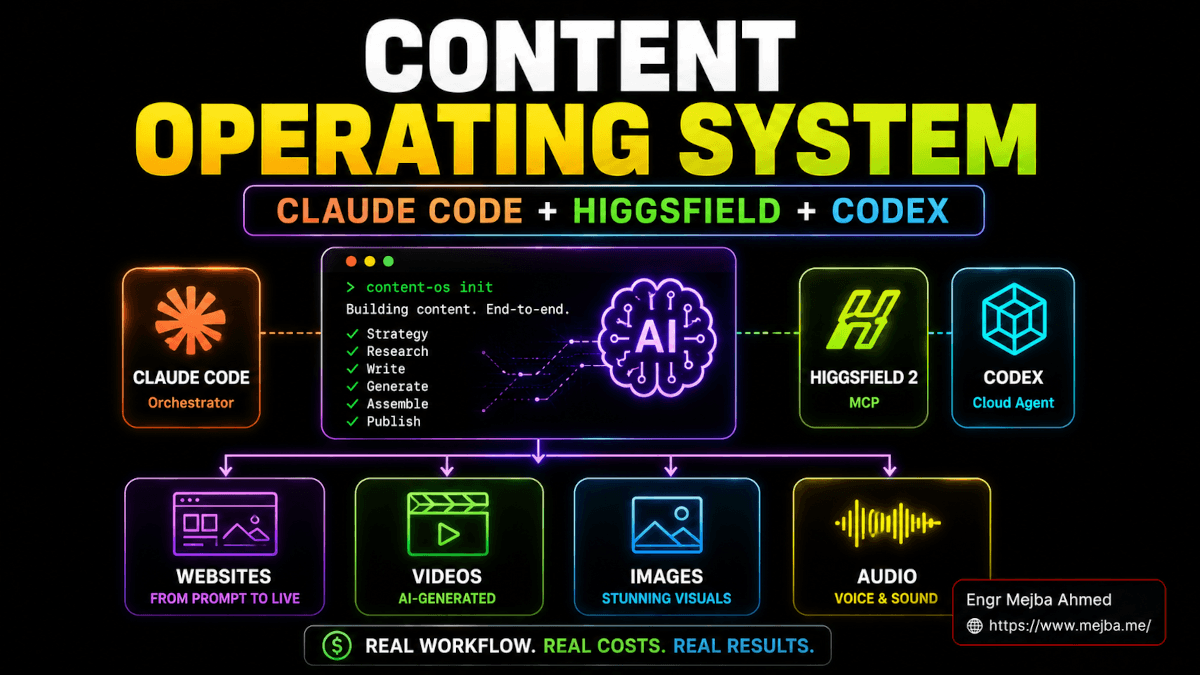
I have founded three ventures — Ramlit, ColorPark, and xCyberSecurity — and shipped 1,500+ projects over 8+ years, and almost every dollar of that came from selling services, not products. So when people ask how I would build a one-person AI business with Claude starting from zero, my answer is unfashionable: I would not build anything for the first two weeks. I would sell a service, then use Claude to deliver it. The order matters more than the tooling, and it is the part most AI business advice gets backwards.
The popular script says build an app. The app graveyard says otherwise. A product asks you to guess what strangers want, build it for months, then discover whether you guessed right. A service inverts that: you find one person with a problem, promise the outcome, and only then build the delivery machinery — with a paying client attached to it. Everything I now run as automation started life as a service someone paid for first.
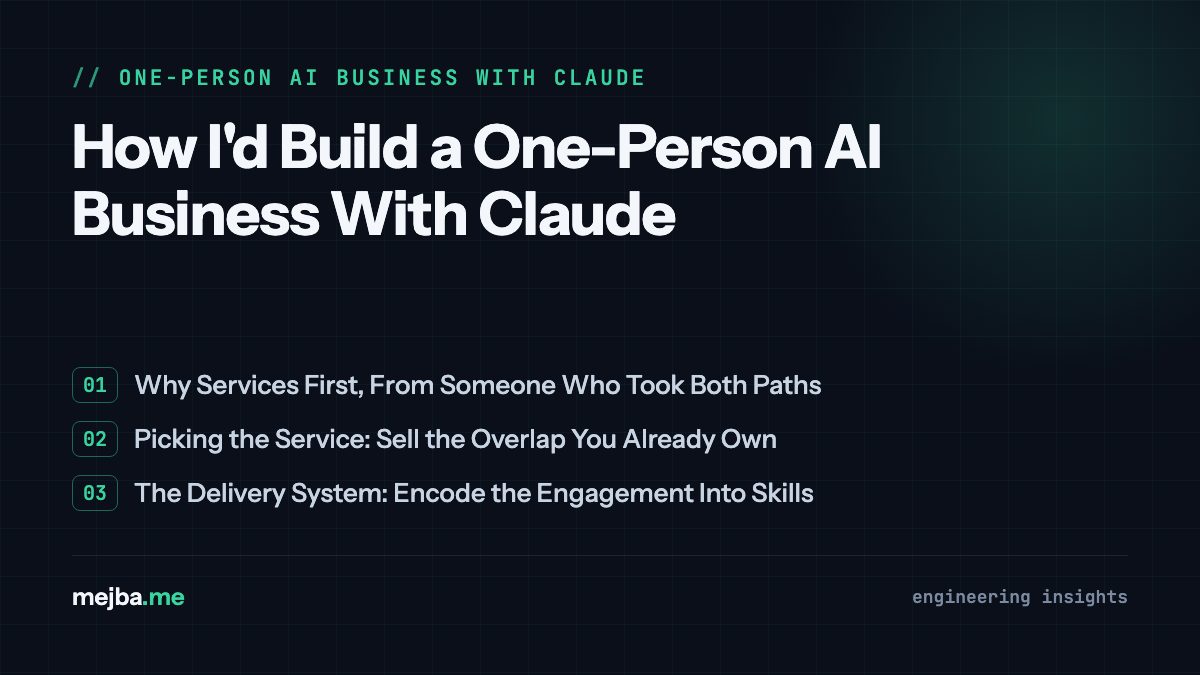
Why Services First, From Someone Who Took Both Paths
Service revenue is what funded every venture I own. The agency work came first; the products, platforms, and automation came out of patterns the agency work exposed. That sequence is not an accident of my biography — it is the cheap way to learn what a market wants, because clients tell you directly and pay you for the lesson.
Here is the asymmetry in concrete terms. If nobody buys your service pitch, you have lost a few hours of outreach. If nobody buys your product, you have lost the months you spent building it plus the motivation to try again. For a solo operator with no runway, that difference is survival.
The part people miss is that a good service business is a product business in incubation. After you deliver the same engagement ten times, you know exactly which 80 percent repeats. That repeating core is what you encode into Claude workflows — and eventually, if you want, into a product. I wrote about which Claude Code skills businesses actually pay for, and every one of them maps to a service that existed before the skill did.
Picking the Service: Sell the Overlap You Already Own
The mistake at this stage is choosing an "AI business idea" from a listicle instead of from your own history. Your only durable moat as a one-person operation is the overlap between what you have done professionally and what a specific industry pays for monthly. Claude cannot give you that overlap, but it is genuinely good at helping you see it.
The exercise I would run on day one, verbatim:
I want to find a profitable AI-powered service business idea.
Here's what I know about myself:

- Industries I've worked in: [list them]
- Skills I'm confident in: [list them]
- Problems I've solved for employers or clients: [list them]

Suggest 5 specific AI-powered service businesses I could launch
this month. For each: the exact offer, the ideal client and buyer,
why they'd pay $1,500-$3,000/month, how Claude delivers 80% of
the work, and what my first outreach message would say.
Then validate the shortlist the boring way: search for people already selling something similar. Competitors charging real money means the market exists. A completely empty niche is usually a graveyard with good lighting.
One test I apply from years of scoping client work: if you cannot state the offer in a single sentence with a specific audience and a specific outcome, it is not an offer yet. "I help businesses with content" gets polite silence. "Four SEO-optimized posts a month for B2B SaaS companies, including keyword research and internal linking" gets "what's your availability?"
The Delivery System: Encode the Engagement Into Skills
This is where my actual operation differs from the generic advice, and it is the highest-leverage idea in this post: do not use Claude as a chat window. Use it as a place where your delivery process accumulates.
Every repeatable module of a service becomes a reusable asset — a prompt template, a Claude Code skill, a checklist the model executes the same way every time. I maintain a public marketplace of 50+ agent skills that exists precisely because of this habit: patterns from client work, extracted into files, reused on the next engagement. On this site, the same principle runs my own content operation — the SEO content pipeline I automated with Claude Code started as manual work I did repeatedly until the repetition itself was the specification.
The compounding effect is the point. A traditional freelancer's tenth client takes as long as the first. When your delivery lives in skills, the tenth client takes a fraction of the time because nine engagements' worth of corrections are already encoded. Every client makes the system smarter, and the system is yours — it does not resign, and it does not forget.
What I would build in week one for a new service: one skill per pain-point module, tested against a realistic sample until I would confidently show the output to a paying client. Not a website. Not a logo. The delivery machine for the thing someone will pay for.
The Honest Division of Labor
I am allergic to the "fully automated business" framing because I run AI-heavy operations daily and know where they break. The realistic split:
Claude produces: first drafts of every deliverable, research synthesis, formatting and structuring, variations and iterations that would eat hours manually.
You provide: client conversations, quality control on everything before it ships, the strategic calls that need context the model does not have, and the last-mile refinement that separates plausible output from work a client renews for.
The ratio lands near 80/20, and the 20 is the business. Clients hire people, not prompts. The day you let unreviewed model output reach a client is the day you start training them to leave — I have reviewed enough AI-generated work in my own pipeline to know the failure rate is low but never zero, and the errors cluster exactly where they are most expensive: names, numbers, and claims.
Getting Clients: Outbound Plus One Public Channel
Two channels, run together. Outbound gets you conversations this week; a public body of work makes the outbound credible. When a prospect receives your message, the first thing they do is look you up. What they find decides whether the conversation happens.
For outbound, the discipline is small and consistent: a modest number of genuinely researched prospects daily, each message leading with something specific you noticed and a piece of value you already prepared. Claude compresses the preparation — a content gap analysis or a mini-audit that took an hour now takes minutes — but the personalization stays human. The arithmetic of volume, response rate, and close rate is easy to model and I will not dress a model up as a promise; the honest version is that consistent researched outreach produces conversations, and skipped outreach produces nothing.
For the public channel, this site is my proof. My blog and service pages are the inbound engine for my consulting work: posts demonstrate the exact workflows I sell, and the service pages catch the readers who want them done for them. Pick one platform your buyers actually use, post what you are genuinely doing for clients (anonymized), and let the work sell. I priced and structured that funnel deliberately, and the pricing logic behind it — why I moved from big one-time projects to retainers — is documented in my AI agency retainer model breakdown.
On pricing itself, one rule: price the transformation, not the hours. When Claude collapses your delivery time, hourly pricing turns your efficiency into a discount for the client. Outcome pricing turns it into margin. A service that reliably produces a business result is worth a fixed monthly number regardless of whether it took you forty hours or four.
The Mistakes That Actually Kill Solo AI Businesses
From watching this pattern across my own ventures and the operators I have advised:
- Serving everyone. Narrow wins. You can expand a niche later; you cannot recover from being forgettable.
- Leading with the AI. "I use Claude" is a tooling detail. "First-page rankings in 60 days" is a reason to reply. Be honest if asked — never lead with the wrench brand.
- Perfecting the website before contacting a single prospect. Preparation is procrastination in professional clothing. One page, one offer, one way to book a call.
- Underpricing. Cheap clients are the most expensive ones you will ever serve. Higher prices filter for buyers who take the engagement seriously.
- Automating before anyone pays. Revenue first, then automation. The delivery system built for a real paying client is always shaped better than the one built for an imagined one.
What I Would Do Tonight
If I were starting from zero: run the overlap exercise, pick one service I could deliver this month, write the one-sentence offer, and build exactly one Claude skill that produces the core deliverable. Outreach starts the next morning, not after the brand is ready. The gap between "I have marketable experience" and "I have a business" has never been smaller — Claude removed the production bottleneck, which means the remaining bottleneck is the willingness to sell.
That is not a hype claim. It is what my own P&L across three ventures keeps confirming: the machinery got cheap, the judgment stayed valuable, and one person with both can now run an operation that used to need five.
The next two weeks decide this, not the next two years: one offer, one conversation with somebody who actually has the problem, one skill built after the invoice rather than before it. Most of what sits in my portfolio was built in exactly that order — service first, system second, product last.