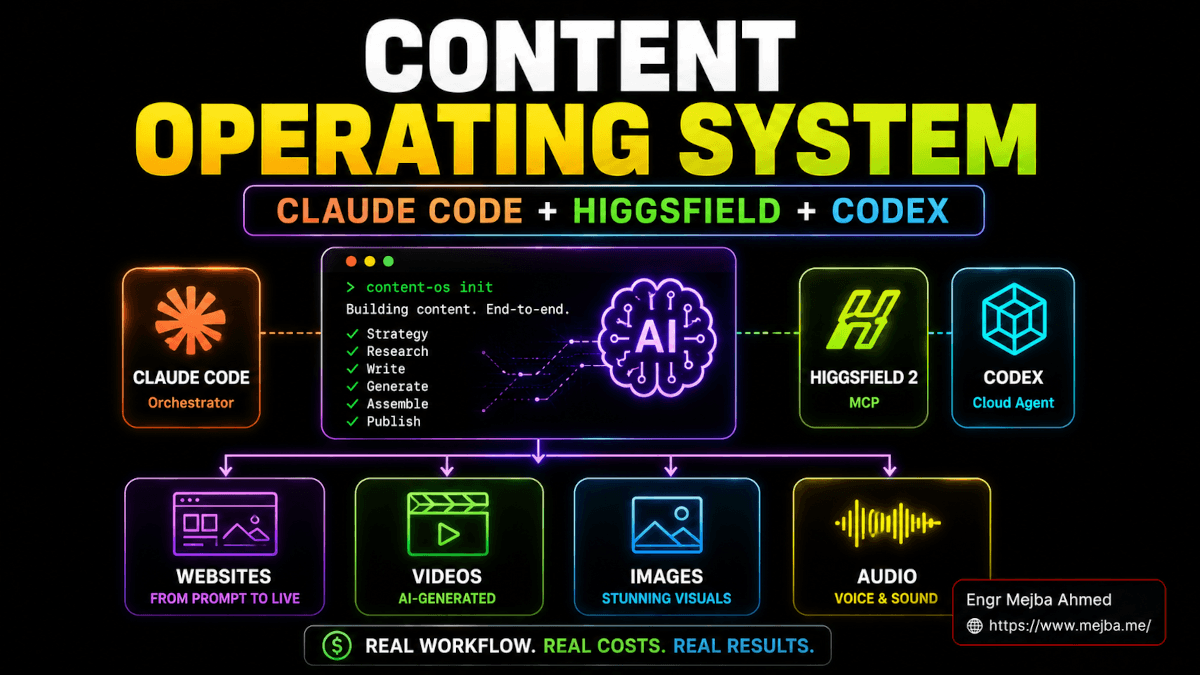
A content operating system is not something you buy. It is what you get when your content lives in the same place your code does, and one agent can touch both. Mine runs a platform of more than 500 published posts in six languages, plus content for three brands, and the entire thing is operated from a terminal: Claude Code as the core process, Higgsfield and HeyGen as media subsystems over MCP, Codex as the independent review layer. No content calendar SaaS, no six-tool Zapier chain, no dashboard I log into.
That claim usually triggers a fair objection ("that's just blogging with extra steps"), so let me define the term by what it actually does, then show the machine.
What Makes It an Operating System Instead of a Pile of Tools
Three properties, and most "content stacks" have none of them:
- One addressable state. Every post, image reference, translation, and SEO field lives in one database behind one Laravel app, in one repo the agent can read. There is no "check the Google Doc, then the CMS, then the spreadsheet"; the question "what state is post 483 in?" has exactly one answer, queryable in one place.
- Programmable operations. Publishing is code, so bulk operations are sessions, not months. When I needed 84 posts rewritten for SEO quality, that was seven batches of parallel agent workers with a resume manifest, a workflow that only exists because content is data.
- Feedback wired in. Search Console numbers come back to the same operator (me, plus scheduled agents) that produces the content, so the loop closes: measure, decide, execute, in the same environment.
The "operating system" framing earns itself at the second property. Any CMS stores content. The difference is whether you can operate on your content at scale without a migration project.
The Core Process: Claude Code Against the Repo
Everything routes through Claude Code working inside the platform repo. The pipeline for a single piece:
Draft in GFM markdown, in the repo, with the agent doing research-assisted drafting and me supplying the point of view, the part that cannot be delegated without the content becoming slop. Process: the platform's ContentProcessingService handles markdown-to-HTML with GitHub-flavored rendering, HTML sanitization, and automatic heading IDs, so what I write in a session is exactly what renders. Publish: content saves trigger model observers that invalidate sitemap caches; the sitemap regenerates on a five-minute scheduler tick. Indexing plumbing runs itself.
The load-bearing insight from operating this for years: the agent is only as good as the platform's own automation beneath it. Claude Code did not replace my pipeline; it sits on top of observers, schedulers, and services that were already dependable. Put an agent on top of a manual, fragile publishing process and you get faster fragility.
Two scars to prove the point. First: my app caches rendered post content per post per locale, and for a while the observer that invalidated sitemap caches did not touch the content cache, so bulk edits looked published while logged-out visitors got stale pages for hours. An agent "confirming" its edit by reading the database misses that entirely; the fix was teaching the workflow to bust the right cache keys and verify as a guest sees it. Second: edge caching adds another stale layer on top. "Published" and "visible" are different states, and every content operating system eventually learns that distinction the embarrassing way.
The Media Subsystem: Higgsfield and HeyGen Over MCP
The detail that makes media part of the system rather than a chore beside it: both generators are wired in as MCP servers, so the same session that writes a post can produce its imagery — and, when a piece warrants it, video.
Higgsfield handles image and video generation; HeyGen handles avatar-presenter video. Over MCP, "generate the hero image, wait on the job, hand back the asset" is a tool call chain inside the workflow, not a browser tab with a download folder in between. I documented the full video chain in my Claude Code + Higgsfield YouTube workflow and the presenter-video side in the HeyGen + ElevenLabs production pipeline.
On costs, the honest shape rather than fake precision: both services are subscription-plus-credits, and credit burn is wildly sensitive to iteration count. The systemic fix is the same one that works for code — put the iteration into the prompt spec before generating, not into regenerate-until-pretty. My real ratio improved more from writing better generation briefs than from any plan upgrade. Budget for your revision habit, not for the price page.
The Review Layer: Codex as Second Opinion
Codex runs in the same repo as an independent reviewer — same files, same context conventions, different model, different failure modes. For content ops I use it where independence matters: fact-flagging passes on technical posts and "does this section actually say anything" critique, where a second model is usefully immune to the first model's self-agreement. The mechanics of running both agents against one repo are in my side-by-side Claude Code vs Codex test.
This is also the layer where I will state the system's real bottleneck, because every content-automation post lies about it: review does not scale with the waves. Generation parallelizes beautifully; judgment does not. The system can draft twelve posts while I sleep. It cannot make twelve posts worth publishing without my hours. Anyone selling you a content OS without a human review bottleneck is selling you a spam cannon.
The Distribution and Feedback Loop
Downstream of publishing, the same operator pattern continues: scheduled agent routines pull Search Console exports, compare against baselines, and flag what dropped and what is one internal link away from ranking — the setup I detailed in automating SEO checks with Claude Code routines. Social distribution runs off the published post rather than as a separate creative act, per my social automation workflow.
The six-locale dimension deserves its own warning label. Every English post here exists in five translations, which multiplies both reach and operational surface: when I rewrite an English post, its translations are now stale: a debt tracked explicitly, or it silently compounds. A multi-locale content OS without a translation-sync ledger is six websites drifting apart while looking like one.
Multi-Brand: The Pattern Transfers, the Voice Does Not
The same architecture serves my other brands — the agency, the design studio, the security brand. What transfers cleanly: the repo-as-state pattern, the MCP media subsystem, the review layer, the measurement routines. What does not transfer: voice and editorial judgment, which are per-brand and stubbornly human. The practical model is one operating system, multiple tenants — shared machinery, separate editorial cores. Trying to share the editorial core is how brand blogs converge into the same beige paste.
Build Order, If You Are Starting
Sequence matters more than tool choice, and most people build this backwards — media toys first, plumbing never. Order that works:
- Content as data you can query. A database or a structured repo: anything an agent can enumerate and address. Without this, nothing else compounds.
- Reliable publish plumbing. Rendering, caching, sitemaps, feeds, all automated and observable before agents touch it.
- The agent core. Claude Code (or equivalent) against the repo, with a context file capturing your conventions and gotchas.
- Measurement routines. Close the loop early; volume without feedback just scales guessing.
- Media over MCP. Last, because pretty images on unmeasured, badly-plumbed content is decoration on sand.
Steps one and two are unglamorous, which is exactly why the people who skip them end up with impressive demos and unmaintainable output.
After 8+ years of shipping web platforms and 1,500+ projects, this is the first content setup I have run where scale stopped meaning hiring or burnout — the machine absorbs volume, and I spend my hours on the two things it cannot do: point of view and judgment. If you are wrestling with the same build — agent core, publishing plumbing, media pipeline, or all three — tell me what you are running and where it hurts; this particular machine is my favorite thing to help people build.