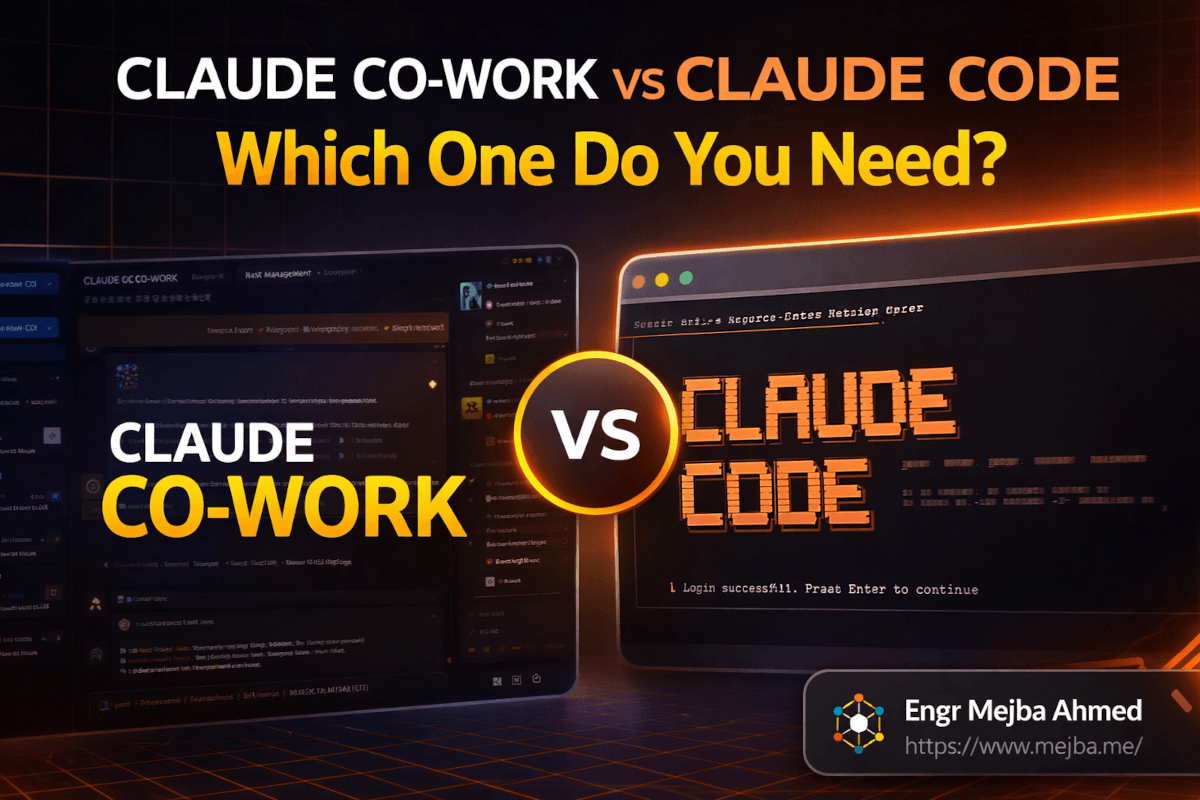
The comparison everyone asks for has a clean answer that almost nobody gives: Claude Code is an engineer, Claude Cowork is an executive assistant, and asking which one you need is usually asking the wrong question — the real question is which of your work is engineering and which is operations. I run both every working day. Claude Code maintains this website's Laravel codebase, including the multi-agent SEO remediation pipeline it is running as I write this. Cowork runs the operations side of my content business — research, file wrangling, scheduled recurring tasks. The tools share a brain and share almost nothing else.
Here is the split as it actually plays out, so you can stop evaluating and start allocating.
The mental model that survives contact with daily use
Claude Code lives in the terminal and thinks in repositories. It reads and edits codebases, runs shell commands and test suites, manages git, wires into your project's tooling through MCP servers, and spawns subagents for parallel work. Its natural unit of work is a commit. Its natural home is a project directory with conventions it can learn.
Cowork lives on the desktop and thinks in outcomes. It works inside a sandboxed folder-access model, connects to your apps through connectors, executes multi-step office workflows — research this, compile that, draft the email, produce the spreadsheet — and runs scheduled tasks without you present. Its natural unit of work is a finished deliverable. Its natural home is your Documents folder and your app stack.
The confusion exists because both can technically touch overlapping territory. Cowork can write scripts; Code can draft prose (this blog's content pipeline is proof). But driving each outside its lane costs you exactly what misassigning a human employee costs: the work happens, badly, with supervision the tool was designed to make unnecessary.
What Claude Code actually is (and who it is for)
Code earns its keep on anything with a repository at the center:
- Full system access. It executes real shell commands with your permissions — package managers, test runners, deploy scripts. Power and responsibility in equal measure; the permission model exists because the blast radius is real.
- Project-resident configuration. A CLAUDE.md carrying your conventions, project-scoped MCP servers exposing your app's schema and routes, hooks enforcing your rules. Sessions start already knowing the project. This is the moat — no chat-style tool accumulates project knowledge this way.
- Delegation primitives. Subagents, background tasks, and agent teams for work too big for one context window. My agent teams guide covers when that layer pays; it exists only on the Code side of this comparison.
- Extensibility as a first-class citizen. Plugins, skills, LSP servers, arbitrary CLI tools. If it runs in a terminal, Code can drive it.
Who it is for: anyone whose work product is versioned files — which means developers first, but not only. My blog posts ship through Code because they live in a pipeline with review gates, not because they are software.
If you are new to it, start with my Claude Code beginner's tutorial rather than this comparison — the tool makes more sense hands-on than described.
What Cowork actually is (and who it is for)
Cowork earns its keep on the work that surrounds the work:
- Sandboxed file operations. You grant folder access; it organizes, renames, extracts, compiles, and produces documents inside that boundary. The sandbox is the point — it makes delegation psychologically and practically safe for non-engineers. I dug into the mechanics in how Cowork's local file access works.
- Connectors instead of configuration. Where Code asks you to edit MCP JSON, Cowork connects to your apps through a marketplace UI. Less power, radically less setup — the correct trade for its audience.
- Scheduled and recurring tasks. Standing work that happens without a human initiating it: the Monday report, the inbox triage, the weekly research sweep. This, more than anything, is what makes Cowork an assistant rather than a chat window.
- Delegation from anywhere. Kick off work from your phone and collect the result later. Operations work is interrupt-driven; the tool matches.
Who it is for: founders, operators, and the operations half of a developer's own life. My daily Cowork workflow is the concrete version — the recurring content-ops tasks documented there are things I would never route through a terminal session, not because Code cannot, but because they do not deserve a terminal session.
The side-by-side that actually matters
| Dimension | Claude Code | Claude Cowork |
|---|---|---|
| Interface | Terminal / IDE | Desktop app |
| Work unit | Commits, files, PRs | Deliverables, documents |
| Access model | Your full user permissions | Sandboxed folder + connectors |
| Setup depth | High (config, MCP, conventions) | Low (connect and go) |
| Automation | Hooks, scripts, agent teams | Scheduled tasks, workflows |
| Learns your project | Deeply, via repo-resident config | Per-task context |
| Ideal user | Builds things in versioned files | Runs things across apps |
The hybrid pattern I actually run
The 80/20 that took me months to settle into: repository-shaped work goes to Code, everything-else-shaped work goes to Cowork, and the two meet in shared folders. Cowork compiles research into a brief; Code turns the brief into shipped content through the pipeline. Cowork produces a client-facing summary from the report Code's agents generated. Neither tool needs to know the other exists — the filesystem is the interface, which is precisely why it works. No integration to maintain, no coupling to break.
The mistake I made early, so you can skip it: I tried to consolidate on Code for everything, on the theory that the more powerful tool subsumes the lesser. It does not. Operations work routed through Code gets over-engineered — a scheduled Cowork task became a cron job with a script with error handling I then had to maintain. Powerful tools impose their shape on the work; sometimes the shape is wrong.
The decision framework
- Your work product is code, or files in a repo: Code, no deliberation needed.
- You do not know what a terminal is and do not want to: Cowork, and it will genuinely cover more than you expect. My Cowork business setup guide shows how far the no-terminal path goes.
- You are a developer: both, and the discipline worth building is routing — noticing whether the task in front of you is engineering or operations before picking up a tool. That noticing, more than either tool, is the actual productivity unlock.
- You are budget-constrained to one: pick the tool matching the majority of your week, not your self-image. Plenty of developers spend most of their hours on operations; buy the assistant first.
Quick answers
Can I use both at the same time? Yes — same account, different surfaces. Concurrent use is the normal case for me, not the exception.
Can Cowork write and run code? It can produce and execute code inside its sandbox for task purposes — parsing a spreadsheet, generating a chart. It is not a development environment and does not pretend to be.
Does Claude Code do what Cowork does? Technically, mostly; practically, at the cost of building and maintaining automation Cowork ships out of the box. See the mistake above.
Which should a non-technical founder start with? Cowork, unambiguously. Graduate specific workflows to Code only when you hit its ceiling and can say precisely where.
The engineer-versus-assistant frame is not a metaphor I chose for elegance — it is a staffing decision you are making whether you notice or not. Staff deliberately.
Make the routing call once, in writing: list the recurring work of your week, mark each line engineering or operations, and let that list decide which tool opens. The guided version of that exercise, with both tools running side by side, is a course at my AI School.