AI News Roundup June 2026: The Week the Models Went Quiet and the Tools Got Loud
Nobody shipped a frontier model this week — and for this AI news roundup June 2026, that absence is the story.
I sat down Friday morning expecting the usual scramble: a benchmark leak, a stealth model in someone's app picker, a thread with 9 million views claiming AGI is six weeks out. Instead I got a NotebookLM update about editable flashcards. A Slack integration. Three new pairs of smart glasses. And two of the most anticipated models of the year quietly slipping their launch dates. That's the entire week. And honestly? It told me more about where AI is actually heading than any benchmark slide has in months.
So this roundup reads a little differently than my usual ones. There's no single bombshell to dissect. What there is — and what I want to walk you through — is a pattern. The action this week didn't happen in the models. It happened in the spaces around them: the editor, the chat sidebar, the channel you already have open, the frames on your face. The labs spent the week trying to get their existing intelligence closer to where you already work. That's a different kind of progress, and it's the kind that usually matters more than a two-point jump on a coding eval.
The Quiet Week: Why "No Model Launch" Is Actually the Headline
The gaps between launches tell you as much as the launches.
For most of the spring, the cadence was relentless. Sonnet 4.6, Opus 4.8, Gemini 3.5 Flash going GA, GPT-5.5 Codex — the frontier kept moving every few weeks, and the whole industry organized itself around catching the next drop. This week, that machine idled. And it idled for two specific, documented reasons: the next two big models aren't ready — for very different reasons.
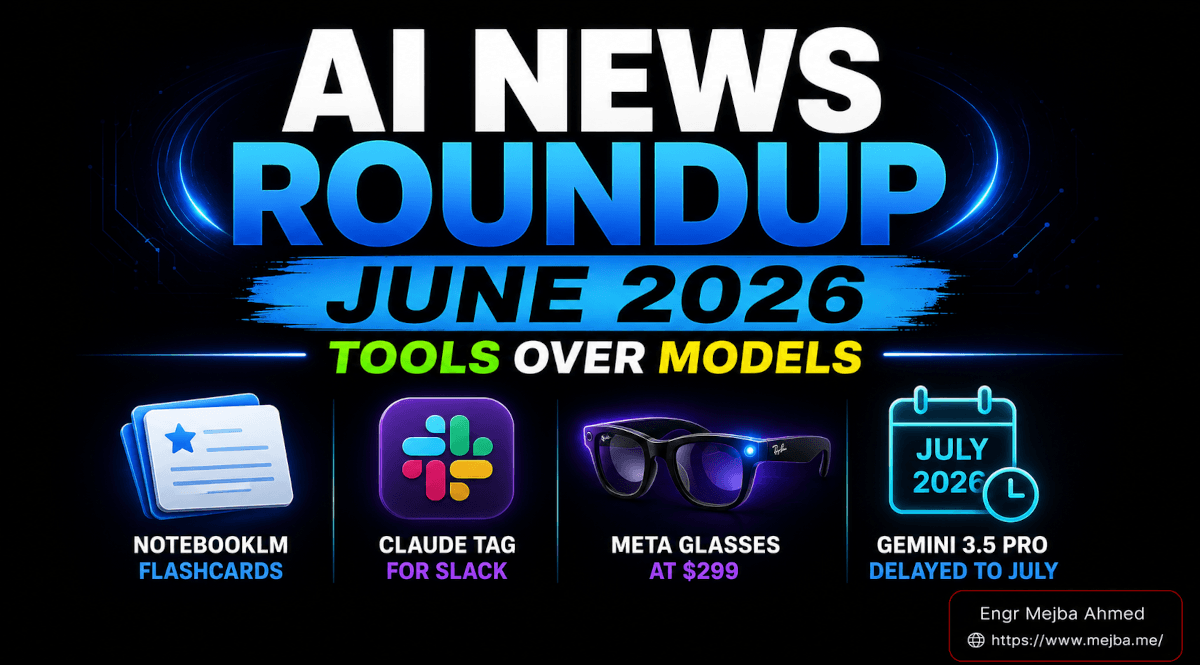
Google postponed Gemini 3.5 Pro to July, the model originally expected in June. OpenAI's GPT-5.6, the one I wrote up from the Soul preview, was also held back — but in its case, TechCrunch reported OpenAI limited the rollout after a US government request. Two labs, same month, same delay window — but, as I'll get into below, not the same cause. I'll come back to what I make of that at the end. First, the stuff that actually shipped — because while the models stalled, the tooling had a genuinely productive week.
NotebookLM Finally Lets You Fix Its Own Flashcards
The smallest update this week is the one I'll personally use the most.
NotebookLM's flashcards used to be a one-shot deal. You'd generate a deck from your sources, and whatever the model produced was what you got — frozen. If card #7 had an awkward phrasing or a flat-out wrong answer, your only move was to regenerate the whole set and pray. As someone who runs research decks off long PDFs, I found that infuriating enough that I mostly stopped using the feature.
That's fixed. As of this update, you can edit, create, and delete individual flashcards. Click the three-dot menu on any card, hit "Edit flashcard," rewrite the answer, done. You can add cards the generator missed and share a finished deck with someone else. Progress now saves across sessions too — mark cards "Got it" or "Missed it," shuffle, and rerun only the ones you fumbled. It's live for everyone, including free accounts.
Why does a flashcard tweak make my roundup? Because it's a perfect, tiny example of the week's whole theme: the model didn't get smarter, the tool got more usable. The intelligence that generates the cards is the same as it was last month. What changed is that Google handed you control over the output instead of treating it as sacred AI gospel you have to accept or reject wholesale. That's a maturity signal. Tools that let you correct them are tools built by people who've watched real humans actually use them.
The platform's been on a tear lately, and this is one more brick in it.
Gemini Study Notebooks: AI That Teaches to What You Already Know
This is the Google move I'd actually stop and pay attention to if I had a kid in school or a certification to grind through.
Google pulled NotebookLM inside the Gemini app. You can now access and chat with your notebooks directly in Gemini, and sources flow between the two — past chats, uploaded class materials, all of it referenceable in either place. Google's been folding NotebookLM into Gemini for a while; this is the version that actually delivers on it.
The headline feature is a new notebook type: Study notebooks. And the mechanic underneath it is the part worth understanding.
Here's how it works. You tell Gemini what you're trying to learn — say, prepping for the LSAT, or ramping on a framework — and upload whatever materials you've got. Before it builds you a single lesson, it gives you a diagnostic quiz. That quiz figures out what you already know. Then it builds the lesson plan around your actual gaps instead of dumping a generic curriculum on you and making you scroll past the parts you've already mastered.
Think about why that's different. Most "AI tutor" products treat every learner like a blank slate. They generate a tidy, linear course that assumes you know nothing — which is exactly the experience that makes a competent adult close the tab in frustration. The diagnostic-first approach flips it: the AI calibrates to you before it teaches. It tracks progress over time and adapts as you go. That's not a content-generation feature. That's a pedagogy feature, and pedagogy is where most AI learning tools fall flat on their face.
It's rolling out now for personal accounts on the web, with school accounts and mobile coming later this summer. I tested the diagnostic flow on a topic I half-know — and it correctly skipped the basics and parked me right at the edge of my actual understanding. That's rare. Most tools waste your first ten minutes confirming things you told them you already knew.
Google didn't stop at notebooks, either. There's a smaller Chrome change that's quietly excellent.
Gemini in Chrome: Highlight, Then Ask
Quick one, but it's the kind of friction-killer I notice every single day.
Gemini in Chrome now lets you highlight a specific chunk of a webpage and ask the AI about just that selection. Not the whole page. Not a vague "summarize this for me" that pulls in the nav bar, the cookie banner, and four unrelated sidebars. You select the paragraph, the table, the code block — the actual thing you care about — and the question scopes to that.
If you've ever tried to ask an AI about one section of a dense article and gotten an answer about the entire page, you know exactly why this matters. Precision of input is precision of output. It's the same instinct behind Gemini's earlier "ask this page" tooling, tightened to the selection level. It's not flashy. It'll just save you a hundred tiny clarifications a week.
Notice the pattern forming across all three Google updates: editable flashcards, calibrated lessons, highlight-to-ask. None of them make the model smarter. All of them make the model do what you actually meant. Anthropic spent the week chasing the exact same goal from a different direction.
Anthropic's Week: Embedding Claude Where You Already Work
Anthropic didn't ship a model either. What they shipped was placement — moving Claude into the surfaces where work already happens. Three threads here, and one open question.
Claude Tag Put an AI Teammate Inside Slack
This is the one I think most teams will feel first.
Anthropic replaced their old Slack app with Claude Tag — a single, shared, always-on Claude that lives inside a channel, learns the work happening in it, and picks up tasks when someone types @Claude. It runs on Opus 4.8. The stat that made me stop scrolling: Anthropic says 65% of their own product team's code now comes through an internal version of it.
The reason this matters isn't "Claude is in Slack now." It's how it's in Slack. Most AI integrations are a chat window wearing a company logo — you open a side panel, you have a private conversation, nobody else sees it. Claude Tag is shared and persistent. It sits in the channel as a teammate the whole team can hand work to, with shared context, not a thousand private little sessions. That architecture changes how a team actually uses it, and it carries a real governance risk most of the launch coverage skated past. I unpacked what's genuinely new, how it differs from Claude Code, and the rollout risk to watch in my full breakdown of Claude Tag. If your team lives in Slack, work through that before you turn this on.
Claude Co-work and Dispatch: The Mobile Gap Is Still Real
Co-work is the part of the Claude ecosystem I run my own business operations through, so I track its rough edges closely.
On desktop, Co-work is strong — it reaches into files and folders, runs real multi-step work, and has become the backbone of how I run business operations on autopilot. On mobile, it's still hobbled. The bridge for remote access is Dispatch, and right now Dispatch is clumsy: it behaves like one long, single conversation rather than a proper task manager. You can kick things off from your phone, but managing several jobs in parallel is awkward in a way that breaks the flow.
The rumored fix is multitasking — the ability to spin up and manage multiple independent tasks rather than funneling everything through one thread. I'd treat that as expected, not confirmed. The architecture clearly wants to go there, and the desktop side already proves the model works. But until it ships, mobile Co-work is a "start it here, finish it at your desk" tool, not a true pocket operator.
The Claude Design Overhaul Keeps Aging Well
I'll keep this short because I already wrote the long version.
The Claude Design rebuild from earlier this month — cleaner UI, prototyping, motion graphics, wireframes, slide decks, documents, plus new markup tools that let you mark up a design and feed that visual feedback straight back to the AI — is still the most pleasant surprise in my toolchain. It's not going to replace a specialized design tool for a serious product team, and I want to be honest about that ceiling. But for going from idea to a credible, editable draft, it earns its spot. My hands-on with the Claude Design overhaul covers what actually changed and whether it's usable for real work now. Short answer: it finally is.
Those new markup tools deserve one extra line, because they're the same idea as Google's highlight-to-ask. Instead of describing in words what you want changed, you point at it. You circle the thing. The interface is becoming the prompt. That's the quiet UX shift running under this entire week.
Fable's Access, as of Late June, Was Still Cut
As I write this roundup in late June, Anthropic's Fable model is still dark globally — access cut off under US government export restrictions. The negotiation to restore it is reportedly being led by co-founder Tom Brown. The signals lean cautiously positive, but I want to be precise: as of this writing, none of it is confirmed — no restoration date, no official statement, no guarantee of the previous terms.
I've been tracking the breadcrumbs on this for weeks, because a model that's been dark shouldn't be leaving fingerprints — and Fable is. Bedrock listings, update strings in a Claude Code release, prediction-market odds creeping up. I laid out every signal and how much weight each one deserves in my Fable 5 return analysis. If you were running anything on Fable — like the autonomous video pipeline I built on it — that's the post to watch as this develops.
Now, the most physical news of the week.
Meta Glasses at $299: The Hardware Bet That Keeps Not Landing
Meta dropped its own smart-glasses brand this week, and the pricing move is the interesting part.
The big change: Meta broke from the Ray-Ban name and launched styles under its own label — Adventurer (a clean rectangle) and Fury (a bolder frame) at $299 each, plus a Kylie Jenner edition at $399 that even lets you use her voice as the Meta AI assistant. That $299 entry point undercuts the earlier Gen 2 Ray-Ban Meta glasses, which sat higher. Same core hardware across the line — camera, mic array, open-ear audio, roughly 8 hours of mixed-use battery with a charging case for more — and they ship with Meta AI powered by Muse Spark from day one.
On paper, it's a genuinely loaded device for $299. Camera, AI assistant, open-ear speakers, microphone array — a wearable computer that looks like normal glasses. And yet.
Here's my honest read, and it's the same one I've had on every generation of these: the headwinds aren't about the hardware. They're about behavior. Two things keep killing smart-glasses adoption. First, privacy — a camera on your face changes the social contract of every room you walk into, and people feel that, both wearers and the people around them. Second, and bigger: the phone already won. The AI assistant you'd reach for on your glasses is the same one sitting in your pocket, on a bigger screen, with a keyboard, that you already trust and already paid for. The glasses have to be meaningfully better at something to overcome the friction of being one more device to charge, sync, and explain to strangers. For most people, most of the time, they aren't.
So these end up tech-packed and under-used. Bought with enthusiasm, worn for a week, parked in a drawer. Dropping the price to $299 lowers the barrier to buying — it does nothing about the barrier to keeping them on your face. I'd love to be wrong. The Kylie edition will absolutely move units on brand alone. But "will people buy it" and "will people use it daily" are different questions, and Meta keeps nailing the first and missing the second.
Which sets up the thread that ties this whole roundup together.
The Real Story: AI Is Moving To You, Not the Other Way Around
Step back from the individual items and one shape emerges. Every meaningful update this week was about reducing the distance between AI and where you already are.
Walk it back through. Editable flashcards — control moved to you. Study notebooks — the lesson moved to your existing knowledge. Highlight-to-ask in Chrome — the question scoped to your selection. Claude Tag — the AI moved into your Slack channel. Co-work Dispatch — Anthropic fighting to move the agent onto your phone. Claude Design's markup tools — feedback moved from typed prompts to pointing at the screen. Even the Meta glasses are a (clumsy) bet on moving AI onto your literal face.
This is what maturity looks like in a platform shift. The early phase is all capability — can the model do the thing? The phase we're entering now is all about friction — how few steps until the thing happens in the place I already work? The companies that win the next year won't necessarily have the smartest model. They'll have the model that's already open in the tab you had open anyway. Embedding beats raw capability once capability is "good enough," and for a huge range of everyday tasks, it already is.
Why Gemini 3.5 Pro and GPT-5.6 Both Slipped to July
Two frontier models from two rival labs delaying into the same mid-July window looks like one story. It's actually two — and it's worth being careful about that, because the tidy "same cause" narrative doesn't hold up.
Gemini 3.5 Pro's delay was, by Google's own framing, a technical one. Early testers flagged token efficiency, coding results that weren't yet at flagship standard, and long-horizon reasoning that fell short of the I/O bar — and Google reportedly went as far as rebuilding the model's architecture rather than shipping a "Pro" that was only marginally better than the last one. That's a performance and engineering delay, not a regulatory one.
GPT-5.6 is a different case. OpenAI's hold-up was tied to a US government request over the rollout — a security-review dynamic that OpenAI itself pushed back on publicly. So of the two, only OpenAI's delay is genuinely a government story; Google's is about the model.
What they share is timing and climate, not cause. Both slipped into the same window, and both landed in an environment where shipping frontier capability now draws more scrutiny than it did a year ago — which may be nudging labs toward caution at the margin. But I don't want to over-read that into a single grand explanation, because the documented reasons are different. July is going to be loud regardless — Gemini 3.5 Pro, GPT-5.6, and a likely Anthropic counter all landing in the same few weeks. The lull itself is the useful signal: some of the labs' energy has visibly shifted from "make it smarter" to "make it usable and ship it cleanly," and this week's tooling updates are the visible half of that shift.
So what do you actually do with a quiet week? More than you'd think.
What I'd Actually Do This Week
A slow news week is the best time to consolidate, because nothing's about to make your setup obsolete tomorrow. Here's where I'd put my hours.
If you study or learn anything technical: turn on Gemini Study notebooks and run the diagnostic on something you half-know. The calibration is the feature. Pair it with editable flashcards in NotebookLM and you've got a genuinely personalized loop for free.
If your team runs on Slack: evaluate Claude Tag deliberately, not impulsively. The shared-teammate model is powerful and the governance risk is real — decide who on the team can hand it what before you flip it on.
If you run operations through Claude: keep Co-work on the desktop for now and don't bet your mobile workflow on Dispatch until the multitasking update is confirmed shipped, not rumored.
If you were eyeing the Meta glasses: wait a beat. Ask yourself honestly whether you'll wear them past week two. The hardware is fine. The habit is the hard part.
On the models: don't restructure anything around Gemini 3.5 Pro or GPT-5.6 yet. Build on what's GA today — Opus 4.8, Gemini 3.5 Flash — and keep your stack model-agnostic enough to swap in July's winners when they actually land.
The week the models went quiet turned out to be a week worth paying attention to. Not because anything was revolutionary — almost nothing was. But because the whole industry tipped its hand about the next phase. The race stopped being only about who has the smartest model. It quietly became about who can get their intelligence closest to where you already live: your channel, your browser tab, your study session, your face.
The labs that figure out the last few inches of that distance are going to win people who never read a benchmark in their life. Watch the tabs you already have open. That's where the next year of AI is going to be decided — and judging by this week, it's already started.
FAQ
Frequently Asked Questions
Everything you need to know about this topic
The biggest moves were tooling and placement, not new models: NotebookLM added editable, shareable flashcards; Google launched Gemini Study notebooks with diagnostic-driven lessons; Anthropic shipped Claude Tag for Slack; and Meta debuted $299 own-brand glasses. Notably, both Gemini 3.5 Pro and GPT-5.6 were delayed toward mid-July. See the sections above for each.
For different reasons. Google delayed Gemini 3.5 Pro on technical grounds — token efficiency, coding, and long-horizon reasoning that weren't at flagship standard, plus a reported architecture rebuild. GPT-5.6's hold-up was tied to a US government request over its rollout, a security-review dynamic OpenAI pushed back on publicly. They share timing, not cause.
The Meta Adventurer and Meta Fury styles cost $299 each, while the Kylie Jenner edition is $399. That $299 entry price undercuts the earlier Gen 2 Ray-Ban Meta glasses. All three ship with Meta AI powered by Muse Spark and roughly 8 hours of mixed-use battery.
As of this late-June roundup, Fable's access was still cut globally under US government export restrictions, and a restoration was not yet confirmed. Co-founder Tom Brown was reportedly leading the negotiations and the signals leaned cautiously positive, but at the time of writing there was no official date. For the full signal-by-signal breakdown, see my Fable 5 return analysis linked above.
Claude Tag is Anthropic's replacement for its old Slack app — a single, shared, always-on Claude running on Opus 4.8 that lives inside a channel, learns the work there, and picks up tasks when you type @Claude. It's built as a shared teammate rather than private chat sessions, which is powerful but carries a governance risk worth thinking through before rollout.
Want Help Cutting Through the AI Noise?
I track these weekly shifts so I can build with the tools that actually stick, not the ones that trend for a day. If you want a second set of hands deciding which of these — Claude Tag, Co-work, Gemini's study tools — is worth wiring into your own workflow, that's exactly the kind of build I take on. You can start a project with me on Fiverr.