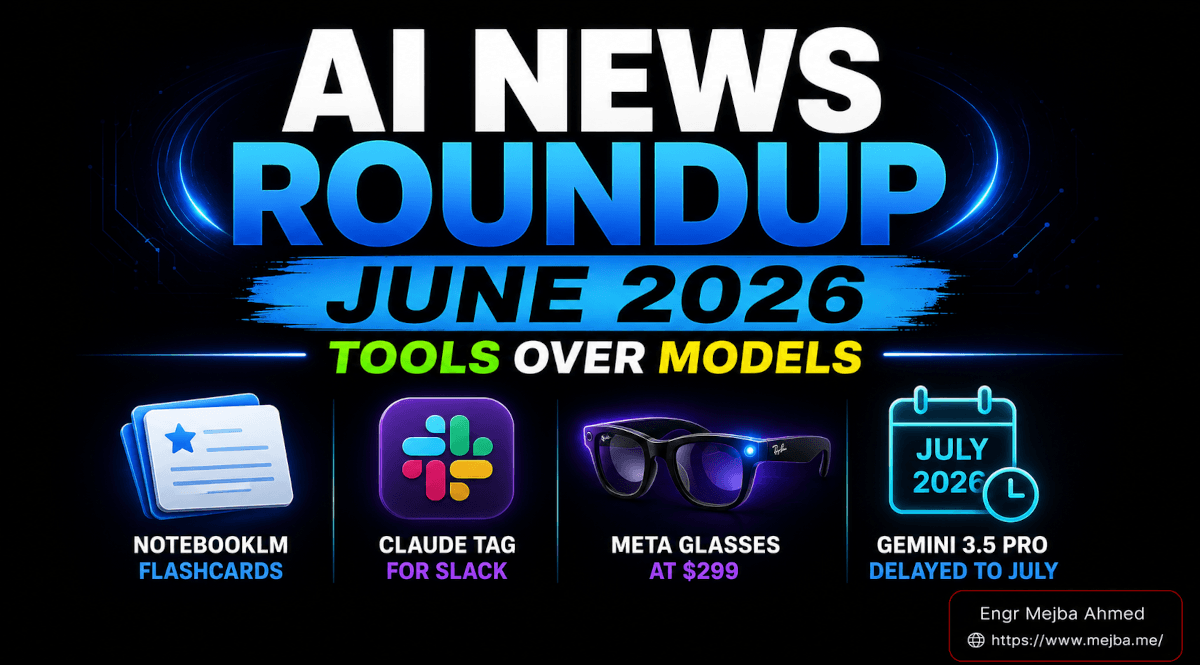
KI-News-Rückblick Juni 2026: Die Woche, in der die Modelle verstummten und die Tools laut wurden
Diese Woche hat niemand ein Frontier-Modell veröffentlicht — und für diesen KI-News-Rückblick im Juni 2026 ist genau dieses Ausbleiben die eigentliche Geschichte.
Ich setzte mich Freitagmorgen hin und erwartete das übliche Hin und Her: ein Benchmark-Leak, ein Stealth-Modell im App-Picker von irgendwem, ein Thread mit 9 Millionen Views, in dem behauptet wird, AGI stehe in sechs Wochen vor der Tür. Stattdessen bekam ich ein NotebookLM-Update zu bearbeitbaren Karteikarten. Eine Slack-Integration. Drei neue Modelle Smart Glasses. Und zwei der am meisten erwarteten Modelle des Jahres, die still und leise ihre Starttermine verschoben haben. Das war die gesamte Woche. Und ganz ehrlich? Das hat mir mehr darüber verraten, wohin sich KI tatsächlich entwickelt, als es jede Benchmark-Folie in Monaten getan hat.
Dieser Rückblick liest sich deshalb ein bisschen anders als meine üblichen. Es gibt keine einzelne Bombe zum Auseinandernehmen. Was es aber gibt — und was ich mit dir durchgehen möchte — ist ein Muster. Das Geschehen dieser Woche fand nicht in den Modellen statt. Es fand in den Räumen um sie herum statt: im Editor, in der Chat-Seitenleiste, im Kanal, den du sowieso schon offen hast, in den Rahmen auf deinem Gesicht. Die Labore verbrachten die Woche damit, ihre bestehende Intelligenz näher an den Ort zu bringen, an dem du bereits arbeitest. Das ist eine andere Art von Fortschritt, und es ist die Art, die meistens mehr zählt als ein Sprung um zwei Punkte in einem Coding-Eval.
Die stille Woche: Warum „Kein Modellstart" tatsächlich die Schlagzeile ist
Die Abstände zwischen den Launches sagen einem ebenso viel wie die Launches selbst.
Für den Großteil des Frühjahrs war die Kadenz unerbittlich. Sonnet 4.6, Opus 4.8, Gemini 3.5 Flash im GA-Status, GPT-5.5 Codex — die Frontier bewegte sich alle paar Wochen weiter, und die gesamte Branche organisierte sich darum, den nächsten Drop zu erwischen. Diese Woche lief diese Maschine im Leerlauf. Und sie lief aus zwei konkreten, dokumentierten Gründen im Leerlauf: Die nächsten zwei großen Modelle sind noch nicht bereit — aus sehr unterschiedlichen Gründen.
Google hat Gemini 3.5 Pro auf Juli verschoben, das Modell, das ursprünglich im Juni erwartet worden war. OpenAIs GPT-5.6, das ich aus der Soul-Vorschau heraus beschrieben habe, wurde ebenfalls zurückgehalten — aber in seinem Fall berichtete TechCrunch, dass OpenAI den Rollout nach einer Anfrage der US-Regierung einschränkte. Zwei Labore, gleicher Monat, gleiches Verzögerungsfenster — aber, wie ich weiter unten ausführen werde, nicht dieselbe Ursache. Ich komme am Ende darauf zurück, was ich davon halte. Zuerst zu dem, was tatsächlich ausgeliefert wurde — denn während die Modelle stehenblieben, hatten die Tools eine wirklich produktive Woche.
NotebookLM lässt endlich zu, dass du seine eigenen Karteikarten korrigierst
Das kleinste Update dieser Woche ist das, das ich persönlich am meisten nutzen werde.
Die Karteikarten von NotebookLM waren früher eine einmalige Angelegenheit. Man erzeugte einen Stapel aus seinen Quellen, und was das Modell produzierte, war das, was man bekam — eingefroren. Wenn Karte #7 eine holprige Formulierung oder eine glatt falsche Antwort hatte, war die einzige Option, den ganzen Satz neu zu generieren und zu beten. Als jemand, der Research-Stapel aus langen PDFs zieht, fand ich das so nervig, dass ich das Feature weitgehend nicht mehr nutzte.
Das ist behoben. Ab diesem Update kannst du einzelne Karteikarten bearbeiten, erstellen und löschen. Klicke auf das Drei-Punkte-Menü einer beliebigen Karte, tippe auf „Karteikarte bearbeiten", schreibe die Antwort um, fertig. Du kannst Karten hinzufügen, die der Generator übersehen hat, und einen fertigen Stapel mit jemand anderem teilen. Der Fortschritt wird jetzt auch sitzungsübergreifend gespeichert — markiere Karten mit „Gewusst" oder „Verpasst", mische, und wiederhole nur die, bei denen du gepatzt hast. Es ist für alle live, auch für kostenlose Accounts.
Warum schafft es eine Karteikarten-Anpassung in meinen Rückblick? Weil sie ein perfektes, winziges Beispiel für das gesamte Thema der Woche ist: Das Modell wurde nicht schlauer, das Tool wurde nutzbarer. Die Intelligenz, die die Karten erzeugt, ist dieselbe wie im letzten Monat. Was sich geändert hat, ist, dass Google dir die Kontrolle über die Ausgabe übergeben hat, statt sie als heilige KI-Offenbarung zu behandeln, die du im Ganzen akzeptieren oder ablehnen musst. Das ist ein Reifezeichen. Tools, mit denen du sie korrigieren kannst, sind Tools, die von Leuten gebaut wurden, die echten Menschen tatsächlich beim Nutzen zugesehen haben.
Die Plattform ist in letzter Zeit auf einem Höhenflug, und das ist ein weiterer Baustein darin.
Gemini Study Notebooks: KI, die dich dort abholt, wo du schon stehst
Das ist der Google-Zug, bei dem ich tatsächlich innehalten und aufmerksam werden würde, wenn ich ein Kind in der Schule oder eine Zertifizierung zu absolvieren hätte.
Google hat NotebookLM innerhalb der Gemini-App eingegliedert. Du kannst jetzt direkt in Gemini auf deine Notizbücher zugreifen und mit ihnen chatten, und Quellen fließen zwischen beiden — vergangene Chats, hochgeladene Kursunterlagen, alles ist an beiden Orten referenzierbar. Google faltet NotebookLM schon seit einer Weile in Gemini hinein; das ist die Version, die es endlich einlöst.
Das Kern-Feature ist ein neuer Notizbuchtyp: Study notebooks. Und die Mechanik dahinter ist der Teil, den es zu verstehen lohnt.
So funktioniert es. Du sagst Gemini, was du lernen möchtest — etwa: du bereitest dich auf den LSAT vor oder arbeitest dich in ein Framework ein — und lädst hoch, was du an Material hast. Bevor es dir auch nur eine einzige Lektion baut, gibt es dir ein Diagnose-Quiz. Dieses Quiz ermittelt, was du bereits weißt. Dann baut es den Lehrplan um deine tatsächlichen Lücken herum auf, statt dir ein generisches Curriculum vor die Nase zu setzen und dich an den Teilen vorbeiscrollen zu lassen, die du längst beherrschst.
Denk mal darüber nach, warum das anders ist. Die meisten „KI-Tutor"-Produkte behandeln jeden Lernenden wie ein unbeschriebenes Blatt. Sie generieren einen sauberen, linearen Kurs, der davon ausgeht, dass du nichts weißt — genau die Erfahrung, die einen kompetenten Erwachsenen dazu bringt, den Tab frustriert zu schließen. Der Diagnose-zuerst-Ansatz kehrt das um: Die KI kalibriert sich auf dich, bevor sie unterrichtet. Sie verfolgt den Fortschritt über die Zeit und passt sich unterwegs an. Das ist kein Content-Generation-Feature. Das ist ein Pädagogik-Feature, und Pädagogik ist der Punkt, an dem die meisten KI-Lernwerkzeuge auf die Nase fallen.
Es wird jetzt für persönliche Accounts im Web ausgerollt, Schul-Accounts und Mobile folgen später im Sommer. Ich habe den Diagnose-Flow zu einem Thema getestet, das ich halb kenne — und er hat die Grundlagen korrekt übersprungen und mich direkt an den Rand meines tatsächlichen Verständnisses geparkt. Das ist selten. Die meisten Tools verschwenden die ersten zehn Minuten damit, Dinge zu bestätigen, von denen du ihnen gesagt hast, dass du sie schon weißt.
Google hat es aber nicht bei den Notizbüchern belassen. Es gibt eine kleinere Chrome-Änderung, die still und leise ausgezeichnet ist.
Gemini in Chrome: Markieren, dann fragen
Kurz und knapp, aber die Art von Reibungs-Killer, die mir jeden einzelnen Tag auffällt.
Gemini in Chrome erlaubt dir jetzt, einen bestimmten Ausschnitt einer Webseite zu markieren und die KI nur zu genau dieser Auswahl zu befragen. Nicht die ganze Seite. Nicht ein vages „Fasse mir das zusammen", das die Navigationsleiste, das Cookie-Banner und vier unzusammenhängende Seitenleisten mit einbezieht. Du markierst den Absatz, die Tabelle, den Codeblock — das eigentliche Ding, das dich interessiert — und die Frage bezieht sich auf genau das.
Wenn du je versucht hast, eine KI zu einem Abschnitt eines dichten Artikels zu befragen und eine Antwort zur ganzen Seite bekommen hast, weißt du genau, warum das wichtig ist. Präzision der Eingabe ist Präzision der Ausgabe. Es ist derselbe Instinkt, der hinter Geminis früherem „Diese Seite fragen"-Tooling stand, nur bis auf die Auswahlebene verfeinert. Es ist nicht spektakulär. Es wird dir einfach hundert kleine Klarstellungen pro Woche ersparen.
Beachte das Muster, das sich über alle drei Google-Updates hinweg abzeichnet: bearbeitbare Karteikarten, kalibrierte Lektionen, Markieren-zum-Fragen. Keines davon macht das Modell schlauer. Alle davon lassen das Modell das tun, was du eigentlich gemeint hast. Anthropic hat die Woche damit verbracht, dasselbe Ziel aus einer anderen Richtung zu verfolgen.
Anthropics Woche: Claude dort einbetten, wo du schon arbeitest
Auch Anthropic hat kein Modell veröffentlicht. Was sie ausgeliefert haben, war Platzierung — Claude in die Flächen zu verlagern, in denen Arbeit bereits stattfindet. Drei Stränge hier, und eine offene Frage.
Claude Tag setzt einen KI-Teamkollegen in Slack
Das ist der, den die meisten Teams zuerst spüren werden, glaube ich.
Anthropic hat seine alte Slack-App durch Claude Tag ersetzt — einen einzelnen, geteilten, immer aktiven Claude, der in einem Kanal lebt, die dort stattfindende Arbeit lernt und Aufgaben übernimmt, wenn jemand @Claude eintippt. Er läuft auf Opus 4.8. Die Zahl, bei der ich zu scrollen aufhörte: Anthropic sagt, dass 65 % des Codes ihres eigenen Produkt-Teams inzwischen durch eine interne Version davon läuft.
Der Grund, warum das zählt, ist nicht „Claude ist jetzt in Slack". Es ist wie er in Slack ist. Die meisten KI-Integrationen sind ein Chat-Fenster mit einem Firmenlogo — du öffnest eine Seitenleiste, führst ein privates Gespräch, niemand sonst sieht es. Claude Tag ist geteilt und persistent. Er sitzt im Kanal als Teamkollege, dem das ganze Team Arbeit übergeben kann, mit gemeinsamem Kontext, statt tausend kleiner Privatsitzungen. Diese Architektur verändert, wie ein Team ihn tatsächlich nutzt, und sie birgt ein echtes Governance-Risiko, an dem der Großteil der Launch-Berichterstattung vorbeigeschrammt ist. Was daran wirklich neu ist, wie er sich von Claude Code unterscheidet und welches Rollout-Risiko im Blick zu behalten ist, habe ich in meiner vollständigen Analyse zu Claude Tag entpackt. Wenn dein Team in Slack lebt, arbeite dich da durch, bevor du das aktivierst.
Claude Co-work und Dispatch: Die Mobile-Lücke ist immer noch real
Co-work ist der Teil des Claude-Ökosystems, über den ich meine eigenen Geschäftsabläufe steuere, deshalb verfolge ich seine rauen Kanten genau.
Auf dem Desktop ist Co-work stark — es greift auf Dateien und Ordner zu, führt echte mehrstufige Arbeit aus und ist zum Rückgrat davon geworden, wie ich meinen Geschäftsbetrieb auf Autopilot laufen lasse. Auf dem Mobilgerät ist es weiterhin gehandicapt. Die Brücke für den Remote-Zugriff ist Dispatch, und im Moment ist Dispatch klobig: Es verhält sich wie eine einzige, lange Konversation statt wie ein richtiger Aufgabenmanager. Man kann Dinge vom Handy aus anstoßen, aber mehrere Jobs parallel zu verwalten ist auf eine Weise umständlich, die den Fluss bricht.
Die gerüchteweise Lösung ist Multitasking — die Möglichkeit, mehrere unabhängige Aufgaben aufzuspannen und zu verwalten, statt alles durch einen Thread zu trichtern. Ich würde das als erwartet, nicht bestätigt behandeln. Die Architektur will offensichtlich dorthin, und die Desktop-Seite beweist bereits, dass das Modell funktioniert. Aber bis das ausgeliefert ist, ist mobiles Co-work ein „Hier anfangen, am Schreibtisch beenden"-Tool, kein echter Taschen-Operator.
Die Claude-Design-Überarbeitung altert weiter gut
Ich fasse mich hier kurz, weil ich die lange Version schon geschrieben habe.
Der Claude-Design-Umbau von Anfang dieses Monats — sauberere UI, Prototyping, Motion Graphics, Wireframes, Foliensätze, Dokumente, plus neue Markup-Tools, mit denen du ein Design markieren und dieses visuelle Feedback direkt zurück an die KI füttern kannst — ist nach wie vor die angenehmste Überraschung in meiner Toolchain. Es wird ein spezialisiertes Design-Tool für ein ernsthaftes Produktteam nicht ersetzen, und ich möchte ehrlich sein, was diese Grenze angeht. Aber um von der Idee zu einem glaubwürdigen, bearbeitbaren Entwurf zu kommen, verdient es seinen Platz. Meine Praxis-Erfahrungen mit dem Claude-Design-Umbau beschreibt, was sich tatsächlich geändert hat und ob es jetzt für echte Arbeit nutzbar ist. Kurze Antwort: Es ist es endlich.
Diese neuen Markup-Tools verdienen noch eine zusätzliche Zeile, weil sie dieselbe Idee sind wie Googles Markieren-zum-Fragen. Statt in Worten zu beschreiben, was du geändert haben möchtest, zeigst du darauf. Du kreist das Ding ein. Das Interface wird zum Prompt. Das ist die leise UX-Verschiebung, die unter der gesamten Woche läuft.
Fables Zugriff war Ende Juni noch immer gekappt
Während ich diesen Rückblick Ende Juni schreibe, ist Anthropics Fable-Modell global weiterhin abgeschaltet — der Zugriff ist unter US-Regierungs-Exportbeschränkungen abgeschnitten. Die Verhandlung zur Wiederherstellung wird Berichten zufolge von Mitbegründer Tom Brown geleitet. Die Signale neigen vorsichtig ins Positive, aber ich möchte präzise sein: zum Zeitpunkt dieses Textes ist nichts davon bestätigt — kein Wiederherstellungsdatum, keine offizielle Erklärung, keine Garantie für die vorherigen Bedingungen.
Ich verfolge die Brotkrumen dazu seit Wochen, denn ein Modell, das abgeschaltet ist, sollte keine Fingerabdrücke hinterlassen — und Fable tut das. Bedrock-Einträge, Update-Strings in einem Claude-Code-Release, Prognosemarkt-Quoten, die nach oben kriechen. Ich habe in meiner Analyse zur Rückkehr von Fable 5 jedes Signal aufgelistet und wieviel Gewicht jedem einzelnen zusteht. Wenn du irgendetwas auf Fable am Laufen hattest — wie die autonome Video-Pipeline, die ich darauf aufgebaut habe — dann ist das der Beitrag, den du im Auge behalten solltest, während sich das entwickelt.
Nun zur körperlichsten Nachricht der Woche.
Meta-Brille für 299 $: Die Hardware-Wette, die immer noch nicht landet
Meta hat diese Woche seine eigene Smart-Glasses-Marke fallen gelassen, und der Preiszug ist der interessante Teil.
Die große Änderung: Meta hat sich vom Ray-Ban-Namen gelöst und Modelle unter eigenem Label gestartet — Adventurer (ein cleanes Rechteck) und Fury (ein kühnerer Rahmen) für jeweils 299 $, plus eine Kylie Jenner Edition für 399 $, die es dir sogar erlaubt, ihre Stimme als Meta-KI-Assistent zu nutzen. Dieser Einstiegspreis von 299 $ unterbietet die früheren Gen-2-Ray-Ban-Meta-Brillen, die höher lagen. Gleiche Kern-Hardware in der ganzen Linie — Kamera, Mikrofon-Array, Open-Ear-Audio, ungefähr 8 Stunden Akku bei gemischter Nutzung, mit Ladeetui für mehr — und sie kommen ab Tag eins mit Meta AI, angetrieben von Muse Spark.
Auf dem Papier ist es ein wirklich vollgestopftes Gerät für 299 $. Kamera, KI-Assistent, Open-Ear-Lautsprecher, Mikrofon-Array — ein Wearable-Computer, der aussieht wie eine normale Brille. Und trotzdem.
Hier ist meine ehrliche Einschätzung, und es ist dieselbe, die ich bei jeder Generation davon hatte: Die Gegenwinde haben nichts mit der Hardware zu tun. Sie haben mit Verhalten zu tun. Zwei Dinge bringen die Adoption von Smart Glasses immer wieder um. Erstens Privatsphäre — eine Kamera auf deinem Gesicht verändert den sozialen Vertrag jedes Raums, den du betrittst, und Menschen spüren das, sowohl Träger als auch die Leute um sie herum. Zweitens, und größer: Das Telefon hat schon gewonnen. Der KI-Assistent, nach dem du auf deiner Brille greifen würdest, ist derselbe, der in deiner Tasche sitzt, auf einem größeren Bildschirm, mit einer Tastatur, dem du bereits vertraust und für den du bereits bezahlt hast. Die Brille muss deutlich besser in irgendetwas sein, um die Reibung zu überwinden, ein weiteres Gerät zu sein, das man laden, synchronisieren und Fremden erklären muss. Für die meisten Menschen die meiste Zeit ist sie das nicht.
Also enden diese Dinger tech-vollgestopft und untergenutzt. Mit Begeisterung gekauft, eine Woche getragen, in einer Schublade geparkt. Den Preis auf 299 $ zu senken, senkt die Hürde zum Kaufen — es tut nichts an der Hürde, sie im Gesicht zu behalten. Ich würde mich gerne irren. Die Kylie Edition wird schon aufgrund der Marke Einheiten bewegen. Aber „werden Leute es kaufen" und „werden Leute es täglich nutzen" sind unterschiedliche Fragen, und Meta trifft die erste immer wieder und verfehlt die zweite.
Was die Klammer setzt, die diesen ganzen Rückblick zusammenhält.
Die eigentliche Geschichte: KI bewegt sich zu dir, nicht umgekehrt
Tritt einen Schritt von den einzelnen Punkten zurück, und eine Form tritt hervor. Jedes bedeutsame Update dieser Woche drehte sich darum, die Distanz zwischen KI und dem Ort, an dem du schon bist, zu verringern.
Geh es noch mal durch. Bearbeitbare Karteikarten — die Kontrolle wanderte zu dir. Study notebooks — die Lektion wanderte zu deinem vorhandenen Wissen. Markieren-zum-Fragen in Chrome — die Frage wurde auf deine Auswahl beschränkt. Claude Tag — die KI zog in deinen Slack-Kanal ein. Co-work Dispatch — Anthropic kämpft darum, den Agenten auf dein Telefon zu bewegen. Die Markup-Tools von Claude Design — Feedback verschob sich vom getippten Prompt zum Zeigen auf den Bildschirm. Selbst die Meta-Brille ist eine (klobige) Wette darauf, KI auf dein buchstäbliches Gesicht zu bewegen.
So sieht Reife in einer Plattform-Verschiebung aus. Die frühe Phase dreht sich ganz um Fähigkeit — kann das Modell das Ding? Die Phase, in die wir jetzt eintreten, dreht sich ganz um Reibung — wie wenige Schritte, bis das Ding an dem Ort passiert, an dem ich schon arbeite? Die Firmen, die das nächste Jahr gewinnen, werden nicht zwangsläufig das schlauste Modell haben. Sie werden das Modell haben, das schon in dem Tab offen ist, den du sowieso offen hattest. Einbettung schlägt reine Fähigkeit, sobald Fähigkeit „gut genug" ist, und für eine riesige Bandbreite alltäglicher Aufgaben ist sie das bereits.
Warum Gemini 3.5 Pro und GPT-5.6 beide auf Juli gerutscht sind
Zwei Frontier-Modelle von zwei rivalisierenden Laboren, die sich beide auf dasselbe Mitte-Juli-Fenster verschieben, sieht aus wie eine Geschichte. Es sind eigentlich zwei — und da lohnt sich Vorsicht, denn die saubere „gleiche Ursache"-Erzählung hält nicht stand.
Die Verzögerung von Gemini 3.5 Pro war, nach Googles eigener Darstellung, eine technische. Frühe Tester bemängelten Token-Effizienz, Coding-Ergebnisse, die noch nicht auf Flaggschiff-Niveau waren, und langfristiges Reasoning, das die I/O-Latte verfehlte — und Google ging Berichten zufolge so weit, die Architektur des Modells neu zu bauen, statt eine „Pro"-Version auszuliefern, die nur marginal besser als die letzte war. Das ist eine Leistungs- und Ingenieurs-Verzögerung, keine regulatorische.
GPT-5.6 ist ein anderer Fall. OpenAIs Verzögerung war an eine Anfrage der US-Regierung zum Rollout geknüpft — eine Sicherheits-Prüfungs-Dynamik, die OpenAI selbst öffentlich zurückwies. Von den beiden ist also nur OpenAIs Verzögerung wirklich eine Regierungs-Geschichte; Googles dreht sich um das Modell.
Was sie teilen, sind Timing und Klima, nicht Ursache. Beide sind in dasselbe Fenster gerutscht, und beide landeten in einer Umgebung, in der das Ausliefern von Frontier-Fähigkeit inzwischen mehr Aufmerksamkeit auf sich zieht als noch vor einem Jahr — was Labore möglicherweise am Rand zu Vorsicht schubst. Aber ich möchte das nicht in eine einzige große Erklärung überinterpretieren, denn die dokumentierten Gründe sind unterschiedlich. Der Juli wird ohnehin laut werden — Gemini 3.5 Pro, GPT-5.6 und ein wahrscheinlicher Anthropic-Konter, die alle in denselben paar Wochen landen. Die Flaute selbst ist das nützliche Signal: Ein Teil der Energie der Labore hat sich sichtbar von „schlauer machen" zu „nutzbar und sauber ausliefern" verlagert, und die Tool-Updates dieser Woche sind die sichtbare Hälfte dieser Verschiebung.
Was macht man also tatsächlich mit einer stillen Woche? Mehr, als du denken würdest.
Was ich diese Woche tatsächlich tun würde
Eine langsame Nachrichtenwoche ist die beste Zeit zum Konsolidieren, denn nichts steht kurz davor, dein Setup morgen obsolet zu machen. Hier würde ich meine Stunden investieren.
Wenn du irgendetwas Technisches lernst oder studierst: Aktiviere Gemini Study notebooks und lasse die Diagnose auf etwas laufen, das du halb kennst. Die Kalibrierung ist das Feature. Kombiniere es mit bearbeitbaren Karteikarten in NotebookLM, und du hast eine wirklich personalisierte Schleife — kostenlos.
Wenn dein Team auf Slack läuft: Bewerte Claude Tag bewusst, nicht impulsiv. Das Modell des geteilten Teamkollegen ist mächtig und das Governance-Risiko ist real — entscheide, wer im Team ihm was übergeben darf, bevor du es einschaltest.
Wenn du Operations über Claude laufen lässt: Behalte Co-work vorerst auf dem Desktop und setze deinen mobilen Workflow nicht auf Dispatch, bis das Multitasking-Update als ausgeliefert bestätigt ist, nicht bloß gerüchteweise.
Wenn du mit den Meta-Brillen geliebäugelt hast: Warte einen Moment. Frag dich ehrlich, ob du sie über Woche zwei hinaus tragen wirst. Die Hardware ist in Ordnung. Die Gewohnheit ist der schwierige Teil.
Zu den Modellen: Baue vorerst nichts rund um Gemini 3.5 Pro oder GPT-5.6 um. Baue auf dem auf, was heute GA ist — Opus 4.8, Gemini 3.5 Flash — und halte deinen Stack modell-agnostisch genug, um die Gewinner des Juli einzuschwenken, wenn sie tatsächlich landen.
Die Woche, in der die Modelle verstummten, stellte sich als eine Woche heraus, die Aufmerksamkeit verdient. Nicht, weil irgendetwas revolutionär gewesen wäre — fast nichts war es. Sondern weil die ganze Branche ihr Blatt zur nächsten Phase gezeigt hat. Das Rennen dreht sich nicht mehr nur darum, wer das schlauste Modell hat. Es wurde still und leise ein Rennen darum, wer seine Intelligenz am nächsten dorthin bringen kann, wo du schon lebst: dein Kanal, dein Browser-Tab, deine Lernsitzung, dein Gesicht.
Die Labore, die die letzten paar Zentimeter dieser Distanz herausfinden, werden Leute gewinnen, die in ihrem Leben nie einen Benchmark gelesen haben. Beobachte die Tabs, die du schon offen hast. Dort wird das nächste Jahr KI entschieden — und nach dieser Woche zu urteilen, hat es bereits begonnen.
Häufig gestellte Fragen
Was waren die größten KI-Updates Ende Juni 2026?
Die größten Bewegungen waren Tooling und Platzierung, keine neuen Modelle: NotebookLM erhielt bearbeitbare, teilbare Karteikarten; Google startete Gemini Study notebooks mit diagnosegesteuerten Lektionen; Anthropic veröffentlichte Claude Tag für Slack; und Meta stellte hauseigene Brillen für 299 $ vor. Bemerkenswerterweise wurden sowohl Gemini 3.5 Pro als auch GPT-5.6 auf Mitte Juli verschoben. Details zu jedem findest du in den obigen Abschnitten.
Warum wurden Gemini 3.5 Pro und GPT-5.6 verschoben?
Aus unterschiedlichen Gründen. Google verschob Gemini 3.5 Pro aus technischen Gründen — Token-Effizienz, Coding und langfristiges Reasoning, die nicht auf Flaggschiff-Niveau waren, plus einem berichteten Architektur-Neubau. Die Verzögerung von GPT-5.6 war an eine Anfrage der US-Regierung zu seinem Rollout gebunden, eine Sicherheits-Prüfungs-Dynamik, gegen die sich OpenAI öffentlich wehrte. Sie teilen das Timing, nicht die Ursache.
Wie viel kosten die neuen Meta Glasses?
Die Modelle Meta Adventurer und Meta Fury kosten jeweils 299 $, während die Kylie Jenner Edition 399 $ kostet. Dieser Einstiegspreis von 299 $ unterbietet die früheren Gen-2-Ray-Ban-Meta-Brillen. Alle drei kommen mit Meta AI, angetrieben von Muse Spark, und ungefähr 8 Stunden Akku bei gemischter Nutzung.
Kommt Claude Fable 5 zurück?
Zum Zeitpunkt dieses Rückblicks Ende Juni war der Zugriff auf Fable weltweit weiterhin unter US-Regierungs-Exportbeschränkungen gekappt, und eine Wiederherstellung war noch nicht bestätigt. Mitbegründer Tom Brown leitete Berichten zufolge die Verhandlungen, und die Signale neigten vorsichtig ins Positive, aber zum Zeitpunkt des Schreibens gab es kein offizielles Datum. Für die vollständige Signal-für-Signal-Aufschlüsselung siehe meine oben verlinkte Analyse zur Rückkehr von Fable 5.
Was ist Claude Tag für Slack?
Claude Tag ist Anthropics Ersatz für seine alte Slack-App — ein einzelner, geteilter, immer aktiver Claude auf Opus 4.8, der in einem Kanal lebt, dort die Arbeit lernt und Aufgaben übernimmt, wenn du @Claude eintippst. Er ist als geteilter Teamkollege gebaut, nicht als private Chat-Sitzungen, was mächtig ist, aber ein Governance-Risiko birgt, das es sich lohnt, vor dem Rollout durchzudenken.
Willst du Hilfe dabei, das KI-Rauschen zu durchdringen?
Ich verfolge diese wöchentlichen Verschiebungen, damit ich mit den Tools bauen kann, die tatsächlich Bestand haben, nicht mit denen, die einen Tag lang im Trend sind. Wenn du ein zweites Paar Hände willst, die entscheiden, welches davon — Claude Tag, Co-work, Geminis Study-Tools — es wert ist, in deinen eigenen Workflow eingebaut zu werden, dann ist das genau die Art Build, die ich übernehme. Du kannst ein Projekt mit mir auf Fiverr starten.