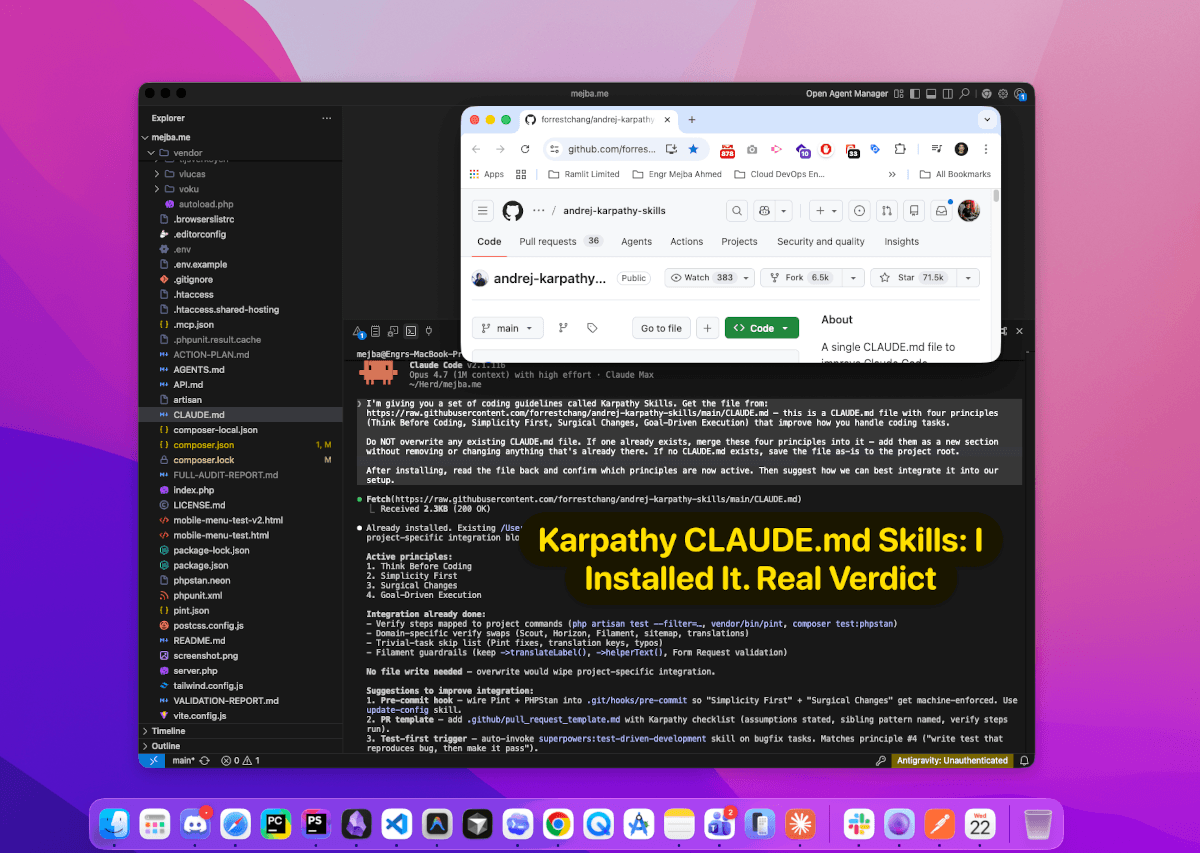

Claude Code is my daily driver — this site, my client work, and my content pipelines all ship through it — and the honest answer to "which repos made it faster" keeps changing. I've now written two versions of this list, and before consolidating them into this one, I did something most listicles skip: I re-pulled every repository through the GitHub API. Two of my previous picks had moved or been renamed, several had gained a quarter-million stars, and one had pivoted to a different product entirely. That churn is the first lesson: in this ecosystem, a list is a snapshot. Here is mine, current as of August 2026, organized by what each repo actually does to your workflow.
One framework before the list, because it's the difference between a faster setup and a bloated one. Every useful repo fits one of four layers: the harness (changes how Claude Code itself behaves), the knowledge base (makes you better at driving it), the extension (adds capabilities it doesn't have), and the accelerator (removes friction from one specific step). The classic mistake — I made it, one afternoon of mass-installing that took two hours to untangle — is stacking harness tools before your fundamentals justify them. Install for a bottleneck you have, not a feature that sounds cool.
The Harness Layer: Changing How Claude Code Thinks
1. Superpowers — github.com/obra/superpowers (~272K stars, MIT). Jesse Vincent's skills framework encodes a development methodology — structured brainstorming before creative work, test-driven development, systematic debugging, verification before claiming completion. This one I can vouch for beyond a test drive: it runs in my own environment, and its brainstorming and TDD skills gate my real sessions on this Laravel platform. The behavioral difference is that Claude stops sprinting into implementation and starts interrogating the problem first — which sounds slower and ships faster. I've written up how its review workflow catches what I miss.
2. ECC (Everything Claude Code) — github.com/affaan-m/ECC (~240K stars, MIT). Affaan Mustafa's agent-harness optimization system: skills, memory, security scanning, and research-first development patterns, now targeting Codex, OpenCode, and Cursor as well. Note the rename — the old everything-claude-code URL redirects to ECC. It's a buffet, and the people who complain it's "too much" are the ones who enabled everything at once. I run four pieces: the research-first pattern, the security scanner, memory, and the review hook. Start there.
3. Get Shit Done (GSD) — github.com/gsd-build/get-shit-done (~65K stars, MIT). A spec-driven development system that forces work into small, checkable plans, executes each in a fresh context window, and lands an atomic git commit per completed task. GSD attacks the real killer of long agentic sessions — context rot, where the agent's decisions at minute ninety contradict its decisions at minute ten. On a client Laravel integration, the spec kept Claude from wandering into refactoring middleware that already worked. If your projects outlive a single session, this is the harness pick.
4. claude-mem — github.com/thedotmack/claude-mem (~91K stars, Apache-2.0). Persistent memory across sessions: lifecycle hooks capture what happened, compress it, and inject relevant context when you next start up. It removes the fifteen-minute ritual of re-teaching Claude your architecture every morning. Worth knowing: its worker service claims a local port, so check for conflicts. If you'd rather own your memory layer in plain files, my Obsidian-based persistent memory setup is the DIY alternative — I prefer files I can read; claude-mem is the appliance version.
5. Anthropic's skills repo (skill-creator) — github.com/anthropics/skills (~169K stars). The first-party skills collection, including skill-creator — Anthropic's own tooling for building and iterating on skills. If you write custom skills (after a month of daily Claude Code use, you should), working from the official patterns beats reverse-engineering community examples, and it's the reference I check before publishing anything to my own skills marketplace.
The Knowledge Layer: Upgrading the Human
6. claude-code-best-practice — github.com/shanraisshan/claude-code-best-practice (~64K stars, MIT). The missing manual: worked examples of wiring commands, agents, skills, and hooks together, converging on a research-plan-execute-review-ship loop. Its tiered-context approach to CLAUDE.md — lean root file, domain context distributed into scoped files — is a pattern I now use on this very codebase, and it noticeably reduced instruction-drift on long sessions. Read it before installing anything; it improves every other repo on this list.
7. awesome-claude-code — github.com/hesreallyhim/awesome-claude-code (~52K stars). The curated ecosystem index — skills, hooks, slash commands, orchestrators — with an unusually good signal-to-noise ratio and a fitting quirk: pull requests are submitted by Claude itself. I scan it weekly; three tools in my permanent rotation came from it. The value is the cadence, not any single visit.
8. Prompt Engineering Guide — github.com/dair-ai/Prompt-Engineering-Guide (~77K stars, MIT). Not Claude Code-specific, on the list anyway: two developers with identical setups produce wildly different results, and the difference is always prompt structure. Read the chain-of-thought and ReAct sections — ReAct maps directly onto how Claude Code agents actually operate — then mine the prompt hub for your domain. Pairs well with the harder-won lessons in my 50 Claude Code tips.
The Extension Layer: New Capabilities
9. UI UX Pro Max — github.com/nextlevelbuilder/ui-ux-pro-max-skill (~117K stars, MIT). A design-intelligence skill that injects styles, palettes, font pairings, and UX guidelines into Claude Code's UI decisions, plus a design-system generator that becomes the source of truth for every subsequent screen. It closes most of the gap between "developer placeholder UI" and "presentable prototype." A human designer's eye still finishes the job — but clients stopped wincing at first demos.
10. n8n-mcp — github.com/czlonkowski/n8n-mcp (~23K stars, MIT). An MCP server that gives Claude Code structured knowledge of n8n's node ecosystem, so "when a GitHub issue is labeled urgent, notify on-call and open a ticket" comes back as a real, importable workflow instead of pseudocode. Building automations this way collapsed my n8n editing time from an hour of node-dragging to a conversation — the full setup is in my n8n MCP server walkthrough. The same author's n8n-skills repo layers workflow-building patterns on top.
11. obsidian-skills — github.com/kepano/obsidian-skills (~46K stars, MIT). From Obsidian's CEO Steph Ango: three skills teaching Claude Obsidian-flavored Markdown, .base database views, and JSON Canvas. The unlock is bidirectional — Claude doesn't just write notes, it reads your decision records and specs as development context. Combined with a memory layer, you get working memory plus reference memory, which is how human developers actually operate.
12. LightRAG — github.com/HKUDS/LightRAG (~39K stars, MIT). Graph-based retrieval: it extracts entities and relationships from a codebase or document set into a knowledge graph Claude can query via MCP. Overkill below ~50 files; a force multiplier for onboarding onto large legacy projects, because the agent gets structural understanding instead of text proximity. Loading a 400-file client project plus its internal docs visibly improved the architectural quality of Claude's suggestions.
The Accelerator Layer: Removing Specific Friction
13. Continue — github.com/continuedev/continue (~35K stars, Apache-2.0). The open-source IDE assistant, model-agnostic by design. I pair it with Claude Code rather than instead of it: terminal Claude Code for architecture and multi-file work, Continue for inline completions and quick in-editor questions. Different scales of work; using one tool for both is how you end up frustrated with both.
14. Supabase CLI — github.com/supabase/cli (~2.4K stars). The sleeper pick, and the principle matters more than the repo: agents are only as good as the CLIs in their environment. With the Supabase CLI installed, "set up auth schema with row-level security" becomes generate-migrate-typegen-verify in one agentic loop; without it, Claude writes SQL files and a README telling you what to do manually. Whatever your database stack, install its CLI so the agent can close the loop.
15. notebooklm-py — github.com/teng-lin/notebooklm-py (~19K stars, MIT). An unofficial Python API for NotebookLM that makes my NotebookLM research-synthesis workflow scriptable — push sources, query, pull synthesized findings back into a spec, no browser tabs. The honest caveat: it rides undocumented Google APIs and breaks occasionally; treat it as a community convenience, not infrastructure.
What I Cut From Earlier Versions — and Why
A consolidated list should say what fell off it. Open Interpreter (~68K stars) has repositioned itself as a coding agent for open models — a different mission than the general computer-controller I originally recommended. AutoGen (~60K stars) folded into the Microsoft Agent Framework; for most multi-agent needs, Claude Code's native orchestration covers it — my agent swarm architecture writeup shows how far that goes without an external framework. LangChain (~144K stars) remains excellent production infrastructure, but it doesn't make Claude Code faster — the real synergy is using Claude Code to write your LangChain code. Flowise earns a look only when stakeholders need to see a pipeline visually. And bolt.new's open-source repo hasn't moved since late 2024 — the hosted product lives on, but I don't recommend repos that are effectively frozen.
Installation Order, If You're Starting Today
Read claude-code-best-practice first — it costs nothing and upgrades everything. Then one harness pick matched to your actual pain: claude-mem if you keep re-explaining context, GSD if long sessions drift, Superpowers if output quality is the issue. Add your database CLI the same day. Everything else waits until you hit the wall it solves. The fastest Claude Code developers I know run four or five of these fifteen, not all of them — more tools past your real bottleneck means configuration conflicts and context overhead, not speed.
Best GitHub Repos for Claude Code: Quick Answers
Which repo should I install first? None — read claude-code-best-practice and fix your CLAUDE.md. First install: whichever harness tool matches your loudest pain point.
Can Superpowers and GSD run together? Yes, at different altitudes: Superpowers governs per-task methodology, GSD orchestrates multi-task milestones. Add them one at a time and test in isolation.
Are these free? All fifteen are open source — mostly MIT or Apache-2.0. Your only cost is the extra API usage their tool calls and context injection generate.
How current is this list? Every repo was re-verified through the GitHub API in August 2026 — existence, license, stars, and last push. Given how fast this ecosystem moves, re-check anything here before building your team's workflow on it.
Apply the same evaluate-before-you-install rule to my own work: the skills I have built and shipped from daily Claude Code practice are listed in my agent skills marketplace, and most readers need two of them, not twelve.