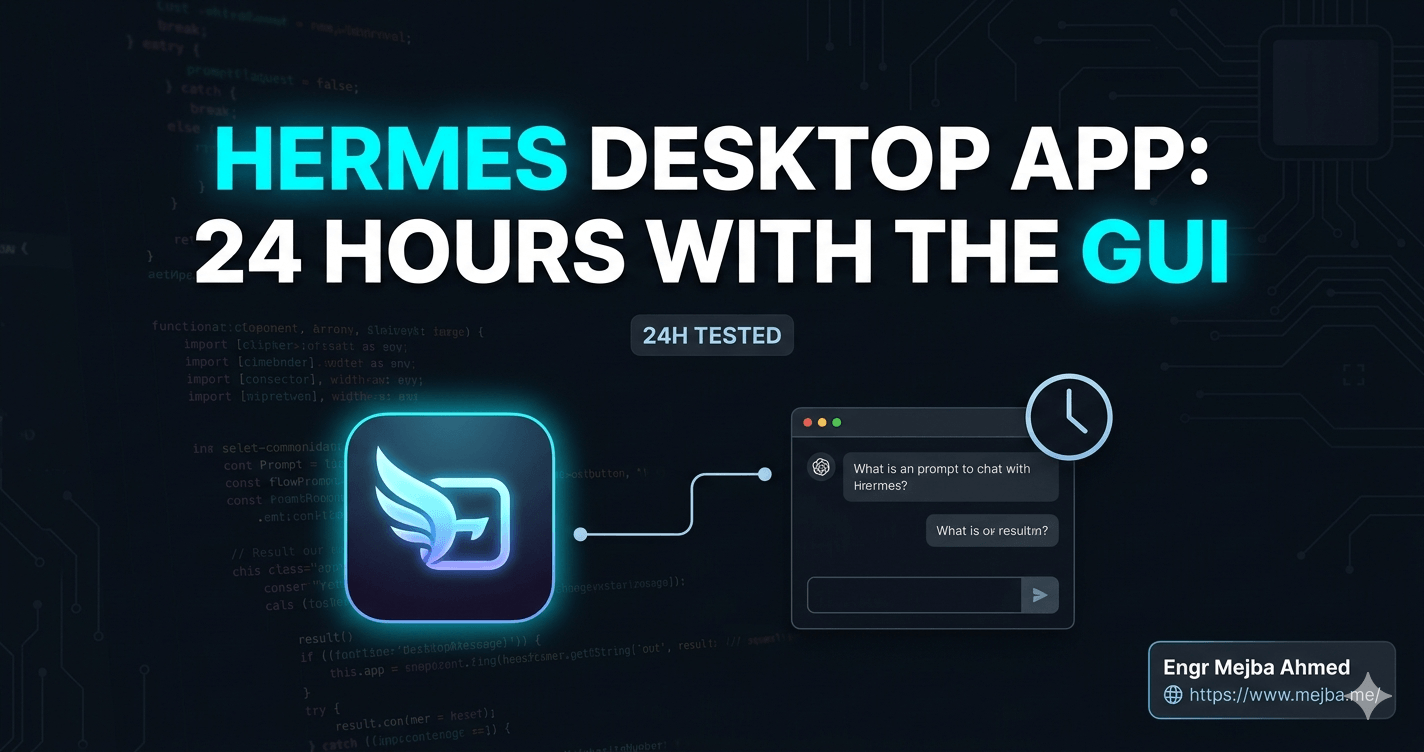
Hermes Desktop App: 24 Hours With the New GUI
The Hermes desktop app shipped at the worst possible time for me. I was three commits deep into a Godot side project, my Hermes agent was babysitting two cron jobs on a Mac Mini in the next room, and the last thing I wanted was a new piece of software to learn. Then the release note crossed my feed on June 3: Nous Research releases Hermes Desktop — a native cross-platform front end for Hermes Agent. MIT-licensed. Mac, Windows, Linux. Same agent core as the CLI.
My first reaction was a tired "I'll get to it next week." My second reaction, about ninety seconds later, was to quit my editor and run hermes desktop.
Here's why I caved. For months I'd been driving Hermes the same way most people do — through Telegram on my phone, through a Discord channel for the build-and-deploy stuff, and through a terminal when I needed to actually see what the agent was doing. Three surfaces. Three mental models. A constant low-grade tax of "wait, which window did I tell it that in?" The presenter whose walkthrough pushed me over the edge made a bold claim after his first day with the app: that it makes Telegram, Discord, the CLI, and OpenClaw obsolete for desktop use. That's his framing, not mine — but after my own 24 hours in it, I understand exactly why he said it.
This is my first-look on the Hermes desktop app: what it actually changes, the four things that genuinely surprised me, the one setting you have to fix on day one, and the honest answer to whether it replaces everything the hype says it does. I'll separate the presenter's claims from what I verified myself, and I'll flag every place I'm still running on 24 hours of data rather than 24 days.
What the Hermes desktop app actually is (and what it isn't)
Let me kill the biggest misconception first, because it changes how you should think about the whole thing. The Hermes desktop app is not a new product — it's a native window onto the exact same Hermes agent you already run from the terminal. Same config file. Same API keys. Same sessions. Same skills. Same memory. Per the official docs, "if you have used Hermes in a terminal, everything you set up there is already here, and anything you do here shows up there." They share state. You can start a session in the CLI and resume it in the desktop window, or the reverse.
That one design decision is the reason this launch matters more than it looks. It is not an Electron wrapper bolted onto a chat API. It's a GUI driving the same Hermes Agent core — version 0.15.2 as of this release, built by Nous Research, the same lineage I broke down when I wired Hermes into Claude Code as a shared-memory AI operating system. Nothing under the hood changed. What changed is the surface you touch it through.
So when people say "the terminal era is over," that's the press headline. The accurate version is narrower and more useful: the terminal is no longer the only high-fidelity way to operate the agent. You still have the CLI. You still have the messaging gateways. You now also have a real desktop UI that exposes the parts of Hermes that used to live in config files and --help output.
The app launched in public preview on June 3, 2026, downloadable as an installer or launchable straight from the CLI with hermes desktop — which by default installs the workspace Node dependencies, builds an unpacked Electron app for your OS, and launches it. First run worked on my Mac without drama. If you've already got Hermes configured, the desktop app finds your existing setup and you're talking to your agent in under a minute.
That's the foundation. Now here's what surprised me once I was inside.
Sessions on the left, and why my Telegram threads suddenly felt primitive
The first thing the app does is reframe how you think about a conversation. Every interaction is a session, and they all live in a list down the left side — named, persistent, clickable. The value only becomes obvious next to how I'd been working before.
In Telegram, everything Hermes and I had ever discussed was one infinite scroll. Content ideas, a stock-price check, a debugging thread, a half-finished business plan — all smeared into a single timeline I had to scroll-archaeology through every time I wanted to pick something back up. Discord at least gave me channels, but channels are heavyweight. You don't spin up a channel for a forty-minute question.
The desktop app's session model fixes this without making you think about it. I now have a session for content work, one for the Godot game I'm building, one for investment tracking, and one for general programming. Each one keeps its own thread. I can rename them. I can group them into folders. And — this is the part that earns its keep — I can pin the ones I touch constantly to the top.
Pinning earns its keep for one specific reason: Hermes spawns sessions automatically when cron jobs fire. Every scheduled task that runs in a "completely fresh agent session," per the docs, becomes a new entry in your list. Leave a few cron jobs running for a day and your sidebar fills with machine-generated sessions you didn't open by hand. Pinning the three or four sessions you actually drive keeps them from drowning. After a single day of testing I already had a dozen cron-spawned sessions stacked up. The pin feature went from "nice" to "required" inside about six hours.
Is this enough to retire Telegram on the desktop? For me, yes — on the desktop. When I'm at my Mac, the session list beats threading in any messaging app I've used with an agent. On my phone, Telegram still wins because there's no mobile Hermes app yet, and a phone screen doesn't have room for a session sidebar anyway. The presenter said the same thing, and I think it's the honest take: desktop migrates to the app, mobile stays on Telegram until Nous ships a phone client.
But the session list isn't the feature that made me sit up. That was the next one.
The "second brain" feature I didn't know I needed
Buried in the app is an Artifacts section, and it quietly solved a problem I'd stopped noticing because I'd been living with it so long.
Every link, file, and image you send to Hermes across any session gets collected in one place. Not per-conversation. Globally. Send the agent a YouTube URL to transcribe in your content session, drop a PDF into your research session, paste a screenshot into your programming thread — all of it lands in Artifacts, accessible later regardless of which session it came from.
I'd been using a tangle of browser bookmarks, a Notes app, and the occasional "let me just paste this into Telegram so I don't lose it" for exactly this. The Artifacts panel collapses all of that into the agent itself. It's a persistent memory hub for the stuff you hand the agent, which is a different and more practical thing than the agent's own conversational memory.
Here's the concrete way it changed my day. I send Hermes a lot of videos to transcribe. Pre-app, the source link was gone the moment the chat scrolled — if I wanted the original two days later, I was digging through my browser history. Now the video sits in Artifacts next to the transcript the agent produced. The same goes for PDFs I want summarized and presentation decks I want the agent to reference. Nothing evaporates as the conversation moves on.
The presenter called it a second brain. I'd put it more plainly: it's the file-and-link management an AI agent should have shipped with from the start, and it's the first time I've seen it integrated into the agent rather than bolted on through a separate note-taking tool. If you've read my piece on building a persistent second brain with Claude Code and Obsidian, this is the same instinct — keep the raw material attached to the intelligence that works on it — except Hermes does it natively, no vault required.
That's the feature that sold me on the app itself. The next two are the ones that fixed things I'd quietly given up on.
Cron jobs you can finally see, test, and trust
If you've run Hermes for any length of time, you know the cron pain. You set a job to run every morning. It runs once. Or it runs at the wrong time. Or it silently stops and you don't notice for three days because nothing tells you it died. I lost a daily stock-check job this way and didn't realize it until I went looking for output that was never generated.
The desktop app puts cron behind a real interface. You can view every scheduled job, set its schedule with an actual form instead of a raw cron expression you got slightly wrong, pause jobs you don't want firing right now, and — the part I care about most — test a job to confirm it actually does what you intended before you trust it to run unattended at 3 AM.
There's an important mechanical detail the docs are explicit about, and it'll save you a confused hour: a Hermes cron job runs in a completely fresh agent session. It does not inherit context from your chat history. The prompt has to contain everything the agent needs that isn't already supplied by an attached skill — and yes, a cron job can load one or more skills before it runs. That's why a job that "works when I ask it in chat" can fail on a schedule: in chat, the agent had context the cron run doesn't. The desktop app's test button is the fastest way to catch that gap, because you run the job in its real fresh-session conditions and watch what it does.
For anyone running scheduled automations — the morning stock check, the nightly build, the daily competitor scrape — this is the difference between hoping a job ran and knowing it did. I'd put the cron manager second only to Artifacts in terms of features that changed how I work this week. It's the same reliability problem I kept hitting when I scheduled Hermes-style automations from a Discord-driven VPS, except now I can validate the schedule visually instead of tailing logs and praying.
A fair caveat on 24 hours of data: I've tested the cron interface, paused jobs, and watched test runs. I have not yet run a full 30-day window to confirm the desktop-managed scheduler survives a Mac sleep, a network drop, or an agent restart with the same stubbornness as a Linux cron entry on a VPS. My working recommendation mirrors what I tell people about any new scheduler: configure jobs in the app for clarity and testing, but mirror your mission-critical ones in plain cron on a VPS until you've watched the app hold up under real load.
Profiles, models, and the settings that quietly run cost
Three more pieces matter, and they're the ones that separate someone running one agent from someone running a fleet.
Profiles let you run multiple distinct Hermes agents, each with isolated config, skills, and sessions. This is not the same as sub-agents, and the distinction is worth getting right. A sub-agent is a copy of your main agent — same memories, same skills, dispatched to parallelize a task. A profile is a different agent entirely: its own memory, its own personality, its own skill set and tool sets. The presenter runs seven of them across a DGX Spark, a couple of Mac Minis, and a Mac Studio, each with a different job. I run fewer, but the principle holds — my content agent and my code agent shouldn't share a brain any more than my designer and my accountant should. Creating and configuring a profile, editing its personality, and choosing its model all happen inside the app now, with no config-file surgery.
Model selection is a dropdown. It matters because of the old failure mode: switching models mid-stream could break or crash the agent. The desktop app handles the swap cleanly through the Nous Portal, which exposes over 300 models across free and paid plans. I'm running Claude Opus 4.8 as my main chat model — it's what I trust for the reasoning-heavy work — but the dropdown makes it trivial to drop to a cheaper model for a session where I don't need the heavyweight. Which brings me to the two settings that quietly decide your bill and your sanity.
Skills and tool sets are manageable from the UI, and this is where token cost lives. Hermes ships with default skills — iMessage access, Apple Reminders, Find My, and others — that you may never use. Every skill loaded is context the agent carries, and context is money, especially on an Opus-class model where auxiliary tasks add up fast. Turning off the skills you don't need is the single cheapest optimization in the app. I disabled three default skills in the first hour and watched my per-session token footprint drop. Skills in Hermes are also self-improving — they evolve based on usage — and the app lets you actually see your custom skills, including one I'd been growing while building that Godot game without realizing how much it had matured. Tool sets are groups of tools that work together, like browser automation, surfaced so you can understand and extend what the agent can actually do.
If you want the deeper mental model for why disabling unused capabilities matters so much on agent platforms, I went long on exactly this dynamic in my AI agent cost optimization guide — the short version is that the cheapest token is the one you never load.
This is the section where, if you're setting up the app yourself, I'd pause and actually do the work: audit your default skills, pick your main model deliberately, and split your agents into profiles by job. Twenty minutes here saves you weeks of muddled, expensive sessions later.
There's one more setting that isn't optional. It's the fix that decides whether the app is genuinely usable.
The one setting you must change on day one
Earlier Hermes versions had a memory problem: in long sessions, the agent would lose context — forget what you'd established forty messages ago, repeat itself, drift. If you tried Hermes a version or two back and bounced off it for this reason, this is your reason to come back.
The fix is a configuration value, and the Hermes team's own recommendation is the one I followed: set the compression threshold to 0.5. Hermes' default compression threshold is 0.50 (50% of the context limit), and that's the value you want — it triggers compression more frequently but more lightly, so the agent compresses in smaller, gentler passes instead of waiting until the context window is nearly full and then crushing it in one lossy heave. More frequent, lighter compression means less catastrophic memory loss across a long session.
In practical terms: with the threshold set correctly, my sessions held their thread far longer than the older Hermes builds I'd given up on. The agent remembered decisions I'd made early in a session that previous versions would have flattened. This is the difference between an agent you can have a real working session with and one you have to keep re-briefing. Set it on day one. It's the highest-leverage tweak in the entire app, and it costs you one config change.
While you're in settings, there are two more worth knowing about. The first is purely cosmetic — a range of appearance themes including light and dark. I run the light theme with a subtle icy-blue tone; it's the only purely aesthetic choice in this post and I'm not going to pretend it changes your output. The second is not cosmetic at all.
API keys, finally out of the chat box
Here's a security habit the app fixes that I'm a little embarrassed I ever had. The old way of getting an API key into Hermes for some workflows was to paste it into a chat message. Think about what that means: your credentials sitting in plain text inside a conversational log, one screen-share or one synced backup away from exposure.
The desktop app has a dedicated API keys menu. You add and manage keys there, separate from any conversation. Credentials live in their own store, out of the chat history entirely. This is the kind of unglamorous fix that doesn't make the launch headline but absolutely should, because the failure mode it prevents — a leaked key in a log someone else can read — is one of the most common and most costly mistakes people make with agent platforms. Move every key out of chat and into the keys menu. It takes two minutes and it closes a real hole.
So what does all of this add up to after a day?
Does it really replace Telegram, Discord, the CLI, and OpenClaw?
This is the claim that pulled me in, so let me answer it honestly, piece by piece, after 24 hours.
Telegram and Discord, on the desktop: yes, mostly. The session model genuinely beats threading in a messaging app, and Artifacts beats the "paste it so I don't lose it" habit those apps encourage. When I'm at my Mac, I don't have a reason to drive Hermes through Telegram anymore. On my phone, Telegram still wins by default — there's no mobile Hermes app yet, and I expect Nous to ship one before this claim becomes fully true.
The CLI: replaced for most tasks, not retired. The desktop app exposes things the terminal made you dig for — cron, profiles, skills, keys — in a way that's faster for daily operation. But because the app and CLI share the same state, the terminal is still there when I want raw control or I'm SSH'd into a headless box. It's not "the terminal is dead." It's "you no longer have to live in the terminal."
OpenClaw: this is the spicy one, and I'd be careful with it. Hermes Desktop is a strong reason to run Hermes over OpenClaw if you're choosing a personal-agent platform fresh today. But "obsolete" overstates it. OpenClaw has its own ecosystem and its own community GUI — I reviewed ClawX, the desktop app for OpenClaw agents, which solves the same surface problem on the other platform. The accurate read is competitive pressure, not extinction. The presenter himself expects OpenClaw to imitate this UI quickly, and I agree — when one platform ships the GUI everyone wanted, the others copy it within a release cycle.
My one honest hesitation across the whole thing: 24 hours is a first look, not a verdict. Everything I've described, I touched and verified. What I haven't done is run it as my only Hermes surface for a month, through OS updates, sleep cycles, and the slow accumulation of cron jobs that reveals whether a tool is actually durable or just demo-pretty. The features are real. The longevity is still on probation. I'll know more in thirty days than I do today, and I'll say so when I do.
One bigger thing stuck with me. For years, the price of admission to serious AI agents was comfort with a terminal, and that single requirement quietly kept the most powerful tools away from the people who'd have used them well. Hermes Desktop doesn't simplify the agent — it does the same powerful things — it just stops making you prove you can use a command line first. If the GUI is finally this capable, the terminal becomes a preference rather than a gate.
FAQ
Frequently Asked Questions
Everything you need to know about this topic
The Hermes desktop app is a native cross-platform GUI for Hermes Agent, released by Nous Research on June 3, 2026. It runs on macOS, Windows, and Linux, is MIT-licensed, and drives the same Hermes Agent core (v0.15.2) as the CLI — sharing config, API keys, sessions, skills, and memory. For the full breakdown, see "What the Hermes desktop app actually is" above.
Download the installer from the Nous Research site, or run hermes desktop from the CLI if Hermes is already installed. The CLI command installs workspace Node dependencies, builds an unpacked Electron app for your OS, and launches it. If your Hermes is already configured, the app finds your existing setup automatically.
On the desktop, it largely replaces Telegram and Discord for operating the agent, thanks to its session list and Artifacts hub. It does not retire the CLI — both share state, so the terminal stays available for raw control and headless servers. Mobile still favors Telegram until a phone app ships.
Set the compression threshold to 0.5, which is Hermes' default (50% of the context limit). This triggers more frequent but lighter compression, reducing the memory loss that plagued earlier long sessions. It's the single most important day-one setting in the app — see "The one setting you must change on day one" above.
Yes, the Hermes desktop app is open-source and MIT-licensed. Model access runs through the Nous Portal, which offers both free and paid plans across 300+ AI models, so your only real cost is the inference you choose to run on paid models like Claude Opus 4.8.
My plan for the next thirty days
I'm keeping Hermes Desktop as my primary surface for a month to see whether it survives sleep cycles, network drops, and the slow pile-up of cron jobs — and I'll write up what breaks. If you'd rather skip the trial-and-error and have a multi-agent Hermes setup architected for you — profiles, skills, cron, and the cost guardrails that keep an Opus-class agent affordable — that's the kind of build I take on through my Fiverr profile.