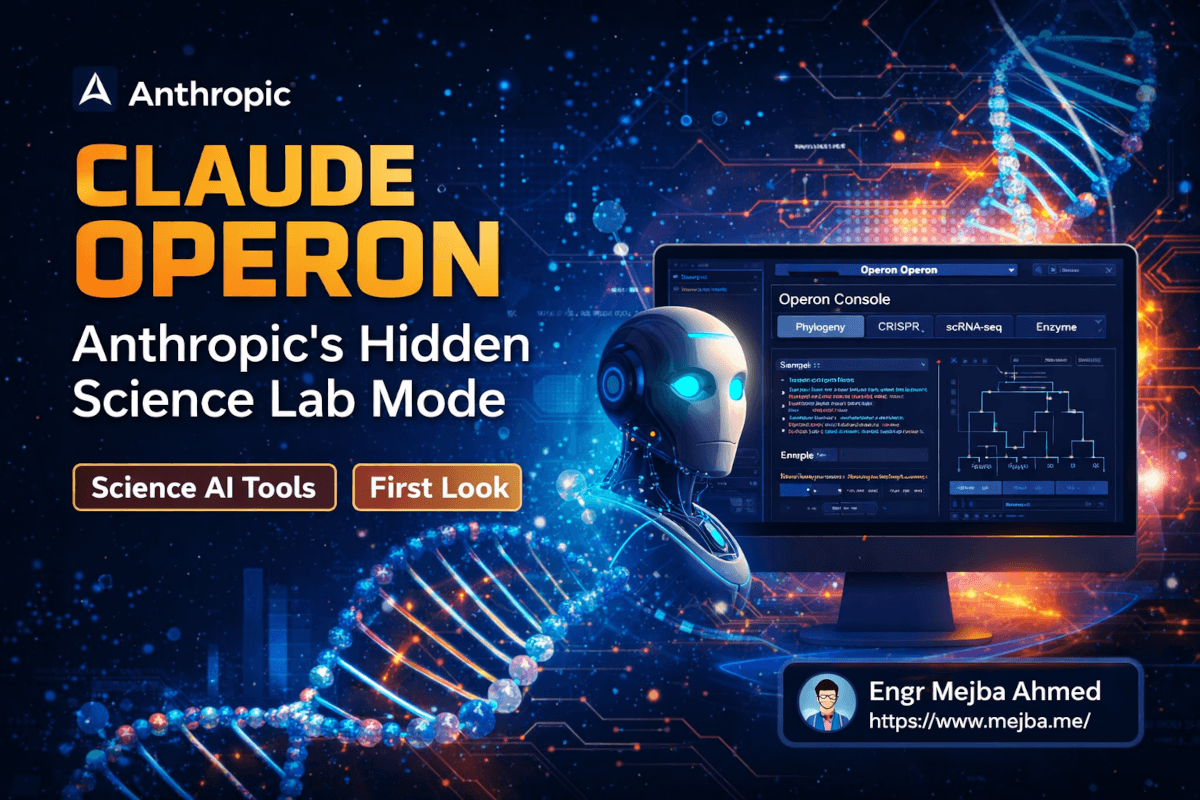
Claude Operon Science Mode: Anthropic's Hidden Lab
On March 27, 2026, someone at TestingCatalog was poking around the Claude desktop app and found something Anthropic hadn't announced yet.
A fourth mode. Not Chat. Not Code. Not Co-work.
Something called Operon.
The name alone caught my attention. If you've taken a molecular biology class — or even skimmed a genetics textbook — you know an operon is a cluster of genes that work together as a coordinated unit. lac operon, trp operon, the kind of thing that shows up on every biology midterm. Anthropic didn't pick that name by accident. They're signaling exactly what this mode is supposed to be: an interconnected system where multiple research capabilities operate as one coordinated workspace.
And based on what's been uncovered so far, Operon isn't a minor feature update. It's the clearest signal yet that Anthropic is done building general-purpose chatbots and has started building professional-grade tools for specific domains. That shift has implications well beyond biology — and I want to walk through exactly why.
But first, let me explain what was actually found inside the app. Because the details matter more than the headline.
What TestingCatalog Actually Found Inside the Claude Desktop App
Here's the technical reality of the discovery. TestingCatalog, a site that tracks unreleased features across AI applications, found traces of Operon embedded in the Claude desktop app's interface code on the night of March 27, 2026. This wasn't a leaked blog post or an internal memo — it was functional UI elements sitting inside an application millions of people already have installed.
When a user enters Operon for the first time, they're greeted with an onboarding screen titled "Welcome to Operon" that explains Claude will set up a private environment to work alongside them. After onboarding, users create a project with a system prompt that persists across all sessions within that project.
That persistence detail is worth pausing on. If you've used Claude for any kind of ongoing work, you know the frustration of re-establishing context every time you start a new conversation. "I'm working on a React app with this specific architecture, using these specific libraries, and here's what we've built so far..." — that ritual happens hundreds of times a week across Claude's user base. Operon eliminates it for research workflows. Your project context carries forward. Your experiment history stays intact. The AI remembers where you left off yesterday.
The mode sits alongside Chat, Code, and Co-work as a completely separate experience with its own layout, its own capabilities, and its own design philosophy. This isn't a plugin or a skill bolted onto an existing mode. It's a standalone workspace built from the ground up for biology and health research.
And the specific capabilities they've baked in tell you exactly who this is for.
The Four Research Templates That Reveal Anthropic's Priorities
Operon launches with four biology-specific task templates. Each one targets a workflow that currently requires specialized software, significant computational biology expertise, or both.
Phylogenetic tree construction. Claude can take raw genetic sequence data, align sequences, construct evolutionary trees, and interpret the biological significance of branching patterns. For researchers studying gene families or tracing pathogen evolution, this workflow typically spans multiple tools — BLAST for alignment, MEGA or RAxML for tree construction, manual interpretation for biological meaning. Operon appears to compress that into a conversational interface where the researcher stays in control of the scientific judgment while Claude handles the computational grunt work.
CRISPR knockout screen design. This is where it gets genuinely ambitious. Designing a CRISPR knockout screen involves selecting guide RNAs, predicting off-target effects, determining library coverage, and planning experimental controls. It's the kind of work that a postdoc might spend days on before an experiment even starts. The fact that Anthropic built this as one of four launch templates tells you they've been talking to real lab teams about their biggest time sinks.
Single-cell RNA sequencing analysis. scRNA-seq data is notoriously complex — you're looking at gene expression patterns across thousands of individual cells, trying to identify cell types, developmental trajectories, and differential expression. The analysis pipeline involves quality control, normalization, dimensionality reduction, clustering, and biological interpretation. Each step has dozens of parameter choices that affect downstream results. Having an AI collaborator that understands the entire pipeline and can explain why it's recommending specific parameter choices — that's a meaningful acceleration for researchers who currently spend weeks on this analysis.
Enzyme variant ranking with protein language models. This template uses protein language models to rank enzyme variants by predicted fitness. If you're doing directed evolution or rational enzyme design, you're evaluating hundreds or thousands of variants and trying to predict which ones will actually fold correctly and maintain catalytic activity. Protein language models like ESM-2 have gotten remarkably good at this, but the interface between those models and a working scientist's questions is often a Python notebook and a lot of bioinformatics expertise. Operon appears to make that interface conversational.
I want to be clear about something: I haven't personally run these workflows inside Operon. Nobody outside Anthropic (and possibly a few early testers) has. What I'm working from is the UI evidence discovered by TestingCatalog and the pattern of Anthropic's prior science investments. The specific performance of these templates — how accurate the CRISPR predictions are, how well the phylogenetic trees compare to established tools — remains to be seen.
That honest caveat matters, because the architecture of what Anthropic is building is genuinely interesting regardless of whether the v1 execution is perfect.
Why the Two-Speed System Changes Everything for Research
Here's the feature that made me sit up straight.
Operon borrows the Plan mode and Auto mode system directly from Claude Code. If you've used Claude Code — and if you're reading this blog, there's a decent chance you have — you know how these work. Plan mode means Claude outlines what it intends to do before doing it. You review the plan, adjust it, approve it, and then execution begins. Auto mode means Claude just runs. No checkpoints. No confirmation screens. Tasks complete without interruption.
I wrote about this two-speed system in my Claude Code desktop app review, and the permission architecture is genuinely one of the most underrated design decisions in AI tooling right now. But in a scientific research context, the implications are different — and arguably more important.
Here's why. Scientific research requires accountability at every decision point. When you're designing a CRISPR experiment that will be run in a wet lab with real reagents costing real money, you need to understand why specific guide RNAs were selected and what assumptions went into the off-target prediction. Plan mode gives researchers that transparency. Claude says: "I'm going to align these sequences using ClustalW, then construct a maximum likelihood tree using 1000 bootstrap replicates, and I'll flag any branches with less than 70% support." The researcher reads that, thinks "actually, I want neighbor-joining for this dataset because the sequences are closely related," and corrects the approach before any computation happens.
That's human-in-the-loop done right. Not a rubber-stamp approval dialog. An actual scientific collaboration where the AI proposes and the expert directs.
Auto mode has its place too — but in research, it's for the tedious phases. Running quality control on a batch of sequencing files. Reformatting output for a specific visualization tool. Generating the boilerplate sections of a methods description. The work that has to happen but doesn't require scientific judgment at every step.
The ability to switch between these modes mid-session is what makes this practical rather than theoretical. Start in Plan mode for experimental design. Switch to Auto for data preprocessing. Drop back to Plan when you hit the analysis phase where parameter choices actually matter. I've been doing exactly this pattern in Claude Code for software development — deliberate oversight for architecture decisions, autonomous execution for scaffolding and boilerplate. Applying the same pattern to research workflows feels natural and, honestly, overdue.
Local File Access: The Feature Researchers Actually Need
Operon grants Claude access to local files and folders on the user's machine. No upload to external servers. No cloud storage required. Direct interaction with files sitting on your hard drive.
For most people, this sounds like a convenience feature. For researchers, it's a requirement.
Here's the reality of scientific data. A single-cell RNA sequencing experiment can generate 50-100GB of raw data. Whole genome sequencing runs produce terabytes. Even processed datasets — the kind you'd actually feed into an analysis pipeline — routinely hit several gigabytes. Uploading that to a cloud AI service isn't just slow. In many institutional contexts, it's a compliance violation.
Universities, hospitals, and pharmaceutical companies operate under data governance frameworks that restrict where patient-derived or experimentally sensitive data can be stored and processed. HIPAA for healthcare data. IRB protocols for human subjects research. Institutional data handling agreements that specify exactly which systems are authorized to touch specific datasets.
Local file access means the data never leaves the researcher's machine. Claude processes it in place. The analysis happens where the data lives, not where the AI lives. That's not a nice-to-have — it's the difference between "interesting demo" and "tool I can actually use in my lab."
This design choice also connects directly to Anthropic's Claude for Healthcare launch in January 2026, which emphasized HIPAA-ready infrastructure. Operon appears to be the product-level realization of that compliance commitment. The infrastructure was built for healthcare. The workspace is being built for research. The thread connecting them is the same: keep sensitive data under the user's control.
Anthropic's 12-Month Science Strategy — And Why Operon Was Inevitable
Operon didn't appear out of nowhere. It's the culmination of a systematic, 12-month strategy that Anthropic has been executing in plain sight. Once you see the timeline, Operon stops looking like a surprise and starts looking like an inevitability.
Mid-2025: The AI for Science credits program. Anthropic started offering free Claude access to research laboratories in exchange for feedback on how scientists use AI tools. This wasn't charity — it was user research at scale. Hundreds of labs across biology, chemistry, physics, and medicine got hands-on time with Claude, and Anthropic got something more valuable than benchmark scores: real workflow data showing where AI helps and where it falls short in actual research contexts.
October 2025: Claude for Life Sciences. The first commercial product from that research. Claude for Life Sciences added connectors to Medidata, ClinicalTrials.gov, and other scientific platforms. It gave Claude domain-specific knowledge about preclinical research and development. Opus 4.5, released around this time, showed measurable improvements in figure interpretation, computational biology tasks, and protein structure understanding.
January 2026: Claude for Healthcare. Launched at the J.P. Morgan Healthcare Conference, this added HIPAA-ready infrastructure, native integrations with medical databases including the CMS Coverage Database and ICD-10 codes, and a partnership with HealthEx that lets patients use Claude to query their own electronic health records. Banner Health, a 33-hospital system, had already deployed BannerWise — an internal Claude-powered tool that had processed over 1,400 clinical notes by end of 2025, reducing after-hours clinician workload.
March 2026: Operon discovered. The private research workspace that pulls all of these threads together into a single, dedicated experience.
See the pattern? Credits program generates workflow data. Life Sciences adds domain connectors. Healthcare adds compliance infrastructure. Operon builds the workspace that ties everything into a cohesive environment where a researcher can sit down, open a project, and have all of those capabilities available in one place — with persistent context, local file access, and the Plan/Auto control system.
Each step funded and informed the next. That's not product development by accident. That's a deliberate vertical strategy.
How Does Operon Compare to What Google and OpenAI Are Building?
The competitive context matters here because the approach each company is taking reveals fundamentally different philosophies about what AI should do for scientists.
Google's AI Co-Scientist runs hundreds of trials autonomously, evaluating outcomes and iterating without human intervention. It's designed to generate hypotheses, test them computationally, and surface the most promising results. The approach is maximally autonomous — the AI does the science, and the human evaluates the output. Google's system won recognition for its broad applicability across scientific domains and its ability to integrate with large research teams.
OpenAI established a dedicated science team in 2025 focused on integrating AI with laboratory software. Their approach centers on connecting language models with existing lab infrastructure — equipment control, data management systems, electronic lab notebooks. Think of it as making AI a better layer on top of tools scientists already use.
Laya Sciences raised over $500 million to build an end-to-end science process automation platform. Their bet is on full-stack automation — replacing entire workflows rather than augmenting specific steps.
Anthropic's approach with Operon is different from all of these. The two-speed control system is the key differentiator. Operon doesn't try to replace the scientist or automate the entire research process. It positions Claude as a collaborator that can operate independently on routine tasks (Auto mode) while deferring to human expertise on decisions that require scientific judgment (Plan mode).
The real-world evidence supports this approach. Harvard physicist Matthew Schwartz demonstrated that Claude Opus 4.5, under expert supervision, completed a theoretical physics calculation that would typically take a year — in two weeks. The critical phrase is "under expert supervision." The AI didn't do the physics alone. The physicist directed the calculation, caught errors, and made judgment calls about which approaches to pursue. The AI handled the computational labor.
That's the model Operon is built around. Not autonomous AI science. Augmented human science.
| Company | Tool | Philosophy | Control Model |
|---|---|---|---|
| Anthropic | Operon | Human-directed AI collaboration | Two-speed (Plan/Auto) with local processing |
| AI Co-Scientist | Autonomous hypothesis generation | Fully autonomous with human evaluation | |
| OpenAI | Science team tools | AI as infrastructure layer | Integration with existing lab software |
| Laya Sciences | Automation platform | End-to-end process automation | Full-stack workflow replacement |
Whether the collaborative model or the autonomous model produces better science is a question that won't be settled by press releases. It'll be settled by published papers, replicated results, and retraction rates over the next two to three years. But if you forced me to bet on which approach institutional review boards and compliance officers will approve first — the one that keeps the human scientist in the loop wins, and it's not close.
The Bigger Signal: Domain-Specific Modes Are the Future of AI
Here's what I think most people will miss about Operon, and it's the thing I actually care about most.
Operon isn't just a science tool. It's a proof of concept for how AI interfaces are going to evolve across every professional domain.
Think about what Anthropic has built in the Claude desktop app as of March 2026. Four modes, each designed for a fundamentally different type of work:
- Chat for general conversation and knowledge work
- Code for software development
- Co-work for agentic task execution on your local machine
- Operon for science and health research
Each mode has its own layout, its own capabilities, its own interaction patterns, and its own design philosophy. They share the same underlying model, but the experience is completely different because the work is completely different.
Now extrapolate. What happens when Anthropic — or any major AI company — applies this same pattern to legal research? Financial analysis? Architecture and engineering? Journalism? Education?
The general-purpose chatbot era is ending. Not because chatbots don't work — they do, for general-purpose tasks. But professionals don't do general-purpose work. A computational biologist designing a CRISPR screen and a software engineer debugging an API integration and a financial analyst modeling a DCF valuation all need different tools, different interfaces, different guardrails, and different context persistence patterns.
Operon is the first real implementation of that insight inside a consumer-facing AI product. The name they picked for another discovered mode — Epitaxy, a term from materials science referring to crystal growth on a substrate — suggests this isn't stopping at biology.
For developers and AI builders — my core audience — the implication is direct. If you're building AI-powered tools for specific professional domains, study what Anthropic is doing with Operon's architecture. The persistent project context. The two-speed control system. The local file access for compliance-sensitive data. The domain-specific templates that target real workflow bottlenecks. These aren't arbitrary design choices. They're the result of a year of user research with actual scientists.
The companies that figure out domain-specific AI experiences — not just domain-specific prompts, but domain-specific interfaces — are going to own the next wave of professional AI tools.
What I'm Watching Next
Three things will determine whether Operon is a breakthrough or a footnote.
Accuracy on real research tasks. The templates are impressive. The architecture is smart. But biology doesn't grade on design. If the phylogenetic trees have systematic errors, or the CRISPR predictions miss obvious off-target sites, or the scRNA-seq analysis clusters cells incorrectly — none of the interface polish matters. The first independent benchmarks from real computational biologists will tell us everything.
Institutional adoption speed. Individual researchers might try Operon out of curiosity. Institutional adoption — the kind where a university or pharma company integrates it into standard workflows — requires IT security review, compliance sign-off, data governance approval, and budget allocation. Anthropic's HIPAA-ready infrastructure from the Healthcare launch gives them a head start here, but the path from "interesting tool" to "approved for use with patient data" is measured in months, not days.
Whether the model keeps up with the domain. Biology moves fast. New CRISPR variants, new sequencing technologies, new protein structure databases — the knowledge base shifts constantly. If Operon's capabilities freeze at launch while the field advances, it becomes a snapshot rather than a tool. Anthropic's track record with model updates (Opus 4.5 to 4.6 brought specific improvements in protein understanding and figure interpretation) suggests they know this, but sustained investment is different from a launch push.
One more thing worth watching: the Mythos leak. On the same week Operon was discovered, Anthropic inadvertently exposed approximately 3,000 internal files revealing a new model called Claude Mythos that reportedly outperforms Opus 4.6 on every benchmark tested. If Mythos ships as the engine behind Operon, the computational biology capabilities could jump significantly. That's speculative — Anthropic hasn't confirmed any connection — but the timing is suggestive.
What This Means If You're Building AI Tools
I started this article talking about a name. Operon — a coordinated system of genes working together. And that metaphor captures something about where AI is heading that I think most of the industry is still underestimating.
We've spent the last three years arguing about which model is smarter. GPT vs Claude vs Gemini vs Llama. Benchmark wars. Vibes-based rankings. Model drop announcements that feel like sneaker releases.
Operon suggests the next competitive advantage isn't the model. It's the workspace. The persistent context. The domain-specific templates. The control architecture that lets experts direct AI without becoming prompt engineers. The compliance infrastructure that lets institutions say "yes" instead of "not yet."
If you're building AI-powered products — for science, for business, for any domain — the question isn't just "which model should I use?" anymore. The question is: "What does the workspace need to look like for the people who will actually use this every day?"
Anthropic just showed their answer for biology. The rest of the domains are wide open.
Claude Operon Science Mode: Common Questions
What is Claude Operon?
Claude Operon is a new mode inside the Claude desktop app designed specifically for biology and health research. Discovered on March 27, 2026 by TestingCatalog, it sits alongside Chat, Code, and Co-work as a fourth standalone experience with persistent project context, local file access, and research-specific task templates. For the full breakdown, see the feature analysis above.
When will Claude Operon be available?
Anthropic has not officially announced Operon or confirmed a release date as of March 30, 2026. Based on Anthropic's typical deployment pattern — internal testing followed by research preview followed by general availability — public access within one to three months is plausible. The mode was found in existing desktop app code, suggesting development is well advanced.
How is Claude Operon different from Claude Chat?
Operon provides a dedicated research workspace with persistent project sessions, biology-specific task templates (CRISPR design, phylogenetic analysis, scRNA-seq, protein modeling), local file access for compliance-sensitive data, and Plan/Auto execution modes borrowed from Claude Code. Chat is a general-purpose conversation interface without domain-specific tooling or session persistence.
Can Claude Operon analyze DNA sequences?
Based on the discovered UI elements, Operon includes templates for phylogenetic tree construction from genetic sequence data, CRISPR knockout screen design, single-cell RNA sequencing analysis, and enzyme variant ranking using protein language models. These capabilities suggest direct DNA and protein sequence analysis, though independent performance benchmarks are not yet available.
How does Claude Operon compare to Google's AI Co-Scientist?
Google's AI Co-Scientist operates autonomously, running hundreds of trials and surfacing results for human review. Claude Operon emphasizes human-directed collaboration through its two-speed control system — Plan mode for decisions requiring scientific judgment, Auto mode for routine computation. See the full comparison table in the competitive analysis section above.
Whether Operon Changes Your Research Workflow
Claude Operon — Anthropic's hidden fourth mode for scientific research — matters because it points at where AI-assisted science is heading, even in beta. For anyone doing research-shaped work, it's worth watching how it develops.
Explore it on a real question in your field before you judge the category. My Claude Mythos autonomy piece and Anthropic Managed Agents review go deeper on where Anthropic is pushing.
If you want help wiring AI into a research workflow, that's something I do through Ramlit.