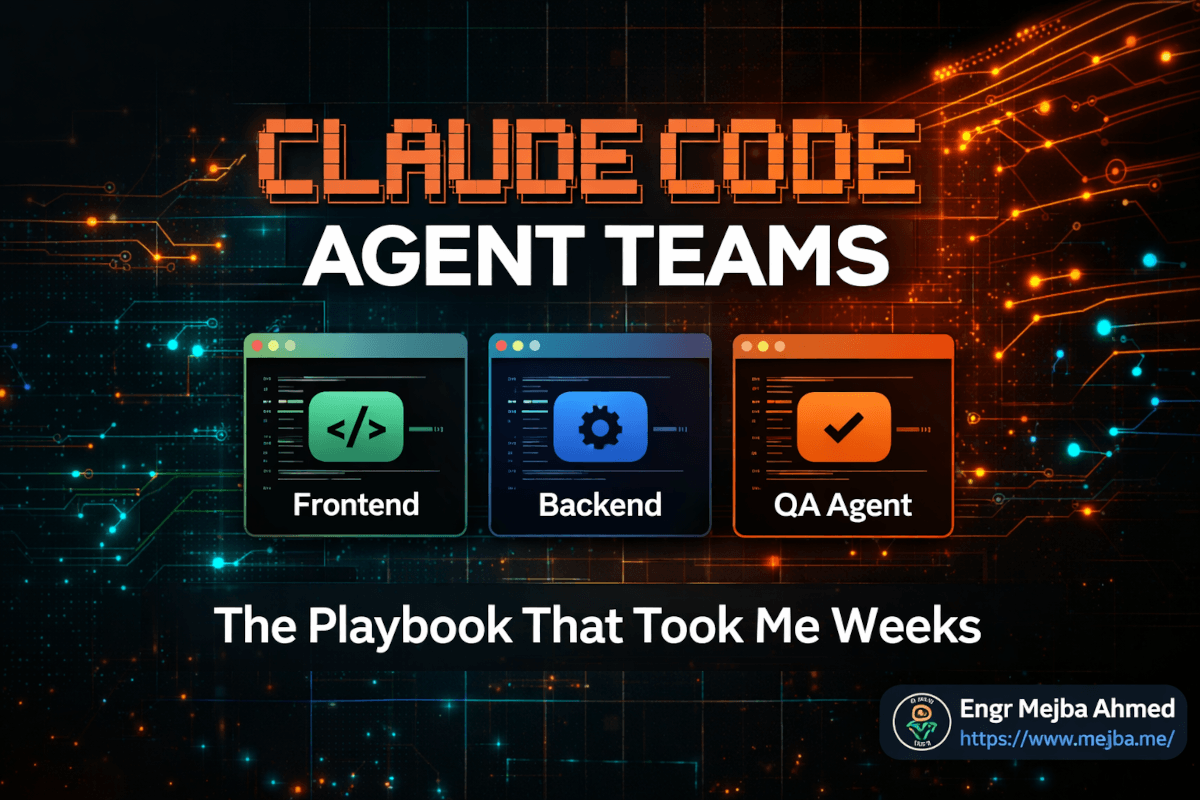
Claude Code Agent Teams Playbook: Weeks of Work
The QA agent found eleven bugs. Eleven. On the first pass.
I'd just watched two other agents — a front-end developer and a back-end developer — spend four minutes building a landing page for a fictional AI startup called Neuroflow. Text, animations, color schemes, responsive layout, API endpoints. All running in parallel, each agent working inside its own Claude Code session while I watched the terminal split into color-coded panels. The front-end agent submitted its work. The back-end agent submitted its work. Then the QA agent tore both of them apart.
Missing hover states. An API endpoint returning data in a format the front-end wasn't expecting. A color contrast ratio that failed WCAG standards. An animation that fired before the content loaded, causing a flash of unstyled text.
Here's the part that stopped me cold: I didn't have to do anything. The QA agent filed its issues, tagged the responsible agents, and both developers picked up the fixes immediately. On the second pass, QA approved everything. The final landing page looked like a small design team had spent a week on it.
That was the moment I understood what Claude Code agent teams actually are. Not a feature. Not a setting you toggle. A fundamentally different way of building software with AI — one where the agents don't just execute tasks, they collaborate, argue, and hold each other accountable. And getting to that moment required weeks of painful experimentation that I'm about to compress into this post.
Because here's what nobody tells you about agent teams: the feature is easy to enable. Getting it to produce results like what I just described? That's where most people fail. The difference between a well-orchestrated agent team and a chaotic token bonfire comes down to how you prompt, how you structure roles, and how you handle the dozen things that can go wrong.
I've burned through more tokens figuring this out than I'd like to admit. This is the playbook I wish existed when I started.
Why Agent Teams Exist (And Why Sub Agents Aren't Enough)
If you've used Claude Code's sub agents, you already know the pitch: spin up independent agents, let them work in parallel, collect results. Fast, cheap, effective for bounded tasks. I still use sub agents daily for things like "analyze this codebase and list every API endpoint" or "write unit tests for this module." They're perfect when the work is isolated.
The problem shows up the moment work isn't isolated.
I learned this the expensive way while building a dashboard application. One sub agent handled the React front-end. Another built the Express API. A third wrote the database layer. All three ran simultaneously — and all three made independent decisions that contradicted each other. The front-end agent expected paginated responses. The API agent returned everything in a single payload. The database agent built queries optimized for a pagination pattern that neither of the other agents knew about.
Three brilliant pieces of software that couldn't talk to each other. I spent more time stitching them together than the agents spent building them.
Sub agents are parallel but deaf. They can't ask each other questions. They can't negotiate an API contract. They can't say "heads up, I changed the response format for the /users endpoint." Each one operates in a sealed context window, reports back to the main agent, and that's it. The main agent becomes a bottleneck — every piece of coordination has to flow through it.
Agent teams solve this with a different architecture entirely. Three components make it work:
The team lead — your main Claude Code session. It understands the full picture, breaks down the mission, assigns domains, and coordinates integration. Think of it as the tech lead who doesn't write all the code but makes sure everyone's building the same product.
Teammates — separate Claude Code instances, each with their own full context window. They run in parallel and own specific domains. The front-end agent only thinks about front-end concerns. The back-end agent focuses entirely on API logic. No context pollution between them.
Direct messaging — and this is the critical difference. Teammates can communicate with each other without routing everything through the team lead. The front-end agent can ask the back-end agent directly: "What format does the /users response use?" The back-end agent responds. Work continues. No bottleneck.
When I saw this working for the first time, the comparison that popped into my head wasn't technical — it was organizational. Sub agents are like emailing three freelancers in three different countries. Agent teams are like putting those freelancers in a Slack channel together. Same talent, radically different coordination capability.
But more coordination also means more complexity, more tokens, and more ways to screw things up. The setup matters enormously — and most guides I've read skip the parts that actually determine success or failure.
Setting Up Agent Teams: The Configuration That Actually Works
Agent teams are experimental as of March 2026 and disabled by default. Anthropic shipped this as a research preview with Claude Code v2.1.32, which tells you two things: it's powerful enough to release, and rough enough that they want you to know what you're getting into.
Step 1: Enable the feature.
Open your project's settings.local.json (or your global Claude Code settings file) and add this:
{
  "env": {
    "CLAUDE_CODE_EXPERIMENTAL_AGENT_TEAMS": "1"
  }
}
Restart Claude Code. That's it for the technical setup. The feature flag gives Claude access to team coordination tools — creating teammates, assigning tasks, sending inter-agent messages, and managing a shared task list.
Step 2: Install tmux (strongly recommended).
You don't strictly need tmux, but running agent teams without it is like driving without a dashboard. Tmux lets you see each agent's terminal session simultaneously — color-coded by role, updating in real time. On macOS:
brew install tmux
When agent teams are active and tmux is installed, Claude Code automatically splits your terminal into panels for each teammate. You can watch the front-end agent writing JSX in one panel while the back-end agent sets up Express routes in another. It's genuinely mesmerizing and practically useful — you can spot coordination failures as they happen instead of discovering them in the final output.
Step 3: Train your Claude Code project.
This is the step most tutorials skip, and it's the one that made the biggest difference for me. Before running your first agent team, import the agent teams documentation into your project context. I pulled the key concepts from Anthropic's agent teams docs into my project's CLAUDE.md file — specifically the sections on file ownership rules, communication protocols, and task dependency management.
Why does this matter? When Claude spawns teammates, each one starts with a fresh context. They don't automatically know the best practices for agent team coordination. But if those practices are in your CLAUDE.md, every teammate reads them on initialization. The difference in coordination quality is immediate and dramatic.
Here's the section I added to my CLAUDE.md:
## Agent Team Rules
- Each teammate owns specific files. Never modify files owned by another agent.
- Always communicate API contracts before implementation begins.
- QA agent must receive final output from all other agents before running checks.
- Save progress to temporary files after each major milestone.
Four lines. They prevent about 80% of the coordination failures I encountered in my first two weeks.
Step 4: Pre-approve common commands.
Agent teammates inherit permissions from the main session. By default, they'll pause and ask for permission every time they want to run a shell command, write a file, or execute code. With three agents running simultaneously, you'll spend your entire session clicking "Approve" instead of watching them work.
In your project settings, pre-approve the commands your agents will need. File reads, writes, npm commands, test runners — whatever your project requires. The specific commands depend on your stack, but the principle is universal: remove the permission bottleneck before you start, or your "parallel" agents will spend half their time waiting for you.
The Prompting Playbook: How to Tell Agents What to Build
Here's where most people go wrong. They enable agent teams, type "build me a to-do app," and wonder why the output is fragmented. The prompting strategy for agent teams is fundamentally different from prompting a solo agent, and the gap between a mediocre prompt and an excellent one shows up in token cost, output quality, and coordination overhead.
I've tested dozens of prompt structures over the past several weeks. This is the pattern that consistently produces the best results.
The anatomy of an effective agent team prompt:
Create a team of [number] agents using [model]:

1. [Role Name] — responsible for [specific domain].
   Owns files in: [directory or file pattern].
   Deliverables: [exact outputs expected].

2. [Role Name] — responsible for [specific domain].
   Owns files in: [directory or file pattern].
   Deliverables: [exact outputs expected].

3. [Role Name] — responsible for [specific domain].
   Owns files in: [directory or file pattern].
   Deliverables: [exact outputs expected].

Communication rules:
- [Agent A] must share [specific artifact] with [Agent B] before [specific action].
- [Agent C] reviews all deliverables before the team reports completion.

Final deliverables: [list everything the team should produce].
Goal: [one sentence describing the end state].
Let me break down why each element matters.
Explicit role assignment prevents overlap. When you say "front-end developer responsible for all UI components, styling, and client-side interactions," the agent knows exactly what belongs to it and — just as importantly — what doesn't. Without clear boundaries, I've watched two agents both decide they should handle form validation, producing conflicting implementations in different files.
File ownership prevents overwrite conflicts. This one cost me hours before I figured it out. If two agents both think they own app.js, one will overwrite the other's work. Every agent needs to know which files are theirs. "Front-end agent owns all files in /src/components/ and /src/styles/." "Back-end agent owns all files in /src/api/ and /src/models/." No ambiguity. No conflicts.
Explicit communication rules prevent the deaf-freelancer problem. The single most effective line I've ever put in an agent team prompt is this: "Back-end agent must share the API endpoint contract with the front-end agent before either begins implementation." That one sentence eliminates the class of bugs where agents build against incompatible assumptions. Without it, they'll start coding immediately — in parallel, at full speed, toward different destinations.
Deliverables create accountability. "Deliver a running application" is vague. "Deliver a running app, a QA test report covering all critical user flows, and a README documenting the API endpoints" is specific. When agents know they'll be measured on specific outputs, the team lead allocates work differently — and the QA agent has clear criteria for its review.
Here's a real prompt I used for the Neuroflow landing page project:
Create a team of 3 using Sonnet:

1. Front-End Developer — responsible for HTML structure, CSS styling,
   animations, and responsive design. Owns all .html and .css files.
   Deliverables: Complete, responsive landing page with hero section,
   features grid, pricing table, and footer.

2. Back-End Developer — responsible for JavaScript functionality,
   form handling, and any API mock endpoints. Owns all .js files.
   Deliverables: Working contact form, smooth scroll navigation,
   and dynamic pricing toggle.

3. QA Agent — responsible for testing all interactive elements,
   checking cross-browser compatibility, and verifying responsive
   breakpoints. Owns the /tests directory.
   Deliverables: Test report listing all issues found, severity ratings,
   and verification that fixes resolve each issue.

Communication rules:
- Front-End and Back-End must agree on element IDs and class names
  before implementation begins.
- QA reviews all work after initial build, sends issues back to
  responsible agents, and re-verifies after fixes.

Goal: A polished, production-quality landing page for Neuroflow,
an AI startup, that passes QA review with zero critical issues.
That prompt took me three iterations to get right. The first version didn't specify file ownership — two agents edited the same HTML file and overwrote each other's work. The second version didn't include the communication rule about element IDs — the JavaScript agent built event handlers targeting classes that didn't exist in the HTML. The third version, above, produced the eleven-bugs-then-zero-bugs result I described in the opening.
Three to five agents is the sweet spot. I've experimented with larger teams — seven agents on one ambitious project — and the coordination overhead became crushing. Agents were spending more time messaging each other than writing code. The token bill was astronomical. For most projects, a front-end agent, a back-end agent, and a QA agent covers everything. Add a fourth for infrastructure or DevOps if the project demands it. Go beyond five only if you genuinely have five independent work domains that need parallel execution.
Agent Teams vs. Sub Agents: The Decision Framework I Actually Use
I've run both approaches on enough projects now to have a clear mental model for when to use which. This isn't theoretical — it's born from watching token bills pile up when I chose wrong.
Use sub agents when:
- The task is focused and bounded. "Analyze this file." "Write tests for this function." "Generate documentation for this API."
- Tasks are truly independent. No shared decisions, no API contracts to negotiate, no files that multiple agents might touch.
- Speed and cost matter more than coordination. Sub agents are significantly cheaper because they skip the communication overhead entirely.
- You need a quick result returned to your main session. Sub agents are fire-and-forget — launch, get result, continue.
Use agent teams when:
- The project has multiple specialized domains that need to work together. A React front-end, a Node.js API, and a PostgreSQL schema aren't independent — decisions in one affect the others.
- Quality requires iterative feedback. The QA-agent pattern I described — where one agent reviews and sends work back for fixes — only works with agent teams. Sub agents can't do round-trip quality loops.
- You need parallel execution WITH coordination. Sub agents give you parallel execution. Agent teams give you parallel execution plus communication. The "plus communication" costs more but prevents the integration nightmares that eat hours of manual cleanup.
- The project is complex enough to justify the overhead. My rough threshold: if the project would take a solo agent more than 15 minutes, agent teams start making sense. Below that, you're paying coordination tax on a problem that doesn't need it.
Never use agent teams for:
- Simple or sequential tasks. If one thing must happen before the next, parallelism doesn't help — it hurts.
- Tasks requiring unified conversation history. Each teammate has its own context. There's no shared memory of previous conversations.
- Projects with heavily shared files. If every agent needs to edit
index.html, you're going to have a bad time regardless of how carefully you assign ownership. - Exploration and planning. I made this mistake early — using agent teams to "research and plan" a project architecture. The agents spent their entire budget discussing possibilities instead of building anything. Use a solo agent for planning, then bring in the team for execution.
The cost difference is real and significant. A solo agent might burn 45,000 tokens on a task manager app. The same app built by an agent team can hit 150,000-200,000 tokens — three to four times more — because inter-agent communication isn't free. Every message between teammates consumes tokens from both sides. The QA review-and-fix cycle alone can double the total usage.
For my work, the math works out like this: agent teams produce higher-quality output on complex projects, but the token cost is 3-5x higher. I only reach for agent teams when the quality difference matters enough to justify the expense — client projects, production applications, anything where integration bugs would cost more to fix manually than the extra tokens cost to prevent.
The Mistakes That Cost Me Thousands of Tokens
I want to be honest about the failures because they taught me more than the successes. Here are the mistakes I made so you can skip them.
Mistake 1: Not assigning file ownership.
My first three agent team sessions produced code that looked fine in each agent's terminal and was completely broken when combined. Two agents would both create a utils.js file. One agent would modify package.json while another was in the middle of reading it. The team lead would try to integrate everything and find conflicting changes scattered across the project.
The fix was embarrassingly simple: tell each agent exactly which files and directories they own. "You can read anything, but you only write to files in your directory." I lost probably 300,000 tokens learning this lesson across multiple failed sessions.
Mistake 2: Letting agents communicate freely without structure.
Unrestricted inter-agent messaging sounds great in theory. In practice, three agents with free communication will spend an alarming amount of time talking instead of building. I watched a back-end agent and a front-end agent have a seven-message exchange about the best way to handle date formatting before either had written a single line of code.
Now I set explicit communication checkpoints: "Share the API contract before implementation. Report completion to QA after implementation. Don't message each other during implementation unless you're blocked." This cut token usage by roughly 40% without reducing output quality.
Mistake 3: Using the wrong model for the wrong role.
Running every agent on Opus 4.6 feels safe — it's the strongest model, so everything should work better, right? In practice, the cost is staggering and the quality improvement for execution-level tasks is marginal.
My current model assignment:
- Team lead: Opus 4.6 — it's making architectural decisions and coordinating complex dependencies. Worth the premium.
- Developer agents (front-end, back-end): Sonnet — fast, capable, and roughly 5x cheaper per token than Opus. For writing code within well-defined boundaries, Sonnet performs nearly identically.
- QA agent: Sonnet or even Haiku for simpler projects — it's following testing patterns, not inventing architectures. The cheapest model that can reliably execute test logic.
This tiered approach cut my agent team costs by about 60% compared to running Opus everywhere.
Mistake 4: Not pre-approving permissions.
With three agents running in parallel, each needing approval for file operations and shell commands, I became the bottleneck. Agents would sit idle for 30-60 seconds waiting for me to click "Approve" in each panel. Multiply that across dozens of operations per agent, and a project that should take five minutes stretches to twenty — not because the agents are slow, but because I can't click fast enough.
Pre-approve everything your agents need in your project or local settings. The productivity difference is massive.
Mistake 5: Running teams without a QA agent.
My first few agent teams were two developers and no QA. The output was fast but riddled with integration issues — mismatched IDs, broken event handlers, CSS that conflicted between components. I was doing QA myself, which defeated the purpose of having a team.
Adding a dedicated QA agent changed the game. It catches integration issues that would take me 10-15 minutes to find manually, and the review-fix-verify loop happens without my involvement. The QA agent costs maybe 20,000 extra tokens per session. The time it saves me is worth ten times that.
Advanced Patterns: Plan Approval, T-Mux Monitoring, and Context Persistence
Once you've got the basics working, three advanced features will push your agent team workflow from good to genuinely powerful.
Plan Approval Mode
By default, agent teammates just... go. They receive their assignment and start executing immediately. Plan approval mode adds a checkpoint: each agent generates a plan and waits for approval before writing any code. The approver can be you, the team lead, or a designated reviewer agent.
I use this selectively. For projects where I know the architecture well, I let agents execute freely — the speed matters more than the control. For unfamiliar territory or client projects where mistakes are expensive, plan approval gives me a review gate without slowing the entire team to sequential execution. Each agent submits their plan in parallel. I review all plans simultaneously. Then they all execute in parallel. The total overhead is usually under two minutes, and it prevents the kind of architectural divergence that requires a complete rebuild.
Tmux Monitoring
I mentioned tmux earlier for terminal splitting, but the monitoring workflow deserves more detail. When agent teams are running with tmux, each agent gets a dedicated pane with a color-coded header showing its role. You can:
- Watch all agents work simultaneously
- Click into any agent's pane to send a direct message
- Observe the message flow between agents in real time
- Spot blocking issues before they cascade
The direct messaging capability is particularly valuable. If I see the front-end agent going down a path I know won't work, I can jump into its pane and redirect without affecting the other agents. "Hey, use CSS Grid for this layout instead of Flexbox — the nested components will need two-dimensional alignment." The agent adjusts, and the back-end agent keeps working undisturbed.
This kind of surgical intervention isn't possible with sub agents. You'd have to cancel the sub agent, rewrite the prompt, and relaunch — losing all the work it had already done.
Context Persistence Through Temp Files
Agent teams have a vulnerability that bit me twice: if an agent crashes or the session drops, any work that wasn't written to disk is gone. The agent's context window evaporates, and the team lead doesn't have a copy of work-in-progress.
My workaround: instruct agents to save progress to temporary files after every major milestone. "After completing the header component, save your progress to /tmp/frontend-checkpoint-1.md with a summary of what's done and what's next." If an agent dies mid-session, the replacement agent reads the checkpoint file and picks up where it left off instead of starting from scratch.
This adds maybe 5% to your token usage and has saved me from two complete team restarts. The first restart, before I implemented checkpoints, cost me about 180,000 tokens of duplicated work.
The Mental Model That Makes Everything Click
After weeks of experimentation, I've settled on a way of thinking about agent teams that predicts when they'll work well and when they'll fail. It comes from real-world team management, not AI theory.
Agent teams follow the same rules as human engineering teams:
Brooks's Law applies. Adding more agents to a project increases communication overhead quadratically. Three agents have three communication channels. Five agents have ten. Seven agents have twenty-one. The coordination cost doesn't scale linearly — it explodes. Keep teams small. Three to five agents. No more.
Conway's Law applies. The structure of your agent team will be mirrored in the structure of the code they produce. If you have a front-end agent and a back-end agent, you'll get a clearly separated front-end and back-end. If you have one agent handling "UI and API" together, you'll get tightly coupled code. Design your team structure to match the architecture you want.
The mythical man-month applies. Two agents don't produce twice as fast as one agent on every task. On some tasks — sequential, tightly coupled, requiring shared context — two agents are slower than one because of coordination overhead. Agent teams shine when work is genuinely parallelizable with clear domain boundaries.
The practical implication: before spawning an agent team, sketch the project as a dependency graph. If you have three or more independent work streams that eventually need to integrate, agent teams make sense. If the work is fundamentally sequential or everything depends on everything else, use a solo agent.
I've started asking myself a simple question before every project: "Could I explain this to three separate freelancers in three separate rooms and get a coherent result?" If yes, agent teams. If no, solo agent or sub agents with careful integration.
What I'm Building Now — And What's Coming Next
Right now, I'm using agent teams for almost every project with more than two integration points. The workflow has stabilized into a pattern: I plan with a solo Opus session, set up file ownership and communication rules, then spawn a team of 3-4 Sonnet agents to execute while a QA agent watches the output.
The results speak through the process, not the hype. My landing pages come back cleaner because the QA agent catches things I'd miss at 2 AM. My full-stack builds integrate on the first pass because agents negotiate API contracts before writing code. My debugging sessions are faster because I can have three agents test three different hypotheses simultaneously instead of testing them sequentially.
The feature isn't perfect. Session stability can be flakey — I've had agents disconnect mid-task on long sessions. The token cost is genuinely high for complex projects. And the prompting precision required means there's a learning curve that's steeper than Anthropic's documentation suggests.
But here's what convinced me this is the future of AI-assisted development, not just a feature: the pattern of collaboration itself. Watching a QA agent find bugs, send them to the responsible developer, receive fixes, and verify the corrections — all without my involvement — that's not just automation. That's a team. A team that happens to be made of AI, but a team nonetheless, with the same dynamics of communication, accountability, and iterative quality improvement that make human engineering teams effective.
The tooling will get cheaper and more stable. The models will get faster and smarter. But the pattern — specialized agents collaborating through structured communication on shared goals — that pattern is permanent. Learning it now means you're building a skill that compounds with every improvement Anthropic ships.
If you're still running everything through a solo agent and wondering why complex projects feel like pushing a boulder uphill, try this: take your next multi-component project, define three roles with clear file ownership, add a QA agent, and write one communication rule. Just one. "Agree on the API contract before writing code."
Then watch what happens.
Claude Code Agent Teams Playbook: Common Questions
How do I enable Claude Code agent teams?
Add "CLAUDE_CODE_EXPERIMENTAL_AGENT_TEAMS": "1" to the env object in your project's settings.local.json file and restart Claude Code. You need Claude Code v2.1.32 or later, available on Pro ($20/month) or Max ($100-$200/month) plans.
How many agents should I use in a team?
Three to five agents is the sweet spot for most projects. Beyond five, inter-agent communication overhead grows quadratically and token costs escalate. A typical effective team includes a front-end agent, back-end agent, and QA agent. For a deeper look at model selection per role, see my Claude agent teams guide.
What's the difference between agent teams and sub agents?
Sub agents run independently, complete a task, and return results to the main agent — they cannot communicate with each other. Agent teams have a shared task list, direct inter-agent messaging, and a team lead coordinating parallel work with iterative feedback loops. Sub agents are cheaper and faster; agent teams produce higher-quality output on complex, multi-domain projects.
Do agent teams cost more tokens than a solo agent?
Yes, significantly. A task that costs 45,000 tokens with a solo agent typically costs 150,000-200,000 tokens with an agent team due to inter-agent communication overhead. Reduce costs by using Sonnet or Haiku for execution agents and reserving Opus for the team lead only.
Can agent teammates access my project files and tools?
All teammates inherit permissions from the main session, including file system access, command execution, MCP servers, and skills. You cannot grant different permission levels to different teammates — they all share the same access configuration.
Which Agent-Team Pattern to Start With
The agent-teams playbook took weeks to earn because orchestration, QA integration, and parallel workflows each have failure modes that cost real tokens — $47 of mine, for one. The value is the patterns that avoid those, not the raw parallelism.
Start with two agents on one real task before you build a whole team. My Claude Code agent skills guide and advanced workflow guide go deeper.
If you want a multi-agent workflow designed for your team, that's something I do through Ramlit.