

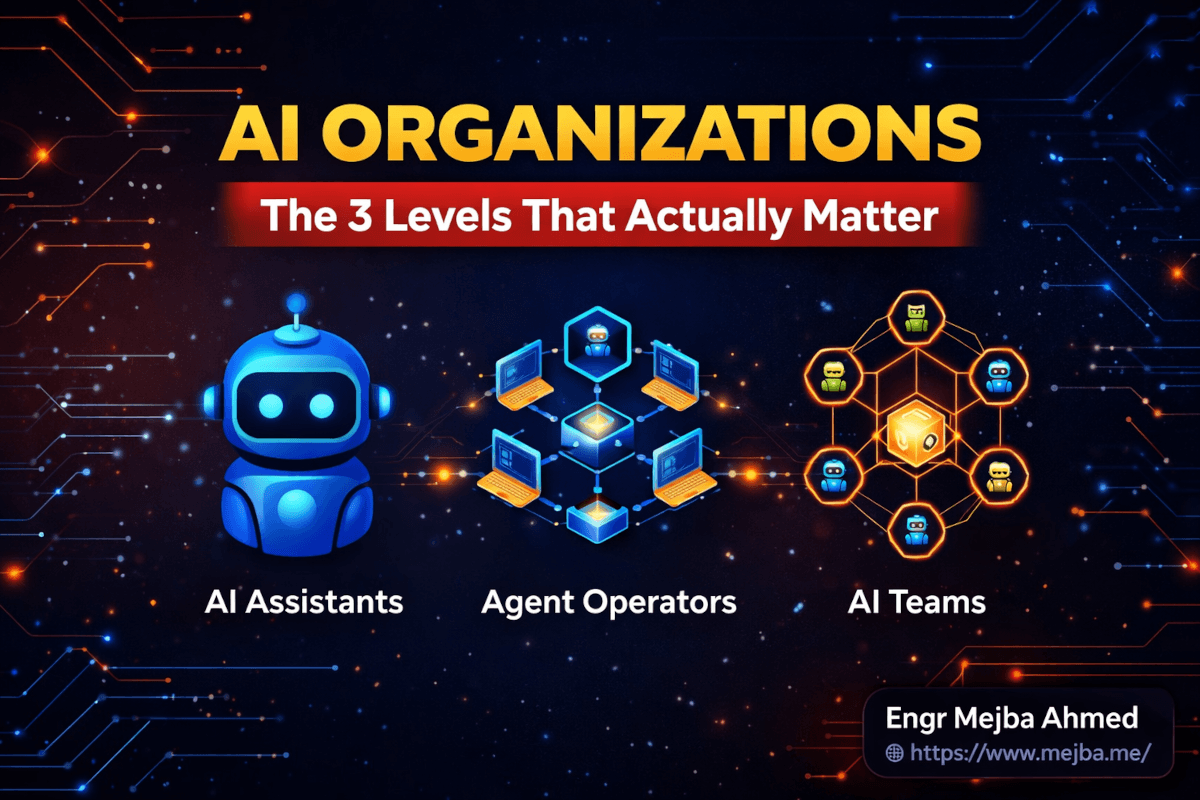
AI Organizations: The 3 Levels That Actually Matter
I keep seeing smart people say they are "using AI heavily" when what they really mean is that they have three chat tabs open and a few prompts saved in Notion.
That's not nothing. It's useful. It can absolutely make you faster.
It's also not the real shift.
I recently went through a video that framed AI adoption in three levels: assistants, agent operators, and AI organizations. I like the framework because it explains why so many people feel both impressed by AI and slightly underwhelmed by the business impact. They are using powerful models inside a weak operating model.
That's the gap.
Most people are still treating AI like a very talented intern they need to supervise sentence by sentence. The next level is treating AI like a worker you assign outcomes to. The level after that is treating AI like an organization layer that routes work, manages specialists, remembers context, and keeps moving while you sleep.
I think this is one of the clearest ways to understand where the market actually is right now.
And the timing matters. In PwC's May 2025 survey of 308 US executives, 79% said AI agents were already being adopted in their companies. In McKinsey's November 2025 State of AI survey, 62% of respondents said their organizations were at least experimenting with AI agents. That tells me two things at the same time: the interest is real, and most teams are still early.
So let me break this down the way I would explain it to a founder, developer, or operator trying to decide what actually changes next.
Level 1: AI Assistants Make You Faster, But You Still Do The Work
This is where almost everyone starts.
You use ChatGPT, Claude, Gemini, or a coding assistant to help with slices of work:
- drafting an email
- summarizing research
- generating an image
- cleaning up a proposal
- writing some code
- brainstorming content angles
The workflow still belongs to you. You are the one holding the plan, deciding the order of operations, checking the output, moving data between tools, and reconnecting context every time the task changes.
That means Level 1 AI is best understood as acceleration without delegation.
And to be clear, this level is already valuable. I use assistant-style workflows every day. If you are a developer, marketer, writer, or founder, Level 1 can remove a shocking amount of friction from your week. You write faster. You research faster. You get to first draft faster. You recover from blank-page paralysis faster.
But there is a hard ceiling.
The moment the task becomes multi-step, cross-tool, or open-ended, assistant workflows start leaking time everywhere:
- you have to restate the goal
- you have to decide what happens next
- you have to copy outputs from one place to another
- you have to notice when the model quietly drifted off course
- you have to keep all the moving parts in your own head
That last point is the killer.
People think Level 1 AI saves them time because the model writes faster than they do. What it really saves is production time at the sentence or artifact level. What it does not save is management time. In some cases it increases it, because now you're supervising a machine that can generate a lot of wrong-but-plausible output very quickly.
If you've ever ended a long AI session feeling productive but weirdly tired, that's why. You were not delegating. You were micro-managing a very fast system.
This is also why so many AI demos look incredible and then collapse in daily operations. The demo ends with one clean output. Real work is a chain of twenty decisions, six tools, and three follow-ups.
Level 1 is still worth mastering. It teaches prompt clarity. It teaches output evaluation. It teaches you where models are strong and where they are still fragile.
But if you stay here, AI remains a better interface for work you still fundamentally do yourself.
Level 2: Agent Operators Stop Doing Tasks And Start Assigning Outcomes
This is where things get interesting.
At Level 2, the unit of work changes.
You are no longer prompting for fragments. You are assigning a goal:
- research these competitors and give me the three strongest positioning gaps
- clean this inbox and draft replies that follow my tone rules
- build this feature, run tests, and report blockers
- source leads that match this ICP and organize them by priority
- create the first version of a landing page, then refine it against these examples
Now the AI is not just generating content. It is planning, sequencing, executing, and returning progress.
That sounds simple, but it is a different job description for the human.
At Level 1, you are a doer using AI.
At Level 2, you become an operator of digital workers.
You decide:
- what the objective is
- what constraints matter
- what "done" looks like
- when to approve, redirect, or stop the work
The agent handles more of the messy middle.
This is the shift I think most ambitious solo founders and small teams should care about right now, because it is the first level where AI starts changing operations instead of just productivity.
I have felt this most clearly in coding and content workflows.
When I use AI like an assistant, I am still driving every turn. I ask for code, inspect it, ask for tests, inspect them, ask for a refactor, inspect that, then manually decide the next move. When I use an agentic workflow, I define the outcome and the constraints, then let the system work through the sub-steps before bringing me something worth reviewing.
Same models. Different operating model. Completely different leverage.
That distinction matters more than people realize. A lot of teams are buying new models when what they really need is a new workflow layer.
There is also a mindset shift here that people resist.
To operate agents well, you have to stop asking, "What can AI help me do?" and start asking, "What work package can I hand off safely?"
That sounds obvious, but it forces discipline:
- better SOPs
- clearer definitions of quality
- clearer permission boundaries
- better file organization
- better memory systems
Messy operators usually get messy agents.
This is why agent adoption feels magical in one company and useless in another. The model quality matters, but operating clarity matters just as much.
The cleanest way to describe Level 2 is this: you stop being the person doing every step and become the person managing digital workers. You are not chatting your way through a task anymore. You are supervising autonomous execution.
That comes with new risks, obviously.
If your agent has weak context, weak permissions, or no review checkpoints, you don't get leverage. You get chaos at machine speed.
So the real Level 2 skill is not "using agents." It is designing good assignments:
- objective
- context
- boundaries
- tools
- checkpoints
- success criteria
When those are clear, Level 2 can feel like having a competent junior team member who never gets tired and can juggle five workstreams at once.
When they're not clear, it feels like paying tokens to create confusion.
Level 3: AI Organizations Add An Operating Layer Above Individual Agents
This is the level that sounds like hype until you see the architecture clearly.
An AI organization is not just "more agents."
It's a system where one primary interface manages a network of specialized agents across functions, memory, tools, and approvals. Instead of talking separately to a writing agent, a research agent, a sales agent, and an operations agent, you talk to one orchestration layer that routes work to the right specialists and brings the result back coherently.
That's the real idea.
In practice, this tends to look like the same few patterns showing up again and again:
- an inbox layer that triages and drafts across email, chat, and support channels
- a research layer that keeps scanning for leads, risks, or opportunities without waiting for a prompt
- an execution layer that can buy, book, file, update, or hand work off to the next system
- a natural interface such as voice, chat, or Slack that lets the human manage the whole thing from one place
Whether you use the speaker's preferred tools or not is almost beside the point. The structural lesson is stronger than the product lesson.
Level 3 means the human relationship shifts again:
- you stop managing individual tasks
- you stop managing individual agents
- you manage direction, policy, approvals, and exceptions
That is much closer to running an organization than running prompts.
And this is where the framework becomes useful beyond personal productivity. It starts mapping onto actual business design.
An AI organization needs the same things a human organization needs:
- role clarity
- access control
- escalation paths
- performance measurement
- shared memory
- process ownership
- governance
If those pieces are missing, what you have is not an AI organization. It's a pile of automations with better branding.
This is also the level where people get reckless.
Because once a system can route messages, purchase things, write replies, inspect data, and trigger downstream actions, the conversation stops being about prompt engineering and starts being about trust, security, and operational design.
That's why I think the most serious idea in the framework is not the fancy tooling. It is the claim that the future of work is about managing AI, not doing every task manually.
I agree with that direction.
I just think most teams are underestimating how much management infrastructure has to exist before that becomes safe.
The Speaker's Percentages Matter Less Than The Underlying Pattern
The summary included rough adoption percentages across the three levels. I would treat those as the speaker's observation, not as hard market data.
Still, the underlying pattern feels right.
Most people are at Level 1.
A smaller group is experimenting with Level 2.
A tiny group is trying to build Level 3 systems that behave more like AI-native organizations.
That pattern is also consistent with broader enterprise data. The market is talking about agents aggressively, but the reliable survey data still shows most companies are in experimentation, pilot, or partial deployment modes rather than full organizational reinvention.
That's why I would be careful about copying the most extreme examples too literally.
If you are a solo founder or small operator, the wrong takeaway from a video like this is:
"I need a fully autonomous AI company next month."
No. You probably need one clean Level 2 workflow that reliably removes eight hours of repetitive work from your week.
That's the bridge.
Level 3 is not where you start. It is what becomes possible after you have:
- stable Level 1 habits
- repeatable Level 2 delegations
- trust boundaries
- memory architecture
- approval logic
Skip those steps and you will build something that looks futuristic in screenshots and breaks in real life.
What Actually Changes At Each Level
The simplest way I can put it is this.
Level 1 changes your speed.
You still own the workflow. AI helps you move faster inside it.
Level 2 changes your role.
You become a manager of outcomes instead of a producer of every intermediate step.
Level 3 changes your operating model.
AI becomes part of how the work system itself is structured.
That's the progression.
And once you see it, you can diagnose your current setup very quickly.
If you touch every step, you're at Level 1.
If you assign a full deliverable and review the result, you're moving into Level 2.
If one orchestration layer routes work across multiple specialists and systems while you mostly handle direction and approvals, you're moving into Level 3.
This is why I think the phrase "AI organization" is useful. It forces you to think beyond chat interfaces and toward systems design.
I've written before about agent team workflows in Claude Code and the operational trade-offs in multi-agent setups. The pattern keeps repeating: the value is not just intelligence. The value is coordination.
Raw intelligence helps.
Coordinated execution changes throughput.
The Best Near-Term Play For Most People
If I were advising a founder, creator, or technical operator right now, I would not tell them to chase Level 3 branding.
I would tell them to do this instead.
1. Max out Level 1 on your highest-friction recurring tasks
Before you delegate work, you need to understand the work.
Use AI assistants heavily on:
- writing
- coding
- research
- content repurposing
- documentation
- inbox triage
Find the parts where the output is strong enough that you trust the system with a first pass.
2. Turn one of those tasks into a Level 2 handoff
Pick one workflow with:
- clear inputs
- clear outputs
- low downside if imperfect
- meaningful weekly repetition
This might be:
- weekly competitor research
- lead qualification
- content outlines
- support triage
- bug reproduction and reporting
Build one agentic workflow that can run with minimal intervention and return something reviewable.
3. Add memory and evaluation before adding more autonomy
Don't scale chaos.
Before adding more agents, make sure your system can remember key context and that you have a simple rubric for output quality. If the system cannot improve or be audited, more autonomy just multiplies mistakes.
4. Only then think about orchestration
Once you have multiple stable handoffs, you can ask the next question:
Should these agents remain separate, or should one orchestration layer own routing, status, and escalation?
That's the real Level 3 question.
Not "how do I make it look like a sci-fi operating system?"
How do I create one coherent management layer for specialized digital workers?
That is a much better design problem.
My Honest Take
I think this three-level framework is useful because it gives people a cleaner target.
A lot of AI discourse is still stuck in shallow binaries:
- AI is overhyped vs AI changes everything
- prompts matter vs models matter
- assistants vs agents
The three-level model is better because it explains that the same underlying models can create completely different business value depending on how you structure the work around them.
The biggest mistake I see right now is not underusing AI. It's using advanced AI inside old operating assumptions.
That's why someone can spend all day in Claude, ChatGPT, or Gemini and still not feel transformed.
They're still the bottleneck.
The real upgrade is not "a smarter chatbot."
The real upgrade is moving from:
- doing the work with AI help
- to assigning work to AI workers
- to directing a system of AI workers that can coordinate across functions
That is a much bigger shift than most people realize.
And yes, it will change jobs.
But before it changes jobs at scale, it is already changing what competence looks like for founders, operators, and developers. The high-leverage skill is becoming less about producing every artifact yourself and more about designing systems that reliably produce the right artifacts with the right checks in place.
That's management. Just pointed at software workers instead of human ones.
If you're still mostly at Level 1, that's fine. Most people are.
Just don't confuse being impressed by AI with actually restructuring your work around it.
Those are very different things.
The people who win over the next two years will not be the ones with the most prompts.
They'll be the ones who learn how to design, direct, and govern agentic systems before everyone else figures out that's the actual job.
Which Level You're Actually Operating At
The three levels — assistants, agent operators, AI organizations — aren't a hierarchy to climb blindly; most work sits at level one or two, and forcing an AI-organization structure onto a solo task just adds overhead. The shift that changes how work gets done is matching the level to the job.
Figure out which level your real work needs, then build exactly that. My agent-teams guide and Cowork business phases show what the higher levels look like in practice.
If you want help designing an AI operating structure for your work, that's something I do through Ramlit.




