Three years ago, I would have laughed at the term "vibe coding."
Seriously. I had engineers I respected telling me these AI-generated codebases were fragile toys — spaghetti logic wrapped in hype. I was one of those people who'd open an AI-generated file, spot the first logical inconsistency, and think "yeah, this is why humans still have jobs." I said it out loud. To other engineers. In code review sessions.
I was wrong. The pace at which I realized I was wrong is the actual story here.
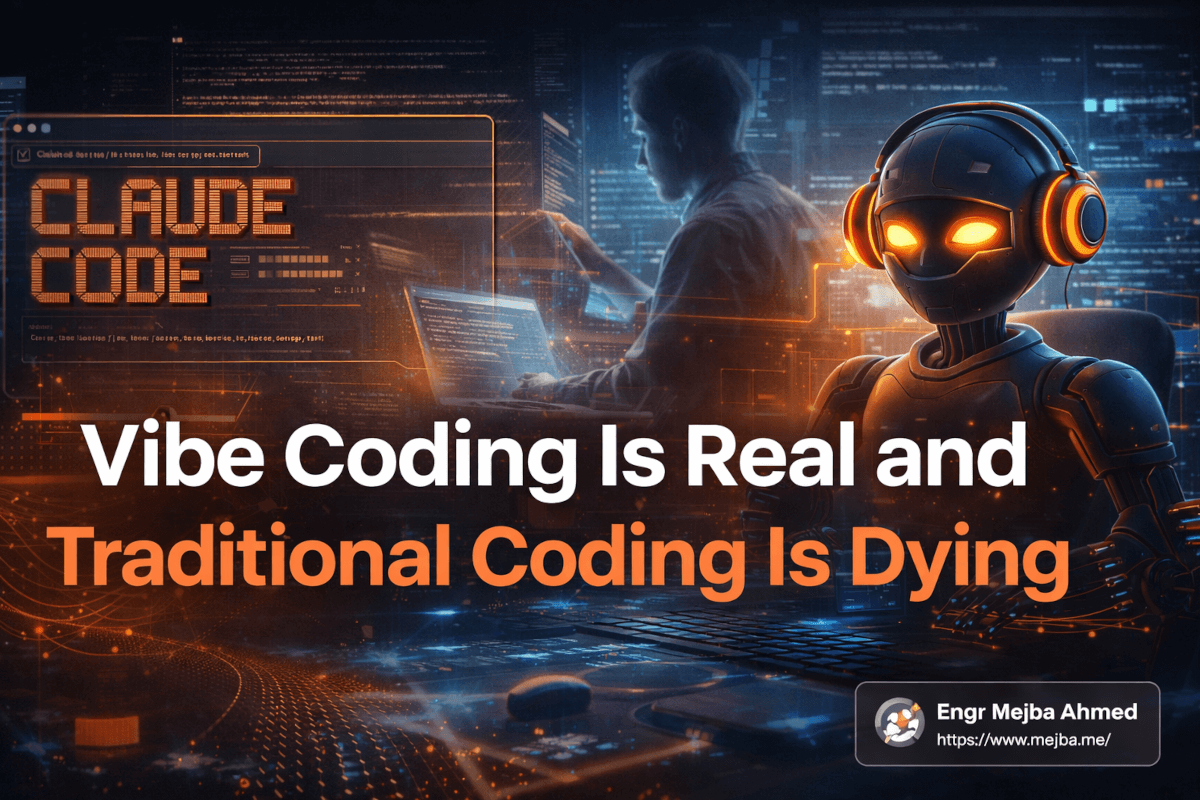
What changed my mind wasn't a single breakthrough. It was watching something happen in slow motion, then suddenly all at once — like a building that's been cracking for months finally coming down. The moment that crystallized it for me was when Anthropic shipped Claude Code with cloud security capabilities built in. Not as a plugin. Not as an add-on. As a core architectural feature that understands what you're building, reasons about the threat surface, and produces secure infrastructure automatically.
That's when I understood: this isn't about AI helping you write code faster. This is about AI becoming the thing that does the entire job.
By 2030, engineers who still insist on writing every line by hand — as proof of their skill — are going to look like people who refused to use email because handwritten letters were more personal. The people who spent the last few years loudly insisting vibe coding was fake? They're going to quietly stop saying that.
Here's what I've actually seen — and where I think this ends up.
The Skepticism Was Reasonable. Until It Wasn't.
The criticism around vibe coding was fair for a long time. You'd prompt an AI to build you a web app, it'd generate something that looked right but fell apart under actual load. Edge cases weren't handled. Security was treated as an afterthought. The context window was too small for the AI to understand your entire codebase — which meant it'd "fix" one thing and quietly break three others.
If you'd tried to build a production-grade system with AI alone in 2022 or early 2023, you would have spent more time cleaning up after the AI than the AI saved you. The promise was clearly there. The execution wasn't.
Most developers — including me — tried the tooling during that window, hit those friction points, and filed the whole concept under "interesting experiment, not production-ready." That was the right call at the time.
But something shifted in 2024-2025 that most people still haven't fully processed.
Context windows got massive. Claude 3.5 stretched into territory where you could hold entire project structures in a single conversation. Claude 3.7 pushed further — not just more tokens, but qualitatively better reasoning over larger inputs. When a model can hold your entire backend, your frontend, your configuration files, and your documentation in context simultaneously, it's not just "writing code" anymore. It's reasoning about your whole system as a connected thing.
I've seen this directly on my own projects. Describing a feature to Claude Code, referencing a specific module, asking for an implementation that fits the existing patterns — what comes back isn't a standalone function I have to wire up manually. It's a complete implementation that understands the existing codebase. That didn't work reliably eighteen months ago. Now it mostly does.
The dead code problem, which was another real objection, has also changed shape. "AI generates bloated code — legacy cruft that compounds over time until you have an unmaintainable mess." That was true when people were using AI as a glorified autocomplete. It's less true when you're running Claude Code in agentic mode with file system access, where the model can scan your existing code, identify unused functions, and clean as it goes. Dead code becomes something the agent notices. Legacy code becomes something it can refactor when you ask, not something it makes worse by layering on top.
But the biggest shift — the one that removed the last serious objection — is in security. And that deserves its own section.
Security Was the Last Credible Argument Against This. It Just Lost Its Teeth.
Here's how the conversation about vibe coding went for years:
"Sure, AI can write working code. But who's responsible for security?"
That was a fair point. AI-generated code had real vulnerabilities. SQL injection, improper input validation, exposed secrets in config files, weak authentication implementations — these weren't hypothetical risks from worried traditionalists. They showed up in real codebases. I saw them. Other engineers saw them. The concern was legitimate.
What Anthropic's recent Claude Code security work addresses is exactly that gap. When the AI is reasoning about your cloud infrastructure, your IAM policies, your network configuration — and doing so with security threat modeling baked into the process — you're not just getting faster code. You're getting code that's been checked against an attack surface you didn't have to define yourself.
That's the thing people are missing when they see the market reaction to these launches. When cloud security stocks move on AI announcements, it's not irrational noise. It's investors recognizing that the cost structure of secure software is about to change. Tools that previously required dedicated security engineering headcount are getting absorbed into the development workflow.
This isn't perfect. AI security tooling catches the common patterns — the OWASP Top 10 stuff, misconfigured permissions, obvious injection vectors. It doesn't replace a real penetration test on a complex system. But it moves the bar from "you absolutely need dedicated security review on every AI-generated file" to "AI handles the first layer, humans focus on the genuinely complex threat modeling." That's a completely different cost structure for building software. And it removes the last excuse people had for dismissing this entire shift.
Now the hard question: what does this actually mean for how you should be working?
What Vibe Coding Actually Is (Most People Define It Wrong)
Vibe coding isn't typing "build me a SaaS app" into an AI chatbot and hoping something good comes out. That's not vibe coding — that's prompt gambling. The results are about as reliable as you'd expect.
Vibe coding, at its actual definition, is a development methodology where you communicate intent, constraints, and architecture to an AI at a high level, and the AI handles the implementation details. You still understand what you're building. You still own the decisions. You just aren't the one typing the code.
Think about how senior engineers work on large teams. They don't write most of the code — they design the architecture, define the patterns, review the output, and make decisions about direction. They understand every component, but they don't manually produce every line. They treat the junior engineers doing the line-by-line work as extensions of their thinking.
Vibe coding is that — except the "junior engineers" doing the implementation are AI agents that work at a pace no human team can match.
The engineers who will thrive aren't the ones who can write the most elegant for loop. They're the ones who can design systems well, communicate requirements precisely, and evaluate AI output critically. The people who struggled most with AI tooling weren't junior engineers who didn't know much. They were often the best syntax writers — the kind of developers who could produce complex, clever code from memory. Ironically, that skill became a crutch. They'd fight the AI's output, rewrite it to match their personal style, miss the point.
The engineers who adapted fastest were the ones already comfortable describing architecture in abstract terms. If you can say "I need a service that handles webhook events, validates the signature, updates the database, and emits an internal event for downstream processing" — Claude Code can implement that cleanly. If you think in terms of variable names and function signatures, you'll spend your time arguing with the AI's choices instead of shipping.
There's a practical shift in how I work that made the biggest difference, and it's worth walking through.
How I've Actually Changed My Development Workflow
The first change I made: before starting any new project, I write a detailed system prompt describing the project's conventions. Database naming patterns. Error handling strategy. How I want API responses structured. Which libraries I'm using and why. File organization rules.
This document becomes the context the AI operates in for the entire project. Instead of explaining conventions over and over — or watching the AI pick its own conventions each time — I give it the architecture once. Every subsequent session inherits that context. The quality difference in AI output is dramatic when the model knows the rules it's supposed to follow versus when it's improvising from scratch.
If you haven't done this, try it on your next project before you do anything else.
The second change: I shifted my evaluation energy. The skill that matters most in a vibe coding workflow isn't prompt writing. It's output evaluation. Can you read code you didn't write and understand whether it does what it should? Can you spot a logic error in an AI-generated function? Can you identify when a security decision looks reasonable versus when it's a shortcut that'll surface as a vulnerability later?
Good engineers already have these skills. The difference is that in a vibe coding workflow, you're exercising them constantly — not occasionally, when reviewing a PR, but every single time the AI hands you output. Think of yourself as the tech lead of a very fast, very capable team that needs code review on everything. You don't write most of the code. But you own every decision.
The third change is harder to talk about in developer circles: I started investing in distribution before I finished the code.
Here's the uncomfortable reality. As AI lowers the barrier to building software, the market gets crowded faster than ever. Apps that took three months to build in 2020 take two weeks now. The scarcity shifts from "can you build this" to "can you get this in front of the people who need it." Marketing and distribution knowledge — which used to be optional for technical founders — is becoming table stakes.
The engineers I know who are building successfully right now aren't the best coders. They're the best at finding under-served markets, building for them, and reaching them before saturation. That's a different game than the one most of us trained for. It's also a more interesting game, once you adjust to it.
What I Got Wrong — And What I'm Still Uncertain About
I want to be honest about something I conflated for too long.
My original concern about vibe coding wasn't "this can't produce working software" — it clearly could, even in the early days. My concern was "this produces software nobody actually understands, and when it breaks at 3 AM you're going to be completely lost." And that concern is still partially valid.
If you use AI to build a system you genuinely don't understand architecturally — if you're prompting your way to features without knowing what the code is actually doing — you're building on unstable ground. Not because the AI code is necessarily bad, but because you can't maintain what you can't reason about. When something breaks in production, understanding is the only thing that saves you.
But I was conflating two separate things: "developers who use AI without understanding their systems" and "vibe coding as a methodology." The methodology doesn't require ignorance. It requires a different kind of understanding — architectural and systemic rather than syntactic. That's a real distinction.
The other thing I got wrong: I severely underestimated how fast the tooling would mature. In 2023, I thought we were five to seven years from AI being able to handle real production codebases reliably. We were roughly two years away. That's a humbling miss. When I hear people today saying "AI-generated code will never be truly production-ready," I hear my 2023 self — and I'm now skeptical in a different direction.
What I'm genuinely uncertain about is the market saturation question. As building software approaches near-zero cost, the competitive moat shifts entirely to distribution and differentiation. That's good news if you're a marketer who wants to build apps. It's genuinely challenging news if you're an engineer who thought technical skill was the durable advantage.
The honest answer is that nobody knows exactly how this shakes out. But waiting to find out while everyone else figures it out is probably the worst option available.
What Changes When You Actually Commit to This
Here's what the numbers look like in my own work since I shifted my workflow:
Projects that used to take me six to eight weeks to build solo now take two to three weeks. That's not because I'm cutting corners — the code quality is comparable and often better, because the AI catches things I'd have missed when moving fast. The saved time comes from not spending mental energy on boilerplate, API documentation lookup, or syntax debugging. That energy goes to architecture and product decisions instead, where it actually compounds.
Security-wise: using Claude Code's security features during development, I've caught real issues that would previously have required a dedicated audit pass. Not every issue — I'd be lying if I claimed AI security tooling replaces a proper penetration test on a complex system. But the "low-hanging fruit" vulnerabilities that make it into production because of time pressure? Those are getting caught earlier in the cycle now.
One honest tradeoff: AI-assisted development raises the quality floor dramatically (even rushed work has structure and error handling) but can lower the ceiling if you're not careful (truly elegant code for complex domain logic still benefits from human-directed design). Know which you're optimizing for on a given project. Most projects need a higher floor, not a higher ceiling.
If you've made it this far, you're already thinking about this more seriously than most engineers. Here's a practical benchmark: track your time from "idea" to "working prototype" and from "prototype" to "production-ready" on your next three projects using a vibe coding workflow. Both should compress measurably. If they're not, you're still fighting the tooling instead of using it — and that's usually a workflow problem, not a capability problem.
Your first project this way will be slower than you expect. You're building new habits in parallel with building a product. The second will be faster. By the fifth, you'll wonder what you were doing before.
The One Question Worth Sitting With
At the start of this, I said that Anthropic's Claude Code cloud security work was the moment something clicked for me. Not because it was the first impressive AI development tool — it wasn't. But because security was the last credible objection standing.
Every other concern had been addressed. "The code doesn't actually work" → solved by context windows and agentic debugging. "The AI makes a mess of your codebase over time" → AI can also clean and refactor codebases. "You can't build real production systems this way" → production systems built primarily through AI-assisted methods are running right now, at scale, in companies you use daily.
Security was the one that remained. And now it doesn't.
Before you close this tab, name one legitimate practical blocker you currently have to adopting a more AI-assisted development workflow. Not a philosophical objection. Not "but real engineers write code." An actual, specific, practical blocker. Then spend thirty minutes this week testing whether that blocker still exists with current tooling — because there's a genuinely good chance it was solved six months ago and nobody sent you the memo.
The people who'll be most frustrated in 2030 aren't the ones who tried vibe coding and struggled with it. They're the ones who kept waiting until they had no choice.
Where the Craft Actually Goes
The vibe coding traditional coding debate misses the point: syntax is commoditizing, judgment isn't. The engineers who thrive own architecture, review, and taste. My vibe coding apps and the beginner's guide go deeper.
If you want your team positioned for this shift, that's something I do through Ramlit.