I’ve spent the last year watching AI model launches split into two very different stories.
The first story is the benchmark story. Bigger numbers. Better charts. Cleaner launch pages. The second story is the workflow story, and that one matters more to me. Does the model actually read files before editing them? Does it stay on task during a long coding session? Does it stop hallucinating package names, fake API versions, and phantom git hashes when the work gets messy?
That’s why the Opus 4.7 conversation is interesting.
This piece is based on a long-form video breakdown and surrounding public discussion, not on an official Anthropic technical paper. So I’m not treating every product claim as independently verified fact. I’m treating it as a serious field report about what changed, why users got angry, and what those changes would mean if they hold up in real use.
The core claim is simple: Opus 4.7 is not just a marketing refresh after Opus 4.6. It is a deliberate attempt to fix the exact problems power users were complaining about.
If that framing is true, this is one of the more important model updates of the year. Not because Anthropic shipped “the smartest AI ever” again. Every lab says that. It matters because Opus 4.6 appears to have broken trust with some of the exact people who rely on Claude most heavily: developers, technical operators, and users paying enough money to notice when model quality quietly drops.
Why the Opus 4.6 Criticism Hit So Hard
Most model complaints online are vague. “It feels dumber.” “It got lazier.” “This version is worse.” Those are hard to act on because they’re emotional observations, not operational signals.
What made the Opus 4.6 criticism different is that some of it came with measurable patterns.
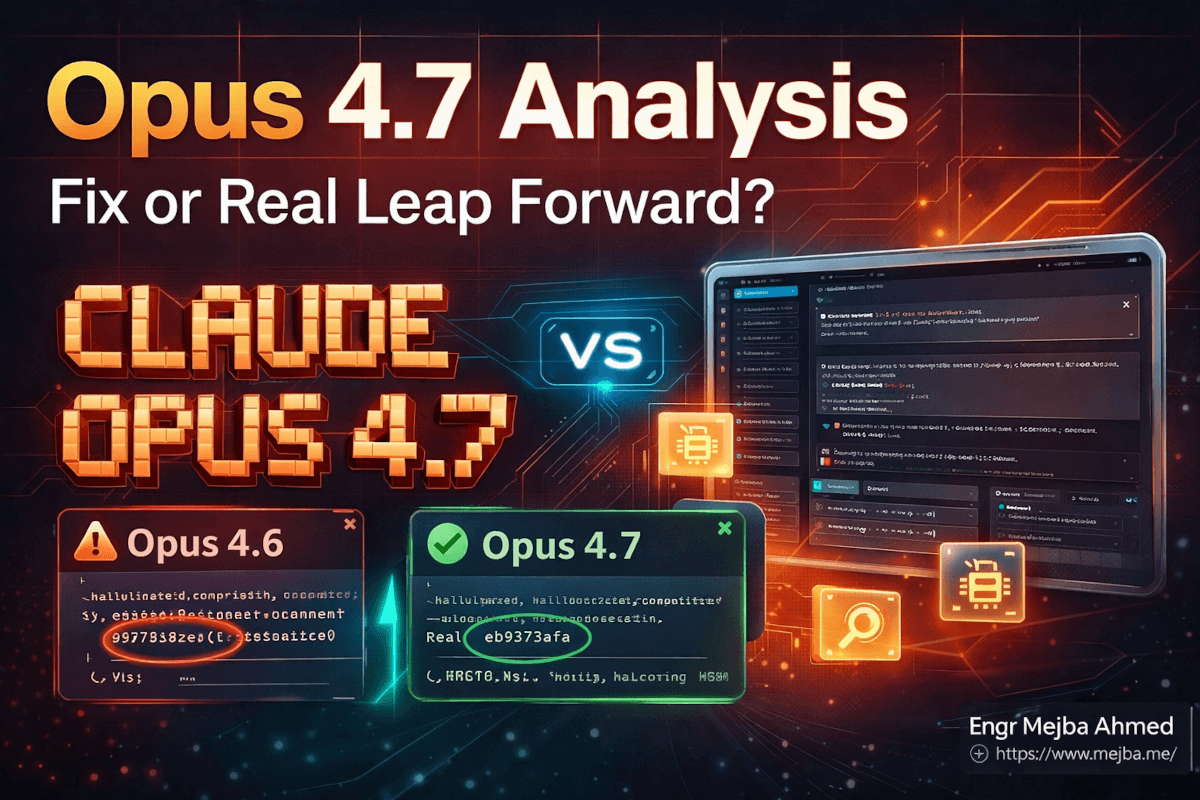
According to the video, a senior AMD director analyzed roughly 7,000 coding sessions and found a dramatic drop in reasoning depth, along with a sharp increase in cases where the model edited before fully reading and in situations where users had to interrupt it to prevent errors from compounding.
That lines up with the kind of failure mode experienced users notice immediately. Not “the benchmark dropped by three points.” Something worse. The model starts acting like it wants to finish quickly instead of finish correctly.
You can feel that shift when you work with these tools every day.
The article-worthy detail for me is not just the hallucinations themselves, though those are bad enough. It’s the pattern behind them: invented package names, fake API versions, made-up commit references, early exits, and a repeated bias toward low-effort completion even when the task clearly needed patience. That doesn’t sound like a model that forgot how to reason. It sounds like a model being pushed toward a thinner operating mode.
The video argues that the degradation was caused by parameter changes rather than an entirely different underlying architecture. In practical terms, that means the frustration may not have been “Anthropic suddenly forgot how to build strong models.” It may have been “Anthropic tuned a strong model into a cheaper, shallower operating mode.”
If you were paying for Opus because you wanted the model that overthinks hard problems, that would feel like a betrayal.
Why Opus 4.7 Matters More Than a Normal Incremental Update
What makes the reported 4.7 update interesting is how directly it answers the 4.6 complaints.
That’s the part I find most compelling.
The pitch, as described in the video, centers on five broad themes: stronger coding on harder tasks, better visual and document understanding, more stable long-context behavior, more disciplined reasoning allocation, and a higher-effort mode for users who actually want the flagship model to think hard.
Why? Because new effort tiers usually reveal how the company wants the model to be used.
If users were upset that Opus 4.6 felt too constrained, then adding a higher effort ceiling is effectively Anthropic admitting that a serious slice of the market wants a model that thinks longer, not shorter. That matters for debugging, architecture work, refactors, financial modeling, and any task where the first answer is rarely the right one.
The same report also points to gains in document handling, long-context analysis, and specialized scientific reasoning. I’m not the target user for the biomolecular material, so I’m less interested in that benchmark for its own sake. What I care about is the pattern it suggests: Anthropic appears to be moving Opus back toward difficult, compute-heavy reasoning instead of smoothing it into a generic medium-effort assistant.
That is the right direction.
Too many companies assume the path to scale is to make their most advanced models behave more uniformly, more cheaply, and more predictably. That helps margins. It often hurts expert users. The best technical users do not want a flagship model that behaves like a cautious mid-tier default. They want a system that can go deep when the task actually requires depth.
The Benchmark Story Is Useful, but the Workflow Story Is Bigger
One detail from the video stood out to me more than the rest: a reported Bridge benchmark decline during the Opus 4.6 period, including weaker hallucination performance than Sonnet 4.5.
That is not a rounding error. That is a credibility problem.
If Opus 4.7 genuinely recovers benchmark ground while also restoring long-task reliability, then the story becomes bigger than “4.7 beat 4.6.” The real story becomes that Anthropic had enough user pain in the field to justify a focused correction cycle.
I always treat benchmark wins cautiously because benchmarks can overstate practical value. A model can look incredible on a polished eval and still become annoying in real work if it over-edits, stops early, or burns tokens without making concrete progress.
That said, benchmarks do matter when they align with lived experience.
The reason this update is interesting is that the benchmarks and the user complaints appear to point in the same direction. Users said reasoning got shallower. The new model emphasizes adaptive thinking. Users said reliability got worse. The new release emphasizes harder-task coding and long-term coherence. Users said the model quit too early. The new positioning focuses on sustained performance.
That is a coherent product response, even before we decide how well Anthropic actually executed it.
The Token Cost Trade-Off Could Be the Hidden Catch
There is one caveat from the report that I think deserves more attention than the average launch thread will give it: better reasoning may come with higher token burn.
The updated tokenizer is described as more efficient in some respects, but the practical cost picture may still move in the wrong direction for heavy users. If the model thinks longer and consumes more expensive context in the process, the workflow penalty is real even if raw quality improves.
This matters because “best model” and “best workflow model” are not always the same thing.
If Opus 4.7 is meaningfully smarter but also eats context and paid usage at a much faster rate, then Anthropic has not fully solved the 4.6 problem. It has solved one part of it. Developers who were angry about shallow thinking may be happier. Developers who were angry about blowing through expensive plans may still have a reason to complain.
That trade-off becomes especially important for people running multi-hour debugging sessions, large-context document analysis, or agent workflows with multiple retries. A flagship model can be excellent and still be operationally frustrating if the token economics punish normal usage patterns.
So the real question is not “Is Opus 4.7 better?” It’s “Is it better enough to justify the new reasoning and cost profile in actual daily work?”
The Desktop App Might Reveal Anthropic’s Bigger Ambition
The new desktop app is easy to dismiss as a side story. I don’t think it is.
If Anthropic is trying to make Claude the operating environment rather than just the underlying model, then desktop matters a lot. Session management, project switching, integrated terminal access, token tracking, task views, split panes, and simultaneous workstreams all push Claude closer to becoming a full AI-native workspace.
That is strategically smart.
The model layer is becoming crowded fast. What differentiates platforms now is not just raw intelligence but orchestration: how the model holds state, how it manages long tasks, how clearly it exposes plans, and how naturally it fits inside real technical workflows.
But the criticism in the video is also a warning sign.
If a reviewer can find more than 40 bugs in an hour, including broken controls and weird cross-input behavior, then Anthropic is shipping the shell faster than it is stabilizing it. That startup-speed energy can be exciting when the product is still finding form. It becomes a liability when users are trying to trust the app as a daily driver for serious work.
This is where model companies often reveal their weak spot. They can build frontier intelligence and still ship rough product surfaces around it. If the app is buggy, the user does not experience “frontier intelligence.” They experience friction.
What the Two Experiments Actually Suggest
The report uses two practical comparisons rather than only leaning on benchmark slides: a stock-chart analysis task and a SaaS finance-model exercise.
The interesting part is that the results are not one-sided.
In the market-analysis task, 4.7 reportedly came across as clearer, sharper, and more expert-like. That suggests Anthropic may have improved synthesis and framing quality, not just raw answer generation.
In the SaaS modeling task, though, the older model apparently produced the more polished interactive experience while 4.7 skewed toward something more deliverable-oriented but still imperfect.
That kind of mixed outcome is exactly what I’d expect from a real model update.
Better models do not instantly dominate every workflow. Sometimes they become more grounded and practical while losing a bit of showmanship. Sometimes they get better at deliverables and worse at presentation. Sometimes a new default behavior makes one class of task feel tighter while another loses a little magic.
That’s why I care less about “which one won” and more about what kind of work each model now optimizes for.
If 4.7 is more dependable on hard tasks, less likely to abandon multi-step work, and better at allocating effort intelligently, I’ll take that over a shinier one-off demo almost every time.
My Real Take on the Opus 4.7 Story
Here’s my honest read after going through the report carefully and separating the claims from the parts that still need real-world validation.
If the claims hold up in real usage, Opus 4.7 is not just a better model than 4.6. It is Anthropic acknowledging that power users noticed the regression, measured it, and forced a correction.
That matters.
It means the market for serious AI tools is maturing. Labs can no longer rely only on polished launch framing if their heaviest users are running thousands of sessions, comparing versions, and publishing measurable evidence when quality slips. That feedback loop is healthy.
I also think the story exposes a broader truth about frontier AI products in 2026: model quality alone is no longer enough. You need intelligence, yes. But you also need token efficiency, reliability under long workloads, and a product surface that doesn’t feel half-baked.
Opus 4.7 appears to push the intelligence side forward again. The desktop app, based on this video, suggests Anthropic still has work to do on the product side.
That combination feels very 2026 to me. The core systems are improving at a brutal pace. The surrounding experience is still catching up.
So is Opus 4.7 the best AI model released so far? Maybe. It could also turn out to be something more specific and more important: the first clear example this year of a frontier lab reversing a self-inflicted regression and getting its flagship back on track.
For now, that’s enough to make me pay attention.
Not because the benchmarks say I should. Because if Anthropic really restored depth, reliability, and long-task coherence after the 4.6 backlash, that changes how serious users will structure their workflows around Claude again.
And in this market, regained trust is worth more than a flashy launch graphic.
Opus 4.7 Analysis: Quick Answers
Is Opus 4.7 a completely new model or just a tweak to Opus 4.6?
Based on the source material summarized here, Opus 4.7 is being positioned as a genuine model update rather than a small parameter tweak. The strongest signals are the new X High effort tier, stronger long-context and vision claims, and a release narrative centered on correcting reliability and reasoning issues that users reported with Opus 4.6.
Why were developers so frustrated with Opus 4.6?
The backlash was not just emotional. Power users reported shallower reasoning, more hallucinations, more cases where the model edited without fully reading, and more frequent task abandonment. If you rely on Claude for coding or long technical sessions, those issues break trust quickly.
What is the biggest claimed improvement in Opus 4.7?
For most technical users, the biggest improvement is adaptive thinking paired with higher-effort modes. That matters more than a benchmark headline because it suggests Anthropic is trying to restore deeper reasoning on hard tasks instead of optimizing the flagship model for fast, shallow completions.
Does the Claude desktop app matter, or is it just extra product packaging?
It matters strategically. If Anthropic wants Claude to become a full AI-native work environment, the desktop app is part of that platform shift. But if the app remains buggy, users will feel the friction before they feel the model improvements.
Should benchmarks alone determine whether Opus 4.7 is worth using?
No. Benchmarks are useful directional signals, but the real test is workflow performance: how well the model stays on task, whether it reads before acting, how often it hallucinates, and how expensive it becomes during real multi-step work.
Whether Opus 4.7 Is Upgrade or Repair
After the Opus 4.6 backlash, 4.7 reads as much as a repair job as an upgrade — the benchmark gains are real, but so is the sense that Anthropic was fixing what power users complained about. Whether that counts as progress depends on how much 4.6 frustrated you.
Test it on the exact work where 4.6 let you down before you trust the headline numbers. Your regressions are the only benchmark that matters. For the tier picture, my Sonnet 5 vs Opus 4.8 comparison and effort-levels review go further.
If you want help choosing the right Claude tier for your workload, that's work I take on through Ramlit.