I almost did not clone the repo. The message said "someone open-sourced Claude Design," and my exact thought was yeah, sure they did, because I have watched a dozen open-source clones of proprietary tools ship as duct-taped wrappers around the same paid API they claimed to replace. Then a friend sent a screenshot: a Linear-grade dashboard with proper density and typography that breathed, captioned "Open Design. Free tier. Six minutes." I ran git clone that afternoon, and after four days of side-by-side testing my conclusion is not that one tool beats the other. It is that they are two different bets about who should own the design tool, and which bet is right depends entirely on whether you ship for clients.
My grading standard here is practitioner, not spectator. I recently rebuilt my own site's blog on a token-driven design system, and design-skill tooling like the impeccable design skill is part of my daily Claude Code environment. When an AI design tool outputs a spacing scale, I know whether it is defensible.
The 30-second version
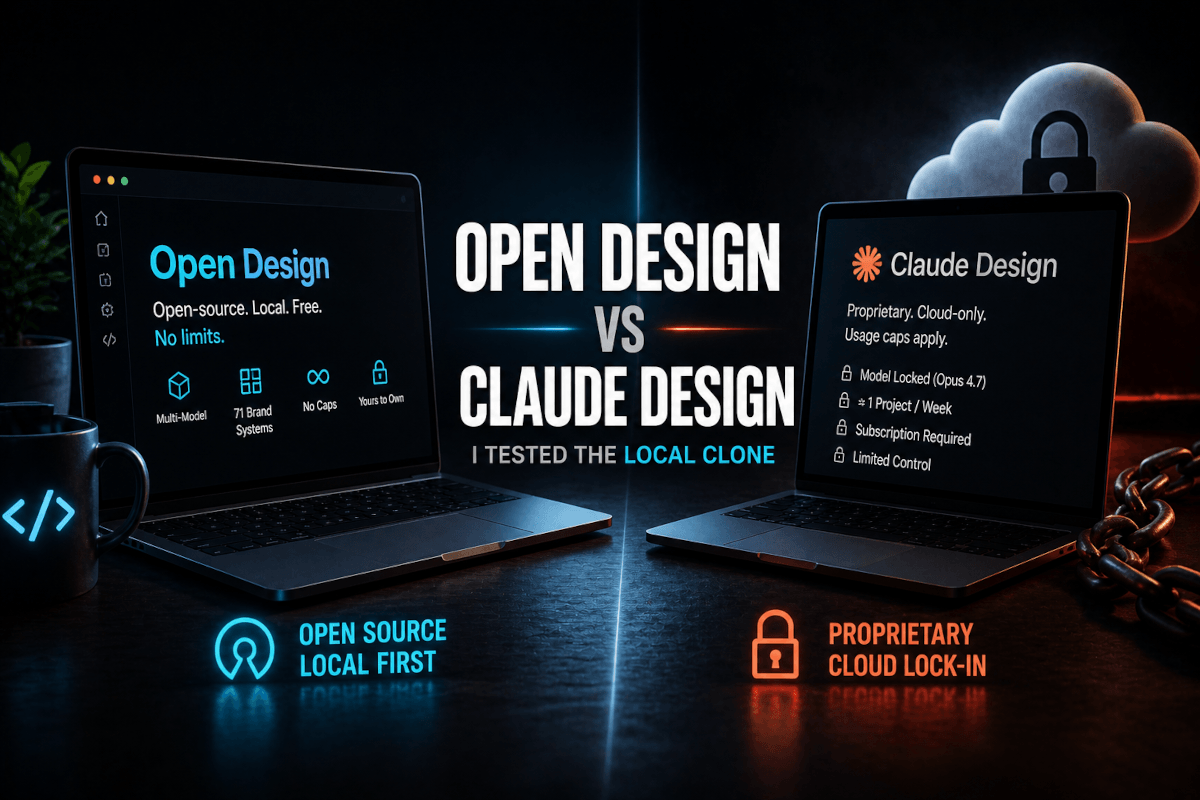
Open Design, from the nexu-io team, is an Apache 2.0, local-first, open-source alternative to Claude Design, launched in late April 2026 within days of Anthropic's tool. It runs on whichever coding CLI you already have installed: Claude Code, Codex, Gemini CLI, Cursor, OpenCode, Qwen, Copilot, Hermes, Kimi. It ships 71 brand-grade design systems and 19 composable skills, a sandboxed preview, exports to HTML, PDF, PPTX, and MP4, and a one-click Vercel deploy.
Claude Design is Anthropic's proprietary tool: cloud-only, locked to Anthropic's model, gated behind Claude subscription tiers with soft usage caps. The output quality is excellent, which I documented in my Claude Design first look. But the moment your work gets real, the caps and the model lock start to feel like training wheels you did not ask for.
Headline: agencies, freelancers, and anyone who cares about commercial rights should take Open Design seriously. Designers who want the cleanest zero-setup chat-to-prototype loop should stay on Claude Design.
What Open Design actually is
The first thing most reviews get wrong: Open Design is not an agent. When you clone the repo and run it, what comes up is a local UI that orchestrates whichever coding CLI you already have authenticated on your machine. The agent is your existing setup; Open Design is the design surface, the skill library, the brand-system library, and the export pipeline wrapped around it.
That architectural choice is the whole point. Building a competitive coding agent in 2026 is a billion-dollar problem, and the teams good at it are Anthropic, OpenAI, Google, and a handful of open-weights labs. The Open Design authors made the right call: do not fight the agent layer, replace the experience layer. The strongest coding agents already live on your laptop.
My first run: Claude Code as the engine, the Apple design system from the gallery, hi-fi over wireframe, web platform, tone slider toward premium. The prompt was eight words: fitness tracking dashboard for runners and cyclists. Six minutes later I had a rendered dashboard with Apple Health-adjacent navigation, spacing that respected the system I picked, and a palette that was distinctly Apple rather than the generic slate-and-blue average of the web. One click exported the HTML bundle.
Then I tried the model switch, and that is where the comparison stops being close for operators like me.
The feature that separates them: mid-project model switching
In Claude Design you use Anthropic's model. Full stop. You cannot run a second pass with a different engine, and you cannot drop to a cheaper model for small refinements.
In Open Design, the model is a dropdown. I generated the dashboard's architecture with Claude, whose structural taste (component hierarchy, spacing tokens) is genuinely the best available right now. Then I switched to Codex for a typography pass; it reaches for tighter line-heights and more confident weight contrast on display type than Claude does. Then Gemini for color exploration, because its palette instincts pull toward saturated mid-tones and odd neutrals I would never prompt my way toward. Twenty minutes, one project: architecture from one model, type from a second, color from a third, all on my own API keys.
That is not a party trick. Different design phases genuinely reward different models, and forcing all three phases through one engine is a constraint pretending to be a workflow. This is the feature that will make it hard for experienced operators to go back.
The sleeper feature: 71 brand design systems
Generic AI design tools converge on the same aesthetic: slate gray, one blue, a 12-column grid, Inter or an Inter knockoff, corners slightly too rounded. They converge because the models are trained on roughly the same web, and that gray-blue-rounded thing is the web's average. Claude Design fights this and never fully escapes it; five different products I generated there over a week shared a family resemblance I could not shake.
Open Design's fix is brutally simple: it bakes hand-curated design systems into the prompt scaffolding. Pick Apple and the prompt carries Apple's spacing tokens, type hierarchy, corner-radius logic, and density rules at a structural level. I ran the same prompt (project management app for a five-person startup) through four systems back to back. Linear gave me the dense top bar and keyboard-first vibe with one accent color. Stripe gave me generous whitespace and documentation-grade type hierarchy. Notion went modular blocks and warm neutrals. Lamborghini, a real preset, produced a project tracker that looked like a hypercar dashboard, which is exactly the kind of unhinged you want available when a client asks for "different."
Describing an aesthetic in a Claude Design prompt gets you a gesture toward it. Injecting the actual system into the scaffold gets you the thing. The difference is visible from the first render. Honest caveat: the systems are not uniformly strong. The famous-brand tiers (Apple, Stripe, Linear, Notion, Nike, Vercel) are extremely well tuned; some obscure ones feel imprecise. Expect a 70/30 split while the team iterates.
The cost math
My real usage over the four days: an architecture pass on a strong paid model, then the long tail of refinement (margins, labels, palette tweaks) routed to a free-tier model. DeepSeek's free tier handled an entire afternoon of refinement without costing a dollar, and nobody reviewing the output could tell. A solo operator doing occasional design work lands around $5 to $15 a month in API spend; a freelancer shipping several projects a week lands somewhere between $20 and $60. Against subscription tiers that run into hundreds monthly per seat and still impose weekly project caps, and multiplied across agency seats, the comparison stops being interesting. The precise numbers will vary with your prompt sizes and iteration habits; the structural point does not. Open Design's cost ceiling is your actual compute. Claude Design's is a flat fee plus a cap that lands mid-thought.
The license row compounds this. Apache 2.0 means I can fork it, run it on a client's air-gapped machine, ship it inside a deliverable, or build a paid product on top. None of those moves exist under a proprietary ToS without an enterprise conversation.
The workflow I actually ran
Day two, door to door: clone, pnpm install, copy .env.example and add whichever provider keys you use, launch, and the local UI opens on localhost. First-time setup took ten minutes including the README; every launch after is instant. Pick model, pick brand system, fill the short project form (name, wireframe or hi-fi, platform, tone slider, palette), type one sentence, generate. Hi-fi took about six minutes, wireframe about two. Switch model, refine. Export a ZIP with HTML, CSS, design tokens, and a component breakdown, or click the Vercel button: linked, pushed, live URL in under three minutes.
Total: about twenty-five minutes for a multi-page hi-fi product surface refined across three models. Not meaningfully faster than Claude Design for a single pass, and that is the wrong measurement. The flexibility of the sequence is the category difference, because no step burns a project against a weekly cap.
One strategic detail deserves its own paragraph: Open Design imports Claude Design ZIP exports. I tested three; all reconstructed cleanly with component hierarchies and tokens intact, and one lost a custom font reference pointing at a Claude-internal URL, a thirty-second fix. That import path turns the tools complementary: ideate in Claude Design's frictionless chat loop, the workflow I walked through in my Claude Design website review, then graduate the project into Open Design when you need model mixing or commercial delivery. It is also a quiet hedge: if Anthropic's pricing or ToS shifts under you, your assets are portable.
Where Open Design falls short right now
It was twelve days old when I tested it, and it shows in specific places. Setup is a real barrier for terminal-averse designers; cloning a repo and configuring an .env is nothing for a developer and a wall for many design-first users, and Claude Design wins day one on that axis without contest. The HyperFrames video module is functional but the weakest part of the chain; fine for prototypes, not client delivery. The sandboxed preview crashed twice in four days of heavy use (a server restart fixed it both times). And the deeper documentation, especially around authoring custom skills and extending the brand-system library, is thin enough that serious customization means reading source.
None of these are dealbreakers, and comparing a twelve-day-old open project to a staffed proprietary product on polish alone misses what is interesting. The architectural decisions (local-first, multi-model, license-permissive) are the soul of the project, and those are not bugs that get fixed or features that get removed.
Which tool, for whom
Pick Claude Design if you live in the chat-to-prototype loop, never want to see a terminal, are already paying for a Claude subscription anyway, and one project a week on one model is genuinely enough. Pick Open Design if you ship for clients, need commercial rights without ToS friction, want the right model per design phase, care about data residency (healthcare, finance, legal, anywhere client assets cannot transit a third-party cloud), or your volume would blow past the caps. Use both if you want the smoothest ideation loop feeding a flexible delivery pipeline via ZIP import.
My own configuration after four days: Claude for the architecture pass, Codex for type refinement, Gemini for palette exploration, a free-tier model for the long tail of tweaks. That stack costs less per month than one design-tool subscription and produces output across more stylistic range. The same division of labor thinking behind my Claude Design workflows inside Claude Code applies here, with the leash removed.
Whichever side of the bet you take, take it deliberately: the tool you build your client pipeline on is a dependency you will live with for years, and "open and forkable" versus "polished and capped" is a real strategic fork, not a feature checkbox. Standing this pipeline up for an agency — local-first install, your own provider keys, your brand system compiled into the scaffold instead of described in a prompt — is work I take on directly.