I’ve watched a lot of AI agent demos that collapse the moment they touch the real world.
They look slick right up until money, timing, ambiguity, or failure enters the picture. Then the whole thing turns into a polished prompt chained to bad judgment.
That’s why this 24/7 AI trading agent walkthrough grabbed my attention.
Not because it promised some magic money printer. Not because it used a bigger model. And definitely not because “AI trading bot” is a phrase that usually attracts careful engineers. It grabbed me because the system was framed the right way: routines, memory files, guardrails, paper trading, constrained autonomy, and a strategy built around slower, fundamentals-driven decisions instead of trying to scalp candles every three minutes.
That’s a much more serious design.
This article is based on a video walkthrough I analyzed and the system details presented there, not on a live trading agent I personally deployed with real capital.
The setup in the walkthrough uses Claude Opus inside Claude Code, with the project upgraded from Opus 4.6 to Opus 4.7 for stronger agentic behavior. Around that model sits a practical operating system: Alpaca for brokerage, Perplexity for market research, ClickUp for notifications, GitHub for state persistence, and scheduled routines that keep the agent moving even when nobody is sitting at the keyboard.
If you strip away the “AI trader” hype, what you’re really looking at is a continuously running decision pipeline with memory, tooling, and risk constraints.
That distinction matters.
Because the interesting question is not “Can Claude buy stocks?”
Of course it can, if you wire it to a brokerage API.
The real question is this: can you build a system that keeps making sane decisions when the market is noisy, the context window is finite, yesterday’s assumptions are half-wrong, and nobody is around to babysit every move?
That’s the part this walkthrough takes seriously. And that’s why I think it’s worth studying even if you never let an AI touch a live brokerage account.
This Is Not a Day Trading Bot, and That’s a Strength
The smartest decision in the entire architecture is the one most people will skip past.
This agent is not positioned as a high-frequency monster hunting sub-second trades. It is not trying to outcompete market makers. It is not pretending Claude is suddenly a quant desk with co-located infrastructure and a PhD research team.
It’s built for a slower style: swing trades, longer holding periods, fundamentals, catalyst research, portfolio reviews, and disciplined execution windows.
That choice immediately makes the whole project more believable.
Large language models are good at synthesis. They can read messy inputs, weigh conflicting signals, produce written reasoning, compare narratives, and keep a strategic frame in mind when the task is scoped well. That maps far better to “research a company, inspect catalysts, compare conviction, size the risk, log the decision” than it does to “predict the next five-minute move in SPY.”
The walkthrough reinforces this with one benchmark that I think people often misunderstand: agentic financial analysis. That kind of evaluation is not really about becoming a scalping machine. It’s about whether the model can study businesses, reason through fundamentals, and produce coherent investment theses.
That’s a completely different use case from technical day trading.
And if I were building anything in this category, I’d make the exact same bet: let the model operate where language, research, and decision framing actually matter.
The Real Product Here Is the Routine System
Most people watching a video like this focus on the brokerage integration because that’s the flashy part. Buy. Sell. Position opened. Trade executed.
I think that misses the real engineering win.
The real product is the routine layer.
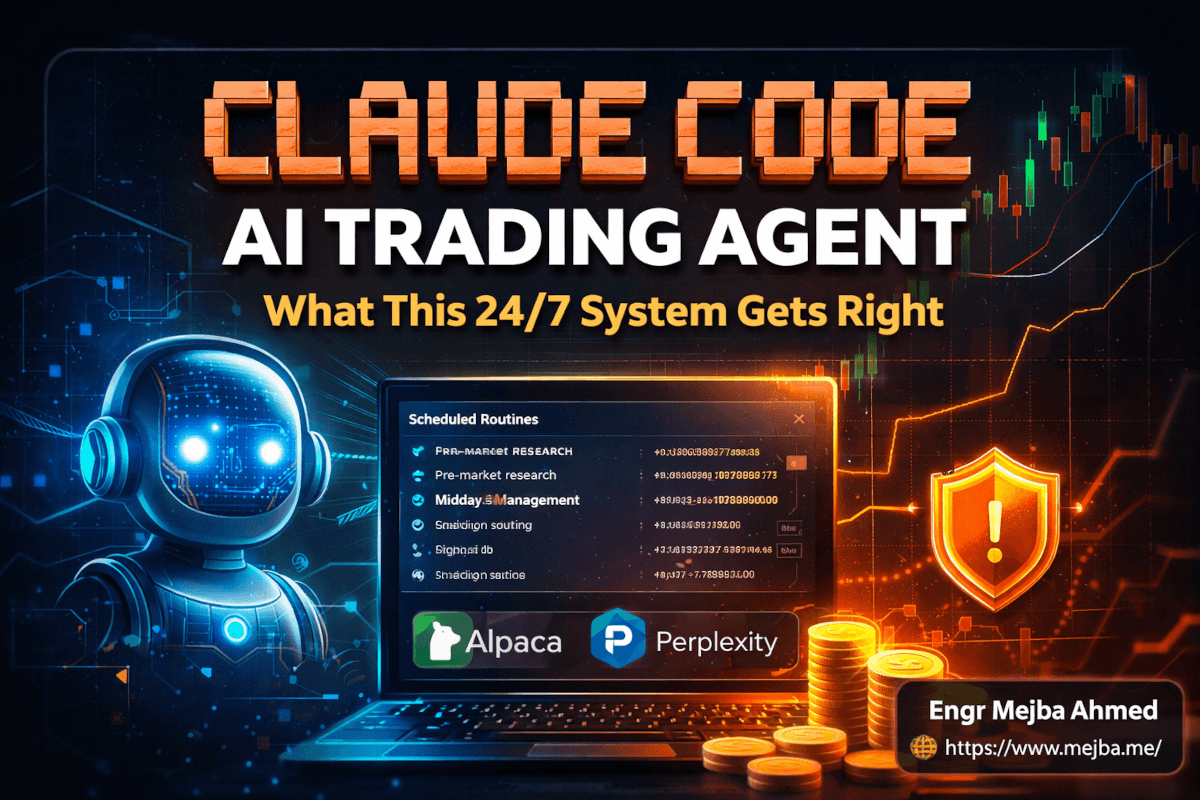
The walkthrough breaks the agent into scheduled jobs across the trading week:
- Pre-market research
- Market-open execution
- Midday risk management
- Market-close review
- Weekly performance grading
That schedule is what turns a one-off prompt into an operating system.
Without routines, you don’t have an autonomous agent. You have a clever chat session that forgets everything the moment the window closes.
With routines, you get repeated behavior under predictable conditions. The agent wakes up, reads memory, checks the environment, performs a defined job, updates logs, and hands better state to the next run. That pattern is far more valuable than the trading niche itself. You could reuse the same design for sales prospecting, security monitoring, support triage, content research, or infrastructure maintenance. It’s the same reason I got excited about Claude Code tasks and parallel execution: the leverage comes from repeatable orchestration, not from one impressive prompt.
This is one of the biggest mindset shifts I’ve had while working with AI systems: the moat usually isn’t the prompt. It’s the loop.
A strong routine system does three things at once:
- It narrows the job for each run.
- It makes failure easier to inspect.
- It compounds learning over time through files, logs, and revisions.
That’s exactly what this project is doing.
Stateless Runs, Stateful Memory
This is the part I liked most.
Each routine run is treated as stateless at execution time, but the broader system remains stateful through files. That is such a practical pattern for Claude Code work.
Instead of pretending the model will “just remember,” the agent explicitly reads and writes its memory:
- strategy files
- research notes
- trade history
- daily logs
- summaries
- portfolio snapshots
That gives every run a continuity layer without forcing all knowledge to live inside a single bloated conversation.
I’ve seen too many AI workflows fail because the builder assumes a large context window solves persistence. It does not. Bigger context helps, but it also tempts people into stuffing everything into one place until the signal gets muddy. The walkthrough even calls this out with the token budget concern: roughly 200,000 tokens sounds huge until you mix system instructions, logs, prior research, API responses, and live market context into the same run.
Then the rot starts.
Not dramatic failure. Worse. Soft degradation.
The model still writes fluent output, but the judgment gets less crisp. Old assumptions linger too long. New evidence receives too little weight. Trade-offs flatten into generic summaries. That’s dangerous in any autonomous workflow, and especially dangerous in something that touches money.
External memory files are the right countermeasure.
They force you to structure state intentionally. What is durable strategy? What is temporary research? What belongs in the trade journal? What should be summarized instead of copied forward raw? Once you think this way, the agent becomes easier to scale and much easier to debug. I’ve seen the same principle show up in self-improving Claude Code systems, where the real gains come from what the agent preserves, audits, and refines over time.
Why Opus 4.7 Fits This Kind of Work Better
The walkthrough frames the move from Opus 4.6 to Opus 4.7 around stronger agentic performance: better judgment in ambiguous situations and better self-verification. I unpacked that model-shift angle more directly in my Opus 4.7 analysis, but in this trading setup the practical question is simpler: does the model behave like a better operator over repeated scheduled runs?
That matters more here than raw eloquence.
A trading routine is full of messy questions that don’t have clean labels:
- Is this news meaningful or just noise?
- Is the position thesis broken or merely uncomfortable?
- Should the agent wait for confirmation or act now?
- Does the previous note still apply after today’s catalyst?
- Is this conviction high enough to open risk, or is it just an interesting idea?
Those are judgment problems.
In my experience, the AI systems that survive longer in production are not the ones that sound the smartest in a demo. They’re the ones that hesitate correctly, verify before acting, and stay coherent when the input is incomplete.
That’s why the “agentic workflow” framing matters. If a model is better at checking its own reasoning, cross-referencing files, and resisting the urge to improvise past the evidence, that’s exactly the improvement you want in a scheduled autonomous system.
I’d still never trust that blindly. But I would absolutely prefer that profile over a model optimized mainly for pretty prose or one-shot coding speed.
The Best Part of the Strategy Is the Risk Design
The walkthrough mentions a 30-day challenge where the earlier system outperformed the S&P 500 by 8%.
That’s a fun result. It also should not be the main takeaway.
Short windows can flatter almost anything. A good month is not a durable edge. Plenty of reckless systems look brilliant right before they blow up.
What I care about more is the guardrail design:
- max position size around 5% per position
- limits on new positions
- daily loss limits
- stop management
- paper trading first
That is adult behavior.
If you’re going to automate anything with financial consequences, the first design layer should not be “How do I make it more aggressive?” It should be “How do I stop it from doing something stupid at 9:47 AM on a weird Tuesday?”
The routine schedule reflects that mindset well.
Pre-market is for research and idea generation.
Market open is for executing planned trades rather than improvising from scratch.
Midday is for cutting losers and tightening control on winners.
Weekly review is for grading the system and adjusting the meta-layer.
That rhythm pushes the agent away from impulsive behavior and toward process discipline. Even the use of trailing stops and loss thresholds shows an awareness that AI confidence is not the same thing as risk control.
If I were adapting this architecture, I would treat those guardrails as the actual core product and the signal generation as the secondary layer. Signals come and go. Risk architecture is what keeps the experiment alive long enough to learn.
GitHub as the Persistence Layer Is a Clever, Boring Choice
I mean that as a compliment.
One of the strongest signs that a system was built by someone practical is when the persistence layer is boring on purpose.
This project keeps its working state in a private GitHub repository. The cloud routines clone the repo, run the job, update files, and commit the changes back. That means the agent’s memory, logs, strategy documents, and operating history all live in a versioned, inspectable timeline.
That is dramatically better than hiding everything inside ephemeral chat history.
It also gives you a few concrete advantages:
- you can inspect how the strategy evolved
- you can compare weekly changes in prompts or memory files
- you can recover from bad edits
- you can audit why a decision happened
- you can migrate the system between environments without rebuilding state manually
There’s a deeper lesson here too.
When people talk about “AI agents,” they often obsess over the model and underinvest in the surrounding software hygiene. But autonomy without auditability is just chaos with nice branding.
A Git-backed memory system is not glamorous. It is exactly the kind of boring infrastructure that makes autonomous workflows survivable.
The Notification Layer Tells You a Lot About the Builder
The walkthrough uses ClickUp for summaries and alerts instead of defaulting to Telegram or some louder notification channel.
That’s a small choice, but it reveals something useful: the system isn’t trying to turn every state change into drama.
Good autonomous workflows should be interrupt-driven, not noise-driven.
Pre-market only sends urgent messages.
Market open only notifies when a trade actually happens.
Midday logs activity without spamming.
Weekly review produces a digestible summary.
That’s the right pattern. If every routine screams for attention, the human operator eventually ignores all of it. A useful notification layer only escalates when a person genuinely needs to know something.
This matters even outside trading. I use the same principle in automation design generally: if a workflow pings me every time it breathes, I’ve built a needy robot, not a reliable system.
The Biggest Lesson: Teach the Agent Like a Beginner, Not a Genius
My favorite analogy in the walkthrough is the bike-riding one.
You don’t throw someone into traffic on day one and call it a learning strategy.
You start with training wheels. Then a quiet street. Then a real road.
That is exactly how these systems should be built.
Start with paper trading.
Write the strategy down clearly.
Define what counts as a valid signal.
Log every action.
Review mistakes.
Tighten prompts.
Increase autonomy slowly.
That progression is much healthier than the common “connect model to API and pray” approach. It respects the fact that AI agents do not become reliable because you gave them permission. They become reliable because you created an environment where good behavior is easier than bad behavior.
That’s the real craft.
Not the prompt theatrics. Not the screenshot of a trade confirmation. The craft is in the operating constraints.
Where I Think This Can Break
I like the architecture, but I also think anyone attempting this should be brutally honest about the failure modes.
First, the model can still overfit to whatever is most legible in the context. If one strong research note is written more persuasively than the others, the agent may overweight the narrative quality instead of the actual evidence.
Second, stale memory is dangerous. A strategy file that made sense three weeks ago can quietly become bad guidance if market conditions shift and nobody updates the document.
Third, API-integrated systems inherit the weaknesses of every external dependency. Brokerage, research, notifications, repo sync, schedule execution, environment variables, branch permissions, rate limits. Every moving part adds another way for the workflow to fail at the exact wrong time.
Fourth, logs can become clutter instead of memory if they are not summarized aggressively. A long journal is not automatically a useful journal.
And fifth, the psychological risk is real. If the agent has a strong writing style, it can sound more certain than it deserves. That can seduce the operator into trusting explanation quality instead of outcome quality.
I would only run a system like this if I had a routine for reviewing the reviewer: not just “what trades did it make,” but “which assumptions keep showing up, which files are getting too heavy, and where is the system rationalizing instead of reasoning?”
What I’d Steal From This Architecture Immediately
Even if I had zero interest in automated trading, I’d steal several ideas from this setup right now.
The first is the scheduled-routine model for dividing work across the day.
The second is the file-based memory architecture for keeping the agent grounded between runs.
The third is the GitHub-backed persistence layer with version history as an audit log.
The fourth is the bias toward sparse, high-signal notifications.
And the fifth is the insistence on paper mode before live mode.
That last one applies almost everywhere. Before an agent touches production infra, customer data, invoices, security actions, or real capital, let it operate in shadow mode first. Watch it think. Watch it log. Watch it be wrong in a safe environment.
That discipline is what separates a useful autonomous system from an expensive story.
What I’d Require Before Letting This Touch Real Money
If someone asked me where to draw the line between “cool prototype” and “system I’d trust with a live account,” my answer would be pretty strict.
I would want at least four things in place.
The first is a shadow period long enough to expose pattern drift. Not two days. Not one lucky week. I’d want the agent to run in paper mode long enough to show how it behaves across boring sessions, volatile sessions, news-heavy sessions, and days where doing nothing is the correct choice.
The second is decision review at the thesis level, not just the trade level. A lot of builders only review whether the trade made or lost money. That’s not enough. I want to know whether the reasoning was internally consistent, whether the cited catalysts were real, whether the sizing matched the stated conviction, and whether the exit logic followed the written rules.
The third is hard operational fallback. If GitHub sync fails, if the brokerage API is unavailable, if a research call returns junk, or if the environment variables are missing, the safest behavior should be to stop and log the failure, not improvise around it. Autonomous systems earn trust partly through what they refuse to do.
The fourth is a regular strategy pruning ritual. One underrated risk in file-based memory systems is accumulation. Every week you add more notes, more lessons, more opinions, more exceptions. Over time the agent can end up reading a museum of half-dead beliefs. I’d want a weekly or monthly cleanup pass where stale assumptions are removed, live rules are rewritten cleanly, and the core strategy stays compact enough to remain sharp.
That’s the piece a lot of AI builders underestimate. The system doesn’t just need intelligence at runtime. It needs maintenance discipline between runs.
And honestly, that might be the real edge in projects like this. Not the model upgrade. Not the API stack. Not the prompt wording. The edge is whether the human operator keeps the environment clean enough for the agent to keep making sane decisions.
My Take
This walkthrough is interesting because it treats AI autonomy like systems engineering instead of wishful thinking.
Yes, the headline is a 24/7 AI trading agent in Claude Code.
But the real lesson is broader: if you want an AI agent to do serious work continuously, give it routines, memory, risk boundaries, versioned state, selective notifications, and a narrow enough job that judgment can actually matter.
Would I trust any AI trading agent blindly with real money? No.
Would I study this architecture as a template for building long-running agents that operate with more discipline than the usual demo bait? Absolutely.
That’s the part worth paying attention to.
Because the future of useful AI agents probably won’t be one giant omniscient bot doing everything at once. It’ll be systems like this one: scheduled, constrained, logged, reviewed, and built to improve over time.
And honestly, that’s a much better future than the hype merchants are selling.
Whether a 24/7 Trading Agent Is Worth Building
This Claude Code trading agent works because it isn't a day-trading bot — it's a patient, scheduled system with real guardrails, and the guardrails are the whole point. Automating decisions without limits is how you lose money fast; automating discipline is how you keep it.
If you build one, spend most of your effort on the constraints, not the signals. Treat it as risk management with automation, not a money machine.
If you want an automated agent built with real guardrails for your use case, that's work I take on through Ramlit. The system and its limits are above.