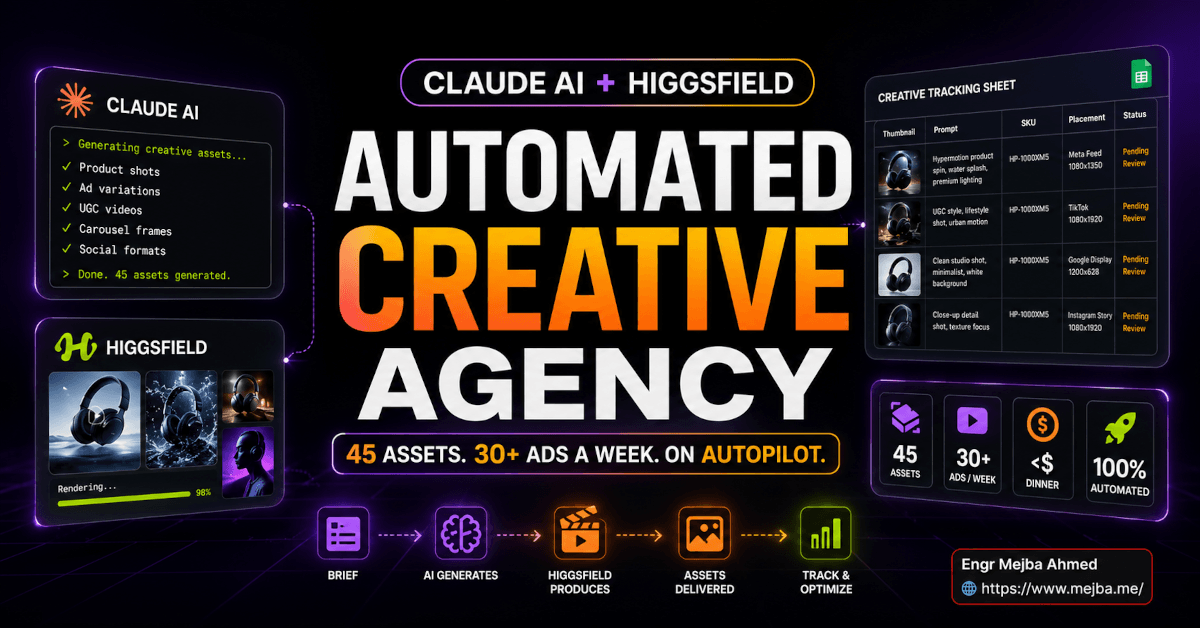
Generating one beautiful image is a solved problem. Generating fifty on-brand assets a week that match a product's actual look, fit specific ad placements, avoid repeating themselves, and land in a review queue with their cost and provenance attached — that's the job, and no image platform solves it, because the job isn't generation. It's operations. That's the honest premise behind running what I'd call an automated creative agency: Higgsfield supplies the engine, Claude Code supplies the brain, and everything valuable lives in the wiring between them.
I run this exact stack. The Higgsfield connector is wired into my Claude environment permanently, and my skills library contains four Higgsfield skills I wrote myself — one for general generation, one for product photoshoots, one for consistent-character work, and one that produces marketplace card assets for my own site. This isn't a workflow I read about. It's tooling I maintain, which also means I know precisely where it breaks, and the second half of this post is about that.
The Engine Has No Brain
Higgsfield's pitch is aggregation: fifteen-plus video and image models — Sora 2, Veo 3.1, Kling, their own Soul line — under one subscription, from a $15 starter tier to a $99 Ultra tier on annual billing, with per-generation credit costs that vary sharply by model. Above the raw models sits a marketing-oriented layer exposing ad-shaped formats: product motion shots, unboxing reveals, UGC-style clips, and cinema presets that emulate specific camera bodies and focal lengths instead of a generic "cinematic" filter.
The platform is genuinely good, and it is also exactly as far as a platform can go. It doesn't know your brand. It doesn't remember last week's batch. It will generate the same hero shot six times without noticing, can't write a brief, and has no opinion on which of fifty drafts deserves ad spend. Every one of those gaps is an orchestration problem, and orchestration is what Claude Code, with connectors, skills, and scheduled routines, has quietly become excellent at.
The Brain: Connector, Skills, Ledger, Knowledge
The connector turns Higgsfield from an app I visit into a tool Claude reaches for. Through it, a Claude session can fire a generation with a prompt and reference image, run batches as background jobs and wait on them collectively, pull finished assets by ID, and even consult the platform's workflow catalog for templated formats like UGC clips and explainer videos. The consequence sounds small and isn't: I never paste prompts into a web UI or download files by hand. The generation step becomes a function call inside a larger process — the same shift I described with the Canva connector for design automation, applied to a much heavier engine.
The skills are where brand consistency lives. A skill, in Claude Code terms, is a reusable recipe file: trigger conditions, methodology, references. My product-photoshoot skill bakes in the prompt structure that survived testing, loads the brand brief, and — the critical line — anchors every job to a canonical reference image per product. Without that anchor, every generation is a fresh dice roll: cup shapes ease, colors warm half a step, labels mutate. With it, drift drops dramatically, though never to zero. My soul-id skill does the equivalent for consistent characters across UGC-style clips. If skill files are new territory, my advanced agent skills walkthrough covers the anatomy.
The ledger is the piece nobody talks about, and it's the difference between a toy and a system. Claude is brilliant inside a session and amnesic across them; an agency without institutional memory is fifty disconnected experiments. Mine is a plain spreadsheet the agent reads and writes: one row per asset, with columns for SKU, placement, format, job ID, prompt hash, asset URL, status, review notes, and cost. Every column is load-bearing. The prompt hash lets the agent detect it's about to regenerate an existing shot before burning credits. The status column gives me a "pending review" pile each morning. The review notes — why something was rejected — feed back into the skill the following week, so the same mistake doesn't recur. That feedback loop is the system's actual learning mechanism, and it runs on a twelve-column sheet.
The knowledge doc changed output quality more than any other single decision. I maintain a long markdown reference — an advertising masterclass, several hundred lines — covering what junior ad designers learn and rarely write down: how a hook works in the first second of a Reel, why UGC outperforms polish on cold traffic and underperforms on warm, how a three-second ad differs structurally from a thirty-second one. The generation skills reference it explicitly, so every brief and every critique passes through that lens. Without it, you get the model's training-data average, which is exactly the AI ad slop you can already recognize on sight. Give the model a real practitioner's reference and the ceiling moves. If you've run paid social for years, write your own; if you haven't, that document is the thing to acquire before you automate anything.
What Running It Actually Looks Like
I stress-tested the stack on a fictional brand — headphones across three SKUs plus a supplement, chosen deliberately so I could push hard without spending a client's budget or reputation. Each SKU got a one-page brief, a locked canonical hero image, and a placement list. A scheduled routine then drove the loop: read the ledger, find the SKU and placement with the fewest fresh approved assets, draft prompt variations through the brand skill, send them through the connector as a batch, poll to completion, write every result to the ledger as pending review, and ping me when done. Mornings started with a review pile instead of a blank brief. The full scheduling mechanics are the same ones I covered in my Claude Routines migration post — this is simply the most credit-hungry routine I run.
Two findings from those weeks that I'd defend in front of any creative director:
First, the per-asset economics are not subtle. Clean product-motion B-roll and organic-reading unboxing clips came out of an afternoon of batches for a handful of credits each — work in a category that traditionally prices per shoot, not per attempt. The interesting consequence is psychological: when a variant costs cents, you stop protecting your first idea and start actually testing.
Second, adding a category the skills weren't built for (the supplement) broke things immediately — first batches looked like stock photography. The fix wasn't better prompts; it was restructuring the brand skill to handle category-specific reference anchors. Generalization is a design property of your skills, not a capability you get free from the model.
Where It Falls Apart
Text inside generated video is unreliable, full stop. Every video model in the aggregation wobbles letters, collapses kerning on random frames, or mutates a logo mid-clip. No client signs that. The architecture fix: the model generates clean, text-free motion footage, and a downstream compositing step applies price callouts, logos, and CTAs using an actual typographic system. Text never passes through the model. Separating those concerns is the single most important production decision in this entire pipeline.
Moderation will block innocent prompts. Platform moderation layers are conservative — as they should be — and they misfire on phrasing like body-part-adjacent product language ("earbuds in the ear"). Early batches saw double-digit rejection rates on completely legitimate ad prompts. I wrote a pre-check skill that scrubs prompts and substitutes neutral phrasing before submission, and rejections dropped to a rounding error. If you skip this layer you will lose an afternoon to wondering why an obviously innocent ad keeps bouncing.
Brand drift is gradual, so it evades spot checks. Two ads side by side look perfect; twenty ads across a month of batches show the product slowly morphing. The canonical-reference anchor cuts most of it, the ledger's review notes catch the rest, and the honest answer is that a human eye remains the final QA on anything customer-facing.
The bottleneck relocates. Once generation is nearly free, selection becomes the hard job. Picking the right ten of fifty is now where the taste lives. I run a scoring routine that ranks pending assets against the masterclass criteria to pre-sort the pile, but I have not automated final approval and I don't intend to. A system that can produce infinite variants needs exactly one scarce input: judgment about what ships.
The Frame That Makes This Work
Notice what the stack actually consists of: a connector (plumbing), four skill files (procedures), a spreadsheet (memory), a markdown doc (expertise), and a cron schedule (persistence). There is no exotic infrastructure anywhere in that list. The moat isn't access to models — everyone has that for $15 a month. The moat is the accumulated operational layer: the tested prompt structures, the moderation workarounds, the drift anchors, the review-note feedback loop. That layer compounds weekly, and it's portable to any client brand because it's encoded in files rather than in my head.
That's also why I'd push back on both reflexive reactions to this kind of system. It doesn't replace an agency's strategy or taste — the masterclass doc exists precisely because the model has neither. And it isn't a toy — it fed a real ad account's worth of placements from a schedule while I slept. It's a production line with a human editor-in-chief, which is what most creative automation will look like for years.
Read other people's skill files before you write your own creative stack. The four Higgsfield skills behind this pipeline follow the same authoring discipline as everything else in my library, and that library sits published and documented at the Agent Skills Marketplace, ready to study.