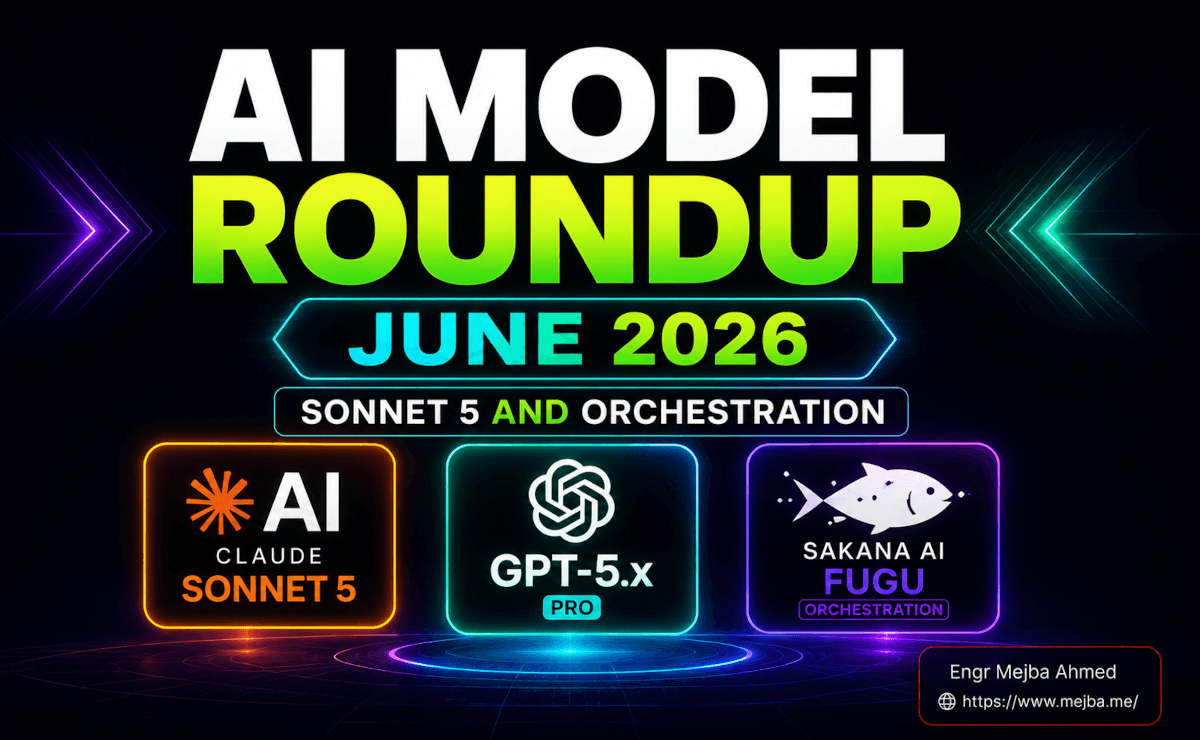
June 2026 was the month the AI race stopped being a single-file sprint. Three things moved at once: the frontier kept climbing on raw capability, a second axis — cost-efficiency — became just as load-bearing, and a third architecture, orchestration, walked in and started beating bigger models on price. And in the middle of it, the US government briefly pulled Anthropic's two most capable models off the shelf, then put them back nineteen days later.
So this AI model roundup June 2026 has one job: separating what's actually confirmed from what's just chatter, because a good half of what circulated this month was vapor. I'll tag every item so you know which bucket it lives in.
A friend messaged me late one Sunday with a leaderboard screenshot and three words — "is this real?" The model sitting on top came from Sakana AI, a Tokyo lab, and it wasn't a model in the usual sense at all: it was an orchestrator routing tasks across everyone else's frontier models, and undercutting them on cost. Six months ago I'd have bet the next jump would be "a bigger Opus." I'd have been wrong.
Here's everything that moved — sorted into confirmed, rumored, and vapor.
The confirmed-vs-rumor scoreboard for June 2026
The most useful thing I can give you before the details is a clean line between shipped and speculated. This is where most roundups quietly cheat — they blend a leaked codename with a real product and let you assume both are equally solid. Not here.
Confirmed and shipping:
- Claude Opus 4.8 — released late May 2026, 1M-token context by default, 128K max output, stronger agentic coding and honesty tuning. This one I use daily.
- Claude Fable 5 — Anthropic's first publicly available Mythos-class model, launched June 9, 2026. Always-on adaptive thinking, 1M context, roughly 2x the price of Opus 4.8 at $10 per million input tokens and $50 per million output tokens. It debuted at #1 on Artificial Analysis's Intelligence Index (a launch score near 64.9), about 5 points ahead of the next lab's best model.
- A US export-control directive that suspended both Fable 5 and Mythos 5 on June 12, 2026 — then was lifted on June 30, with Fable 5 restored globally on July 1. This is the biggest story of the month and I unpack it below.
- Sakana Fugu — Tokyo lab Sakana AI's orchestration system. Beta from April 2026, wider launch on June 22. Real product, real OpenAI-compatible API.
Rumored / leaked / unconfirmed:
- Claude Sonnet 5 — not announced. "Launches next week" has been circulating since February. Treat any feature claim as a wish list.
- A more capable Opus-class variant beyond what's public — the Mythos thread, genuinely murky.
- GPT-5.x Pro and the next real-time voice model — strongly reported, partially rolling out, not fully GA.
Keep that scoreboard in your head as you read. The interesting part isn't any single release — it's what happens when you line them all up. Let's start with the one people keep asking me about.
Claude Sonnet 5: the rumor that won't die (and what's plausibly true)
The disclaimer first: Anthropic has not announced Claude Sonnet 5. Not a date, not a name confirmation, nothing. If anyone tells you they know the launch day, they're guessing.
I'm covering it anyway because Sonnet is the model I — and probably you — actually reach for most. Opus is the heavyweight you bring out for hard reasoning; Sonnet 4.6 (shipped February 17, 2026, 1M-token window, $3/M in and $15/M out) is the daily driver that handles most real work without melting your budget. So the next Sonnet matters more to working developers than the next Opus does, even though Opus gets the headlines.
The rumor mill, as reported around June 21, 2026, paired a possible Sonnet 5 with OpenAI's next release in the same week. Some outlets floated a SWE-bench score somewhere in the low-to-high 80s. Take that with a fistful of salt — the same "next week" prediction has been wrong repeatedly since February. One report even recycled the codename "Fennec," which already turned out to be Sonnet 4.6. That's not a leak; that's an echo.
So what's plausibly true, based on where the trajectory points? A few threads worth tracking — and I want to be clear these are rumored, framed as analysis of what people are claiming, not facts I've verified:
- A bigger context window — talk of pushing toward 1-2M tokens as the standard. Plausible, given Opus 4.8 already ships 1M by default.
- Better vision — specifically reading UI mockups and architecture diagrams more reliably. This is the rumor I most want to be true, because it's where I hit walls today.
- A new tokenizer — and here's the catch nobody's emphasizing: the same chatter suggests it could consume roughly 30% more tokens per prompt. If that's real, a "cheaper, smarter" Sonnet 5 could still cost you more per task than Sonnet 4.6, because you're feeding it more tokens to do the same job. Read the per-token price and the per-task token count before you celebrate.
- Fast, high-quality SVG generation — niche, but if you've ever asked a model for an SVG icon and gotten a tangle of broken paths, you know why this matters.
Will Claude Sonnet 5 actually be cheaper to run?
Not necessarily — and this is the question I'd pin down before planning around it. A lower price per million tokens is meaningless if a new tokenizer makes each prompt consume ~30% more tokens, which is exactly what the current rumors suggest. Cost-per-task, not cost-per-token, is the number that hits your invoice. Until Anthropic publishes both, treat any "cheaper Sonnet" claim as unproven.
My honest take after a year in these models: I don't bet on rumored features. What I do is keep my workflows model-agnostic enough that I can swap Sonnet 4.6 for Sonnet 5 the day it ships and measure the real numbers myself. Building for the swap, not the spec sheet, has saved me more time than any single upgrade. But the Sonnet rumor isn't even the spiciest Anthropic thread this month. The spicier one involves models that briefly stopped existing for most of the planet.
When a government took Fable 5 and Mythos 5 off the shelf — then put them back
This is the thread that gets garbled most in secondhand summaries, so let me walk it carefully, because the real version is more dramatic than the rumor.
There's been persistent talk of an Anthropic model above the public Opus tier — a high-end variant with stronger long-horizon reasoning, real planning, and reliable execution across large, multi-step tasks. The kind of model that doesn't just write a function but ships a feature across twelve files without losing the plot. In leaked-and-rumored discourse this has worn a few names. The internal-codename version — the one where Anthropic reportedly exposed a model described in their own documents as their most capable ever — I covered in full in my breakdown of the Claude Mythos leak. I won't re-litigate it here.
What made the "too powerful to ship" framing literal this month wasn't a leak. It was policy.
On June 12, 2026 — three days after Fable 5's public launch — the US Department of Commerce issued an export-control directive requiring Anthropic to suspend access to both Claude Fable 5 and Claude Mythos 5, cutting them off for foreign nationals worldwide. The reported trigger was a jailbreak that bypassed Fable 5's safety rules. The most capable Mythos-class tier — the public one (Fable 5) and the one above it (Mythos 5) — went dark, not because it failed an internal safety eval, but because a government decided the capabilities carried national-security weight. For nineteen days, enterprise customers across dozens of global cloud platforms simply lost access.
Then, on June 30, 2026, Commerce lifted the controls. Anthropic restored Fable 5 to global users across Claude.ai and Claude Code starting July 1, after strengthening the model's cybersecurity protections with government and partner input. Mythos 5 came back too, but only for a small set of vetted US organizations. So the "banned high-end Opus-class model" was never a conspiracy theory or a marketing tease — it was a real, documented, and now resolved case of frontier models being gated by regulation after release, and then un-gated.
Here's why I still find it unsettling, even with the happy ending: for nineteen days, the bottleneck on the most capable models wasn't compute or training data. It was a directive. The capability existed the whole time; whether you could touch it was a regulatory switch someone else controlled. It flipped off, then back on. If you want the export-control mechanics and the open-source response in depth, I went long on that in my June roundup on export controls and open-source ensembles.
So Anthropic's month: a daily-driver rumor, and a frontier tier that vanished behind a government gate for nineteen days before the gate reopened. Now across the aisle, because OpenAI did not spend June being quiet.
OpenAI's GPT-5.x Pro and the voice model that talks back mid-sentence
Two threads here, each tagged for its reality level.
Thread one — GPT-5.x Pro (reported, partially rolling out). The reported gains center on front-end and web-design quality plus raw creative range. The demo that got passed around — and I'm framing it exactly as it reached me, as a demo claim, not a benchmark I ran — was a first-person, playable interior of a house: multiple rooms, walk-through navigation, built into a single ~700KB HTML file, generated in roughly 40 minutes.
I want to be careful, because this is precisely the kind of number that gets repeated as fact until everyone "knows" it. I did not build this. I'm reporting what the source showed. What I can tell you, from shipping front-ends with these models all year, is that the shape of the claim is believable — the jump in single-file, self-contained interactive output over the last two generations has been real and large. A playable room in one HTML file is exactly what GPT-5.5 was already flirting with. So I don't dismiss it. I just won't quote "700KB in 40 minutes" as gospel until I've reproduced it.
There's also strong reporting that the next-gen line pushes context toward 1.5M tokens, up from the 1M GPT-5.5 shipped in April. Plausible, consistent with the trend, still unconfirmed at the version level.
Thread two — the real-time voice model (reported, limited rollout). This is the one that made me stop and think about interface, not just capability. OpenAI has been shipping real-time voice models with GPT-class reasoning — models that listen and speak at the same time rather than the old walkie-talkie "you talk, then it talks" pattern.
The capabilities being reported for the newest one:
- A knowledge cutoff around August 2025
- Mid-sentence corrections — it can catch and fix itself partway through a spoken answer, the way a human does
- Active turn-taking — it handles interruptions and overlapping speech instead of waiting for a hard stop
- A limited, staged rollout rather than instant general availability
Why does this matter more than another benchmark bump? Because turn-taking is what's made voice agents feel robotic for years — the unnatural pause, the talking-over, the "sorry, could you repeat that" after you already moved on. A model that negotiates the rhythm of conversation in real time isn't a bigger model; it's a different product category. I've built voice flows where the latency and rigid turn structure killed the whole experience, and this attacks exactly that.
If you've worked with the previous generation of OpenAI's real-time voice stack, the trajectory will look familiar — I dug into the translation and agent side of that in my look at GPT real-time voice agents. The new piece is the conversational rhythm.
So OpenAI's June: better web-design output (reported, believable) and a voice model that finally behaves like a conversation partner (reported, rolling out). Both real directions. Now for the release that genuinely surprised me — the one that isn't from Anthropic or OpenAI at all.
Sakana Fugu: the month orchestration became its own architecture
I'd have skimmed past this in most roundups, and it turned out to matter most, so it gets room.
Sakana Fugu is confirmed and real — built by Sakana AI, the Tokyo research lab, with beta access from April 2026 and a wider launch on June 22. But calling it a "model" undersells it. Fugu doesn't generate tokens from its own weights the way Opus or GPT-5.5 does. It's an orchestrator: it sits behind one OpenAI-compatible API endpoint and dynamically routes each task across a swappable pool of frontier models — reportedly including GPT-5.5, Claude Opus, and Gemini 3.1 Pro.
It grows out of Sakana's published research on evolved LLM coordination and learning to orchestrate agents in natural language. The system assigns roles — think Thinker, Worker, Verifier — across the pool and adaptively delegates per task: one model drafts, another executes, a third checks. Because the pool is swappable, Fugu can route to new frontier models as they ship without being retrained. That's a genuinely different bet on where AI value comes from.
Now, the benchmark claims. Sakana says Fugu Ultra outperforms publicly accessible frontier models — including GPT-5.5 and Opus 4.8 at high-effort settings — across coding, scientific reasoning, and agentic research. Here's where the skeptic hat goes on: these are the lab's own numbers. A vendor grading its own product is running a marketing exercise until outside evaluators reproduce the result. I'm not saying they're wrong; I'm saying the burden of proof sits with Sakana and right now it's unmet. (One tell that they're building a real product, not a demo: Fugu wasn't available in the EU/EEA at launch while Sakana worked through GDPR compliance.)
The Crossy-Road head-to-head that reframes what "winning" means
The source ran a comparison I keep coming back to, because it has nothing to do with which model is "smarter." The brief: build a 3D Crossy-Road-style game. Same task, two systems. I'm presenting these strictly as the source's reported figures, not numbers I verified:
| Dimension | Opus 4.8 Ultra | Fugu Ultra (orchestrated) |
|---|---|---|
| Time to build | ~79 minutes | ~22 minutes |
| Tokens consumed | ~940,000 | ~90,000 |
| Cost | ~$37.85 | ~$7.32 |
| Output polish | Higher — clean controls, solid camera | Lower — inverted controls, wonky camera |
Look at what that table is quietly arguing. The orchestrated route finished several times quicker, on a small fraction of the tokens, for a fraction of the price — and shipped a worse game: inverted controls, a camera fighting the player, less polish. (I break the exact multipliers down in my full Sakana Fugu Ultra review.) Asking which one "won" is the wrong frame, and that's the whole point. If you're prototyping fifty game concepts to find one worth pursuing, Fugu's profile is obviously correct — you want speed and cost, and polish comes later. If you're shipping the one game players will actually pay for, Opus 4.8 Ultra's polish is worth every extra dollar and minute. Capability — the axis everyone argues about — isn't the only axis anymore. Cost-efficiency is now a first-class dimension, and orchestration is the architecture betting hardest on it.
This is where the whole roundup clicked for me. We've spent two years asking "which model is best?" The sharper question now is which architecture suits the task in front of you — and "one orchestrator routing work across many models" has become a legitimate answer, not a lab curiosity. I traced the early version of this multi-model pattern in my piece on open-source ensembles, and the broader Anthropic-vs-OpenAI capability race in my coding-war playbook. (If you want a deep, tested look at Fugu specifically, that's its own write-up — this section is the roundup-level summary.)
What I actually think, after a year inside these tools
A roundup that just lists releases is a press-release digest, and you can get that anywhere. So, with the marketing stripped off:
First: I was wrong about where the next jump would come from. I assumed a bigger single model. Fugu suggests a real share of near-term progress will instead come from coordination — orchestrating today's models so they hand tasks off to each other intelligently, rather than waiting for a fatter brain. That's a humbler, less glamorous form of progress, and it's been underrated precisely because it doesn't make a flashy "new model" headline.
Second: price-per-finished-task now matters as much as raw capability, and most coverage still skips it. Everyone benchmarks intelligence. Almost nobody measures dollars per completed job. That Opus-vs-Fugu split is the sharpest proof I've run into that "best" has quietly turned into a budget-relative label. When teams ask me for advice, I no longer open with "which model is smartest." I open with "on this job, how much are you willing to trade polish for cost?" I'll take a 5x cost saving and fix the camera myself most days.
Third — the uncomfortable one: availability is now part of the equation. The Fable 5 / Mythos 5 suspension was the canary. Yes, the controls lifted on June 30 and Fable 5 came back July 1 — but for nineteen days the most capable public model was simply gone for most of the world, on a policy decision no customer could appeal. The frontier of what's possible and the frontier of what's reliably available to you can now split without warning. I've started designing client systems with a deliberate "drop to the next tier down" fallback, because access is no longer something I treat as guaranteed.
Where I'd push back on the hype: treat Sakana's in-house numbers as a hypothesis, not a verdict, until outside labs confirm them. And every "launches next week" Sonnet 5 rumor should be treated as entertainment, not planning input — I've watched that specific prediction be wrong since February. Don't reorganize your stack around a model that doesn't have a date.
The honest summary: this was a fast month, but the speed ran on two axes at once — capability and efficiency — plus a structural shift toward orchestration and a real, if temporary, demonstration that access can be revoked. That combination matters more for how you build than any single release.
Your posture for the weeks ahead
You don't need to chase every release. You need a posture. Here's mine, and what I'd hand to anyone building on these tools right now.
What to track over the next few weeks:
- Whether Sonnet 5 actually ships — and the moment it does, compare cost-per-task, not cost-per-token, against Sonnet 4.6. The tokenizer rumor makes that the number that matters.
- Independent benchmarks on Sakana Fugu — if third parties reproduce even half of Sakana's claims, orchestration goes from curiosity to category.
- Whether the export-control détente holds — the June 30 lift restored Fable 5 globally, but Mythos 5 stayed US-only. Watch whether that gate stays open and whether the pattern spreads to other labs' frontier models.
- GPT-5.x Pro's real-world web-design output — once it's broadly available, the "700KB house in 40 minutes" claim becomes testable. Test it before you trust it.
One thing to do this week: pick a task you run regularly through a single model, and consciously ask "what's my cost-vs-polish tolerance here?" Then try the cheaper path on purpose — a smaller model, or a route through several cheaper ones — and measure what you actually lose. That one experiment will teach you more about 2026's real frontier than ten more roundups. The question that mattered all year, "which model is best?", quietly stopped being the right one. The better one now: "which shape of system fits this job, at this budget, given what I'm actually allowed to use?"
FAQ
Frequently Asked Questions
Everything you need to know about this topic
No — Anthropic has not announced Claude Sonnet 5, a date, or any official feature list. "Sonnet 5 launches next week" has circulated repeatedly since February 2026 and been wrong each time. Treat every feature claim (bigger context, new tokenizer, better vision) as rumor, not confirmed fact.
Sakana Fugu is an orchestration system from Tokyo lab Sakana AI that routes each task across a swappable pool of frontier models (reportedly GPT-5.5, Claude Opus, Gemini 3.1 Pro) behind one API. Unlike a standard model, it doesn't generate from its own weights — it coordinates other models, assigning roles like Thinker, Worker, and Verifier per task.
Yes. On June 12, 2026, a US Commerce Department export-control directive forced Anthropic to suspend access to both models, cutting them off for foreign nationals worldwide after a reported jailbreak in Fable 5. The controls were lifted on June 30, and Anthropic restored Fable 5 globally on July 1, 2026. Mythos 5 returned too, but only for a small set of vetted US organizations.
It depends on your cost-vs-polish tolerance. In the reported Crossy-Road head-to-head, orchestration was far faster and cheaper but produced lower polish (inverted controls, wonky camera). Use orchestration for high-volume prototyping where speed and cost win; use a top single model when finished quality is the priority.
Treat them skeptically until independent evaluators confirm them. The claims that Fugu Ultra outperforms GPT-5.5 and Opus 4.8 are Sakana's own self-reported numbers, which are marketing until reproduced by third parties. The architecture is real and interesting; the leaderboard position is unproven.
Working out which model fits your build
Most of my day is helping people answer exactly the question this month raised: which model — or which shape of system — actually fits a project you're shipping, at your budget, given what's available that week. I build workflows model-agnostic enough to swap tiers when the frontier (or its availability) shifts under you. If that's a problem you're wrestling with, find me on Fiverr.