Tencent Hy3 Review: 295B Open-Weight AI Model
A 295-billion-parameter model just went toe to toe with open-weight giants three to five times its size — and beat most of them everywhere except one place. That's the sentence I kept coming back to while I pulled apart the Tencent Hy3 release, and it reframes the entire "bigger is better" assumption the open-weight race has been running on since DeepSeek V4 Pro shipped its 1.6 trillion parameters.
Here's the number that actually matters. Hy3 activates just 21 billion of those 295 billion parameters on any given token. GLM 5.2 — the model most people I follow currently treat as the open-source ceiling — carries roughly 744B total and burns about 40B active per token. So Tencent walked into the coding-model arena with a model that has less than half the size and roughly half the per-token compute of the reigning champ, and the honest verdict from the benchmarks is: it loses the coding crown by a few points and wins nearly everything else. VentureBeat's headline said it cleaner than I can — Hy3 "takes on GLM-5.2 at half the size, and wins everywhere except coding."
This Tencent Hy3 review is my attempt to answer the only question that matters if you're a builder: should you actually put this thing in your toolkit before the free window closes on July 21, and if so, for what? Because the leaderboard story and the use-it-on-a-Tuesday story are two very different things, and most of the coverage I read this week only told the first one.
One honest disclaimer before I say anything else
I make this disclaimer on every model piece, and it matters more than usual here, so I'm putting it up top instead of burying it.
I verified the hard facts myself. The specs, the license, the OpenRouter listing and its pricing, the benchmark numbers and their sources — I checked those against Tencent's own repos and the primary listings, and I'll cite them as I go. Where I'm walking you through the hands-on build tests — the browser-based macOS clone, the physics demos, the 3D city — I'm reporting and analyzing a documented test battery, not claiming I personally sat there typing every prompt. I'll flag which is which as we move. If a figure is uncertain or provider-dependent, I'll say "reported" rather than dress it up as settled fact.
That distinction is the whole reason I trust some model reviews and ignore others. You should hold me to it too.
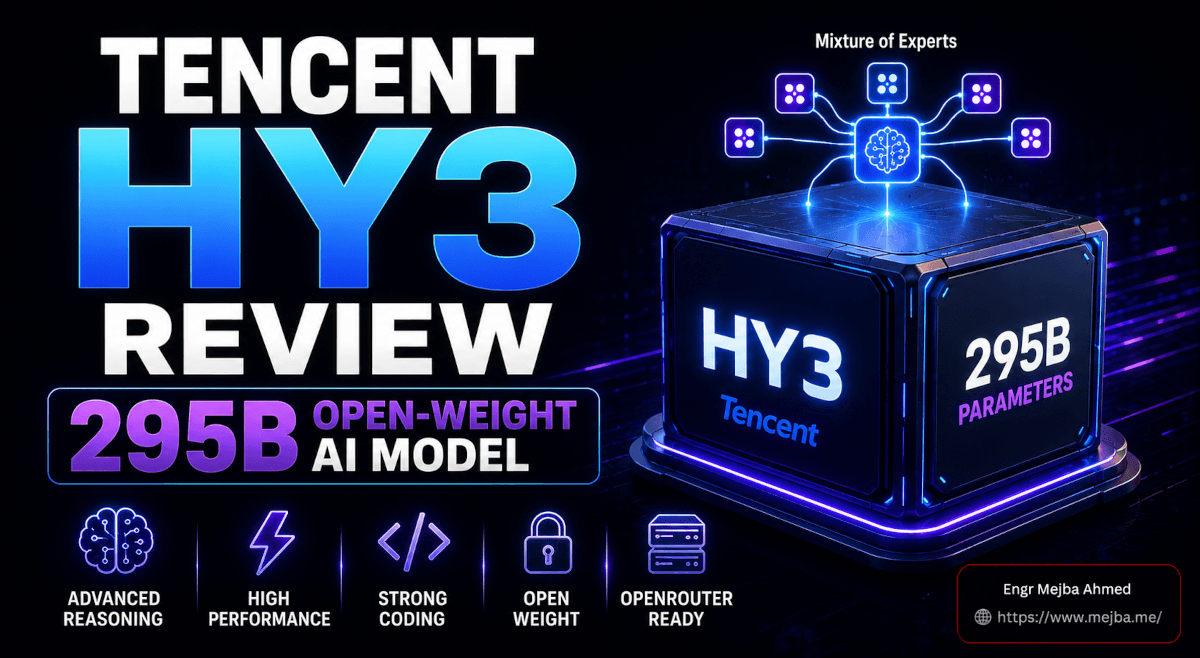
The model is real, and it's not vaporware. Tencent open-sourced Hy3 on July 6, 2026. The weights live at Tencent-Hunyuan/Hy3 on GitHub and tencent/Hy3-preview on Hugging Face. It's on OpenRouter right now. This isn't a leaked benchmark screenshot — it's a shipped, downloadable, Apache-2.0 model you can hit with an API call today.
What Tencent Hy3 actually is
Let me get the spec dump out of the way, because you've probably seen these numbers scattered across a dozen news posts already, half of which called the lab "Tenset" or something equally garbled. It's Tencent — the Chinese giant behind WeChat — and Hy3 is the newest member of their Hunyuan model family.
Here's the architecture, verified against Tencent's own model card:
- 295 billion total parameters, with 21 billion active per token
- 192 routed experts per MoE layer, plus one always-on shared expert, using top-8 routing — meaning only 8 of those 192 experts fire on any single token
- A separate 3.8B multi-token-prediction (MTP) layer that lets the model predict more than one token per decoding step, which is a real speed lever, not a spec-sheet ornament
- 256K token context window (262,144 tokens, to be exact)
- Apache 2.0 license — full commercial use, and Tencent explicitly lifted the geographic restrictions that had limited the April preview
That MoE structure is the entire trick. When people hear "295 billion parameters" they picture a model that costs 295 billion parameters' worth of compute to run. It doesn't. The router wakes up a narrow slice — 8 experts, ~21B parameters — for your specific token, and the other 171 experts stay asleep. You pay for the slice, not the whole brain. That's why a model this capable can be priced like a much smaller one, and it's the same architectural bet DeepSeek, GLM, MiniMax, and Kimi have all been making. If you want the deeper mechanics of how sparse routing collapses inference cost, I walked through it in detail in my DeepSeek V4 Pro review — the routing story there applies almost one-for-one here, just at a fraction of the total size.
Tencent also built in something I wish more labs would ship: configurable reasoning effort. Hy3 defaults to a fast "no-think" mode, then offers low and high reasoning modes you flip on for the hard stuff — a gnarly refactor, a math proof, a multi-step agent chain. You're not paying reasoning-token overhead on a prompt that just needs a quick answer. Anthropic, OpenAI, and Google have all converged on some version of this, and seeing it in an open-weight model at this price is a genuine quality-of-life win.
The stated design goals are reasoning, multi-step and agentic workflows, coding, and — the phrase Tencent keeps repeating — "real-world production deployment." Tencent also claims measurable gains on anti-hallucination, more reliable tool-calling, higher-quality post-training data, and more RL steps than the previous generation. Those last four are the kind of claims you can't verify from a spec sheet; they show up (or don't) in how the model behaves on real work. Which is where the tests come in.
But first, the number everyone actually opens these articles for.
What does Tencent Hy3 cost to run?
Tencent Hy3 is free to use through July 21, 2026, and after that the OpenRouter base listing runs about $0.063 per million input tokens and $0.21 per million output tokens. That's the short, snippet-worthy answer. The longer answer has a wrinkle worth understanding, because I saw two different price tags floating around and I don't want you to get burned by the gap.
The source walkthrough I analyzed quoted post-promo pricing at $0.14 per million input / $0.58 per million output. When I checked OpenRouter's actual listing for tencent/hy3-preview, the base route was cheaper — roughly $0.063 input / $0.21 output — with a separate tencent/hy3:free route sitting at $0 until the July 21 cutoff.
Both can be true at once, and here's why: OpenRouter is a marketplace. Different inference providers list the same open-weight model at different prices, and the number you actually pay depends on which provider serves your request and whether you're routed through the free tier. So treat the $0.14/$0.58 figure as a reported provider quote and the ~$0.063/$0.21 as the base listing I could verify. Either way, you're in the same universe: this is cheap. We're talking about a model that competes with frontier reasoning for roughly the cost of a rounding error.
Put that against the current Claude Opus 4.8 rate — $5 per million input, $25 per million output — and the spread is stark. Even at the higher reported Hy3 quote, you're looking at output tokens that cost something like 40x less than Opus. The quality gap at the very top is real and I'm not going to pretend it isn't. But "40x cheaper and 85% as good" changes the math for a lot of workloads, especially the high-volume, low-stakes ones where you were never going to pay frontier prices anyway.
There's also a free testing path outside OpenRouter — Hy3 has been available to try free through the Nous benchmark portal on free accounts, which is a low-friction way to kick the tires before you wire up an API key. If you already run models through OpenRouter, my guide to running free models in Claude Code via OpenRouter covers the exact setup — Hy3 slots into that same workflow while the free window is open.
Now, does the performance justify the excitement? Partly. Let me show you the honest split.
The benchmarks: where Hy3 wins, and the one place it doesn't
I want to be careful here because benchmark tables are exactly where these launches oversell themselves. So I'll separate what Tencent and third parties reported, and I'll flag the one comparison that actually decides whether this model belongs in your coding stack.
On science and reasoning, Hy3 is genuinely strong. It reports 90.4 on GPQA Diamond and 72.0 on USAMO 2026, with IMOAnswerBench at 90.0 and HLE-with-tools at 53.2. Gigazine's coverage noted Tencent's claim that Hy3 is comparable to GLM-5.2 and DeepSeek-V4 at its size class and surpasses GPT-5.5 in scientific tasks. In a blind evaluation with 270 human experts, Hy3 scored 2.67 out of 4, edging out GLM-5.1 at 2.51. For a model half the size of the open-weight leader, those are not modest numbers.
On agentic search, it's ahead of its whole weight class. Reported figures put Hy3 at 84.2 on BrowseComp and 91.0 on DeepSearchQA — ahead of every other open model in Tencent's own table, and competitive with Claude Opus 4.8 and GPT-5.5. If your workload is research agents, tool-heavy browsing, or long-horizon retrieval, this is the part of the story that should make you sit up.
And then there's coding — the one place it loses. Here's the head-to-head against GLM 5.2, which most people treat as the open-source coding SOTA:
| Benchmark | Hy3 (reported) | GLM 5.2 (reported) |
|---|---|---|
| SWE-bench Verified | 78.0 | 84.2 |
| SWE-bench Multilingual | 75.8 | 83.0 |
| Terminal-Bench 2.1 | 71.7 | 81.0 |
| DeepSWE | 28.0 | 46.2 |
GLM 5.2 wins the coding suite, cleanly, and by a wide margin on DeepSWE specifically. The source video I analyzed quoted a slightly rosier picture — Hy3 edging DeepSeek V4 Pro on a "Swaybench Pro" metric at 57.9 to 55.4, and near-parity on multilingual at 75.8 to 76.2. I read "Swaybench" as SWE-bench misheard, and I'd treat those specific head-to-head-versus-DeepSeek figures as reported-from-the-source rather than independently confirmed. What I can confirm from the primary tables is the shape of it: Hy3 competes respectably with DeepSeek V4 on coding, and trails GLM 5.2. That multilingual 75.8 shows up in both the video and the verified data, so at least that anchor holds.
Here's the reframe that made this click for me. Hy3 trailing GLM 5.2 on coding while leading it on reasoning, science, and agentic search — at 40% of the parameter count — isn't a loss. It's a model making a different bet. GLM 5.2 is the pure-coding specialist. Hy3 is the efficient generalist that happens to also be very good at code. Whether that trade is right for you depends entirely on what you're building. If you want the full breakdown of how GLM 5.2 stacks against the frontier, I put it through five one-shot builds in my GLM 5.2 vs Qwen 3.7 Max vs Claude Opus 4.8 test — worth reading alongside this if coding is your primary use case.
But benchmarks are the map, not the territory. The territory is what happens when you point a model at a real build and hit enter.
The real strength nobody's leading with: front-end and SVG
Here's where the reported test battery got genuinely interesting, and where I think most of the launch coverage buried the lede. Hy3's standout isn't its GPQA score. It's front-end scaffolding.
Across the documented tests, Hy3 produced front-end UI that was well-structured and visually appealing in a way that's still uncommon for open-weight models. Not "functional but ugly," which is the usual open-weight front-end outcome. Actually nice — it reached for real animation packages, scroll-triggered interactions, background effects, custom cursor designs, considered typography. The kind of polish you normally have to prompt a model into three or four times, and often have to hand off to Claude or a frontier model to get right.
That matters because front-end is where a lot of the daily grind of shipping actually lives, and it's historically where open-weight models embarrass themselves. A model that can scaffold a genuinely good-looking landing page or component library in one shot saves you the most tedious part of the build. On this axis, the reported tests put Hy3 in the same conversation as GLM 5.2 as a front-end scaffolding tool — which, given the size and cost gap, is a serious claim.
The macOS clone. The flagship demo was a browser-based macOS clone with native-feeling apps — Finder, Safari, Terminal, Notes, Settings, App Store, Maps — animated SVG icons, and even a "Cyber Strike" 3D FPS mini-game embedded inside it. The honest read: shooting and movement worked, the controls were janky, some of the top and bottom system bars weren't fully wired up, and the Settings panel could visually change the wallpaper and dock position but didn't actually persist the change. So — impressive scaffolding, imperfect execution. It's a "look what one prompt produced" demo, not a shippable product. But as a stress test of how much coherent structure the model can hold in its head across a whole fake operating system, it's a strong showing.
The SVG work is where it quietly excels. In the documented tests, Hy3 generated a realistic painting scene with fireflies and atmospheric depth, and an animated, symmetric butterfly SVG with proper gradients — animation the prompt didn't even explicitly ask for. Clean SVG code generation with tasteful animation is a specific, hard-to-fake skill, and it's one of the more reliable through-lines in the whole battery. If you generate a lot of iconography, illustrations, or lightweight motion, this is a real reason to test the model.
If you're evaluating open-weight models for exactly this kind of front-end and design-heavy work, it's worth putting Hy3 next to the other recent contenders — I did a first look at MiniMax M3 as an open-weight model that makes a useful comparison point for the same job.
The 3D and game tests: fast, clean, not quite frontier
The reported battery pushed further into 3D and simulation, and this is where the honest picture of Hy3's ceiling comes into focus. It's fast and clean. It's not top-tier on raw generation quality. Both things are true.
The 3D visualizers held up well. A spinning-Earth HTML visualizer was compared against Opus 4.8 and Fable 5. Fable 5 came out most photorealistic — no surprise, that's its whole thing — but Hy3 reportedly out-looked Opus 4.8 on visual appeal, which is not a sentence I expected to type about a model this cheap. A 3D solar-system explorer landed a real starfield, believable planet shading and shadows, a working camera, and recognizable planets — Neptune, Jupiter, Saturn all identifiable. Focus-on-planet needed repeated clicks to trigger, so interaction was rough, but the rendering itself was solid.
The physics demos are the efficiency story in miniature. In a comparison across three HTML5 canvas physics demos — bowling, air hockey, and a pool break — Hy3 was put up against Gemini 3.5 Flash, GLM 5.2, and DeepSeek V4. The reported result: Hy3 used about 30k tokens for a fraction of a cent and matched Gemini 3.5's quality at roughly 35x less cost. Gemini hit similar quality at ~23k tokens but about $0.21. GLM 5.2 (~25k tokens, ~$0.07) produced the strongest pure logic and code. DeepSeek V4 used ~50k tokens for ~1 cent and came out weakest of the four. Hy3's collisions were clean, its spin and momentum believable, the simulation polished. That "35x cheaper for comparable quality" line is the entire value proposition compressed into one test.
On the heavy 3D tasks, the ceiling showed. A final round pitted Hy3 against Fable 5, Opus 4.8, and Sonnet 5 on three demanding builds: an ocean wave crumbling a sandcastle, a factory assembly line, and an interactive 3D city on a modern Three.js setup. Hy3 finished fastest at 14 minutes with clean, polished output — versus Fable 5 at 18 (most photorealistic), Sonnet 5 at 19 (high quality, slower), and Opus 4.8 dead last at 27 minutes and, notably, less visually appealing than Hy3. But speed came with compromises: Hy3 used approximate physics instead of a full simulation, the factory logic had minor bugs, and the 3D city looked convincing but wasn't heavily optimized. Competitive on speed and efficiency; a step behind the top end on raw quality.
That's the honest shape of it. Hy3 gets you 85% of the way there, faster and cheaper than almost anything else, and then asks you to close the last 15% yourself. For a huge number of real workloads, that's a fantastic trade.
If you'd rather not stitch this evaluation and setup together yourself — picking the right open-weight model for a given workload, wiring it into an agent harness, and knowing where each one breaks — that's a chunk of what I do for clients. You can see the kind of AI build and integration work I take on over on my Fiverr profile.
Real talk: the limits, and who this is actually for
Every model review that skips the limitations is marketing. Here's where I'd push back on the hype.
The 256K context window is the real constraint. In a world where GLM 5.2 and DeepSeek V4 advertise a million tokens, 256K is genuinely limiting for certain jobs. If you're feeding a model an entire large codebase, a book-length document, or a sprawling multi-file agent task, you'll hit the ceiling on Hy3 faster than on its bigger rivals. For most day-to-day prompting — a feature, a component, a bounded refactor, a research task — 256K is plenty. But know your workload. If long-context is your bottleneck, this isn't your model, and no amount of cost savings changes that.
Coding is a real, measured weakness relative to GLM 5.2. I said it in the benchmarks and I'll say it plainly here: if your single highest priority is raw agentic coding and you want the best open-weight option, GLM 5.2 still wins that specific fight. Hy3 is competitive — it trades blows with DeepSeek V4 on code — but "competitive" isn't "best." Pick Hy3 for coding when the cost savings and speed matter more to you than squeezing out the last few points of correctness. Pick GLM 5.2 when correctness is everything.
The demos are demos. The macOS clone, the games, the 3D city — they're scaffolding showcases, and every single one had rough edges when you actually poked at it. Controls that half-worked, settings that didn't persist, physics that were approximated. This is normal for one-shot generation and it's not a knock unique to Hy3. Just don't confuse an impressive screenshot with a finished product. You will be doing cleanup.
So who is Hy3 actually for? If I had to write the recommendation on a sticky note: it's for front-end and design-heavy work, agentic search, reasoning and science tasks, and high-volume workloads where cost and speed beat squeezing out the last few points of coding accuracy. It's a superb second model in a multi-model setup — the cheap, fast generalist you route most work to, while keeping a frontier model on standby for the jobs that genuinely need it. Running models in exactly that hybrid way is something I've written up before, in my hybrid AI coding workflow with DeepSeek V4 and Claude Code — Hy3 drops into that same pattern as the low-cost workhorse.
What to actually expect if you test it
Let me set realistic expectations, because I'd rather you go in calibrated than disappointed.
Point Hy3 at a front-end scaffold, an SVG illustration, a landing page, a reasoning-heavy or research task, or a mid-complexity 3D or physics demo, and you should expect output that's clean, fast, and genuinely good-looking — often on the first try, occasionally needing a nudge. Expect the cost to be so low it stops factoring into your decisions. Expect the speed to beat most frontier models outright.
Point it at a giant codebase, a subtle multi-file agentic refactor, or a task where correctness has to be perfect, and expect to either hit the 256K ceiling or find yourself wishing you'd used GLM 5.2 or a frontier model. Expect the demos you build to need cleanup before anyone but you touches them.
The pattern across everything I looked at is consistent: Hy3 punches dramatically above its parameter count, delivers usable code and reliable reasoning, and only shows its size at the very top end of difficulty. For a 295B model priced like a toy, that's not just impressive — it's a signal about where the open-weight race is heading. Tencent didn't ship the biggest model. They shipped one of the most efficient ones, and efficiency is the axis that actually reaches your wallet.
The window closes July 21
Back to that opening sentence — a model less than half the size of the open-weight leader, winning nearly everywhere except coding. A month ago that would've read like a press-release fantasy. This week it's a downloadable, Apache-2.0, free-to-test reality with the benchmarks and the repos to back most of it up.
The single concrete thing I'd do in the next few days: spin up Hy3 while it's free — through OpenRouter's free route or the Nous portal — and throw your actual work at it. Not the demos. Your real front-end scaffold, your real research agent, your real SVG batch. Twenty minutes of testing on tasks you already understand will tell you more than every benchmark table in this post, mine included. The promotional free period ends July 21, and after that you're paying — still almost nothing, but paying.
Because here's the thing the whole open-weight surge keeps proving, one release at a time: the model that changes your workflow usually isn't the biggest or the highest on a leaderboard. It's the one that's good enough, fast enough, and cheap enough that you stop thinking about the cost and just build. Hy3 has a real shot at being that model for you. You've got about two weeks to find out for free.
FAQ
Frequently Asked Questions
Everything you need to know about this topic
Tencent Hy3 is a 295-billion-parameter open-weight Mixture-of-Experts AI model released July 6, 2026, under the Apache 2.0 license. It activates 21B parameters per token using 192 experts with top-8 routing, supports a 256K context window, and targets reasoning, agentic, and coding workloads. See the spec breakdown above for full details.
Tencent Hy3 is free to use through July 21, 2026, via OpenRouter's tencent/hy3:free route and the Nous benchmark portal. After the promo ends, the OpenRouter base listing runs roughly $0.063 per million input tokens and $0.21 per million output tokens, though provider-dependent quotes as high as $0.14/$0.58 have been reported.
It depends on the task. GLM 5.2 wins the coding benchmarks — SWE-bench Verified 84.2 vs Hy3's 78.0 — but Hy3 leads on reasoning, science, and agentic search while using less than half the parameters. For pure coding, GLM 5.2 is stronger; for efficient general use, Hy3 competes hard. See the benchmark table above.
Hy3's strongest reported use cases are front-end scaffolding, SVG generation and animation, agentic search, and reasoning or science tasks — plus mid-complexity 3D and physics demos, where it matched pricier models at up to 35x less cost. It's weakest on very long context and top-tier agentic coding.
Hy3 is far smaller — 295B total parameters versus DeepSeek V4 Pro's 1.6 trillion. On coding benchmarks the two trade blows despite that size gap, which is a large part of why Hy3's parameter efficiency drew so much attention. My full DeepSeek V4 Pro review covers that model in depth.
Let's Work Together
Looking to build AI systems, automate workflows, or scale your tech infrastructure? I'd love to help.
- Fiverr (custom builds & integrations): fiverr.com/s/EgxYmWD
- Portfolio: mejba.me
- Ramlit Limited (enterprise solutions): ramlit.com
- ColorPark (design & branding): colorpark.io
- xCyberSecurity (security services): xcybersecurity.io