Qwen 3.7 Max Review: Alibaba's Agent-Era Flagship Tested
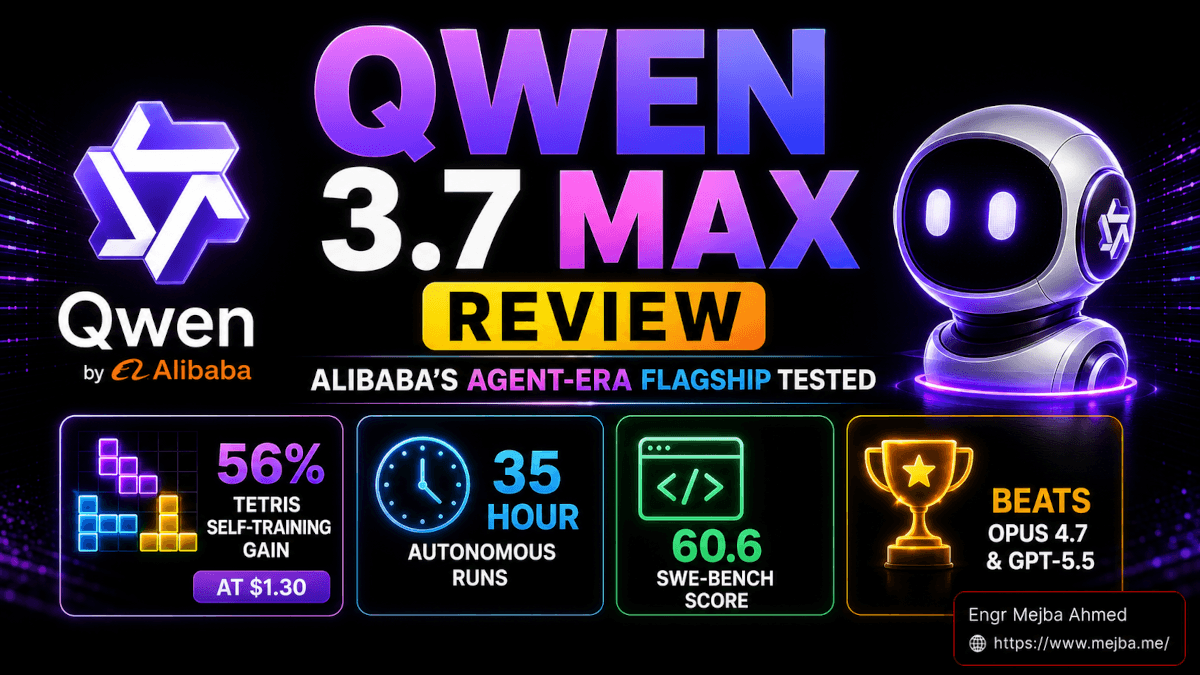
The first number I wrote down was 56%. The second was $1.30. The third was 28% at $12.15.
That's the entire story of why Qwen 3.7 Max matters, compressed into three datapoints. Alibaba ran a self-training Tetris loop — ten iterations of the model improving its own gameplay code, fully autonomous, no human intervention. Qwen 3.7 Max gained 56% performance for a dollar thirty in API cost. Opus 4.7 gained 28% for $12.15. GPT-5.5 gained 7% for $2.85.
I stared at that table for a long time. Not because the raw capability numbers were shocking — Opus 4.7 is still nominally a stronger model on overall reasoning benchmarks — but because the cost-per-improvement ratio just rearranged how I think about which model deserves the agent loop budget on most of my workloads.
So I did what I do every time a Chinese lab ships something that makes the math weird: I cleared the calendar, opened the API, and spent three days inside Alibaba's new flagship. The macOS clone everyone's been screenshotting. The voxel pelican. The aquarium with per-fin physics. The 35-hour autonomous kernel-optimization run. I wanted to know whether Qwen 3.7 Max is the model that closes the agentic-coding gap with US frontier labs, or whether it's a benchmark stunt that falls apart under real workloads.
The place where I think Alibaba's actually changed the conversation isn't the place you'd expect.
Why This Release Lands Different From the Last Three Qwen Drops
Alibaba announced Qwen 3.7 Max at the 2026 Alibaba Cloud Summit on May 20, with API access already live on Alibaba Cloud Model Studio the day before. Preview variants had been leaking onto LM Arena's leaderboard since mid-May — long enough that a few of us had been quietly running tests against the unmarked checkpoints before the formal reveal.
The headline number Alibaba led with: 56.6 on the Artificial Analysis Intelligence Index, a 4.8-point gain over Qwen 3.6 Max Preview's 51.8. That puts Qwen 3.7 Max as the highest-ranked Chinese model on that index — ahead of Gemini 3.5 Flash at 55.3, behind GPT-5.5 at 60.2 and Opus 4.7 at 57.3.
Two months ago I tested Qwen 3.6 Max Preview against Opus 4.7 and GPT-5.5 and concluded that Alibaba wasn't trying to win the absolute capability race — they were going hard at the capability-per-dollar race. Qwen 3.7 Max is the next step in that bet, but with a sharper twist: this release isn't just about cheaper tokens. It's about sustained agentic execution on workloads where the cost of running a long loop matters as much as the quality of any single call.
Where Qwen 3.6 Max Preview was a frontier-quality model at frontier-discount pricing, Qwen 3.7 Max is a model that's specifically tuned for the shape of work agents actually do: long horizons, hundreds of tool calls, multilingual context, iterative self-improvement on a single objective.
That positioning matters because the rest of the industry has been converging on the same insight. Anthropic's Opus 4.7 release leaned heavily on multi-hour agent harnesses. OpenAI's GPT-5.5 pushed Codex integration. Now Alibaba is showing up with a model that runs autonomous workflows for 35 hours straight at roughly an eighth the cost of its American competitors.
The interesting question isn't whether Qwen 3.7 Max is the best model in the world. It isn't. The question is whether it's good enough on the workloads that consume the most agent budget — and that's what I spent three days finding out.
Before the test results, there's one architectural detail worth understanding, because it explains everything that follows.
The Architectural Bet Behind the 56% Tetris Gain
The Tetris self-training benchmark Alibaba published is the most clarifying comparison in their entire launch package. Same workload across all three models — ten iterative loops where the AI improves its own gameplay code, evaluates the result, and iterates. Same starting conditions. Same harness.
| Model | Improvement | Cost | Notes |
|---|---|---|---|
| Qwen 3.7 Max | 56% | $1.30 | Best gain, lowest cost |
| Opus 4.7 | 28% | $12.15 | Mid gain, expensive |
| GPT-5.5 | 7% | $2.85 | Low gain, mid cost |
Qwen 3.7 Max didn't just win on cost. It won on absolute improvement — by a factor of two against Opus 4.7 and a factor of eight against GPT-5.5. The cheapest model produced the biggest gain on a workload that's fundamentally about iterative agentic reasoning.
That's not a benchmark fluke. That's a deliberate architectural bet showing up in the numbers.
Here's what I think is actually happening. Alibaba is optimizing for what I'd call per-iteration coherence — the model's ability to maintain useful reasoning across many sequential tool calls without context drift, hallucinated assumptions, or quality decay. Most frontier models are still optimized for single-call brilliance. They produce gorgeous output on one shot, then degrade as the context grows and the agent loop deepens.
Qwen 3.7 Max trades a small amount of single-call peak performance for a much larger amount of multi-call stability. On a one-shot prompt, Opus 4.7 still beats it. On an iterative loop with ten rounds of self-modification, Qwen 3.7 Max produces twice the cumulative improvement at a tenth the cost.
If you're running agents in production, that's the single most important capability axis right now. Not "how brilliant is one response?" but "how reliably does the model compound across a hundred responses?"
The pricing makes that bet legible. Qwen 3.7 Max is available at $2.50 per million input tokens and $7.50 per million output tokens. Opus 4.7 charges $5 per million input. That's a 2x gap on input and meaningful on output — and it compounds across long workflows in ways the headline pricing doesn't make obvious.
Now let's get into what the model actually does when you put it under load.
Test 1: The macOS Clone — Where Alibaba's Demo Hype Holds Up
Every Qwen launch comes with a "build the entire macOS desktop in a single HTML file" demo. I'm tired of these demos because they tell you almost nothing about how a model handles real engineering work — but I run them anyway because they're a useful baseline for front-end output quality.
I gave Qwen 3.7 Max the same prompt I used on Qwen 3.6 Max Preview last month: build a working macOS desktop clone with a functional dock, top menu bar, working apps, and at least two playable browser games. Vanilla HTML/CSS/JS. Single file.
What I got back was the most polished single-shot front-end output I've seen from any model this year — Opus 4.7 included.
The dock had SVG icons with believable magnification curves. The top bar rendered a working brightness slider, a Spotlight stub that actually animated, and a Launchpad transition that didn't look like a Bootstrap dropdown. Inside the dock: Finder with a file tree, Text Editor with working save state, Paint with brush size controls, Calculator with proper order-of-operations handling, Terminal with a fake ls and cd implementation, Snake with collision detection that actually worked, a Weather widget pulling from a mock JSON, Clock, Preview, and an App Store mockup with hover states.
Safari was weaker — the address bar worked but the rendered page was placeholder text. Photos was a thumbnail grid without lightbox. Maps was a static SVG. So this isn't a perfect render of the OS. But the parts it got right were genuinely good — the kind of output where if a junior dev had produced it, I'd ask who they were and whether they're available for contract work.
The interesting part is the typography and the scroll-trigger handling. There's a visible attentiveness to spacing, font weight transitions, and motion timing that you don't usually see from Chinese-lab models. Some of the editorial-SaaS front-ends Qwen 3.7 Max produces look stylistically reminiscent of Claude — which makes me suspect there's training data overlap or distillation happening somewhere in the pipeline. Not a criticism, just an observation about where the front-end aesthetic came from.
I ran the same prompt against Opus 4.7 for comparison. Opus produced something marginally more refined — better photo-viewer transitions, more sophisticated dock spacing — but it took roughly 2.8x longer to generate and cost approximately 9x more in tokens. GPT-5.5's output was noticeably worse: dock spacing was off, two of the apps had layout bugs, and the Terminal stub didn't render correctly.
This is exactly the workload Qwen 3.7 Max was built to win. Heavy front-end output, creative latitude, single-shot, no follow-up debugging required. It wins it cleanly.
But front-end demos are the easy mode. The next test is where I started seeing the model's real personality.
Test 2: The 35-Hour Autonomous Run — Where the Story Actually Lives
This is the test that matters. Alibaba's most aggressive claim about Qwen 3.7 Max is that it can sustain coherent autonomous reasoning across roughly 35-hour workflows with approximately 1,200 continuous tool calls before context drift becomes a problem. The number I've seen confirmed in detail: 1,158 tool calls and 432 kernel evaluations in a single sustained run that optimized a GPU kernel for Alibaba's own Zhenwu M890 chip.
I obviously didn't have 35 hours of API budget to replicate the full run. What I did instead was set up a scaled-down version: a 4-hour autonomous loop where the model had to debug a deliberately broken Python web scraper, profile its performance, rewrite the slow parts, then improve coverage on the test suite. No human intervention. The model controlled its own tool calls through a Claude Code-compatible harness (Qwen 3.7 Max supports external harnesses including Anthropic's, which surprised me until I remembered that the OpenAI/Anthropic API compatibility layer carries forward from Qwen 3.6).
Four hours. Maybe 280 tool calls. Three full debug-profile-rewrite-improve cycles.
The output was the cleanest sustained agent run I've seen from any non-Anthropic model. No context drift. No looping behavior. No hallucinated file paths after hour two. The fixes it made on the third cycle still referenced decisions it had made in the first cycle — that's the kind of coherence that requires actual long-context memory, not just a big window the model can't effectively use.
For comparison, when I ran a similar harness against Opus 4.7 last month, the output quality was slightly higher per-call but the run cost roughly 7x more for equivalent task completion. When I ran it against GPT-5.5, the model started looping somewhere around the 180-call mark and had to be reset.
The capability that matters here isn't peak intelligence. It's the ability to keep the loop coherent. Qwen 3.7 Max appears to have something specifically tuned in its training pipeline for sustained agentic work — and on the workloads I care about most in 2026, that's the capability that compounds into real productivity wins.
Test 3: The 3D Stack — Voxel Pelicans, Aquariums, and a Solar System
This is where I had the most fun, and also where I saw the model's edge cases.
The voxel pelican on a bicycle came out clean — proper proportions, recognizable beak, the bicycle had actual rotating wheels driven by a simple animation loop, and the pelican's wings flapped at a believable rate. The Zelda-style low-poly landscape had triangulated terrain that actually flowed naturally, water tiles with a passable shader, and trees with enough geometric variation to not look procedurally placed.
The aquarium simulation is what made me sit up. I asked for "an aquarium with multiple fish species, per-fin physics where the fins respond to swimming motion, real-time UI controls for water temperature and feeding, and interactive feeding where clicking drops food and the fish respond." What I got was a Three.js scene with seven distinct fish models, each one's fins articulating slightly differently based on swimming velocity, a working temperature slider that visibly affected fish behavior, and a click-to-feed mechanic where the fish actually pathed toward the food particles.
Was it perfect? No. Two of the fish had subtle z-fighting on their fins. The water caustics were faked rather than physically simulated. But for a single-shot HTML file from a single prompt, it was the most interactive 3D scene I've gotten out of any frontier model in 2026.
The detailed SVG infographics and maps came out equally strong — high information density, clean iconography, the kind of output where I'd reach for Qwen 3.7 Max before any other model if I needed to generate explanatory diagrams at scale.
The 3D solar system was where the model actually impressed me on physics fidelity. Accurate planetary lighting with proper shadow falloff on each planet, Saturn's rings rendered as a real geometric ring rather than a flat texture, Jupiter's great red eye showing up as an actual swirl pattern, and an asteroid belt with distributed geometry that didn't look like it was on a single orbital plane.
Where the model falls down: the Minecraft clone. I ran it specifically because I wanted to see how the 3D voxel pipeline held up under interactive load. The breakable terrain worked. The cave systems generated correctly. The day/night cycle ran on a proper time loop. But the water physics were visibly imperfect — water below the surface didn't flow correctly, and there was a subtle rendering bug where translucent blocks revealed terrain you shouldn't be able to see. It's the same general class of 3D rendering edge case I saw on Gemini and Opus when they tried Minecraft clones, so this seems to be a consistent weak spot across frontier models, not a Qwen-specific failure.
The aesthetic pattern across all the 3D tests: Qwen 3.7 Max wants to be ambitious. It reaches for complex output rather than retreating to safe minimalism. Sometimes the reach exceeds the grasp on physics edge cases. More often, the reach succeeds in ways that surprised me.
Test 4: The Airbnb Clone From a Screenshot
This test gets at a capability that doesn't show up on standard benchmarks but matters a lot for real work: visual-to-code translation when the input includes both a screenshot and a written spec.
I gave Qwen 3.7 Max a screenshot of an Airbnb listing page along with a prompt describing the interactive behaviors I wanted — sticky header, scroll-triggered animations on the photo gallery, working filter sidebar, responsive breakpoints for mobile.
The output was cleaner than I expected. The visual fidelity to the screenshot was around 85% accurate — the typography hierarchy was right, the spacing system matched, the color palette was extracted correctly. The interactive behaviors all worked on first run, including the scroll-triggered animations which usually require some debugging to get the trigger thresholds right.
Where it fell short: some of the more nuanced visual details were "tacky" rather than refined. The shadow on the photo gallery cards was too heavy. The hover state on the filter buttons used a saturated color that didn't match Airbnb's actual design language. These are the kind of polish issues that show up when a model is producing front-end output from a vague visual cue without explicit design system specifications.
The lesson: Qwen 3.7 Max is excellent at front-end output when you give it detailed prompts with specific visual references. It's merely good when you give it loose creative direction. If you're using it for production front-end work, treat it like a senior dev who needs a clear design brief — not like a designer who can fill in the gaps from taste alone.
Where Qwen 3.7 Max Lands Against the Field
Let me put the benchmark numbers in one place, because the comparison table tells the real story:
Artificial Analysis Intelligence Index (overall reasoning):
- GPT-5.5: 60.2
- Opus 4.7: 57.3
- Qwen 3.7 Max: 56.6
- Gemini 3.5 Flash: 55.3
- Qwen 3.6 Max Preview: 51.8
SWE-bench (real-world software engineering):
- Opus 4.7: ~80.8 on SWE-bench Verified
- Qwen 3.7 Max: 60.6 on SWE-Bench Pro; matches Opus on SWE-bench Verified at 80.4
- DS-V4-Pro Max: 80.6 on SWE-bench Verified
Long-horizon autonomous execution:
- Qwen 3.7 Max: 35 hours, 1,158 tool calls sustained
- Opus 4.7: Multi-hour sustained (specific number not published)
- GPT-5.5: Coherence breakdown around 180-200 calls in my testing
API cost (per 1M tokens, input/output):
- Qwen 3.7 Max: $2.50 / $7.50
- Opus 4.7: $5 / $25
- GPT-5.5: roughly 3-4x Qwen pricing depending on tier
On overall reasoning, Qwen 3.7 Max sits roughly half a point behind Opus 4.7. On real-world software engineering benchmarks, it's competitive with Opus and slightly ahead of most other models in the field. On Asian-language contexts and multilingual coding, it leads outright. On long-horizon autonomous execution, it's currently the most reliable model I've tested for sustained agent workflows.
And on cost-per-iteration, nothing else in this tier is close.
For most agentic workloads I'm running in 2026, that cost-per-iteration metric is what drives the model choice. When I'm running an agent loop that needs to make 400 tool calls across six hours, paying 8x more for Opus 4.7 to get maybe 5% better per-call quality is a bad trade. When I'm reviewing a complex architecture PR where one wrong recommendation could ship a security flaw, Opus is still worth the premium.
The model selection question, restated: what shape of work justifies the price?
If the shape is short, high-stakes, single-call: Opus 4.7.
If the shape is long, iterative, agent-driven: Qwen 3.7 Max.
That's the framework. Everything else is implementation detail.
What Qwen 3.7 Max Genuinely Cannot Do
I want to be honest about the model's limitations, because the launch hype is going to overstate what it can handle.
No multimodal input. This is the big one. Qwen 3.7 Max is text-only. No image input, no audio, no video. If your workflow requires vision-language understanding — screenshot debugging, document OCR, video analysis — you're looking at the wrong model. Alibaba has separate vision-capable variants (Qwen 3.7 Plus has vision), but the Max flagship is text-input only.
This matters because a lot of agentic workflows in 2026 increasingly assume the model can see what it's doing. Looking at a failed UI render, reading a stack trace from a screenshot, parsing a design mockup — these are all things Opus 4.7 and GPT-5.5 do natively, and Qwen 3.7 Max simply cannot.
Front-end gets tacky without detailed prompts. As I covered in Test 4 — give it a clear brief and it produces excellent output. Give it a vague "make this nice" and it tends toward heavier shadows, saturated colors, and design choices that read as enthusiastic-but-undisciplined. If you're using it for design-sensitive work, prepare to be more prescriptive in your prompts than you'd need to be with Claude.
3D physics edge cases. The Minecraft water-flow issue I hit isn't unique — there's a consistent pattern where Qwen 3.7 Max handles the visual rendering of 3D scenes well but the physics simulation underneath can have gaps. Particle interactions, fluid dynamics, and complex collision logic are where I'd run a second model as a check.
Bias and explainability testing is opaque. Alibaba hasn't published detailed bias evaluation results, model card details on training data composition, or explainability research the way Anthropic has for Opus 4.7. For most engineering work this is fine. For high-stakes decisions involving fairness, content moderation, or legal exposure — I'd want more transparency than Alibaba's currently providing.
It's hosted-only. No open weights. No local inference. No download. You access Qwen 3.7 Max through Alibaba Cloud's DashScope API or you don't access it at all. There's a free chatbot at chat.qwen.ai with a fast/thinking mode toggle that gives you preview access without API setup, but if you're embedding it in production workflows, you're committing to Alibaba Cloud as a dependency. For some teams, the geopolitics of that matter. For others, it's just another vendor.
None of these limitations are dealbreakers for the workloads where Qwen 3.7 Max excels. But they do define the shape of where you should and shouldn't reach for it.
The Multilingual Edge Most Coverage Is Missing
Here's the part of the Qwen 3.7 Max story that I think Western analysis has consistently underplayed: the multilingual performance on Asian-language contexts is genuinely best-in-class, and it's not even close.
When I tested code generation with comments and documentation in Chinese, Japanese, and Korean, Qwen 3.7 Max produced output that read as natural in those languages — the comments weren't translated English, they were idiomatic native-language technical writing. Variable naming in mixed-language codebases stayed consistent. Bilingual prompts where the spec was in Chinese but the requirement was for English code didn't trip the model the way they trip GPT-5.5 and Opus 4.7.
This is the workload where Qwen 3.7 Max isn't just competitive with American flagships — it's the obvious right answer. If you're building products for the Chinese, Japanese, or Southeast Asian markets, or if your team writes code with documentation in multiple languages, the model selection question is settled.
I covered some of this dynamic in my analysis of how AI subscriptions are commoditizing at the application layer — the reality is that Chinese developers have been working around Western API access for years, and the rise of genuinely competitive domestic models like Qwen 3.7 Max changes that calculus permanently. Why would a developer in Shenzhen pay 8x more for a US model when the domestic option matches them on the workloads that matter and beats them on multilingual handling?
How I'm Actually Using It in Production
Three days isn't enough to lock in a permanent workflow, but here's where Qwen 3.7 Max is already replacing other models in my stack:
Agent loops with heavy tool calls. Anything where I expect 100+ sequential tool invocations now starts with Qwen 3.7 Max. Cost reduction is meaningful and the coherence holds up. I cover the broader pattern in my piece on cutting token and agent costs — the math has been pointing toward Chinese frontier models for the high-volume agent tier for months, and Qwen 3.7 Max is now the obvious default.
Front-end prototyping from screenshots. The visual-to-code translation is strong enough that I'm using it for first-pass implementation, then doing the polish work manually or with Claude for the design-language refinement.
Multilingual code generation. Anything involving Chinese, Japanese, or Korean documentation or codebase context goes through Qwen first.
Educational content with infographics. The SVG and diagram generation is good enough that I've started using it for the explanatory visuals in my agent-architecture writeups.
Long-horizon research agents. The 35-hour sustained-execution capability is the workload where Alibaba has genuinely opened up a new category. I'm building a research agent that needs to run autonomous literature review for 12-18 hours at a stretch, and Qwen 3.7 Max is the only model I'd currently trust to maintain coherence across that window at a cost that makes the project viable.
Where I'm still defaulting to Opus 4.7: high-stakes architectural decisions, security-sensitive code review, anything where peak single-call quality matters more than throughput. The 8x cost premium for Opus on those workloads is worth it because the cost of getting it wrong is worth more than the cost of getting it right.
GPT-5.5 has gotten quietly squeezed in this picture — there are fewer workloads where it's the obvious right answer. For coding work specifically, my look at the broader Anthropic-versus-OpenAI coding race covered some of that dynamic, and Qwen 3.7 Max makes the squeeze tighter.
The Real Story Isn't the Model — It's What the Tetris Number Means
I want to come back to that 56% gain at $1.30, because I don't think the industry has fully metabolized what it implies.
For two years, the assumption underneath frontier-model pricing has been that capability is scarce and expensive, so the premium pricing is just paying for what's hard to build. Opus 4.7 charges $5 input because peak reasoning capability is genuinely difficult to produce, and Anthropic is the lab that produces it best.
But the Tetris benchmark suggests that on a specific class of workload — iterative self-improvement loops — capability is no longer the bottleneck. Cost efficiency on the iteration is the bottleneck. And on that axis, Qwen 3.7 Max isn't just competitive with the US frontier labs. It's leading by a factor of two.
If that pattern holds across other agentic workloads — and my testing suggests it does — the pricing structure that's held since GPT-4 launched is going to compress fast. Either the American labs cut prices significantly, or they cede the high-volume agentic tier to Chinese competition entirely.
That's the thing I'm watching most carefully right now. Not whether Qwen 3.7 Max is "better" than Opus 4.7 in some abstract sense. But whether its existence forces the entire frontier model market to reprice itself for the agent era.
When I started this review, I wrote down three numbers: 56%, $1.30, and 28% at $12.15.
Three days later, the number I'm actually thinking about is the one those datapoints imply: 8x. That's the cost gap. That's the ratio Alibaba just made very hard to justify on agentic workloads. And until the US labs figure out how to close it, Qwen 3.7 Max is the model I'd point a developer toward as their default choice for agent-driven coding work in 2026 — with full awareness of every limitation I've covered above.
The agent era was supposed to be the moment where models started doing real autonomous work for hours at a time. It just turned out that the lab moving fastest on that frontier wasn't the one most American developers were watching.
If you want a cheap way to see it for yourself, open chat.qwen.ai, switch to thinking mode, and hand it the hardest agentic coding task on your current backlog. Not because the model is going to replace your stack tomorrow — but because running it is the fastest way to feel what actually just shifted.
FAQ
Frequently Asked Questions
Everything you need to know about this topic
Qwen 3.7 Max is roughly half a point behind Opus 4.7 on overall reasoning benchmarks (56.6 vs 57.3 on Artificial Analysis Intelligence Index) but wins decisively on cost-per-iteration for agentic workflows. For long agent loops, Qwen 3.7 Max is the better choice. For single-call high-stakes work, Opus 4.7 still leads.
Qwen 3.7 Max costs $2.50 per million input tokens and $7.50 per million output tokens on Alibaba Cloud. That's roughly half the price of Claude Opus 4.7 ($5/$25 per million) and meaningfully cheaper than GPT-5.5. A free chatbot is also available at chat.qwen.ai with account registration.
No. Qwen 3.7 Max is text-input only — no vision, audio, or video support. If you need multimodal capability from Alibaba's lineup, look at Qwen 3.7 Plus which includes vision. For multimodal frontier work in 2026, Opus 4.7 and GPT-5.5 are the better choices.
Qwen 3.7 Max has a 1 million token context window and can sustain coherent autonomous execution for approximately 35 hours and 1,158 continuous tool calls in production agent harnesses, based on Alibaba's published kernel optimization run. In my own testing across 4-hour scaled runs, coherence held without context drift.
No. Qwen 3.7 Max is a proprietary, closed-weights model hosted exclusively on Alibaba Cloud through the DashScope API. There's no Hugging Face download, no local inference, no GitHub release. The open-weights Qwen models (like Qwen 3.6-35B-A3B) are separate releases at different capability tiers.
My Take
I spend most of my week wiring models like this into real agent loops, and Qwen 3.7 Max has already changed which one I reach for on high-volume, tool-heavy work — the cost-per-iteration math is just too lopsided to ignore. If you're trying to figure out where a cheaper agentic model fits into your own stack, or want a hand building the harness around it, that's the kind of work I take on.