A model I couldn't download beat Claude Fable 5 on a public leaderboard, and I spent an afternoon trying to prove the number wrong.
That's the honest starting point for this Kimi K3 review. On July 17, Moonshot AI's newest model landed at the top of Arena.AI's Frontend Code Arena with a 1,679 Elo — ahead of Fable 5 and GPT-5.6 Sol, the two closed models most of us reach for when we want a UI that doesn't look like a bootstrap template from 2019. My reflex when a Chinese open-weight model tops a Western frontier model is skepticism. Leaderboards get gamed. Demos get cherry-picked. So I opened the API console and started feeding it the same prompts I use to stress-test everything else.
Here's the part that annoyed me: the number mostly held up. Not everywhere. Not on every task. But on the specific thing it claims — turning a vague design brief into clean, working front-end code — Kimi K3 is doing something I haven't seen an open model do before. And there's a catch buried in the release timeline that most of the launch-day coverage skipped right over.
Let me walk you through what I actually saw.
What Kimi K3 actually is (and what the numbers mean)
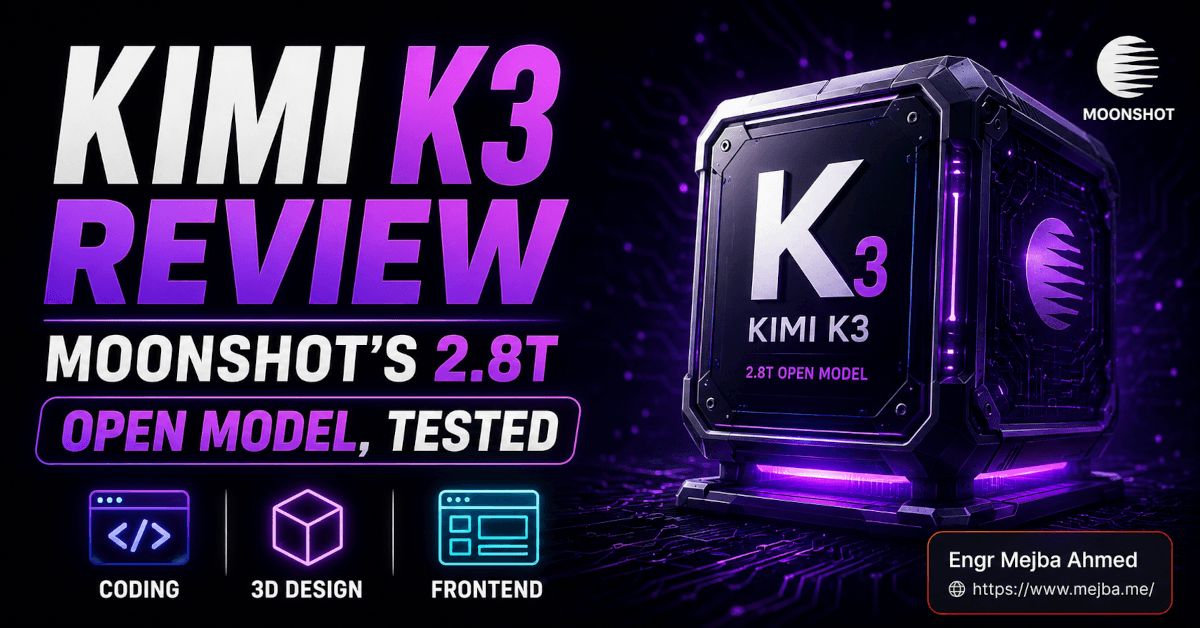
Kimi K3 is Moonshot AI's 2.8-trillion-parameter open-weight model, announced July 16–17, 2026, with a 1-million-token context window and native vision input. Moonshot is calling it the first open model in the "3T class," and on raw parameter count they're right — it's the largest open-weight model anyone has shipped.
But 2.8 trillion parameters is the headline, not the story. The story is how few of those parameters actually fire.
K3 uses a Mixture-of-Experts design that activates roughly 16 of 896 experts per token. So while the full weight file is enormous, the compute cost of any single forward pass is a fraction of what "2.8 trillion" implies. Moonshot pairs that sparsity with two architecture changes I hadn't seen before this release: Kimi Delta Attention (KDA) and Attention Residuals (AttnRes), both aimed at keeping information coherent across long sequences and deep layers. Their claim is roughly a 2.5x improvement in scaling efficiency over Kimi K2. Add MXFP4-style quantization-aware training and you get a model that's cheap to serve despite the terrifying parameter count.
Why does that matter to you and me instead of to a research lab? Because it's the reason the API pricing is what it is — and pricing is where this gets interesting.
If you want the broader open-model context, I compared three of last quarter's open-weight contenders in my breakdown of GLM 5.2 vs Qwen 3.7 Max vs Claude Opus 4.8, and the gap between "open and good" and "open and frontier-competitive" was still real back then. K3 is the first one that makes me want to redraw that line.
The pricing that changes the math
Kimi K3 runs about $3 per million input tokens and $15 per million output tokens through the API, with automatic context caching that drops the effective input cost sharply on repeated context.
That input price sits right around Claude Sonnet territory — not Opus, not Fable. And when Artificial Analysis measured cost per completed task on their agentic benchmark, K3 came in near $0.94 per task, slightly under GPT-5.6 Sol's ~$1.04 and roughly half of Claude Opus 4.8's ~$1.80.
Sit with that for a second. You're getting a model that trades blows with frontier systems on real benchmarks, at half the per-task cost of Opus, with weights that are supposed to become downloadable. If you run any kind of high-volume agent — browser automation, batch code generation, document processing — that's not a rounding error. That's the difference between a workflow being profitable and being a science project.
I've written before about how Fable 5 usage costs sneak up on you when you're running agents at volume. K3's pricing is the first open-weight answer to that problem that doesn't force you to accept a quality cliff. But "supposed to become downloadable" is doing a lot of work in that sentence, and I'll come back to it.
What I tested — and what I couldn't
Time for the honesty this Kimi K3 review is built on, because it matters for how you read everything below.
The open weights are not out yet. As I write this on July 18, 2026, Moonshot has scheduled the full weight release for July 27. That means nobody — not me, not the reviewers posting "self-hosted K3" threads, nobody — has actually run these weights on their own hardware yet. Everything anyone has tested so far, including everything I tested, runs through Moonshot's hosted API. So when you see "I tested K3," read it as "I tested the K3 API endpoint," not "I ran a 2.8T model on a box in my closet." Anyone claiming the latter this week is selling you something.
With that boundary drawn, here's what the live API let me actually probe: front-end generation, 3D/Three.js scenes, and multi-file coding tasks. Those are behaviors you can verify by looking at the output, which is exactly why I leaned on them instead of parroting scores.
Front-end and design: this is the real story
I gave K3 the prompt I give everything: "Build a landing page hero for a developer tools startup — dark, technical, with a subtle animated gradient and a code snippet that feels alive." No design system. No component library. Just vibes and a paragraph.
What came back was the closest an open model has gotten to the thing Fable 5 does well. The spacing had rhythm. The type scale was intentional instead of random. It reached for a restrained color system instead of dumping six accent colors on the page, and the animated gradient was tuned — slow, ambient, not the seizure-inducing default you usically get. I didn't have to talk it out of a purple-to-pink gradient, which is a small miracle in itself.
That lines up with the leaderboard claim rather than contradicting it. K3's #1 finish on the Frontend Code Arena at 1,679 Elo isn't measuring whether the code compiles — plenty of models clear that bar. It's measuring human preference on which rendered result looks and feels better. And on visual judgment specifically, K3 is making choices I'd expect from a mid-level product designer, not a code generator.
If your work touches design at all, this is the section to reread. I've spent a lot of words on the Claude design-to-website workflow, and my honest take is that K3 just became a legitimate second option for that exact job — at a fraction of the token cost.
3D and Three.js: impressive, with caveats
The demos flying around launch week lean hard on 3D — swinging-through-a-city games, isometric rooms, first-person shooters, all rendered in the browser with Three.js and WebGPU. Independent reports describe K3 building a browser-based open-world scene with procedural forests, a village, snowy mountains, and dynamic weather, using GPU compute for the heavy lifting.
I ran a scoped-down version: an interactive 3D product viewer — a rotatable object with clickable hotspots that reveal detail. K3 handled the scene setup, lighting, orbit controls, and interaction logic in one pass, and it ran without me touching the console. That's genuinely strong for a single prompt.
The caveat: single-prompt 3D demos are seductive and misleading. They look like magic in a screen recording and then fall apart the moment you ask for the twelfth feature or a specific physics tweak. I wouldn't ship a game off these outputs. I would use them as a scaffolding tool that gets me to a working prototype in minutes instead of hours. Judge the demos as "look how far the floor has risen," not "look, it's a game studio."
The 1M context window: what it's actually for
Everyone lists "1 million token context" like a spec-sheet trophy and moves on. Let me tell you what it changes in practice, because the KDA architecture is the reason it's usable instead of theoretical.
Long context windows fail quietly. A model claims a million tokens, you fill 400,000 of them, and by the end it's forgotten what you said at the start — the classic "lost in the middle" collapse. The whole point of Kimi Delta Attention and Attention Residuals is to keep information flowing coherently across that depth, and that's the difference between a context window you can market and one you can trust.
I tested it the way I'd actually use it: I pasted a mid-sized codebase — a few dozen files, plus the docs, plus an error trace — into a single request and asked K3 to find where a state bug originated across the whole thing. It held the thread. It referenced a helper defined near the top of the context against a call site buried far later, and connected them correctly. That's the use case that matters for real work: not "how big is the number," but "can it reason across an entire repo without me chunking it into ten prompts and stitching the answers together."
For agent workflows, that coherence plus the automatic context caching is the combination that makes long-context work affordable. You're not re-paying full price to keep the same repo in context across a dozen turns. On a browser agent or a long engineering session, that's the difference between a clever demo and a tool you leave running.
How far this jumped from the last Kimi
Some perspective, because I've been tracking this line. When I covered Moonshot's earlier model in my April 2026 roundup of Kimi, Spud, and Grok, Kimi was the interesting-but-not-frontier option — genuinely good open-weight coding, clearly a step behind the closed labs on the hard stuff. The K2.7 line pushed to around 60% on SWE-bench Verified, setting the open-source high-water mark, and even that felt like "great for open" rather than "great, full stop."
K3 is a different conversation. Moonshot's own number is roughly a 2.5x scaling-efficiency gain over K2, and you can feel it — the jump from "best open model" to "top-three model that happens to be open" is the leap the whole ecosystem has been waiting for. That's a bigger single-generation step than I expected, and it's the reason I stopped treating this as a footnote and spent a full afternoon on it.
Coding: strong, not a clean sweep
On multi-file coding, K3 is very good and occasionally first — but this is where the "beats everything" framing breaks down, and you deserve the nuanced version.
The verified picture: on Artificial Analysis's real-world task benchmarks, K3 ranked #1 in four of eight, including automation, spreadsheet, and browser-use tasks, and hit a state-of-the-art 91.2 on BrowseComp, the browser-navigation benchmark. On the broader GDPval-AA v2 benchmark spanning 44 occupations, it placed third overall at 1,687 — behind Claude Fable 5 Max (1,815) and GPT-5.6 Sol Max (1,748). On the AA-Briefcase agentic benchmark it took second at 1,527, edging out GPT-5.6 Sol Max and trailing only Fable 5 Max.
Read those together and the real position is clear: K3 is a top-three model that wins specific categories — browser automation, front-end, some agentic tasks — while the closed frontier still leads on the broadest general-capability measures. That's a much more useful thing to know than "it beats Fable 5," which is true on exactly one leaderboard and misleading everywhere else.
If you want the other side of that comparison, my GPT-5.4 coding model review still holds up as a picture of where the closed models sit on pure engineering tasks, and the gap on general coding hasn't fully closed.
If you'd rather have someone wire an open model like K3 into a real production workflow — agent pipelines, cost-optimized routing, self-hosted inference once the weights drop — that's the kind of build I take on. You can see my work at fiverr.com/s/EgxYmWD.
The catch nobody's leading with
Back to July 27, because it reframes the entire "open-source" pitch.
Right now, Kimi K3 is "open" the way a movie is "coming soon." The weights are announced, dated, and not in your hands. Until they land — and until someone confirms the license terms, which Moonshot hadn't fully detailed at announcement — K3 is functionally a hosted API model with an open-weight promise attached. That promise is credible; Moonshot delivered on the K2 line. But a promise is not an artifact, and I've watched enough "open" releases slip, ship under restrictive licenses, or arrive in a form too large for anyone outside a data center to actually run.
And that last point is the quiet one. Even after July 27, 2.8 trillion parameters is not something you're loading onto a single consumer GPU, or even a modest multi-GPU rig. "Open weights" here means open to organizations with serious hardware, or to the inference providers who'll host it for you. For most of us, "open" K3 will in practice mean "cheaper API from more vendors," not "runs on my machine." That's still a real win — competition drives prices down and keeps the closed labs honest — but it's a different win than the word "open" makes people picture.
If you want a genuinely run-it-yourself open model today, that's a different tier of tool. My DeepSeek V4 Pro open-source review covers models actually sized for self-hosting, and that distinction — frontier-open versus local-open — is the one I'd keep front of mind before you get excited.
Where Kimi K3 fits in your stack right now
Strip away the launch-week noise and here's the practical read.
Reach for K3 when the task is front-end generation, browser automation, or high-volume agentic work where cost per task decides whether the thing is viable. On those, it's competitive with frontier models at roughly half the cost, and the design quality is the best I've seen from anything open. For a browser agent processing thousands of tasks, that pricing genuinely changes what you can afford to build.
Stay on the closed frontier — Fable 5, GPT-5.6 Sol, Opus 4.8 — when you need top-end general reasoning, the hardest engineering problems, or the reliability of a mature, battle-tested endpoint. The benchmarks say the same thing my testing did: K3 wins categories, not the whole board.
And treat "open" as a July 27 milestone to watch, not a feature you have today. The interesting question isn't whether K3 beats Fable 5 this week. It's what happens to everyone's pricing when a top-three model becomes something a dozen inference providers can host and undercut each other on. That's the pressure this release actually applies.
What I'm watching next
Three things will tell us whether K3 is a real shift or a great demo.
The license. If the July 27 weights ship under a genuinely permissive license, commercial teams can build on it freely and the pricing pressure is immediate. If it's restrictive, K3 stays a cheap API and the "open" story shrinks.
Independent self-hosted benchmarks. Once real people run real weights on real hardware, we'll find out whether the hosted-API quality survives contact with third-party inference — quantization and serving choices can move quality more than people expect.
Whether the design quality is consistent or lucky. One good hero section is a demo. I want to see it hold across fifty briefs before I call it a reliable design tool. I ran maybe a dozen; the hit rate was high, but a dozen isn't a verdict.
I'll be running exactly that once the weights drop. For now, the honest verdict: Kimi K3 is the most impressive open-weight release I've tested this year, genuinely frontier-competitive on front-end and browser tasks, priced to make high-volume agents viable — and still a promise, not a download, until July 27.
Go run your own worst prompt through the API before you believe anyone's leaderboard. Including mine. That's the only Kimi K3 review that'll actually tell you whether it fits your work.
FAQ
Frequently Asked Questions
Everything you need to know about this topic
Kimi K3 is an open-weight model with the full weights scheduled for release on July 27, 2026 — as of mid-July they are announced but not yet downloadable, and full license terms hadn't been detailed at launch. Until then it runs only through Moonshot's hosted API. "Open" here means the weights are coming, not that you can run it today.
Kimi K3 costs about $3 per million input tokens and $15 per million output tokens through the API, with automatic context caching that lowers the effective input cost. On per-task cost, Artificial Analysis measured roughly $0.94 — under GPT-5.6 Sol and about half of Claude Opus 4.8.
On one specific benchmark — Arena.AI's Frontend Code Arena — Kimi K3 ranked first at 1,679 Elo, ahead of Fable 5. On broader measures like GDPval-AA v2, it placed third overall behind Fable 5 Max and GPT-5.6 Sol Max. So K3 wins specific categories (front-end, browser automation), not the whole board.
Not realistically. Even after the July 27 weight release, 2.8 trillion parameters requires serious multi-GPU or data-center hardware — it won't load on a consumer GPU. For most people, "open" K3 will mean cheaper API access from more inference providers rather than true local self-hosting.
Kimi K3 is strongest at front-end and UI generation, 3D/Three.js scene building, and browser-automation tasks, where it hit a state-of-the-art 91.2 on BrowseComp and #1 on the Frontend Code Arena. It's a top-three model overall that wins specific agentic and design categories rather than leading every benchmark.
Let's Work Together
Looking to build AI systems, automate workflows, or scale your tech infrastructure? I'd love to help.
- Fiverr (custom builds & integrations): fiverr.com/s/EgxYmWD
- Portfolio: mejba.me
- Ramlit Limited (enterprise solutions): ramlit.com
- ColorPark (design & branding): colorpark.io
- xCyberSecurity (security services): xcybersecurity.io