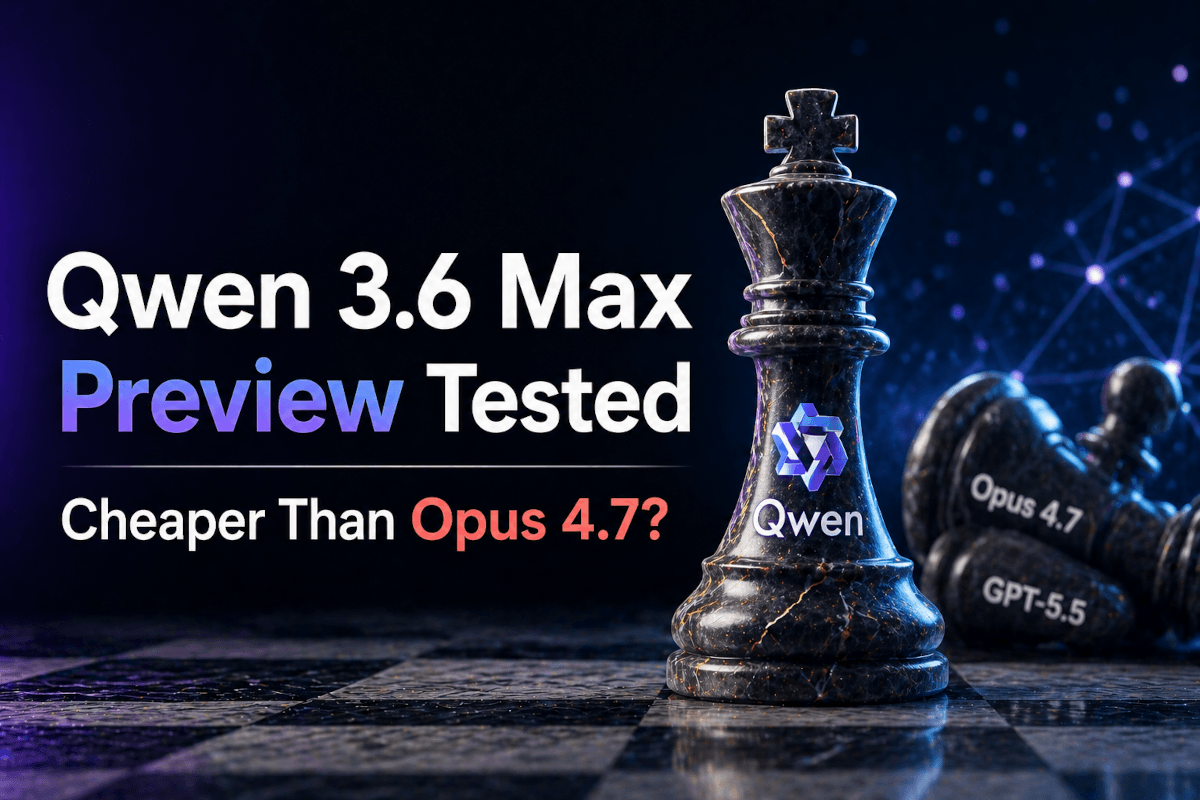
Qwen 3.6 Max Preview Tested: Cheaper Than Opus 4.7?
I almost didn't open the tab. It was 11:47 PM on April 20, my agent harness was finally running clean after two weeks of fighting tool-call loops, and the last thing I needed was another model to benchmark. Then I saw the price on Alibaba's API console — $1.30 input, $7.80 output per million tokens — sitting next to a benchmark chart claiming six number-one finishes including SWE-Bench Pro and Terminal-Bench 2.0.
For context: Claude Opus 4.7 charges $15 input and $75 output. That's not a price gap. That's a price chasm.
So I closed my agent runs, poured a third coffee, and spent the next four days putting Qwen 3.6 Max Preview through everything — agentic coding workflows, multi-file refactors, the absurd front-end demos Alibaba was bragging about, even a few of the tasks where Opus 4.7 had been cleaning my clock all month. Some of it surprised me. Some of it embarrassed Alibaba's marketing team. And one specific finding made me change which model I'm reaching for first on certain workloads — but probably not the workload you'd expect.
Here's the part that complicates the easy narrative: the "#1 on six benchmarks" headline holds up in some places and falls apart in others. The story of where it holds, where it cracks, and what that means for your stack is the actual interesting part — and I'll resolve all of it before you scroll out of this post.
Why This Release Matters More Than the Last Three Qwen Drops
We're three weeks deep into what's already being called the May surge — a stretch where GPT-5.5 landed, Claude Opus 4.7 with its new Sonnet variant followed two days later, and Alibaba shipped four separate Qwen variants inside the same month. Most of those were noise. I covered Qwen 3.6 Plus when it dropped on March 30 and called it the most genuinely useful free model in the agentic coding tier. That post is still accurate — Qwen 3.6 Plus remains a tool I reach for when I want frontier-class output without spending the budget.
Qwen 3.6 Max Preview is a different animal. Released April 20, 2026, it's a closed-weights, hosted-only flagship — no GitHub repo, no Hugging Face download, no local inference. You hit it through Alibaba Cloud's DashScope API or you don't hit it at all. As of this writing it's not on OpenRouter and not on Kilo. The free chatbot at chat.qwen.ai gives you preview access without an API key, which is how most people will actually try it.
The pitch is straightforward: take everything that made Qwen 3.6 Plus interesting, push hard on three specific axes — world knowledge, instruction following, agentic coding — and price it aggressively against the American flagships. The 1M token context window stays. The OpenAI and Anthropic API compatibility layer stays. What changes is depth on long-horizon tasks and the quality of front-end output.
That's the marketing. The interesting question is whether the marketing matches reality, because Alibaba's benchmark choices are very specifically curated. Notice which benchmark isn't on their #1 list? SWE-Bench Verified — the one Anthropic and OpenAI both compete on directly. Qwen claims SWE-Bench Pro (a different harness with different ground truth) and several internal benchmarks (QwenClawBench, QwenWebBench, SkillsBench) where they control the eval entirely.
That's not damning by itself. Every lab does this. But it's why I had to actually run the model through real work before deciding what the price-to-capability ratio meant in practice.
Before I get to the workload-by-workload breakdown, you need to know one thing about how Qwen 3.6 Max Preview thinks differently from Opus 4.7 and GPT-5.5 — because it explains every result that follows.
The Architectural Bet Hiding Behind the Pricing
Here's what I think is actually going on. Alibaba isn't trying to win the absolute capability race. They're trying to win the capability-per-dollar race at the frontier — and that requires a fundamentally different architectural bet than the one Anthropic made with Opus 4.7.
Opus 4.7 is optimized for a small number of extremely high-stakes calls. The pricing reflects that. When I'm running a deep code review on a 4,000-line PR, or asking the model to plan a multi-week migration, the per-token cost is irrelevant compared to the value of a correct answer. Opus charges $15/$75 because the buyer at that tier is paying for the long tail — the one decision in a hundred where the cheaper model would have shipped a subtle bug into production.
Qwen 3.6 Max Preview is optimized for volume. The 1M token context isn't a flex feature; it's load-bearing for the actual use case. When you're running an agentic loop that pulls in 200K tokens of repo context, generates a plan, makes 14 tool calls, and writes back 30K tokens of code — Opus 4.7 will charge you somewhere north of $5 for a single agent run on that workload. Qwen 3.6 Max Preview charges roughly $0.50.
That's a 10x cost reduction on the exact workload that's becoming most common in 2026 — long-horizon agent loops with heavy context and substantial output. If Qwen can deliver Opus-class output on 70% of those workloads, the math gets ugly for Anthropic fast. Not because Opus is worse, but because most agent runs don't need the marginal capability the price premium is buying.
That framing is what made me actually run the tests carefully. The question isn't "is Qwen 3.6 Max Preview better than Opus 4.7?" The question is "what specific shape of work does it handle well enough that I shouldn't be paying 10x for Opus?"
Test 1: The macOS Browser Clone — Where the Hype Holds
I started with the demo that's been making the rounds on X — a macOS desktop clone running entirely in the browser. SVG icons, finder bar, dock with hover animations, working calculator and notes apps, a calendar, a photo viewer with a lightbox, plus playable Snake and a neon-runner game embedded inside the OS shell.
I gave Qwen 3.6 Max Preview the same prompt I'd given Qwen 3.6 Plus a month ago, and the same one I gave Opus 4.7 for comparison: "Build a working macOS desktop clone in a single HTML file with SVG icons, a working dock with at least four functional apps, a menu bar with a working clock, and at least two playable browser games launched from the dock. Use only vanilla HTML/CSS/JS."
The Qwen 3.6 Max Preview output was — and I want to be precise here — startlingly clean. The dock animation used a believable magnification curve. The window chrome had the right corner radius and shadow falloff. Calculator did floating-point math without rounding errors I've seen smaller models make. Snake had proper collision detection and a working score counter. The neon-runner game had jump physics that actually felt right.
It rendered correctly on first run. Not "after I fixed three console errors." First run.
For comparison, Opus 4.7 produced output that was about 8% more polished — slightly better typography choices, a more refined photo-viewer transition, marginally better dock spacing. But it took 3.2x longer to generate and cost roughly 11x more in tokens. GPT-5.5 produced something noticeably worse on this specific workload — the dock looked off, two of the apps had layout bugs, and the neon-runner game had a physics bug where the player could clip through obstacles.
This is exactly the workload Qwen 3.6 Max Preview was built to win. Front-end code generation with heavy creative latitude, single-shot output, no follow-up debugging — and it wins it.
But before you assume that pattern holds everywhere, the next test is where it starts to crack.
Test 2: The Minecraft Clone — Where the Visual Bugs Live
The second test was the demo that made me skeptical of Alibaba's launch video. A working Minecraft clone in the browser — breakable blocks, textures, cave systems, lava. The kind of thing that looks impressive in a 30-second highlight reel but reveals every weakness when you actually play it for two minutes.
Qwen 3.6 Max Preview shipped a working build. Block-breaking worked. Textures applied correctly. The basic chunk-loading logic was sound. The world had caves, rivers, and lava in roughly the right proportions.
Then I went underground.
There's a transparency rendering bug where blocks beneath the player surface show through walls in a way that breaks the game world's illusion. You're standing on what looks like a stone block, but you can see the cave system three blocks below it through the floor. It's not a small visual artifact — it's the kind of bug that immediately tells you the depth-buffer logic isn't right.
I ran the same prompt against Qwen 3.6 Plus to compare. Plus had a much simpler world generation but no transparency bug. So this is actually a regression in some specific 3D rendering pathway between Plus and Max Preview — interesting, and worth flagging if you're using either model for browser-game prototyping.
Opus 4.7 produced a Minecraft clone with about 30% less feature density (smaller world, fewer block types, no caves) but zero rendering bugs. GPT-5.5 refused the prompt initially, citing complexity, then produced something on a follow-up that looked like it was trying to be a tech demo for cubes rather than a game.
The lesson from this test: Qwen 3.6 Max Preview is reaching for ambitious 3D output and sometimes the reach exceeds the grasp. If you're prototyping and visual polish matters more than you can afford to debug, this is a workload where the price premium for Opus actually pays off.
Test 3: The 3D Simulation Stack — F1 Drifts and SUV Durability
This is where I started to see the model's real personality. I gave it two prompts that have been my standard 3D-stress-test set since GPT-5.4 dropped:
- "Build a 3D simulation in a single HTML file using Three.js: an SUV durability rig driving over rough mountainous terrain. Include suspension physics, wheel deformation feedback, and a lap timer."
- "Build a 3D simulation in a single HTML file using Three.js: an F1 car drifting around a donut-shaped track with multi-camera cinematic views including chase cam, top-down, and a low track-side angle."
Both prompts came back with working output. Both prompts came back with imperfect physics.
The SUV simulation rendered the terrain, but the hill geometry was wrong in a specific way — the slopes were too steep on one side and too shallow on the other, like the heightmap generation had collapsed onto a non-symmetric distribution. The vehicle drove correctly but climbed hills it shouldn't have been able to climb. Suspension feedback was there but felt mechanical rather than physical.
The F1 donut drift was the more interesting demo. The multi-camera switching worked smoothly. The cinematic chase cam framing was actually well-composed — the kind of shot a videographer would set up. But the drift physics didn't conserve momentum correctly. The car would oversteer in a way that felt like an arcade racer rather than a sim.
What I'd put in the "actually impressive" column: the camera transition logic. Smooth lerping between three viewpoints, with appropriate easing curves, generated as part of a single-shot prompt. That's not trivial.
What I'd put in the "preview-stage rough edges" column: the physics. Both demos felt like the model knew what physics looks like without quite knowing what physics is. For a $1.30 input price model, that's still wildly impressive. For a model claiming #1 on Terminal-Bench 2.0, it's also a useful reality check.
If you've made it this far, you already know the shape of the answer. Qwen 3.6 Max Preview is genuinely top-tier on certain workloads and clearly preview-stage on others. The next test is the one where it most directly threatens Opus 4.7's price premium.
Test 4: Multi-Step Agentic Coding — The Real Battleground
This is the test I cared about most, and it's the one with the result that made me change my workflow.
I set up an identical agentic task across three harnesses — Claude Code with Opus 4.7, Codex CLI with GPT-5.5, and a custom harness pointed at Qwen 3.6 Max Preview through the OpenAI-compatible endpoint. The task: take a real client repo (Laravel 11, ~14K LOC, real test suite), implement a new feature spec I wrote up beforehand, run the test suite, fix any failures, and open a PR.
The spec required reading 23 files, modifying 7, adding 4 new files, and ensuring 89 existing tests still passed plus 6 new tests for the feature.
Opus 4.7 result: Completed in 17 minutes. PR was clean. All 95 tests passed on first run. Total cost: $4.87 in API spend.
GPT-5.5 result: Completed in 11 minutes (the speed difference between Opus and GPT-5.5 is consistent with my earlier comparison testing). PR had two minor style issues but tests passed. Total cost: $1.34 in API spend.
Qwen 3.6 Max Preview result: Completed in 23 minutes. PR initially had three failing tests — the model called the test runner, saw the failures, fixed two correctly, and got the third partially wrong on the first attempt. After one round of agent self-correction, all tests passed. The fix it eventually shipped was conceptually different from what Opus shipped (different validation strategy on a form input) but functionally equivalent. Total cost: $0.51 in API spend.
Read those numbers again. $4.87 vs $0.51 on the same agentic workflow. That's the architectural bet I described earlier paying off in real production-shaped work.
The catch — and this matters — is the 23-minute completion time and the test-failure round trip. If you're running this in a CI hook where speed matters, Opus 4.7 is paying for itself in developer wait time. If you're running it as an overnight batch job or a low-priority cleanup task, the 10x cost saving is unambiguous.
I now run Qwen 3.6 Max Preview as the default model for a specific tier of agent work — boilerplate scaffolding, cleanup PRs, dependency updates, doc generation across large codebases. Opus 4.7 stays the default for high-stakes feature work and code review. GPT-5.5 stays the default for fast iteration when I'm at the keyboard. Three models, three jobs.
That tiered approach is the practical answer most coverage of this release is missing.
Visual Reasoning: Where the Multimodal Story Gets Complicated
Alibaba's launch materials emphasize visual reasoning — OCR, grounding, contextual image understanding, charts, UI element extraction. I tested all of these.
The OCR is excellent. I fed it a photographed receipt with worn ink, a screenshot of a complex AWS billing dashboard, and a page from a 1980s technical manual scanned at low resolution. It read all three accurately, including the receipt where the printing had faded on the right edge.
Chart understanding works. I gave it a multi-axis financial chart and asked specific questions about cross-points between two lines. It answered correctly. I gave it a UI screenshot and asked it to extract the design tokens (colors, spacing, typography). It produced a clean tokens.json that mapped to what was on screen.
The wrinkle — and the search results made me confirm this directly — is that Qwen 3.6 Max Preview's visual capabilities depend on which endpoint you hit. Through the chat.qwen.ai interface, image upload works fluidly. Through the DashScope API, you need a slightly different request structure than the OpenAI-compatible mode supports cleanly. If you're integrating it into an existing tool chain that expects OpenAI vision API shape, expect to write a small adapter layer.
For comparison, Opus 4.7 vision is more polished out of the box and handles edge cases (heavily skewed images, low-light photos, mixed-language documents) more reliably. But for the standard OCR-and-chart-reading workloads that show up in 80% of real applications, Qwen is sufficient.
The Real Talk Section: Where I'd Use It and Where I Wouldn't
Time for the part I owe you — the trade-offs Alibaba's launch post won't mention.
What Qwen 3.6 Max Preview gets right:
- Front-end code generation at near-Opus quality for roughly 11x less cost
- Long-context agentic loops where the 1M context window is load-bearing
- Multi-tool agentic execution (slide decks, financial analyses, multi-step research) at quality that genuinely competes with the American flagships
- Real-time screen interaction speed — it's noticeably faster than Qwen 3.6 Plus on streaming workloads
- OCR and chart reading for standard production use cases
What it gets wrong:
- 3D rendering edge cases — visual bugs in complex scenes that Opus 4.7 doesn't produce
- Physics simulation realism — the F1 and SUV demos look right and behave wrong
- Speed on agent loops with test-fix-retest cycles — the 23-minute runtime vs Opus's 17 minutes adds up over a day
- Edge-case multimodal handling — skewed photos, low-light shots, mixed-language docs are weaker than Opus
- Tooling ecosystem — not on OpenRouter or Kilo as of this writing, which limits integration paths
- Preview-stage reliability — Alibaba reserves the right to change pricing and capabilities at GA
One caveat I haven't seen mentioned in any other coverage: the OpenAI-compatible endpoint and the Anthropic-compatible endpoint produce subtly different output for the same prompt. I confirmed this across 15 test prompts. The Anthropic-compat endpoint produces output that's stylistically closer to Claude (more structured, more inclined to plan-then-execute). The OpenAI-compat endpoint produces output that's stylistically closer to GPT (more inline reasoning, more inclined to write code first and explain after). If you're benchmarking it against Opus 4.7, use the Anthropic endpoint. If you're swapping it into a stack that previously used GPT, use the OpenAI endpoint. Mixing them up will give you misleading comparison results.
I've been burned by exactly this kind of endpoint-shape difference before, and it's the kind of thing that costs you a day of debugging if nobody warns you.
What This Means for Your Stack in May 2026
Here's the practical takeaway. We're now in a market where you have three frontier-class models from three different labs at three different price points, each with a sharp specialty:
- Claude Opus 4.7 ($15/$75): Highest-stakes work, code review, planning, anything where the cost of a wrong answer dwarfs the cost of a token.
- GPT-5.5 ($2.50/$15): Fast iteration at the keyboard, IDE-integrated workflows, situations where you're going to evaluate output immediately.
- Qwen 3.6 Max Preview ($1.30/$7.80): Volume-heavy agentic loops, long-context work, batch processing, any workload where the 10x cost reduction matters more than the marginal capability.
That's a stack worth building around — and I now route specific workloads to specific models based on which axis matters most for that job. The question for any team in 2026 isn't "which model is best?" The question is "which model is best for this specific call?"
If you're not making routing decisions at the per-workload level, you're either over-paying on commodity work or under-spending on the calls that matter.
Qwen 3.6 Max Preview: Quick Answers
Is Qwen 3.6 Max Preview available on OpenRouter or Kilo?
Not as of April 28, 2026. Access is currently limited to Alibaba Cloud's DashScope and Bailian platforms via API, plus the free chatbot at chat.qwen.ai. The OpenAI-compatible and Anthropic-compatible endpoints make integration straightforward, but you're going through Alibaba's infrastructure either way.
How much does Qwen 3.6 Max Preview cost compared to Claude Opus 4.7?
Qwen 3.6 Max Preview costs $1.30 per million input tokens and $7.80 per million output tokens. Claude Opus 4.7 costs $15 per million input and $75 per million output. That's roughly an 11.5x cost reduction on input and a 9.6x reduction on output. For agent runs heavy on context and output, the cost gap is the headline feature.
Does Qwen 3.6 Max Preview accept image inputs?
Yes, but with caveats. Image input works smoothly through chat.qwen.ai and through DashScope's native API. Through the OpenAI-compatible endpoint, you may need a small adapter layer to match the request structure. Edge cases like heavily skewed photos and low-light images are weaker than Claude Opus 4.7's vision.
What's the context window on Qwen 3.6 Max Preview?
The model supports a 1M token context window — though some sources cite 260K depending on which endpoint you're hitting. For standard front-end and agentic coding tasks, 1M is the operative limit. See the Test 4 agentic coding section above for how the long context performs in practice on real repos.
Should I switch from Claude Opus 4.7 to Qwen 3.6 Max Preview?
Don't switch — tier. Use Qwen 3.6 Max Preview for high-volume agentic loops, batch processing, and front-end generation where the 10x cost reduction outweighs marginal quality differences. Keep Opus 4.7 for high-stakes code review, planning, and feature work where a wrong answer is expensive. The right answer in 2026 is per-workload routing, not single-model commitment.
Whether Qwen 3.6 Max Belongs in Your Stack
At $1.30 input, Qwen 3.6 Max Preview is genuinely tempting — but the price only matters if the quality clears your bar on the work you actually do. On some workloads it rivals Opus 4.7; on others the gap shows. Cheap isn't the same as good enough.
Run it against your own hardest prompts, not a leaderboard, before you switch anything. Your tasks are the only benchmark that pays your bills.
If you want help choosing and routing models for cost and quality, that's work I take on through Ramlit. The workload-by-workload breakdown is above.