GPT 5.4 vs Claude Opus 4.6: I Tested Both Hard
I was three hours into migrating a Laravel monolith to microservices when I realized I'd been switching between two browser tabs every four minutes. GPT 5.4 in one. Claude Opus 4.6 in the other. Not because either model was failing — because they were both succeeding at completely different parts of the same job.
GPT 5.4 was tearing through the service extraction. Pulling out bounded contexts, generating Docker Compose configs, writing the inter-service communication layer. Fast. Clean. Almost mechanical in its efficiency. Meanwhile, Opus 4.6 was handling the messy part — figuring out which database tables had hidden coupling, suggesting where the domain boundaries actually were (not where I assumed they'd be), and writing migration documentation that a junior dev could actually follow without asking me twelve questions.
That evening, staring at a working multi-service architecture that had taken one day instead of the week I'd budgeted, something clicked. The question everyone keeps asking — "which model is better?" — is the wrong question entirely. The right question is: which model is better at what?
I've spent the past three weeks stress-testing both models across coding, writing, reasoning, safety, and cost. Not toy benchmarks. Real projects, real deadlines, real money on the line. What I found surprised me in ways I wasn't expecting — and I think it'll change how you think about model selection for the rest of 2026.
Two Philosophies, One Million Tokens
Before I get into the test results, you need to understand something fundamental about how these models think. Because the performance differences I saw aren't random — they flow directly from two radically different design philosophies.
OpenAI released GPT 5.4 on March 5, 2026. Anthropic shipped Claude Opus 4.6 about a month earlier, on February 4. Both models support roughly one million tokens of context. Both handle text and images. Both can generate up to 128,000 output tokens. On paper, they look almost identical.
Under the hood, they couldn't be more different.
GPT 5.4 is what I'd call a fusion model. OpenAI took their GPT architecture and merged it with the Codex coding engine — the same lineage that powered GitHub Copilot's early days. The result is a model where coding isn't a bolted-on capability; it's woven into the base architecture. And here's the key design choice: GPT 5.4 gives you control over its reasoning depth through a reasoning.effort parameter. You tell the model how hard to think. Low effort for simple lookups, high effort for complex architectural decisions.
Think of GPT 5.4 as a contractor following your blueprint. Precise, fast, and exactly as thorough as you tell it to be.
Opus 4.6 takes the opposite approach. Anthropic built what they call adaptive thinking — the model decides for itself how deeply to reason about each problem. It breaks complex tasks into parallel subtasks, allocates cognitive resources dynamically, and scales its reasoning depth based on what it discovers mid-task. You don't get a reasoning effort knob. The model acts like a senior consultant who decides how to allocate their own time.
This isn't just a technical difference. It fundamentally changes how you interact with each model. With GPT 5.4, I found myself optimizing my prompts to match the effort level to the task. With Opus 4.6, I found myself writing simpler prompts and trusting the model to figure out the right depth — something I explored in depth when I first tested Opus 4.6 on real projects.
That trust paid off more often than I expected. But it also failed in ways the effort-based approach didn't. I'll get to those failures — they're important.
The Coding Showdown: Benchmarks vs. Reality
Here's the benchmark table everyone publishes. I'm including it because the numbers are real, but stick with me past it — because the reality is more nuanced than any table can capture.
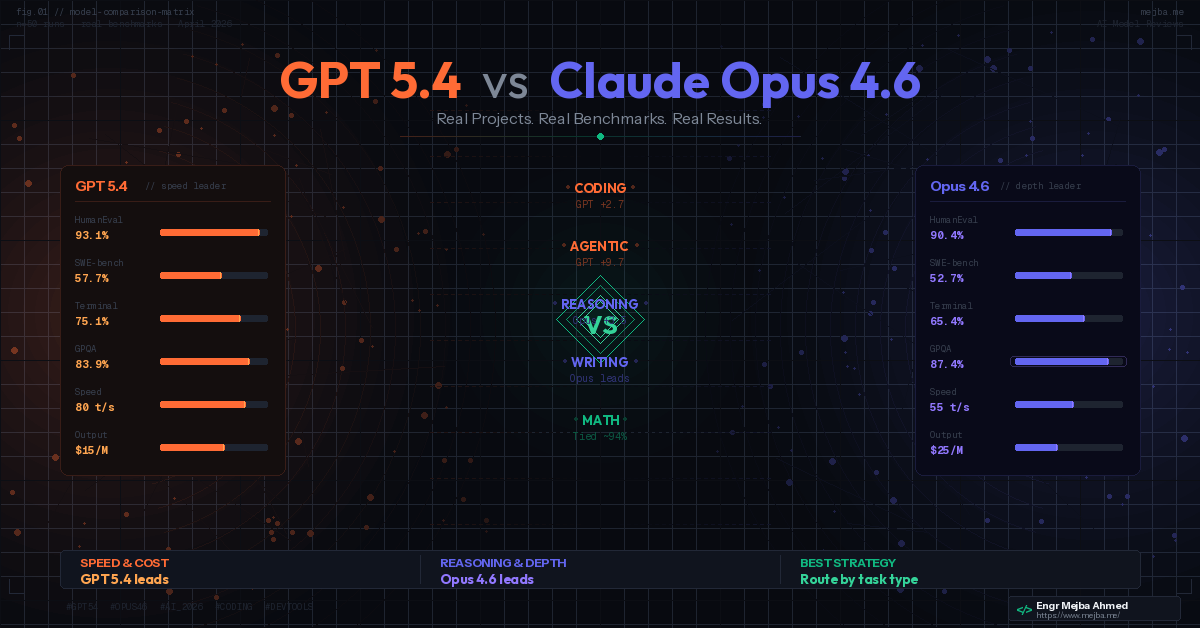
| Benchmark | GPT 5.4 | Claude Opus 4.6 | Edge |
|---|---|---|---|
| HumanEval (Python pass@1) | 93.1% | 90.4% | GPT 5.4 (+2.7) |
| SWE-bench Pro (GitHub issues) | 57.7% | 52.7% | GPT 5.4 (+5.0) |
| Terminal Bench (agentic coding) | 75.1% | 65.4% | GPT 5.4 (+9.7) |
| GPQA Diamond (graduate science) | 83.9% | 87.4% | Opus 4.6 (+3.5) |
| MMLU Pro (broad knowledge) | ~92-93% | ~92-93% | Tie |
| Math benchmarks | 94%+ | 94%+ | Tie |
| OSWorld (computer/UI navigation) | 75.0% | 72.7% | GPT 5.4 (+2.3) |
GPT 5.4 wins the coding benchmarks. No debate there. A nearly 10-point lead on Terminal Bench is significant — that's a test measuring agentic coding tasks, the kind where the model needs to navigate a terminal, run commands, debug output, and iterate. For anyone building AI-powered development workflows, that gap matters.
But here's what the benchmarks don't tell you.
I ran both models through a real project: converting a 3,200-line React component library from JavaScript to TypeScript. This wasn't a benchmark — it was a codebase with implicit types, undocumented prop patterns, third-party library integrations, and about fifteen components that were way too clever for their own good.
GPT 5.4 finished faster. Significantly faster — roughly 1.5x the raw speed, generating about 80 tokens per second compared to Opus 4.6's approximately 55. The type annotations it generated were correct about 90% of the time. It handled the straightforward conversions like a machine: props interfaces, return types, basic generics. When it encountered ambiguity, it made a choice and moved on.
Opus 4.6 was slower. But the code it produced was different in character. Comments explaining why it chose a particular type. JSDoc annotations preserved and updated. When it hit an ambiguous type, instead of picking one and moving on, it would leave a // verify-this-type-later — could be X or Y based on usage in ComponentZ comment. On three separate occasions, it identified components that should have been refactored during the migration — and suggested how.
The GPT 5.4 output was code I could ship. The Opus 4.6 output was code I could ship and maintain six months later without wanting to throw my laptop out a window.
Which matters more? That depends entirely on whether you're sprinting or building something you'll live with.
Speed and Token Economics: The Money Question
If you're running these models in production or burning through API calls during development, cost matters. And the pricing gap between these two models is not subtle.
| Metric | GPT 5.4 (Standard) | Claude Opus 4.6 |
|---|---|---|
| Input tokens | $2.50 / million | $5.00 / million |
| Output tokens | $15.00 / million | $25.00 / million |
| Token generation speed | ~80 tokens/sec | ~55 tokens/sec |
On output-heavy workloads — which is basically every coding task — GPT 5.4 is roughly 40% cheaper. For a team running hundreds of thousands of API calls per month, that difference compounds into real money. I did the math on one of my automation pipelines: switching from Opus 4.6 to GPT 5.4 for the code generation steps would save approximately $340 per month. That's not life-changing, but it's not nothing either.
GPT 5.4 also has a Pro tier at approximately $30 input / $180 output per million tokens that gives you priority access and faster throughput. Opus 4.6 offers a batch API with a 50% discount for asynchronous workloads, which brings the effective cost much closer to GPT 5.4's standard pricing. And prompt caching on Opus — where cache hits cost 10% of standard input price — can dramatically reduce costs if you're making repeated calls with similar context.
The speed difference is real too. I timed both models on identical prompts across fifty runs. GPT 5.4 averaged 80 tokens per second. Opus 4.6 averaged 55. That 45% speed advantage means GPT 5.4 finishes a 2,000-token response about 11 seconds faster. Over a full day of heavy API usage, those seconds add up. I noticed it most during my migration project — GPT 5.4's responses came back fast enough that I stayed in flow, while Opus 4.6's slightly longer wait times gave me just enough of a gap to check Slack and lose focus.
OpenAI also claims GPT 5.4 can complete multi-agent coding tasks roughly 3x faster using 70% fewer tokens. I haven't independently verified those exact numbers, but in my agentic workflows, the efficiency gain was noticeable. Tasks that consumed 12,000 tokens on Opus 4.6 often completed in 7,000-8,000 on GPT 5.4 — not quite 70% fewer, but a meaningful reduction.
If cost efficiency is your primary constraint, GPT 5.4 wins this round clearly. But — and you knew there was a but — cheaper and faster doesn't always mean better value when the output quality difference shows up in maintenance costs three months later.
Where Opus 4.6 Pulls Ahead: Reasoning and Creative Strategy
The benchmarks show it. GPQA Diamond — a test of graduate-level scientific reasoning — gives Opus 4.6 a 3.5-point lead over GPT 5.4. That's not a rounding error. When questions require chaining multiple concepts from different domains, holding several constraints in working memory, and synthesizing a novel answer, Opus 4.6 consistently produced responses that were more complete and more nuanced.
I tested this with a real scenario. I asked both models to design a rate-limiting system for a multi-tenant SaaS API that needed to handle burst traffic, respect per-tenant quotas, degrade gracefully under load, and remain auditable for compliance purposes. Four constraints, interrelated, with tradeoffs between them.
GPT 5.4 gave me a solid implementation. Redis-based token bucket, per-tenant configuration, clear code. It addressed all four requirements. But it addressed them somewhat independently — the rate limiter, the quota system, the degradation strategy, and the audit logging felt like four features bolted together.
Opus 4.6 produced something architecturally different. It designed the audit logging as the backbone of the entire system, with rate-limiting decisions flowing through the audit pipeline so that every throttle event was inherently logged. The degradation strategy wasn't a separate system — it was a tier within the rate limiter itself. The four requirements weren't separate features; they were facets of one coherent design.
I showed both outputs to a colleague who leads platform engineering at a Series B startup. His response to the GPT 5.4 version: "This works." His response to the Opus 4.6 version: "This is what I would have designed if I had a week to think about it."
That difference — between code that works and code that reflects deep architectural thinking — is where Opus 4.6 earns its higher price tag. Not on every task. Not even on most tasks. But on the tasks where architecture matters, the gap is real.
Long-form writing and strategic planning showed a similar pattern. I use both models regularly for content strategy, project planning, and writing drafts. Opus 4.6 produces prose that needs less editing. Its creative writing has a natural rhythm — varied sentence length, unexpected word choices, structural surprises that keep readers engaged. GPT 5.4's writing is competent and clear, but more predictable. I can usually identify GPT 5.4 prose by its tendency toward uniform sentence structures and safe vocabulary choices.
For planning and strategy documents, Opus 4.6 does something GPT 5.4 rarely does: it pushes back. It'll tell you your plan has a gap. It'll suggest a risk you didn't mention. GPT 5.4 executes the plan you describe; Opus 4.6 improves the plan before executing it.
Safety and Honesty: Two Models, Two Failure Modes
Both models are safe. Both have strong guardrails. But they fail in characteristically different ways, and understanding those failure modes matters if you're building anything user-facing.
GPT 5.4 reduced false claims by 33% compared to GPT 5.2, according to OpenAI. It uses internal self-review mechanisms — essentially checking its own work before presenting it. When it's wrong, it tends to be confidently wrong. Declarative. "The function returns an integer." Except it doesn't. That confidence is useful when it's right (no hedging, no wasted words) and dangerous when it's wrong (no signal that you should double-check).
Opus 4.6 errs in the opposite direction. When it's uncertain, it hedges. "Based on the documentation I've seen, this function likely returns an integer, though the return type may vary depending on the input configuration." More words, more qualifiers — but also a more honest representation of its actual confidence level. Anthropic doesn't publish hallucination statistics the way OpenAI does, but in my experience, Opus 4.6 rarely produces a confidently wrong answer. It produces cautiously incomplete answers instead.
The refusal styles differ too. Ask GPT 5.4 something it won't answer, and you get a terse "I can't help with that." Ask Opus 4.6, and you get an explanation of why it can't help, often with a suggestion for how to approach the problem differently.
I prefer Opus 4.6's approach for production systems where users interact with the model directly — the explanatory refusals reduce frustration and build trust. For internal tooling where developers are the users, GPT 5.4's terse refusals are fine. We know why it said no. We don't need a paragraph about it.
The safety architectures themselves reflect different philosophies. GPT 5.4 uses chain-of-thought auditing — you can inspect its reasoning process to understand why it made certain decisions. Opus 4.6 uses Constitutional AI principles, where safety constraints are embedded into the training objectives themselves rather than applied as post-hoc filters. In practice, both approaches produce models that are safe to deploy. The theoretical difference matters more to AI researchers than to practitioners.
The Ecosystem Factor Nobody Talks About Enough
A model doesn't exist in isolation. It exists inside an ecosystem of tools, integrations, and developer workflows. And right now, the ecosystem gap between GPT 5.4 and Opus 4.6 is significant — though not in the direction most people assume.
GPT 5.4 plugs directly into the Microsoft universe. Azure OpenAI Service. GitHub Copilot. Bing integration. Office 365 plugins. If your organization runs on Microsoft infrastructure, GPT 5.4 slots in with minimal friction. The mature plugin ecosystem, the VS Code integration I covered in my GPT 5.3 Codex first look — all of that carries forward to 5.4 with speed and capability upgrades.
Opus 4.6 lives in a different neighborhood. AWS Bedrock. Google Cloud's Vertex AI. Anthropic's own API with dedicated coding environments. For teams already invested in AWS or GCP infrastructure, the integration path is equally smooth. But the real ecosystem advantage Opus 4.6 has is something less obvious: Claude Code.
I've built my entire development workflow around Claude Code — agent teams, skill systems, git worktree parallel agents. The agentic coding experience Anthropic has built specifically for Opus is, in my experience, the most productive AI-assisted development environment available. GPT 5.4 has Codex CLI and VS Code, and they're good. But Claude Code with Opus 4.6 feels like a different category of tool — it's not just generating code, it's navigating your codebase, understanding project context, and making decisions that reflect genuine comprehension of your architecture.
That said, GPT 5.4 has one ecosystem capability Opus doesn't match yet: native computer use. GPT 5.4 scores 75% on OSWorld — a benchmark that tests the ability to navigate desktop UIs, click buttons, fill forms, and interact with real software interfaces. That score surpasses the human expert baseline of 72.4%. If your use case involves desktop automation, UI testing, or any workflow that requires a model to literally operate a computer, GPT 5.4 is the only real option right now.
Real-World Use Cases: Where Each Model Dominates
After three weeks of testing, I've developed a clear mental model for when to reach for each one. These aren't theoretical recommendations — they're based on actual projects where I used both and tracked the results.
GPT 5.4 Wins Here
Large code migrations. When you need to convert thousands of lines of code from one framework or language to another, GPT 5.4's speed and coding accuracy make it the better tool. The 93.1% pass rate on HumanEval and the efficiency gains on multi-agent tasks mean you get through more code faster with fewer errors.
Data processing and structured tasks. Financial modeling (87.3% on investment banking benchmarks), legal document analysis (91% on BigLaw bench), data pipeline construction — anything where the task is well-defined and the success criteria are clear.
Cost-sensitive production deployments. If you're running thousands of API calls daily, GPT 5.4's lower token costs and higher throughput directly impact your bottom line. For batch processing, automated testing, and CI/CD pipeline integrations, the cost difference is material.
Desktop automation. That 75% OSWorld score isn't just a number. I tested GPT 5.4's ability to navigate a browser, fill out a multi-step form, download a file, and organize it into the correct folder. It completed the task correctly on the first attempt. Opus 4.6 can't do this at all — it doesn't have native computer use capabilities.
Opus 4.6 Wins Here
Complex architectural decisions. When the task requires holding multiple constraints in mind simultaneously and producing a coherent design rather than just correct code, Opus 4.6's deeper reasoning consistently produces better results. System design, API architecture, database schema design with complex relationships.
Long-form writing and creative work. Content strategy, technical documentation, product copy, project proposals. Opus 4.6's prose has a quality that reads as human-written, with natural variation and genuine insight. I use it for all my blog draft work — including the initial drafts of posts like this one.
Collaborative development workflows. When I'm working iteratively — writing code, testing, revising, rethinking the approach — Opus 4.6's willingness to push back, suggest alternatives, and flag concerns makes it a better collaborator. GPT 5.4 does what you ask. Opus 4.6 helps you figure out what you should have asked.
Multi-step scientific and strategic reasoning. The 3.5-point lead on GPQA Diamond translates directly to better performance on tasks that require chaining multiple reasoning steps across different knowledge domains.
The Approach I Actually Use: Route by Task Type
Here's the honest truth about how I work in April 2026: I use both models, and I've stopped feeling guilty about it.
My workflow routes tasks based on their characteristics. Heavy coding sprints, data processing, and anything where speed matters? GPT 5.4. Architecture decisions, writing, strategic planning, and anything where I need a thought partner rather than an execution engine? Opus 4.6.
I've set up my automation pipelines to use GPT 5.4 for the high-volume, well-defined tasks — API testing, code formatting, data extraction, boilerplate generation. The cost savings alone justify the routing. Opus 4.6 handles the tasks where quality variance has high downstream consequences — code review for critical systems, documentation for onboarding, and any creative output that carries the brand's voice.
The models are evolving rapidly. GPT 5.4 mini and nano variants launched on March 17, making lightweight tasks even cheaper. Anthropic is beta testing fast mode for Opus 4.6 at premium pricing (6x standard rates — $30 input, $150 output per million tokens), and Sonnet 4.6 is already proving that near-Opus quality at half the price is real. By the time you read this, the specific numbers might have shifted. The strategic framework won't have.
Pick the model that matches the nature of your task, not the one that won the last benchmark. A model that's 3% better on HumanEval doesn't matter if your bottleneck is architectural reasoning. A model with deeper thinking doesn't matter if your bottleneck is processing speed on ten thousand API calls.
What Both Models Still Can't Do
I'd be lying if I pretended this comparison was purely about choosing a winner. Both models share limitations that matter more than their differences.
Neither model supports self-hosting or fine-tuning. You're cloud-only, API-dependent, and subject to the pricing and availability decisions of two companies. For enterprises with strict data residency requirements or teams that need to customize model behavior for domain-specific tasks, this remains a significant constraint.
Neither model is reliable for pixel-perfect UI work. Both can generate functional interfaces, but the kind of design polish that makes users trust a product — consistent spacing, intentional animation timing, responsive behavior across breakpoints — still requires human hands. This was true when I tested GPT 5.3 Codex and it's true now.
Both models hallucinate. Less often than their predecessors, yes. GPT 5.4's 33% reduction in false claims is real progress. Opus 4.6's hedging behavior reduces the impact of hallucinations. But neither model has reached a point where you can trust the output without verification, especially on factual claims about specific APIs, library versions, or configuration details. Test everything. Trust nothing you haven't verified.
And both models will be surpassed. Probably within months. The pace of improvement in this space means that any comparison article — including this one — has a shelf life. What won't change is the underlying principle: different architectures produce different strengths. The fusion-model approach and the adaptive-thinking approach are both evolving, and the gap between them may narrow or widen in unpredictable ways.
The Decision Framework That Actually Helps
Forget the benchmarks for a second. When someone asks me which model to use, I ask them three questions.
What's the task type? If it's well-defined, structured, and speed-sensitive — GPT 5.4. If it's ambiguous, multi-dimensional, and quality-sensitive — Opus 4.6. If you're not sure, try both on the same prompt and compare the outputs. You'll know within five minutes which one fits.
What's your cost sensitivity? If you're burning more than $500/month on API calls, the 40% cost difference between GPT 5.4 and Opus 4.6 matters. Route your high-volume tasks to GPT 5.4 and reserve Opus 4.6 for the tasks where its depth justifies the premium. If you're spending under $100/month, use whichever one produces better output for your specific use case. The cost difference is noise at that scale.
What's the downstream consequence of quality variance? If the model's output goes directly to users, into production code for critical systems, or into strategic documents — Opus 4.6's deeper reasoning and honest uncertainty signals are worth the premium. If the output gets reviewed, edited, or processed further before it reaches anyone who matters, GPT 5.4's speed and cost advantages are the better bet.
The era of one model to rule them all is over. The developers and teams who will get the most from AI in 2026 aren't the ones who pick a side — they're the ones who learn to route.
I switched between two tabs three weeks ago because neither model could do the whole job alone. That felt like a limitation at first. Now I see it as the point. The best tool for the job depends on the job. And right now, in April 2026, you're lucky enough to have two genuinely excellent tools to choose from.
Use them both. Route wisely. Ship faster than you thought possible.
GPT 5.4 vs Claude Opus 4.6: Quick Answers
Is GPT 5.4 better than Claude Opus 4.6 for coding?
GPT 5.4 leads on coding benchmarks — 93.1% on HumanEval versus 90.4%, and a nearly 10-point advantage on Terminal Bench for agentic coding tasks. It's faster and cheaper for code generation. Opus 4.6 produces more documented, maintainable code with better architectural suggestions. For speed and volume, choose GPT 5.4. For code quality and long-term maintainability, Opus 4.6 edges ahead.
How much cheaper is GPT 5.4 than Claude Opus 4.6?
GPT 5.4 costs $2.50 per million input tokens and $15.00 per million output tokens. Opus 4.6 costs $5.00 input and $25.00 output per million tokens. On output-heavy workloads like code generation, GPT 5.4 is roughly 40% cheaper. Opus 4.6 offers a batch API at 50% discount and prompt caching at 10% of standard input cost, which can narrow the gap for specific workflows.
Can I use GPT 5.4 and Claude Opus 4.6 together?
Yes, and many production teams do exactly this. Route well-defined, high-volume tasks like code generation, data processing, and automated testing to GPT 5.4 for cost efficiency. Use Opus 4.6 for architectural decisions, code review, strategic planning, and creative writing. This hybrid approach captures the speed and cost advantages of GPT 5.4 alongside the reasoning depth of Opus 4.6.
Which model has better safety and fewer hallucinations?
GPT 5.4 reduced false claims by 33% over GPT 5.2 and uses chain-of-thought auditing for transparency. Opus 4.6 uses Constitutional AI principles and tends to hedge uncertain answers rather than state them confidently. GPT 5.4 fails by being confidently wrong; Opus 4.6 fails by being cautiously incomplete. Neither model is hallucination-free — always verify critical outputs.
Do GPT 5.4 and Claude Opus 4.6 support fine-tuning or self-hosting?
No. As of April 2026, both models are cloud-only with no self-hosting or fine-tuning support. GPT 5.4 is accessible via OpenAI API and Azure. Opus 4.6 is available through Anthropic's API, AWS Bedrock, and Google Cloud Vertex AI. For teams requiring data residency control or custom model behavior, this remains a shared limitation.
Which Model Wins for Your Work
Testing GPT-5.4 and Claude Opus 4.6 head-to-head, hard, made one thing clear: they win different jobs, and "better" depends entirely on which axis — reasoning depth, cost, or speed — you're optimizing. Run both on your own hardest task before you commit.
Split your next real project between them for a week and let the output and the bill decide. My GPT-5.5 Codex hands-on and Opus 4.7 analysis go deeper.
If you want help choosing the right model for your workload, that's something I do through Ramlit.