Google Gemini 4: The Agentic AI That Actually Acts
It's May 2nd, 2026. Google I/O kicks off in seventeen days. And every person I know who builds with AI for a living is in the same weird mental state — half-skeptical, half-bracing for impact.
Because if the rumors are right, Google is about to do the thing nobody else has fully done yet. Not "smarter chatbot." Not "longer context window." Something stranger. A model that doesn't wait for your next prompt because it's already three steps into the task you just described.
I've spent the last eleven days digging through every leak, every developer preview rumor, every Polymarket prediction line, and — more importantly — every benchmark I can actually verify on Gemini 3.1 Pro, the model that's about to become the previous generation. What I'm about to walk you through is what I think Gemini 4 actually is, what it changes, how it stacks against GPT-5.5 and Claude Opus 4.7 right now, and the one thing about agentic AI that nobody on tech Twitter is being honest about.
This isn't a hype piece. I've been wrong about Google models before — I famously called Gemini 1.0 a "ChatGPT cosplay" in late 2023, and I'm still living that down. But what's coming on May 19 isn't another Gemini iteration. It's a category shift, and the people who understand the shift early are going to spend the next eighteen months running circles around the people who don't.
What Agentic AI Actually Means (Stop Calling Everything An Agent)
Let me get something off my chest before we go any further. The word "agent" has been beaten into mush over the last twelve months. Every wrapper around an LLM with a single tool-use call is now an "agentic AI platform." Half the time when somebody says "agent," they mean "ChatGPT with a Zapier connection."
That's not what's happening with Gemini 4. And that's not what Demis Hassabis means when he uses the word.
Agentic AI — the real version — has three properties that current chatbots don't:
1. Goal persistence across turns. A chatbot answers what you asked. An agent remembers what you're trying to accomplish and keeps optimizing toward it even when you go silent for two hours and come back with a tangentially related question.
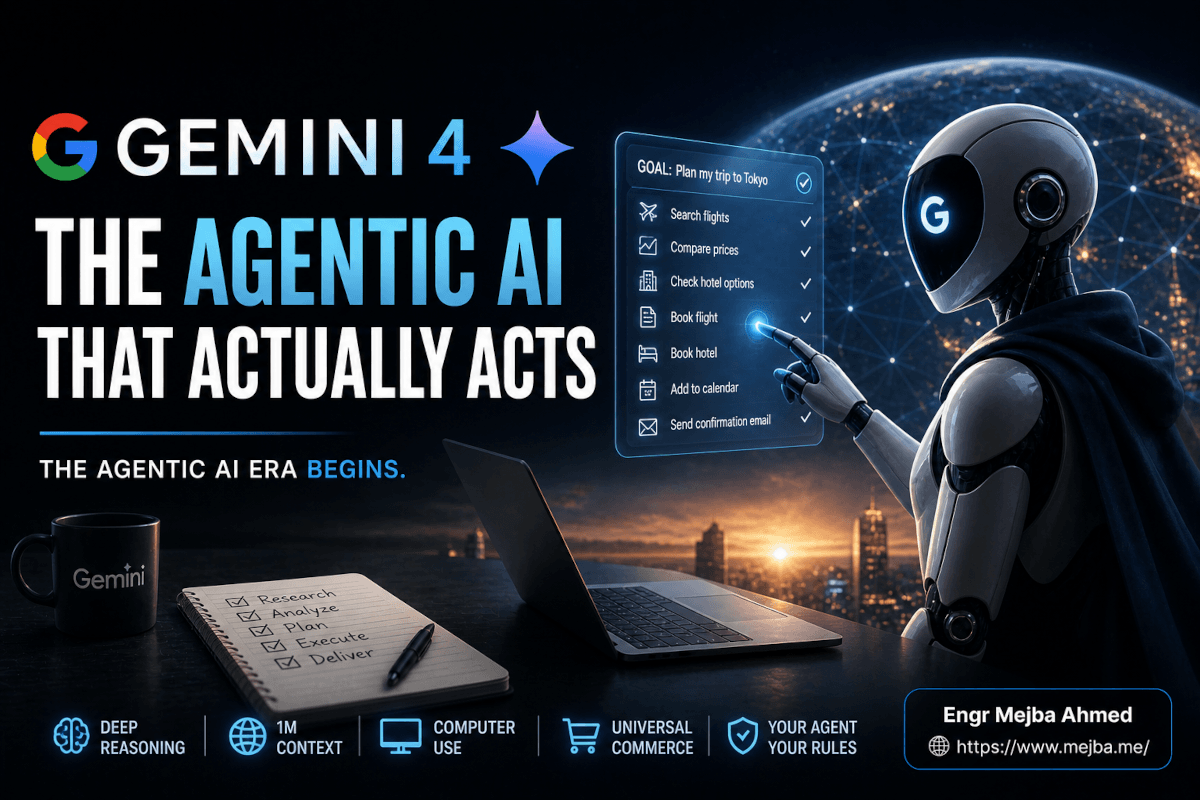
2. Autonomous tool selection and chaining. You tell a chatbot "search the web." You tell an agent "find me the cheapest direct flight to Tokyo next month with a window seat under nine hours" — and it picks Google Flights, parses results, filters by your saved preferences, cross-references your calendar, and only comes back when it has three options or a real obstacle.
3. Real-world consequence. This is the one nobody wants to say out loud. An agent doesn't just suggest. It executes. It books. It charges. It sends. The "send email" button is no longer in your hand — it's in the model's hand, and your hand is on the "approve" button.
This third property is what changes everything. And it's why the Universal Commerce Protocol that Google announced on January 11, 2026 matters more than most people realized at the time. UCP isn't just a shopping standard — it's the rails for AI models to actually transact on your behalf, with Adyen, Stripe, Visa, Mastercard, Shopify, Target, Walmart, and Home Depot already on board. When Gemini 4 ships with full UCP support — and every credible signal says it will — your AI assistant stops being a search engine and becomes a buyer.
That's the shift. Hold that thought, because it matters when we get to the comparison section.
The Evolution Nobody Mapped Out Until Now
Most people think of Gemini as a single product line that's been getting incrementally better. That's not what happened. Each generation was a strategic bet, and once you see the pattern, the trajectory toward Gemini 4 becomes obvious.
| Model | Released | The actual bet Google was making |
|---|---|---|
| Gemini 1.0 | December 2023 | "We can ship a flagship chatbot that competes with GPT-4." |
| Gemini 2.0 | December 2024 | "Native tool use is the future, not plugin marketplaces." |
| Gemini 2.5 | March 2025 | "Reasoning quality matters more than parameter count." |
| Gemini 3.0 | November 2025 | "Deep think is a real feature, not a marketing word." |
| Gemini 3.1 Pro | April 2026 | "Multimodal + 1M context + tool use is now table stakes." |
| Gemini 4 | May 2026 (expected) | "The model is the agent." |
Notice the pattern? Each release wasn't a feature dump — it was Google narrowing in on one thesis: that the future of AI isn't a smarter typewriter, it's an autonomous worker. Every version since 2.0 has been adding capabilities that only make sense if the end state is full agency.
Gemini 1.0 was a chatbot pretending to be agentic. Gemini 4, if the trajectory holds, will be an agent that can be a chatbot if you ask it nicely.
What I Expect Google to Actually Announce on May 19
Google I/O 2026 keynote is locked in for May 19 at 10 a.m. PT at Shoreline Amphitheatre. Two days. The agenda includes "agentic coding" and "latest Gemini model updates" — that's Google's word, not mine.
Here's what I'm genuinely confident we'll see, based on the developer preview leaks, the Polymarket lines (which were sitting around 60% for a Gemini 4.0 announcement before June 30 the last time I checked), and the trajectory of what Google has been quietly shipping in Gemini 3.1 Pro:
Multimodal that actually understands physics. Current Gemini 3.1 Pro can analyze video. Gemini 4 is rumored to reason about it — predicting what happens next in a clip, understanding causal relationships, generating physically-plausible video continuations. If you've watched a Veo 3 demo and thought "that's pretty," wait for Veo 4 paired with Gemini 4's world model.
Native audio output. Not text-to-speech bolted on. The model itself emitting audio as a first-class output modality, which means timing, emotion, and conversational pacing all become controllable in the same way text generation is. This is what makes phone-call agents finally not sound like robots.
1M-token persistent memory via MCP. This is the one I'm watching most closely. Gemini 3.1 Pro gives you a million tokens of context per session. Gemini 4 — if the developer preview chatter is real — extends that to persistent memory across sessions via Model Context Protocol. Your project state, your preferences, your in-progress work — all of it stays loaded between conversations. No more re-explaining your codebase every Monday morning.
Universal Commerce Protocol native support. Already running in Gemini Apps via the January 2026 update with Target as the launch partner. In Gemini 4, this becomes the default execution layer — meaning the model can actually buy things, book travel, settle invoices, and trigger Stripe payments inside the same turn it does the reasoning.
Agentic coding mode. Google explicitly confirmed agentic coding is on the keynote agenda. My read: this is Google's direct answer to Claude Code and Codex CLI. Expect a Gemini-powered coding agent that runs locally, has filesystem access, and can chain multi-file edits with self-verification. Whether it can dethrone Claude Code is a different question — I'll come back to that.
An Ironwood-powered serving infrastructure that makes pricing competitive. Google's Ironwood TPU pods deliver 42.5 exaflops at 9,216 chips per pod — over 24× the compute of El Capitan, the largest classical supercomputer. This is why Gemini 3.1 Pro is already priced at $2 per million input tokens versus $5 for GPT-5.5 and Claude Opus 4.7. Gemini 4 will almost certainly hold or extend that pricing gap.
What I'm less confident about: a true 10T-parameter model. The 10T number has been floating around since March, and while it's plausible based on Google's compute capacity, I'd put my own confidence at maybe 40%. Sparse Mixture-of-Experts is more likely than a dense 10T monster — same effective capacity, much cheaper to serve.
Gemini 4 vs GPT-5.5 vs Claude Opus 4.7: The Honest Comparison
This is the section everybody scrolls down to, so let me give it to you straight. I've been running all three flagships side-by-side for the last six weeks across coding, reasoning, multimodal, and agent workflows. The headline finding: there is no "best model" anymore. There are three models that win three different races, and which one you pick depends entirely on what you're actually building.
Here's my current scorecard, grounded in real benchmark numbers and my own production testing:
| Dimension | Gemini 3.1 Pro (today) → Gemini 4 (expected) | GPT-5.5 | Claude Opus 4.7 |
|---|---|---|---|
| Reasoning (GPQA Diamond) | 94.3% | 93.6% | 94.2% |
| Coding (SWE-Bench Pro) | Mid-50s | 58.6% | 64.3% |
| Terminal/agent loops (Terminal-Bench 2.0) | Strong | 82.7% | High |
| Multimodal | Native text/image/video/audio | Text/image | Text/image |
| Context window | 1M (persistent in Gemini 4) | 256K | 1M |
| Input cost (per M tokens) | $2 | $5 | $5 |
| Output cost (per M tokens) | $12 | $30 | $25 |
| Ecosystem depth | Search, Workspace, Android, Pixel, UCP | ChatGPT + plugins | Bedrock, Vertex AI |
| Speed (tokens/sec, P50) | Fastest, Ironwood-backed | Fast | Fast (coding-tuned) |
Source data: DataCamp's Opus 4.7 vs Gemini 3.1 Pro head-to-head, the Sagnik Bhattacharya benchmark roundup, and my own runs.
What that table doesn't show — and what I've learned the hard way — is the texture of using each model. Let me break it down by use case.
When I reach for Claude Opus 4.7
Long-form coding work where I need the model to hold the entire repo in its head and not lose the plot over a forty-step refactor. I wrote about why in my Opus 4.7 vs GPT-5.5 comparison — Claude Opus is the model that respects existing code patterns instead of imposing its own opinions. SWE-Bench Pro at 64.3% isn't an accident; it's the byproduct of training prioritization that Anthropic clearly made over the last two cycles. If I'm shipping production code and one of the models has to be right, Opus is still my pick.
When I reach for GPT-5.5
Terminal-heavy agent loops, research-style tasks, and anything that requires the model to plan-and-execute against a loose specification. Terminal-Bench 2.0 at 82.7% reflects something real — GPT-5.5 has the most refined "use a tool, observe the output, decide what to do next" loop of any frontier model right now. For autonomous research agents and data-analysis pipelines, this is the one. I covered the full developer angle in my GPT-5.5 status playbook.
When I reach for Gemini 3.1 Pro (and will reach for Gemini 4 even more)
Anything that crosses modalities. Anything where the Google ecosystem is the moat. Anything cost-sensitive. I built an entire video-analysis pipeline in my Gemini 3.1 Pro deep dive that would have cost three times as much on GPT-5.5 and wouldn't have worked at all on Opus 4.7 because video isn't a first-class input there. When Gemini 4 lands with persistent memory and native UCP, this gap widens — not because Gemini becomes "smarter," but because the surface area of what it can do without leaving its own context expands dramatically.
Here's the part nobody on the comparison threads says clearly: the "best model" question is the wrong question. The right question is "which model owns the workflow I'm building?" For Google-ecosystem workflows — Workspace, Android, Search, Shopping, multimodal anything — Gemini 4 is going to be untouchable on day one. For everything else, the race stays close.
The Industry Impact Is Bigger Than People Realize
Let me zoom out. Because focusing on benchmarks misses what's actually happening here.
When agentic AI ships at flagship-model quality — which Gemini 4 is on the cusp of doing — five things change at once:
1. Software development becomes management. I wrote about this transition in my piece on managing AI coding agents — but Gemini 4 is going to accelerate it. The dev who used to write three thousand lines a week is now reviewing twelve thousand lines a week generated by agents. The skill ceiling shifts from typing speed to specification clarity. This is going to filter out a lot of mid-level engineers who built their identity around output volume.
2. Business research collapses by 90%. Finance teams that used to spend three days building a market analysis can do it in forty minutes. Consulting firms that bill $200/hour for "research" services are going to feel margin compression nobody's pricing in yet. Anybody whose job is "synthesize information from public sources and summarize it" should be reading this paragraph carefully.
3. Productivity workflows go from assistive to autonomous. "Hey Gemini, plan my Q3 trip to Tokyo" stops being a question that returns a list of links. It becomes an operation that ends with three flight options booked tentatively, four hotel holds in your inbox, calendar blocks created for the meetings you mentioned, and a Slack message drafted to your team — waiting on your single approval.
4. Robotics finally has a brain. The thing missing from warehouse robotics, smart-home automation, and autonomous logistics for the last five years was a model capable enough to reason about real-world physics in real time. Gemini 4 plus a robotics arm is the combo that makes 2027 the year robotics actually works. Late-2026 integrations are already being signaled by Google — watch for Pixel-tier devices that aren't phones.
5. Browser-native agents replace SaaS workflows. If your product is a web app whose primary value is "we connect three APIs and present a unified interface" — your moat is on fire. Gemini 4 with UCP and MCP will do that connection itself, in the user's browser, without paying you a license fee. This is the existential thing for half the SaaS layer above the database tier.
I'm not catastrophizing. I'm describing what's already starting to happen. The gap between "this is possible" and "this is shipping" is now measured in months, not years.
The Thing Nobody Is Being Honest About
I want to do the uncomfortable part of this post now, because if I skip it I'm just hyping a product that hasn't even launched.
Agentic AI raises the cost of being wrong by an order of magnitude.
A chatbot that hallucinates costs you a wrong answer. An agent that hallucinates costs you a charge on your credit card. A flight booked for the wrong week. An email sent to the wrong client with the wrong attachment. A Stripe refund triggered against the wrong customer because two of them had similar names.
This isn't theoretical. I've already had a Gemini 3.1 Pro tool-use loop confidently call a Calendar API with the wrong timezone offset and create a meeting at 4am instead of 4pm. The model wasn't wrong about what I asked. It was wrong about a single context detail and confidently executed. That's the new failure mode, and it's worse than the old one because there's no draft to review.
Google knows this. Demis Hassabis has been remarkably consistent about this in every interview I've watched — AGI is still five to ten years out, Gemini 4 is a powerful tool that requires human judgment, and agentic actions need user confirmation gates. The roadmap leaks suggest Google is shipping Gemini 4 with mandatory confirmation prompts for any action that has financial, communication, or destructive consequences. That's the right call. It's also slower and more annoying than the demos suggest, and it's going to create a tension between "the agent is autonomous" and "the agent asks before doing anything important" that I don't think anyone has fully solved yet.
My personal rule, which I've been refining since I started building agent stacks: the agent autonomously decides, but the human autonomously approves. Anything irreversible — payments, sends, deletes, bookings — gets a human gate. Anything reversible — searches, drafts, scheduling on your own calendar — runs autonomously. Build your Gemini 4 workflows on that principle and you'll save yourself a lot of weekend cleanup.
There's another thing nobody's talking about: agentic models concentrate failure modes. When one model orchestrates ten tools, a single reasoning error cascades into ten wrong actions. The reliability math gets worse, not better, as you add capability — unless the underlying reasoning quality improves enough to compensate. Gemini 4 needs to be meaningfully more reliable than 3.1 Pro for the agentic flywheel to work in production. If it's just "10% smarter," the 10× action surface will eat that improvement and then some.
I'll be running my own breakage benchmarks in week one. Specifically: how often does the model commit to a tool action that it would have second-guessed if asked to verify? That's the metric that matters.
What I'm Doing Right Now (And What You Should Do)
Seventeen days. That's all I've got to prepare my own stack for what's about to land. Here's what I'm doing this week, in case it's useful:
1. Auditing every agent workflow I've built on GPT-5.5 or Claude Opus 4.7 for portability. Specifically: which ones depend on provider-specific tool-call formats, and which ones could swap models cleanly. Anything tightly coupled to OpenAI function-calling syntax is getting refactored toward MCP-compatible patterns. I covered the architectural reasoning in my piece on context-driven AI agents.
2. Provisioning Vertex AI access ahead of the rush. The day after I/O, the Gemini 4 developer preview waitlist is going to be brutal. I'm getting my project quotas, billing, and IAM roles set up now so I can apply on day one. Five minutes of paperwork now saves three weeks of "your application is being reviewed."
3. Writing the prompts I want to test on launch day. I have a folder of seventeen tasks I've benchmarked against every flagship model since GPT-4. Same prompts, same evaluation rubric, scored on output quality, latency, cost, and tool-use reliability. When Gemini 4 lands, I run it against the same suite within the first 24 hours. I'll publish the results.
4. Talking to my clients about UCP integration. Anybody running an e-commerce or SaaS business needs to be thinking about this now. If your product can be transacted against by an agent on someone else's surface, you need UCP-compatible endpoints by Q3. If you can't, your competitors who did will get the agent traffic. This is the silent disruption nobody's pricing in.
5. Re-reading the Gemini 3.1 Pro release notes. Because Gemini 4 isn't a clean break — it's an extension. Most of the patterns that work in 3.1 will work better in 4. Knowing what works now compounds into knowing what works next faster than anyone starting from scratch.
The Bottom Line, Without the Hype
Gemini 4 is not AGI. Demis Hassabis said it himself, and I believe him. It's not going to replace your judgment, your taste, or your relationships. It's not going to write a strategy that wins your category for you, and it's not going to know which clients matter and which ones don't.
What it is — if everything I'm projecting holds — is the first frontier model that genuinely acts on your behalf at flagship reasoning quality, plugged into the largest consumer ecosystem on earth, at the lowest serving cost in the industry, with a 1M-token persistent memory that finally makes "your AI" feel like yours.
That's not a chatbot. That's a workforce multiplier with a credit card.
I have seventeen days to get ready, and so do you. The people who walk into May 19 with their workflows audited, their MCP integrations sketched out, their UCP merchant feeds prepared, and their evaluation suites loaded — those are the people who get a six-month head start on whatever comes next. The people who watch the keynote on YouTube two days late and think "cool, I'll get to it next week" — those are the people who spend the second half of 2026 feeling vaguely behind and not quite knowing why.
Don't be the second group. The race already started. The starting gun just hasn't fired yet.
I'll be live-testing on May 19. If you want my unfiltered take, watch this space.
FAQ
Frequently Asked Questions
Everything you need to know about this topic
Google Gemini 4 is widely expected to be previewed at Google I/O 2026 on May 19, with a developer beta following in mid-2026 and a full public release likely in late 2026 or early 2027. Google has historically used I/O for announcements, with public API availability arriving weeks to months later. For the full timeline analysis, see the evolution section above.
There is no single winner. Claude Opus 4.7 leads on coding (SWE-Bench Pro 64.3%), GPT-5.5 leads on terminal/agent workflows (Terminal-Bench 2.0 82.7%), and Gemini 3.1 Pro (the predecessor to Gemini 4) leads on multimodal, ecosystem depth, and price ($2/M input vs $5/M for the others). Gemini 4 is expected to extend Google's lead on multimodal and agentic execution.
Agentic AI autonomously plans, selects tools, and executes real-world actions on your behalf — booking flights, sending emails, completing purchases via the Universal Commerce Protocol. A chatbot only responds to prompts. The shift from reactive to proactive is the core of what makes Gemini 4 a category change, not just an incremental upgrade.
The Universal Commerce Protocol is Google's open standard launched on January 11, 2026, that lets AI models transact directly with merchants. Backed by Stripe, Visa, Mastercard, Adyen, Shopify, Target, Walmart, and 20+ partners, UCP is the rails that turn Gemini from a search engine into an actual buyer. Gemini 4 is expected to ship with native UCP support out of the box.
Don't switch — diversify. Each flagship wins different races. Use Claude Opus 4.7 for production coding, GPT-5.5 for terminal-heavy agent loops, and Gemini 4 for multimodal work, Google-ecosystem integration, and cost-sensitive workflows. The right answer in 2026 is multi-model, not single-vendor. See the comparison section above for the full breakdown by use case.
Let's Work Together
Looking to build AI systems, automate workflows, or scale your tech infrastructure? I'd love to help.
- Fiverr (custom builds & integrations): fiverr.com/s/EgxYmWD
- Portfolio: mejba.me
- Ramlit Limited (enterprise solutions): ramlit.com
- ColorPark (design & branding): colorpark.io
- xCyberSecurity (security services): xcybersecurity.io