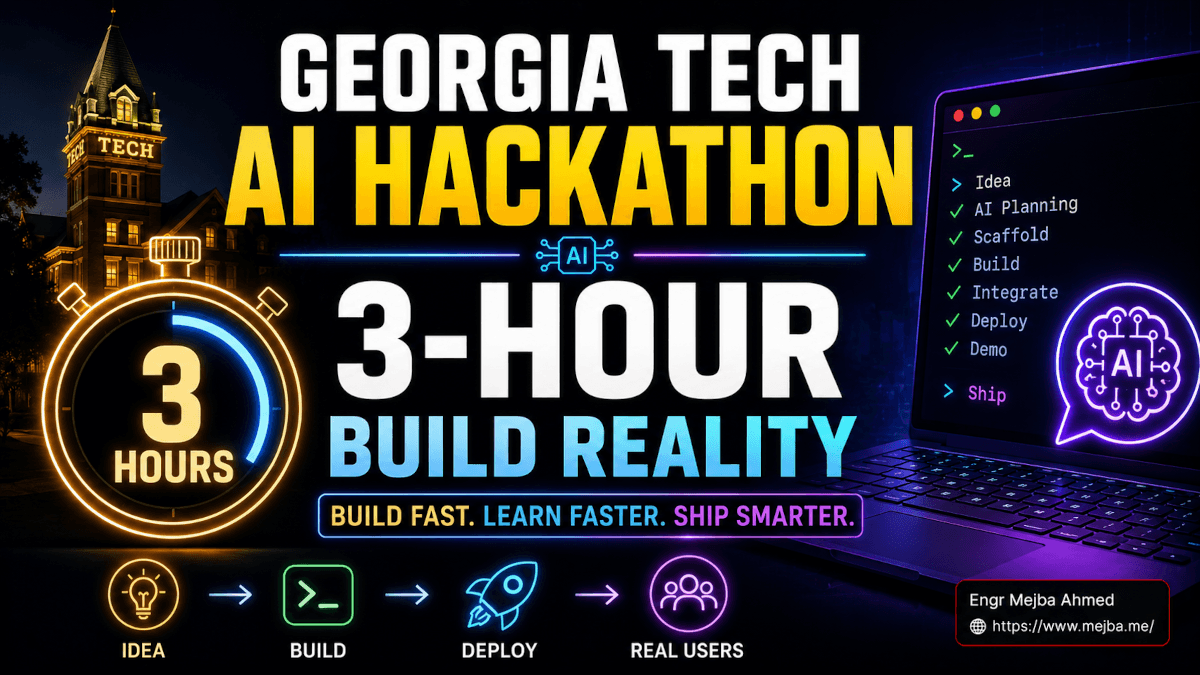
Georgia Tech AI Hackathon: 3-Hour Build Reality
I watched a clip from a Saturday hackathon at Georgia Tech this week and it sat in my head for two days. Not because of the energy in the room — though there was plenty of that — but because of one specific moment. A camera caught a team in the final twenty minutes. Three students hunched around a single laptop. Their app was almost working. Almost. The kind of "almost" where the AI had scaffolded everything in the first hour, and they'd spent the remaining two trying to make it not crash when a real human poked at it.
That look on their faces is the most honest thing I've seen anyone film about AI-assisted development this year.
The event was the Claude Builder Club hackathon, hosted on Georgia Tech's campus and sponsored by Anthropic. The challenge was tight: build a mobile or web app that helps people maintain healthy habits using AI-driven design. Three hours. Prompt revealed at the start. Teams up to three people. Laptops closed at the buzzer, then presentations to a panel of judges. The winning team built a gamified meal-tracking app that suggested nutritional pairings and rewarded users for healthy streaks.
That's the surface story. The story underneath — the one I keep turning over — is what these three hours reveal about how shipping software actually works when AI does the typing.
Because here's the thing nobody tells you when you watch a Claude demo on Twitter and see a full app spin up in six minutes: the demo is the easy part. The hard part is everything between "the prototype looks great" and "a real human can trust this with something that matters." A hackathon is a perfect microcosm of that gap, and the Georgia Tech students lived it on camera in three hours.
Stick with me. The reason this matters isn't the hackathon. It's what the hackathon proves about the next twelve months of every AI-built product that lands on the App Store.
What a Three-Hour AI Hackathon Actually Looks Like
Let me set the scene with the numbers, because the framing matters.
Georgia Tech's College of Computing enrolled 4,621 undergraduates and 16,910 graduate students in computing degrees as of the fall 2024 cycle, making it one of the largest computing programs in the country. Computer Science is the most popular major on campus. When Anthropic's Claude Builder Club runs an event there, the talent floor is high — these aren't intro-to-CS students bumping into their first API. Many of them have shipped real projects, contributed to open source, and used Claude Code or the Anthropic SDK in their personal stack already.
Now drop them into a three-hour container with a novel prompt and tell them to build a working health app with AI as the primary author. What happens?
What happens is exactly what happened in the video: rapid scaffolding, then a slow, frustrating crawl toward something that doesn't crash on first contact with reality.
The first thirty minutes are usually the most magical. A team picks an angle — meal tracking, hydration, sleep, whatever — and starts prompting. Claude Opus 4.7 (released April 16, 2026, the most capable Anthropic model when this hackathon ran) can scaffold a full Next.js or React Native app with auth, database hooks, and a working UI in a single conversation. I've done this myself for personal projects. You watch the file tree fill in, the components compose, the dev server boot, and you feel something close to vertigo. We're already 60% done. We have two and a half hours left. This is going to be easy.
Then you open the app and tap the first button.
That's where every team's hackathon actually starts.
The Gap Between Scaffold and Ship Is Where Engineers Live
When I think about how I use AI in my own work, this gap is where 90% of my time goes — and I think this is the part most people underestimate when they predict what AI will do to software jobs.
Here's a concrete example from my own week. I was building a small internal tool — a CSV ingester that pipes into a tagging workflow. Claude Code 2.1 scaffolded the entire project in about six minutes. Folder structure, parser logic, test fixtures, a clean CLI interface. The first run worked on the test data I'd given Claude. The second run, on a real CSV from a client, broke in three places: a stray BOM character at the start of the file, a column with mixed encodings, and a header row that included a phantom whitespace cell because of how the original Excel export wrote it.
None of those bugs were in the prompt. None of them are in any tutorial. They show up because real data is messy, real users do unpredictable things, and the only way to find these failure modes is to actually run the thing against reality.
That gap — between "AI scaffolded a working prototype" and "this can survive real users" — is exactly the gap a hackathon makes you live in real time. The students at Georgia Tech weren't behind because Claude was slow. They were behind because finding the seventeen edge cases that break a real meal-tracking app takes longer than three hours, no matter how fast your AI is.
The Associate Dean of Georgia Tech's College of Computing said it cleanly in the video: humans need to stay "in the loop" to test, refine, and ensure AI-generated outputs are usable and trustworthy. That's not a polite hedge. That's the actual job description for software engineers in 2026.
Why Time Compression Reveals What Scale Hides
There's a reason a three-hour hackathon is more revealing than a three-month corporate AI project.
When you have three months and twelve engineers, you can hide the gap. You can have one engineer prompting Claude all day, two more cleaning up edge cases, three more writing tests, and a designer polishing the UX. The team ships a "Claude-built app" but in reality, Claude wrote the first draft and a small army of humans turned it into something users could trust. The story you tell on LinkedIn is "we built it with AI." The story your git log tells is more honest.
Compress the same workflow into three hours, with three people, and you can't hide anything. Either the AI got you to the line, or it didn't. Either you found the bugs, or your demo crashes in front of the judges.
That's why hackathons remain the cleanest test of how AI actually changes the rhythm of building. Industry conferences and demo videos all show you the magic moments. Hackathons show you what happens between the magic moments — the silent thirty-minute stretch where someone is digging through a stack trace because the AI confidently called a function that doesn't exist in the version of the SDK they're using.
I've learned more about my own AI workflow from doing 24-hour personal builds than from any blog post. The discipline of "ship something working in a fixed time box" forces you to confront which parts of your stack actually save time and which parts just feel like they save time.
There's a subtle pattern here that I keep seeing in my own work and saw clearly in the hackathon footage. I'll come back to it after we look at why the winning team won.
What the Winning Meal-Tracking App Got Right
The team that took the top spot at this Georgia Tech AI hackathon didn't build the most technically impressive thing. They built the right thing. That distinction is everything in a time-constrained build.
Their app combined meal tracking with gamification — streaks for healthy eating, suggestions for nutritional pairings (protein with carbs, that kind of thing), and rewards for consistency. On paper this sounds simple. Underneath, it's a textbook example of what works in mHealth apps right now.
Diet and nutrition apps have a brutal retention problem. Industry data shows roughly 30% of users churn within the first month. About 70% of users abandon a nutrition app inside two weeks if it feels too complex or time-consuming. Meal logging is one of the most demanding daily user behaviors in consumer software, on par with journaling — it asks the user to do conscious work before they get rewarded.
But here's the data point that makes the winning team's choice click: gamified health apps show roughly 50% higher engagement and retention than non-gamified equivalents. Achievement badges alone boost engagement by around 40%. Streak mechanics — the same primitive that powers MyFitnessPal's retention — work because they hijack loss aversion. You don't want to break the chain.
The winning team didn't invent gamification for nutrition apps. They picked a known retention pattern and let Claude scaffold the implementation around it. That's the move. In a three-hour container, the team that wins isn't the one with the most novel architecture. It's the team that recognizes which pattern already has evidence behind it and uses AI to ship that pattern faster.
This is exactly how I think about my own builds now. I don't try to invent new mechanics. I read the retention data, identify which mechanics have proof, and use Claude to scaffold them in an afternoon. The creative bandwidth isn't in inventing new wheels — it's in choosing which wheel matters and tightening it for my specific user.
The Five Hackathon Failure Modes I See Repeatedly
If you watch enough hackathons — or run enough three-hour personal builds — the same five failure modes repeat. The Georgia Tech footage shows at least three of them. Here they are, in the order they tend to bite.
Failure mode one: scope creep in the first thirty minutes. A team gets the prompt and starts riffing. They go from "meal tracker" to "meal tracker plus social feed plus AI nutritionist plus barcode scanner." The AI is so willing that the team mistakes "Claude can scaffold this" for "we can ship this." Two hours later they have six half-built features and zero working flows. The cure is brutal: pick one user, one screen, one interaction, and ship that. Add nothing until the core works.
Failure mode two: trusting the first AI-generated UI. Claude's default React or React Native output is competent but generic. The first hero screen always has the same purple gradients, the same generic icons, the same CTA copy. Teams that ship something memorable spend at least 20 minutes hand-tuning the visual identity — not because the AI's output is bad, but because every other team's AI is producing similar output from similar prompts. If you've read my breakdown of why AI-generated websites all look the same, this is the same fingerprint problem applied to apps.
Failure mode three: zero error handling. A working happy path is a 30-minute build. A working app with handled errors is a three-day build. Hackathons compress this brutally. The team that wins is usually the one that wraps every API call in a try/catch, shows graceful empty states, and has at least one fallback for when the AI feature times out. Demos don't crash on stage because the team got lucky — they don't crash because the team treated error handling as a first-class feature, not a polish step.
Failure mode four: judging the AI's output by reading it instead of running it. I see this in my own work and saw it clearly in the hackathon footage. A team prompts Claude, scans the output, sees "yeah that looks right," and moves on. Then at minute 145 of 180, they actually run the code, and three things break. The discipline that separates fast shippers from slow shippers is running every AI-generated change immediately. Read-don't-run is the most expensive shortcut in AI-assisted development.
Failure mode five: forgetting that the demo is the deliverable. A hackathon isn't a code review. It's a sales pitch with running software underneath. Teams that build a clean two-minute demo path — start at home screen, hit the three impressive moments, end at a satisfying conclusion — beat teams with more ambitious products that don't know how to show what they built. The same is true for shipping any AI product. The user's first 90 seconds are the demo. Engineer those 90 seconds intentionally.
If you're using Claude Code to build anything in a constrained timeframe, those five failure modes are worth printing out and pinning to your monitor.
The Human-in-the-Loop Question Was Already Settled — Here's What's Actually Changing
The video framed the human-in-the-loop discussion as if it were still an open question. Will AI replace developers, or will humans remain essential? I want to push back on that framing because I think it's the wrong question, and the hackathon itself proved it.
That question was settled the moment Anthropic shipped Claude Code 2.0 and developers started running it as an agent loop with human checkpoints. The answer is that humans stay in the loop. The interesting question — the one that's actually changing month by month — is where the human checkpoints belong.
In 2024, the human-in-the-loop checkpoint was at the line level. You'd ask the AI for a function and read every line before pasting it. In 2025, the checkpoint moved to the file or module level — Claude could write a whole file, and you'd review the diff. By April 2026 with Opus 4.7, the checkpoint has shifted to the feature level. Claude can build, test, and self-correct an entire feature, and the human reviewer is checking the feature's behavior, not its lines.
This is what the Associate Dean was actually pointing at — and what the hackathon demonstrated in compressed form. The students weren't writing every line. They were running, testing, prompting, and re-prompting until the behavior matched what they wanted. The human role moved up a level of abstraction, but it didn't disappear. If anything, it got harder, because reviewing behavior takes more skill than reviewing syntax.
By the way — this is exactly why I keep saying "AI literacy" is a bad framing for what students need now. AI literacy implies reading skills. What you actually need is AI judgment: knowing when to trust the output, when to re-prompt, when to throw it out and write it yourself, and when the AI is confidently wrong. That's a craft, not a literacy. And like every craft, it only develops by building things that have to actually work.
A three-hour hackathon at a top computing school is one of the cleanest training grounds I can imagine for AI judgment. You can't fake it. The buzzer doesn't care.
What I'm Stealing from the Hackathon for My Own Builds
Watching this video changed three things in how I'm running my own AI builds this month. Not because I learned anything new, exactly — but because the hackathon clarified things I'd been doing intuitively.
One: I'm setting harder time boxes. I used to give myself a week to ship a small tool. Now I give myself an evening. Not because I'm faster (Claude is faster, I'm not), but because shorter time boxes force the discipline to skip features that don't matter. The three-hour constraint at Georgia Tech wasn't cruel — it was clarifying. Most of what gets cut under time pressure was never going to ship anyway.
Two: I'm front-loading the demo path. Before I write a line, I write the two-minute demo I want to give. Click here, see this, tap that, watch the streak counter increment, see the reward animation. Then I work backward and build only what's required to make that demo work. Everything else is a stretch goal. This single change has roughly doubled my completion rate on side projects.
Three: I'm running every AI change immediately. I used to read Claude's output, nod, and move on. Now I run it. Every time. If Claude added a function, I call it with real input. If Claude scaffolded a component, I render it with real data. The friction is small. The bug-discovery rate is enormous. Most of the failures I used to find at the end of a build, I now find within ninety seconds of the change being made.
If you've been using Claude Code or any agentic coding tool casually and want to level up, those three changes alone are worth more than any prompt template I've shared.
The Ceiling Isn't AI Capability — It's Trust
Here's the part of the hackathon I keep coming back to. The winning meal-tracking app was clever. The presentation was tight. The judges loved it. And almost certainly, none of those judges would actually use that app to manage their own diet.
That's not a knock on the team — it's the fundamental ceiling on AI-built consumer apps right now. Capability is no longer the bottleneck. Claude Opus 4.7 can scaffold an entire health app in an hour with better default ergonomics than the median app on the App Store. The bottleneck is trust. Will real users hand over their food data, their sleep data, their health data to an app whose creator they don't know, whose privacy policy they didn't read, whose data retention behavior they can't verify?
That trust gap is exactly where the next wave of competitive advantage lives. Anyone can scaffold an AI app. Almost nobody can build the trust infrastructure around it — clear data handling, predictable behavior under edge cases, accessibility for users who don't fit the happy path, error states that don't make the user feel stupid, and a brand that signals "this is going to be here in eighteen months."
This is also why the human-in-the-loop conversation matters way beyond hackathons. In 2026, the question isn't can AI build it. The question is did a human verify it well enough that someone with skin in the game will use it. Hybrid AI workflows, where automation is paired with human oversight at the right altitude, are the production standard now. Industry observers have started calling this "human-verified AI" as a brand differentiator. They're not wrong. The market is starting to price trust the same way it used to price code quality — as a competitive moat.
The hackathon teams who lost weren't outclassed on capability. They were outclassed on judgment — which features to ship, which to cut, which edge case to handle, which polish to invest in. That judgment is the thing AI doesn't replace. It's the thing AI amplifies when the human wielding it has it, and exposes brutally when the human doesn't.
What the Three Students at Minute 145 Were Actually Doing
Let me come back to that moment in the video that's been sitting in my head.
Three students. One laptop. Twenty minutes left on the clock. Their app was almost working. They were debugging, prompting Claude, re-running, prompting again. Trying to get the streak counter to update without crashing the dashboard view.
That's not a story about AI replacing developers. That's a story about three young engineers learning the actual job of an AI-era developer in real time. The job isn't writing code. The job isn't even prompting AI. The job is the loop: define the behavior you want, prompt the AI, run the result, find the gap between behavior and reality, prompt again, run again, until the gap closes. That loop is the entire profession now.
A three-hour hackathon at Georgia Tech doesn't expose students to AI. It teaches them the loop. That's worth more than any course on prompt engineering or any tutorial on the Anthropic SDK. You learn the loop by running it under pressure, not by reading about it.
If I were running a CS program in 2026, I'd make every student do at least one three-hour solo hackathon a month. Not because hackathons are inherently great — they're brutal — but because nothing else compresses the entire AI-era development loop into a single afternoon the way they do.
FAQ
Frequently Asked Questions
Everything you need to know about this topic
The Claude Builder Club hackathon at Georgia Tech challenged students to build a mobile or web app that helps people maintain healthy habits using AI-driven design, in a three-hour window. The prompt was revealed only at the start of the competition, and teams of up to three students could compete. The winning entry was a gamified meal-tracking app with streak rewards and nutritional pairing suggestions.
Hackathons sponsored by Anthropic in 2026 typically give participants access to the latest Claude models, including Claude Opus 4.7 (released April 16, 2026) for complex coding tasks and Claude Sonnet 4.6 for faster iteration. Most teams use Claude Code or the Anthropic API directly during the build window. For a fuller breakdown of how I use these in production, see my Claude Code workflow guide.
Claude Opus 4.7 can scaffold a full Next.js or React Native app — auth, database, UI — in roughly six to fifteen minutes. The "scaffold" is not the same as the "ship-ready product." Real users encounter edge cases, error states, and data shapes that the scaffold doesn't handle by default, which typically takes the bulk of the build time even with AI assistance.
Gamification works because health behaviors require daily friction (logging, tracking, choosing) and the rewards from healthy living are slow to materialize. Streaks, badges, and reward loops compress the feedback timeline so users feel progress within days instead of months. Gamified health apps show roughly 50% higher engagement and retention than non-gamified equivalents, with achievement badges alone boosting engagement around 40%.
Yes — more so, not less. As AI capability has grown, the human-in-the-loop checkpoint has moved up in abstraction from line-level review to feature-level behavior verification. Industry consensus in 2026 treats human-verified AI as the production standard for any system where trust, compliance, or safety matters. The question isn't whether humans stay in the loop, but where in the loop they sit.
The Buzzer Doesn't Lie
The reason that Georgia Tech video sat in my head for two days isn't the technology. It's what the buzzer revealed.
Three hours. Anthropic's best models. Some of the most talented computing students in the country. And the gap between "AI can build it" and "users can trust it" was still wider than three hours could close. That gap is the entire job now. That gap is where every engineer, every founder, every solo builder is going to spend the next five years of their career.
Tonight, before you go to bed, give yourself a three-hour box. Pick something small. Open Claude Code. Set a timer. See what you can ship between scaffold and trust. You'll learn more about how AI is actually changing the rhythm of building than you would from any conference talk this year.
The buzzer doesn't lie. Neither does the demo.
Let's Work Together
Looking to build AI systems, automate workflows, or scale your tech infrastructure? I'd love to help.
- Fiverr (custom builds & integrations): fiverr.com/s/EgxYmWD
- Portfolio: mejba.me
- Ramlit Limited (enterprise solutions): ramlit.com
- ColorPark (design & branding): colorpark.io
- xCyberSecurity (security services): xcybersecurity.io