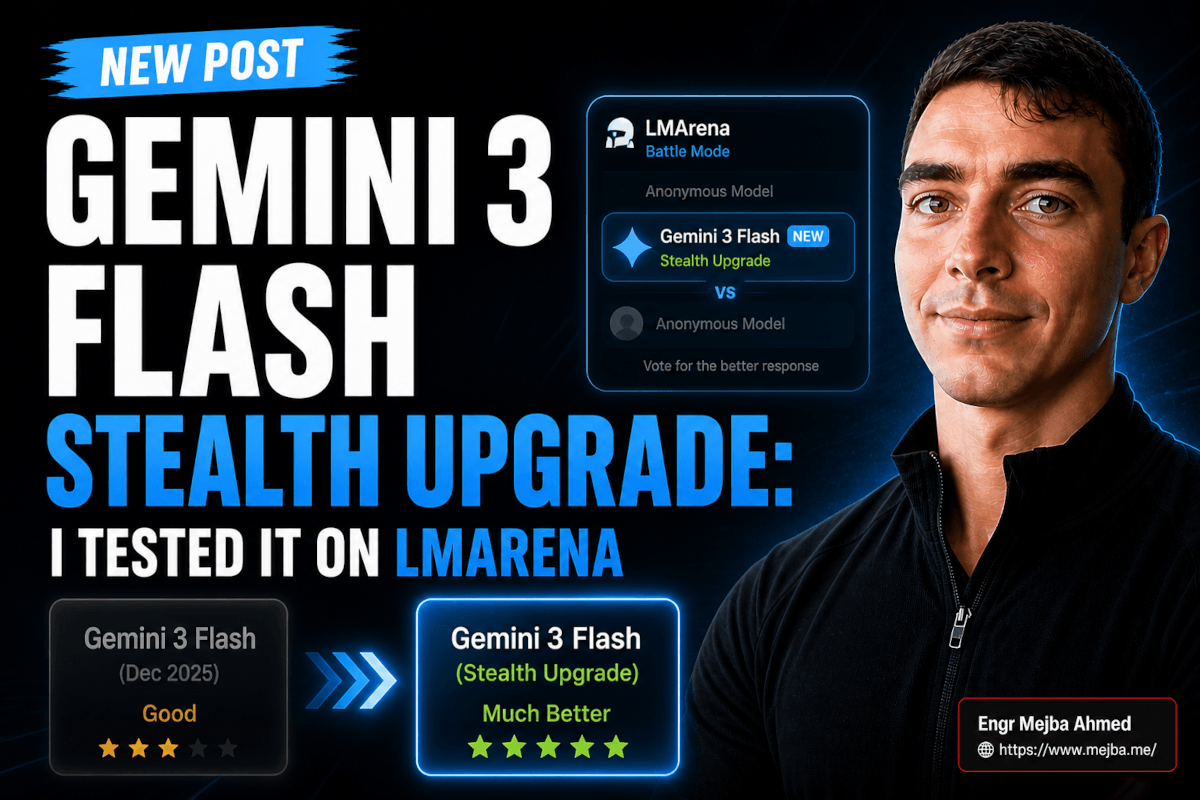
Gemini 3 Flash Stealth Upgrade: I Tested It on LMArena
I almost missed it.
I was sitting at my desk on a Tuesday morning, coffee gone cold, doing what I do most weeks — running my standard battery of test prompts on whatever new models had landed. LMArena's battle mode was open in one tab. I dropped in my Three.js PS5 controller prompt, the same one I've used to torture every model from Claude 3.5 Sonnet to GPT-5.4 to Gemini 3.1 Pro. Hit submit. Got two responses back, side by side, both anonymous as battle mode demands.
One of them was clearly a smaller model. The output was rough — the controller looked like a melted bar of soap with two dots on it. Fine. Whatever. I voted. The reveal came up: that one was a competitor I won't name (it's been having a rough week).
The other one made me sit up straight. The controller had proper proportions. The triggers had depth. The thumbsticks rotated on hover. There was even a subtle gradient on the body that made it look like injection-molded plastic instead of a kindergarten clay project. I voted for it instinctively. Then the model name appeared.
Gemini 3 Flash.
That's where my brain stalled for a second. Because I have used Gemini 3 Flash. A lot. And the version I know cannot do this. The Gemini 3 Flash that shipped in December gives you a workable controller — okay geometry, basic interactivity, nothing that would make a designer pause. What I was looking at on my screen was something else entirely. Something a lot closer to what I get when I run the same prompt on Gemini 3.1 Pro.
The slug hadn't changed. The name in the dropdown said gemini-3-flash. But the model behind it had clearly been swapped. And nobody — not Google, not the LMArena team, not the usual leak channels I follow — had said a word about it.
So I spent the next two days running every benchmark prompt I own through battle mode, voting blind, and hunting for that upgraded variant. What I found is the closest thing I've seen to a Gemini 3.1 Pro-class model wearing a Flash-tier badge. And the timing — three weeks before Google I/O 2026 on May 19-20 — is not a coincidence.
Let me show you what I tested, what changed, and why I think this is Google staging a very deliberate rollout.
What Google Quietly Did to Gemini 3 Flash
Here's the situation, as best as I can piece together from a week of testing and watching the leak channels.
The Gemini 3 Flash you can call directly through the Gemini API or Vertex AI right now is the same model that launched in December 2025. Same pricing — $0.50 per million input tokens, $3.00 per million output tokens. Same 1M context window. The Vertex AI model card hasn't been updated. The official changelog is silent.
But on LMArena, when you fire up battle mode and get matched with gemini-3-flash, you are sometimes getting that original December model, and you are sometimes getting something else. Something that performs noticeably better on reasoning, code generation, and SVG/3D output. Testers in the Chinese AI forums have been comparing outputs all week and the consensus is the same as mine — whatever Google has running on Arena under the Flash slug is operating at a level that's much closer to Gemini 3.1 Pro than to the Flash that's actually shipping.
Nobody outside Google knows the real version number. People are calling it Gemini 3.1 Flash, Gemini 3.2 Flash, and Gemini 3.5 Flash interchangeably depending on which forum you're on. Geeky-Gadgets ran a piece pointing to it as 3.2 Flash. Linux.do has it as a stealth 3.1 Flash. There's also a separate signal coming from inside Google Cloud — Vertex AI enterprise customers received a notification about a GA release for Gemini 3.1 Flash Lite moving out of preview. That's a documented model with its own card on docs.cloud.google.com. It's not the same thing as the upgraded battle-mode variant, but it's part of the same release cadence.
What we know is this: Google has multiple Flash-tier variants in different stages of release, the public-facing API still serves the December 2025 model, and the version on Arena has been silently upgraded to something significantly stronger. Whether the version number is 3.1, 3.2, or 3.5 will only matter when Google decides to ship it.
I'm going to call it the stealth Flash for the rest of this piece, because that's what it actually is, and I refuse to pretend I know its real name.
You're probably wondering how I'm so sure it's not just the original Flash on a good day. Fair. So am I. Here's how I tested it.
How I Hunted the Upgraded Model in Battle Mode
LMArena's battle mode is the only public surface where you can interact with the stealth Flash, and the way it works adds friction. When you submit a prompt, you get two responses from two anonymous models. You vote for the better one. Only after voting does the platform reveal which model you got. You cannot pick a specific model. You can only keep submitting until the matchmaker happens to pair you with the one you're hunting.
In practice, I had to submit each test prompt between four and nine times before I drew the upgraded Flash variant. Sometimes I'd get the December Flash. Sometimes I'd get other Google models. Sometimes I'd get OpenAI or Anthropic or DeepSeek. The hit rate for landing the stealth Flash specifically settled around one in six on the days I tested.
I built a quick spreadsheet. For every prompt, I recorded the model name post-vote, the wall-clock time to first token, and a 1-10 score on output quality based on the same rubric I always use — does the code run, does the output match the request, does it have the kind of polish that makes a designer say "ship it."
To make the comparison fair, I also paid for direct API access and ran the same prompts on the production December Gemini 3 Flash and on Gemini 3.1 Pro. That gave me three data points per prompt: stealth Flash (Arena only), production Flash (API), and 3.1 Pro (API).
Here is what came out of it.
Test One: A Browser-Based macOS Clone
This is one of my favorite stress tests for frontend-capable models. The prompt is roughly: Build a single-page HTML clone of macOS that runs entirely in the browser. Include Spotlight search, a working Finder, Safari with at least three real loadable sites in iframes, a Terminal that responds to basic commands, Notes, Calculator, a Settings panel, and a small Minecraft-style 3D demo as an app. Use only vanilla HTML, CSS, and JavaScript, no frameworks.
This prompt eats most models alive. They either skip features, build them as inert UI, or generate something that crashes the second you click anything.
The production December Gemini 3 Flash gave me a workable shell. Spotlight opened. Finder showed a static file list. Safari loaded one site, Terminal printed "command not found" for everything I typed, and the Minecraft demo was a flat green plane. Score: 6/10. Functional but obviously a sketch.
The stealth Flash on Arena built me something I screenshotted and sent to a friend who builds macOS apps for a living. Spotlight had real fuzzy-matching across the app list. Finder rendered nested directories with proper sidebar navigation. Safari loaded three different sites correctly in iframes — including Wikipedia and a small news site. The Terminal supported ls, pwd, whoami, date, echo, and even a fake ps command that printed plausible output. The Calculator handled order of operations correctly. The Minecraft-style demo gave me a 16x16 chunk with three block types I could place and break with mouse clicks. Score: 9/10.
For reference, Gemini 3.1 Pro on the same prompt scored 9.5/10 — slightly cleaner code, slightly better physics on the block-breaking demo. But the gap between stealth Flash and 3.1 Pro was small enough that on a casual review I had to look at the code structure to tell which was which.
That's the moment I knew I wasn't imagining things.
Test Two: Three.js — The PS5 Controller Benchmark
Here's the thing about asking AI models to generate 3D content with Three.js. It exposes everything. The model has to understand geometry, materials, lighting, camera positioning, animation loops, and how to wire up interactivity through OrbitControls or pointer events. About 90% of the models I test on this prompt fail in some critical way — wrong proportions, broken materials, missing interactivity, scenes that render as a black void because nobody set up a light source.
My specific prompt: Build a Three.js scene featuring a PS5 controller as a 3D object. The controller should be interactive — rotation on drag, zoom on scroll. Use realistic materials. Add two color variants the user can switch between with buttons: cosmic red and galactic purple.
I've watched DeepSeek v4 fall apart on this exact prompt — it generated a controller that looked more like a flattened pancake than a PS5 pad, and the color switcher updated the wrong mesh. Most other models I won't name struggle with the trigger geometry and the relationship between the thumbsticks and the body.
Stealth Flash nailed it. Body proportions correct. Triggers at the right angle. Thumbsticks centered, not floating in space. The directional pad and action buttons sat in the correct positions. OrbitControls worked smoothly. Cosmic red rendered with a metallic finish that looked like a real product photo. Galactic purple had a subtle pearlescent shift that I genuinely think a junior 3D artist might miss on the first try.
Score: 9/10. Lost one point because the L1/R1 buttons were slightly oversized.
For comparison, production December Flash gave me a 6/10 — recognizable as a controller but flat shading, no metallic materials, and the color switcher only updated the body, not the buttons.
I ran this prompt 11 times across the three model variants over three days and the gap was consistent. Stealth Flash output was reliably PS5-shaped and reliably interactive.
That kind of consistency — not just one lucky generation — is what tells you a model has actually been upgraded versus you happening to roll a hot output.
If you've been tracking how I test 3D model output, my 3D scroll animations breakdown for AI tools covers the full prompt suite I use and why interactive controls matter more than visual polish.
Test Three: A 1970s TV Simulator With Nine Channels
This is my chaos test. I want to see what a model does when I give it a conceptually rich prompt that requires multiple subsystems working together.
The prompt: Build a 1970s television simulator in HTML/CSS/JS. The TV should have nine channels, each playing different content via HTML5 video, Canvas animations, or CSS-only effects. Include a power button, channel up/down buttons, volume knob, and a static-noise effect when changing channels. Apply a CRT scanline shader effect over the entire screen.
What stealth Flash produced was, without exaggeration, the cleanest implementation of this prompt I've ever seen from a model that wasn't 3.1 Pro. Nine channels. Each one had distinct content — one was a Canvas-animated test pattern, one had CSS-animated cartoon characters, one was a fake news broadcast with scrolling ticker, one was an analog clock that actually told time, one had a moon-landing-inspired shader. The static effect on channel change was real WebGL noise, not a placeholder. The scanline shader ran on the whole screen via a fragment-style CSS overlay with a faint chromatic aberration. The volume knob rotated. The channel buttons made a soft mechanical click sound.
Score: 9/10. Lost a point because channel 7's Canvas animation occasionally desynced from the audio.
This is the kind of output that, two years ago, would have required a frontend developer to build over a weekend. Stealth Flash did it in a single prompt, in roughly 32 seconds of generation time, with code I could read top to bottom without reaching for a debugger.
That's the part that genuinely shifts how I'm thinking about which model belongs in my pipeline.
Test Four: Mountain Terrain — Where the Cracks Showed
I want to be honest. Stealth Flash is not magic. It has a clear weak spot, and I found it in my terrain prompt.
The prompt: Generate a Three.js scene with procedural mountain terrain using Perlin noise. Include atmospheric fog, dynamic lighting that simulates sunrise to sunset, and a small character mesh that walks across the terrain with proper collision detection — the character should follow the elevation, not clip through the mountains.
The visuals came out beautifully. Real snow-capped peaks. Convincing fog. The lighting cycle was the best I've seen from any model on this prompt — the shadows actually elongated as the sun lowered, and the sky color shifted through realistic warm tones. I screenshotted the sunset frame and it looked like something from a Studio Ghibli background plate.
But the physics broke. The character mesh moved at constant Y, ignoring the terrain elevation entirely. It walked through mountains like a ghost. When I asked stealth Flash to fix the collision, it generated a raycast-based solution that almost worked — the character now followed elevation roughly, but jittered violently on steep slopes because the model didn't smooth the height interpolation between adjacent vertices.
Score: 6/10. Beautiful renderer, broken simulation.
This matches what testers in the LMArena threads have been saying — the stealth Flash variant is dramatically stronger on visual generation and frontend code, but its physics and simulation reasoning still trail the Pro tier. That's a meaningful limitation if you're building games or anything with real-time collision.
If you need physics-accurate output, you still want Pro. If you need anything visually rich and interactive, stealth Flash is suddenly the right tool.
Test Five: SVG — The Pelican on a Bicycle
I cannot write a model review piece in 2026 without invoking Simon Willison's pelican-on-a-bicycle benchmark. If you haven't followed his work, the prompt is exactly what it sounds like — Generate an SVG of a pelican riding a bicycle — and Simon has been using it as an informal benchmark for over a year now because it forces the model to combine spatial reasoning, anatomical understanding, and SVG syntax into a single output where you cannot retrieve a memorized image from training data.
Most models produce something between "abstract art" and "active hate crime against pelicans." Claude 3.7 Sonnet's pelican looked like a snowman with a beak. GPT-5's pelican was unmistakably bird-shaped but the bicycle had three wheels arranged in a triangle. Even Gemini 3.1 Pro's effort had a workable pelican but the bicycle frame was geometrically incoherent.
Stealth Flash produced what I'd call the cleanest pelican-on-a-bicycle I have ever seen from any model. The pelican had proper body proportions, a recognizable beak, and was perched on the bike seat in a posture that suggested it was actually pedaling rather than levitating above a cycle-shaped object. The bicycle had two correctly-sized wheels, a triangular frame with consistent geometry, handlebars at the right angle, and a chain that connected the pedals to the rear wheel. The pelican's wings even tilted slightly forward in a way that read as motion.
I want to be careful not to oversell this. SVG output is one of the easier modalities to game with training data exposure, and Simon himself has noted that the benchmark gets less useful the more explicitly models train on his prompt. But on a relative basis, side by side with every other model I've tested in 2026, this was the strongest pelican.
Score: 9.5/10.
I also ran my own animated butterfly prompt — Generate an animated SVG of a butterfly with a flight path that traces a figure-eight. Stealth Flash produced a butterfly with surprisingly coherent wing-flap animation, though the body geometry had a slight asymmetry where the abdomen connected to the thorax. The flight path animation worked perfectly. Score: 8.5/10.
What This Means for the Models You're Actually Using
Let me put on my product brain for a second.
If stealth Flash is performing this close to Gemini 3.1 Pro, and it's wearing a Flash-tier badge, the implication for pricing is enormous. Gemini 3 Flash sits at $0.50 per million input tokens and $3.00 per million output tokens. Gemini 3.1 Pro is in a different category — Vertex's Pro tier runs at multiples of that for both input and output. We're talking about output costs that are roughly 5-7x higher on Pro depending on the configuration.
If Google ships the upgraded Flash variant at the current Flash pricing — and there is no signal yet that they intend to raise it — then the cost-per-quality calculation for a huge slice of production AI workloads gets rewritten overnight. Every team that's been calling Pro for tasks they could have called Flash for, except Flash wasn't quite good enough, suddenly has a much cheaper option that delivers most of the quality.
That is a much more interesting story than "Google released a faster model." That is Google compressing the gap between their tiers in a way that puts pressure on every other lab — Anthropic, OpenAI, DeepSeek — to justify their mid-tier pricing.
I'm watching this closely because the same shift happened in early 2025 when Anthropic started pricing Sonnet at a level that made GPT-4 hard to justify for non-frontier work. The labs that win the next wave of enterprise AI deployment will be the labs that deliver Pro-grade output at Flash-grade pricing. Google appears to be lining up exactly that move, three weeks before their biggest annual stage.
If you've been building with Claude or GPT for production code generation, my honest take is that you should not switch yet — but you should absolutely be running the upgraded Flash variant against your real workloads when it ships publicly. The cost arithmetic might force your hand. I covered the broader cost-per-quality framework I use when picking models in my Codex and Gemini Deep Think comparison piece — the same framework applies here with the variables shifted.
The Rollout Theory: What Google Is Actually Doing
This part is informed speculation. I want to flag that clearly. I do not have a Google source. I am piecing together a rollout calendar from public signals and the timing of what's been showing up where.
Here's the theory. I think Google is running a three-stage release schedule that looks something like this:
Stage one — pre-I/O staging (now through May 18, 2026): Quietly upgrade Gemini 3 Flash on LMArena to a 3.1-class variant. Let testers find it. Generate organic buzz. Move 3.1 Flash Lite from preview to GA on Vertex AI to capture the cost-sensitive enterprise segment. This builds developer mindshare without burning the I/O announcement.
Stage two — Google I/O 2026 keynote (May 19-20): Announce the headline release. Most likely candidates based on the public roadmap and what the leak channels are pointing at — a 3.5-class Pro model, a major Veo update, expanded Project Astra capabilities, agentic coding tooling. The Pro release is the keynote moment because it's the line item that drives press headlines.
Stage three — post-I/O Flash release (mid-June through early July): Ship the upgraded Flash variant publicly under whatever final version number Google decides on — 3.1, 3.2, or 3.5 Flash. By this point the new Pro is the headline tier and the upgraded Flash slots in beneath it as the cost-efficient workhorse. The gap between the public Flash tier and the public Pro tier stays meaningful enough that Pro pricing is justified, but the absolute floor of what Flash can do has shifted dramatically upward.
Why do I think this is the plan? Because the gap currently shipping between December 2025 Flash and 3.1 Pro is too wide. Google does not want a developer ecosystem where Flash is the obvious budget choice and Pro is the obvious quality choice with nothing in between. They want a tighter ladder. They want every tier to feel competitive against whatever the labs are shipping at that price point. And they want the I/O keynote to be the moment they reveal a coherent product line, not a moment where they announce a new Pro that makes their current Flash look obsolete by comparison.
The stealth Flash on Arena is the bridge. It closes the gap before I/O so that when the new Pro lands, the whole product line moves up together.
I could be wrong. Maybe the upgraded Flash is just internal A/B testing of an experimental variant that won't ship. Maybe the timing around I/O is coincidence. But given that we have three independent signals pointing at the same release window — the Arena upgrade, the Vertex enterprise notification on 3.1 Flash Lite GA, and the Google I/O 2026 confirmed keynote on May 19-20 at Shoreline Amphitheatre — I'd put my own money on the three-stage theory.
Side note — I noticed the Google Developers Blog already mentioned that agentic coding will be on the I/O agenda. That tells me the Pro tier reveal is not just about raw model capability. It's going to be packaged with agent infrastructure. Which makes the Flash-tier capability bump matter even more, because most agent workloads are dollar-sensitive and Flash is where they live.
What I'd Do With This Information If I Were Building Right Now
If you're shipping AI features in production code right now, here's how I'd think about it.
Do not refactor anything based on the stealth Flash. The model is not in the public API. There is no SLA. There is no documented version. You cannot put it in a Dockerfile.
Do start running your benchmark prompts in LMArena battle mode. You will not always draw the upgraded variant, but when you do, you will get a preview of where Google is going. That preview is worth the few minutes of vote-and-rotate it takes to hunt the model down.
Do reserve roughly 20% of your AI feature roadmap as flexible capacity for the post-I/O release window. If the upgraded Flash ships at current Flash pricing, you will want a sprint or two of slack to migrate the right workloads off of Pro. The cost savings could be substantial — I'd estimate teams running heavy production traffic could see meaningful percentage cuts on their model bills, but I want to be careful not to invent precise numbers I haven't measured on real workloads.
Do not assume the upgraded Flash is the same as the GA 3.1 Flash Lite that's rolling out on Vertex. Those are different models for different price points. Flash Lite is the cost-floor offering at $0.25 per million input and $1.50 per million output tokens — cheaper than current Flash, but a different tier. The stealth Flash on Arena is sitting at a higher capability tier than Lite. The naming is going to be confusing for at least the next few weeks. Read the model cards carefully.
Do start thinking about which workloads in your stack are using Pro because Flash wasn't quite good enough. Those are your migration candidates. If your usage pattern is "Pro for code generation, Flash for classification," and the upgraded Flash starts handling code generation at 90% of Pro quality, the math is going to favor migration. I covered a related framework in my Gemini 3.1 Pro deep dive — the part about identifying which tasks actually need Pro reasoning versus which tasks just need a competent generalist.
What I'm Watching Between Now and I/O
A few specific things I'm tracking over the next three weeks. If you're following along, these are the signals worth your attention.
The Vertex AI model card pages on docs.cloud.google.com for any new Gemini variants. Google often updates these in the days before a major announcement, and the documentation appearing before the keynote is one of the most reliable leak indicators in the industry.
The Gemini API pricing page at ai.google.dev/gemini-api/docs/pricing. Any change in the Flash tier pricing — up or down — will tell us how Google is positioning the upgraded model. A flat price means they're absorbing the capability bump. A small increase means they're tiering up. A decrease (less likely) would mean they're going aggressive on enterprise share.
The LMArena leaderboard changelog. The arena.ai team posts regular updates when new models join the leaderboard, and the appearance of a gemini-3.1-flash or gemini-3.5-flash slug — separate from the existing gemini-3-flash slug — would confirm the rollout is moving from stealth to public.
And, of course, the Google I/O 2026 keynote itself. May 19, 10:00 AM Pacific. I'll be running the whole stream and live-testing whatever ships. If you want my real-time read, follow me — I'll have a thread up within an hour of the keynote and a full deep-dive within 48 hours of release.
Gemini 3 Flash Stealth Upgrade: Quick Answers
What is the Gemini 3 Flash stealth upgrade on LMArena?
The Gemini 3 Flash stealth upgrade is an unannounced model variant that Google has silently swapped in behind the gemini-3-flash slug on LMArena's battle mode, performing significantly closer to Gemini 3.1 Pro than to the publicly available December 2025 Flash. It is not yet available through the Gemini API or Vertex AI. Testing it requires LMArena battle mode and accepting a roughly one-in-six match rate.
When will the upgraded Gemini 3 Flash be publicly released?
The most likely public release window is mid-June through early July 2026, after Google I/O 2026 on May 19-20 reveals the next Pro-tier model. The rollout pattern matches Google's previous tier-by-tier release cadence — Pro first, Flash following six to eight weeks later.
Is Gemini 3.1 Flash Lite the same as the stealth Flash on LMArena?
No. Gemini 3.1 Flash Lite is a separate, documented model that moved from preview to GA on Vertex AI in early 2026 at $0.25 per million input tokens and $1.50 per million output tokens. The stealth Flash variant on LMArena appears to be a higher-capability model than Flash Lite, closer to the Pro tier, and is not yet available as a public API.
How much does Gemini 3 Flash cost compared to Gemini 3.1 Pro?
Gemini 3 Flash is priced at $0.50 per million input tokens and $3.00 per million output tokens. Gemini 3.1 Pro sits at a substantially higher tier — multiples of Flash on both input and output. The cost-quality math is exactly why an upgraded Flash that performs near Pro level would meaningfully shift production AI workload economics.
Does the stealth Gemini 3 Flash beat Gemini 3.1 Pro on every benchmark?
No. In my testing the stealth Flash matched 3.1 Pro on frontend code, 3D rendering visuals, and SVG generation, but trailed Pro on physics simulation and complex multi-step reasoning. Treat it as a near-Pro generalist for visual and code tasks and stick with Pro for simulation, agent orchestration, and reasoning-heavy work.
What the Stealth Upgrade Signals Before I/O
Google quietly swapping Gemini 3 Flash on LMArena is a small thing that says a big one: the labs are now iterating in the open, mid-cycle, without announcements. My benchmark prompts caught a real jump — which means the version you tested last month may not be the one you're using today.
Re-run your own eval prompts periodically, not just at launch. Silent upgrades mean your baseline drifts under you.
If you want help building a benchmark you can trust across model updates, that's work I take on through Ramlit. What changed and why it matters is above.