Claude Fable 5 Use Cases: 5 Before Free Ends
The first thing I did when Fable 5 came back was refuse to pick a task for it.
That sounds like a cop-out. It wasn't. I'd just watched three days of my usage window evaporate on prompts that any cheaper model could have handled, and I'd done the math on what happens after July 7 — so I opened a fresh session and typed something closer to a dare than a prompt: "You have memory of everything we've worked on. Look across my projects and tell me the five most complex, highest-value tasks that are actually worth spending you on. Don't touch anything confidential. Just rank them."
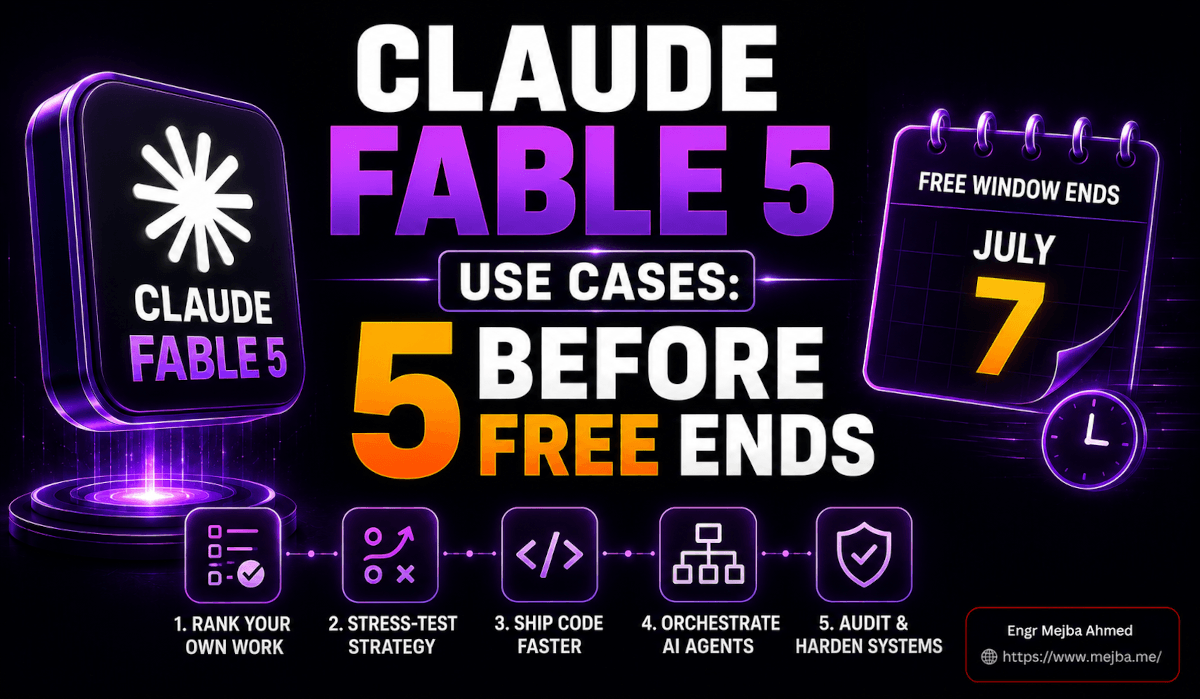
It came back with a list I wouldn't have written myself. And that list became the backbone of the five Claude Fable 5 use cases I want to walk you through, because the real skill this week isn't prompting the model — it's deciding what to point it at. You have until July 7, 2026. After that the free tank is gone.
Why 50% of your weekly limit is a budgeting problem, not a feature
Let me put the constraint on the table before the fun part, because it changes every decision that follows.
When Anthropic redeployed Fable 5 on July 1 — after roughly 18 days completely dark under U.S. export controls that hit on June 12 and lifted June 30 — they didn't just fold it back into subscriptions like nothing happened. On Pro, Max, Team, and select Enterprise plans, you can use Fable 5 for up to 50% of your weekly usage limit, free, through July 7. Hit that ceiling and you drop to another model for the rest of the week, or you keep going on usage credits. And Fable 5's credit pricing is not a rounding error: $10 per million input tokens and $50 per million output, per Anthropic's own pricing. That's roughly double Opus 4.8.
So here's the actual situation. Half your weekly capacity, on the most capable model Anthropic ships, is sitting in your account like a gift card with an expiry date. Most people are going to spend it asking Fable to rename variables. I watched myself start to do exactly that, which is why the "make it rank its own work" move mattered — it forced me to treat the window like a budget, not a toy.
If you want the messy backstory of the ban, the distillation drama, and what's real versus press-release noise, I unpacked all of it in my breakdown of that wild AI week. This post is the opposite. This is where the credits go.
One more framing note, and then the five. There's a companion piece to this one: I already mapped eight tactical workflows for the free window — code review, /loop audits, the fast stuff. Think of that post as the quick-hit menu. This one goes the other direction. Fewer use cases, each one deeper, each one built around a single idea that took me a full day to actually believe: Fable 5 earns its price when you make it extract insight from a large pile of context, then act on it. Small prompts waste it. Big context feeds it.
Use case 1: Ask Fable 5 to find its own best work
Start here, literally. This is the highest-leverage prompt you'll send all week, and it costs almost nothing.
Fable 5's structural advantage over the cheaper models isn't raw reasoning — it's that it carries memory of your past interactions and projects. Most people never exploit that. They treat every session like a cold start. But if you let it read across the work you've actually done, it can do something you can't do well for yourself: look at the whole board at once and tell you where the concentrated value is.
The prompt I settled on was blunt: review my projects, surface the five most complex and valuable tasks suited to your capabilities, don't breach anything confidential, and rank them by leverage. Here's what came back, in order:
- Stress-test my second-half strategy for the year — the H2 plan, poked at hard.
- Design a new premium-tier offer — a higher-priced business tier I'd been circling but never shaped.
- Run a content-to-conversion audit across every platform, pulling from my newsletter, YouTube, and connected APIs.
- Mine three-plus years of archived content into a forward content roadmap. (It flagged this one as usage-heavy — more on that later.)
- Audit and consolidate my personal skill system — the 40-plus AI skills I run my creator workflow on.
Look at the common thread. Every single one is the same shape: a large corpus of context in, a synthesized insight and a next action out. That's not a coincidence — that's Fable telling you where its 1M-token context window and persistent memory actually pay off. The tasks it didn't rank highly were the small, well-scoped ones. It knew those weren't worth its price better than I did.
So the meta-move is simple, and I'd do it before anything else: spend a tiny slice of the free window asking Fable to plan the rest of the free window. Then work down the list. Four of my five use cases below came straight off it.
Which means the obvious next question is: what does "stress-test my strategy" actually look like when you run it? That one turned into the use case I did not see coming.
Use case 2: How do I get real strategic advice from an AI?
Short answer: you don't get it from the model. You get it from the context you feed the model. Fable 5 is only as good a strategist as the situation you hand it — and almost nobody hands it enough.
This was use case #1 on its own ranked list, and it became the thing I'll remember from the whole free window. Not because the AI was smart. Because I finally gave one enough of my real world to say something non-generic.
Here's the context I loaded before I asked a single question:
- A detailed plan document — my yearly goals, plus the decision-making principles I actually run on. Things like "work should feel like play" and "keep the main thing the main thing." Sounds soft. It's the opposite. Those principles are the filter the advice gets scored against.
- Business positioning — target customer, niche, the specific pain points I solve, and how I'm differentiated from the obvious alternatives.
- The competitive landscape — who else is in the lane.
- Personal context — what drains my energy versus what generates it, plus the honest life and financial picture.
Then I connected the live data. This is the part that separates a real assessment from a horoscope. Through APIs and MCP connectors, I wired Fable into the actual numbers: Mercury for banking, Substack for newsletter stats, YouTube analytics for channel growth, Vercel for website traffic, and Google Workspace for the docs and sheets where the plan lives. If you've seen how I connect Fable to outside systems for lead outreach through the Clay connector, this is the same principle aimed inward — at my own business instead of a prospect list.
I wrapped the whole thing in a custom /advisor skill so I could rerun it later without rebuilding the setup. The instruction, roughly: analyze the plan document and content schedule in depth, pull the external data, and generate a detailed one-page business assessment with a clear focus for the next three months.
The detail that made it sing, though, was a small design choice inside that skill. I told it to convene a council of three personas whenever the advice got uncertain: a customer (does this actually help the person I serve?), a skeptic (what's the strongest case this is wrong?), and an execution operator (fine, but who does what on Monday?). Instead of one confident voice hand-waving, I got a short internal debate. That's where the good stuff lived — in the disagreement.
The output was a genuine one-page report, and it was dense with real numbers because the numbers came from the connected APIs, not from thin air. The gist: business is on track. Sponsorship and newsletter revenue are both live and healthy. YouTube is growing steadily. And then the part I needed — the next-quarter focus: improve paid-subscriber retention (not just acquisition), stay on top of sponsor commitments before they pile up, shift content toward hands-on builder tutorials, and fix a leaky annual-subscription renewal flow that was quietly costing me.
None of that is generic advice. You cannot get "your annual renewal flow is broken" from a model that can't see your Stripe-adjacent numbers. That's the whole point.
Here's the honest limitation. This is not a "what should I reply to this email" tool. Fable at this price is wasted on same-day decisions. Where it earns the $50-per-million output rate is the 3-to-6-month, even yearly, horizon — the strategic questions where being 15% smarter about direction compounds into real money. Feed it a structured plan plus live data, ask a long-horizon question, and you get something a $200 consultant would charge a day rate for. Ask it what to have for lunch and you've set money on fire.
That's the advice use case. But the ranked list had a very different kind of task on it too — one where "insight from a big pile of context" meant reading code instead of reading my life.
Use case 3: Make your project ship-ready
Fable 5 is the best pre-launch bug hunter I've put in front of a codebase. Not "good for an AI." Best, full stop, against the other frontier models I compared it to.
The test bed was a fitness app I'd built mostly with Codex and GPT-5.5 — workout tracking, a live progress check-off as you move through a session, calendar views, and historical analysis of weight and volume over time. It worked. The unit tests were green. I was close to calling it done, which is exactly the dangerous moment, because "tests pass" and "safe to ship" are not the same sentence.
The prompt was deliberately unforgiving: review the entire codebase, find all bugs, edge cases, and UX breakdowns, and list every issue that needs fixing — hold a high-quality bar.
Fable spawned five agents and went to work in parallel. It reran the full unit suite (still green). And then it found more than a dozen major bugs the green tests had sailed straight past. The ones that made my stomach drop:
- Data leakage between user sessions on an involuntary sign-out — one user could surface another user's data. That's not a bug, that's an incident waiting for a date.
- Negative weight inputs accepted without validation, quietly poisoning the historical analysis.
- A cloud-sync scenario that could break permanently — not "retry and recover," but stuck.
- Multiple API-integration and routing bugs that unit tests never exercised because unit tests, by design, don't cross those seams.
I'd already run the same codebase past GPT-5.5 and Opus. Fable found meaningfully more of the critical ones — specifically the cross-session and cross-service bugs, the kind that only show up when a model can hold the whole system in context at once instead of reasoning file-by-file. That 1M-token window isn't a spec-sheet flex here. It's the reason the data-leakage bug got caught.
If you're weighing which model to hand a real repo, I went deeper on how the current frontier tiers actually behave under load in my Sonnet 5 versus Opus 4.8 comparison — the short version is that ship-readiness review is precisely where paying up for the top model returns the money.
So that's Fable reading code that exists. The next use case is Fable designing code that doesn't yet.
Use case 4: Plan the next big feature or product
Same fitness app, opposite direction. I wanted to add a nutrition-tracking tab, and instead of vibe-coding it into existence, I used Fable to produce a plan detailed enough that a cheaper model could execute it. That last clause is the whole strategy, and I'll come back to it hard in the tips.
The request had teeth. I asked Fable to:
- Search the internet for real resources — for example, a legitimate food-nutrition data source.
- Produce a phased plan with key decisions called out, plus risks, open questions, and explicit kill-switches for each phase.
- Output the whole thing as HTML, at a level of detail a smaller model could implement without me babysitting every step.
What came back was a genuine build spec, not a wish list:
- A UI/UX proposal for a fourth app tab, designed around one hard constraint — a user should be able to log a meal in under 30 seconds.
- A database schema, with Supabase chosen and the reasoning for it written out.
- A food-data-source analysis that landed on USDA FoodData Central as the recommended API, with the tradeoffs against alternatives.
- Architecture and data-model specs, key decisions on cloud sync and logging mechanics, and acceptance criteria I could actually test against.
The workflow around the HTML output is worth stealing. I reviewed the plan in Lavish Editor, an open-source tool on GitHub, which let me drop comment threads directly onto specific sections — "reconsider the sync strategy here," "this acceptance criterion is too loose" — and send those comments back to Fable for another planning pass. Plan, annotate, iterate, without ever leaving the document. If you liked the product-design plugin workflow I tested with Codex, this is the same collaborative-review loop, just aimed at architecture instead of UI.
Now the caution, because I hit it face-first. That iterative loop — the /go-style "generate the acceptance criteria, now the visual assets, now refine" cadence — burns tokens fast. Every round trip is more output at $50 per million. It's easy to fall in love with the back-and-forth and look up an hour later having spent a third of your window on planning polish. Great plans don't need to be beautiful. They need to be executable. Stop when it's executable.
Which is the perfect bridge to the biggest, hungriest use case of them all.
Use case 5: Refactor a large — or personal — codebase
The thing that put this on my list was a story you've probably seen by now. During early testing, Stripe ran Fable 5 across a 50-million-line Ruby codebase and compressed what would've been two-plus months of manual migration into roughly a day — a result Anthropic highlighted at the Fable 5 launch and Stripe corroborated. Fifty million lines. In a day. That number reorganized how I think about what a refactor even is.
I don't have fifty million lines of Ruby. But I have something that matters more to my daily output: a personal operating system of 40-plus AI-driven creator-workflow skills — document editing, podcast prep, shorts-making, the whole machine I run my content through. It had grown organically for years, which is a polite way of saying it had grown messy. So I pointed Fable at it: audit and improve the entire skill system, remove redundancies, fix bugs.
Five agents again. Thirteen improvement opportunities came back, and they were embarrassingly specific:
- Dead code blocks sitting in escalation pathways that never fired.
- Ambiguities in the document-editing skill that would make its instructions unreliable.
- Missing routings and unhandled email scenarios — silent gaps where the system just... didn't know what to do.
- Temporary files that were never getting deleted, quietly accumulating.
Here's the lesson that outlasts the free window. When your automation is driven by AI reading your own instructions, a messy system produces messy behavior. Every ambiguity in a skill is an ambiguity the model has to guess its way through. Cleaning the system isn't housekeeping — it's directly improving the accuracy of every automated task that runs on top of it. This is the same reason I obsess over structure in my Claude-Code-based second brain: clean inputs, accurate outputs. Fable is just the sharpest tool I've had for finding the mess.
Five use cases. But knowing what to point Fable at only gets you halfway. The other half is not detonating your window in the first two days — which is where I made every mistake so you don't have to.
The three habits that stopped me burning the free window
The five use cases are the what. These three habits are the how much, and honestly they're the difference between finishing the week with work done and finishing it with a usage-credit bill you didn't plan for.
1. Prep with the cheap models. Explore with Fable. All the setup work — writing the plan documents, wiring up the API and MCP connections, drafting and refining the prompts themselves — none of that needs the frontier model. I did all of it on GPT and Opus first. Fable only got switched on for the high-value exploration: the stress test, the bug hunt, the audit. Setup is cheap labor. Don't pay premium wages for it.
2. Plan with Fable, execute with something cheaper. This is the pattern from use case #4, generalized. Let Fable do what only Fable does well — strategy, architecture, data-model design, the hard thinking. Then hand the detailed plan to a faster, cheaper model to actually build. The expensive model designs the house; a cheaper crew pours the concrete. Trying to do both on Fable is how a $2 task becomes a $40 one. I lean on this orchestration split constantly, and it's the core idea behind directing coding agents like a team lead instead of a typist.
3. Drop the effort setting and actually watch it. Fable has an ultra-high-effort mode. Resist it. Unless a task genuinely demands maximum reasoning depth, "high" or lower gets you 90% of the quality at a fraction of the tokens. And babysit the thing — don't fire a big job and walk away. Left alone, a capable model can get into inefficient loops, re-verifying and re-exploring, quietly spending your window on diminishing returns. Watch the output, and kill it the moment it starts spinning.
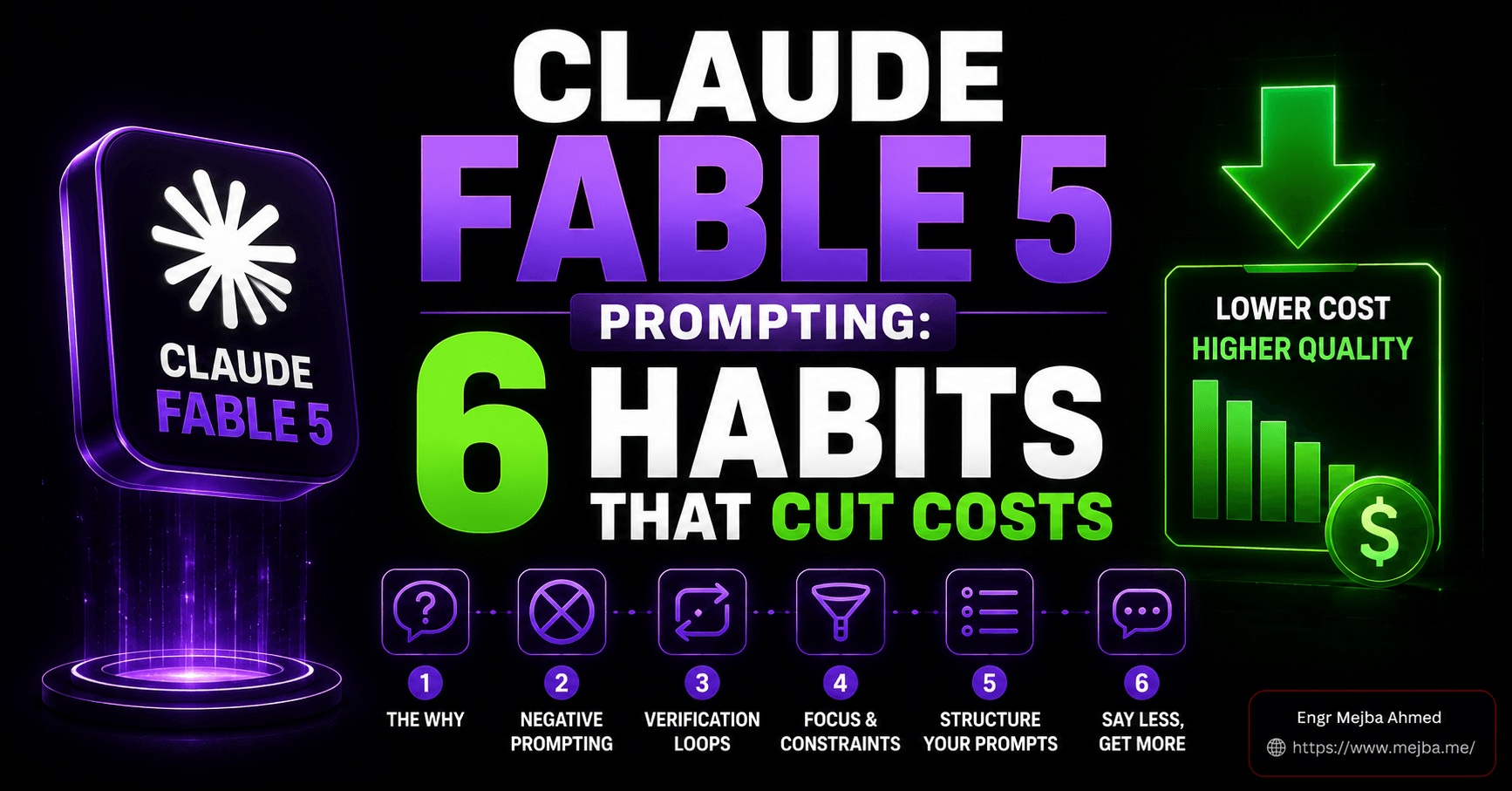
If your setup is solid but your prompts are the leak, that's a separate discipline — I broke down the six prompting habits that cut Fable 5 costs in their own post, because on a $50-per-million-output model, a sloppy prompt isn't a style problem, it's a line item.
If reading all this makes you want the results without spending three days building advisor skills and MCP connections yourself, that's a real service I offer — I build exactly these AI orchestration systems for people. You can see the kind of work at my Fiverr profile. But if you've got the days, the DIY version is genuinely better, because the system ends up shaped like your business, not a template.
What I'd actually do with the last 72 hours
Come back to where we started. I refused to pick Fable's first task, and let it pick for me — and that one move turned a countdown clock into a plan. That's the reframe I want you to take, because as I write this it's July 4, and the window shuts on the 7th.
Don't spend your remaining hours renaming variables. Open a session, hand Fable the memory of your real work, and ask it the same dare I did: of everything I'm doing, what are the five things actually worth spending you on? Then do the top one before you do anything else. Stress-test the strategy you've been avoiding. Bug-hunt the thing you're about to ship. Audit the mess you keep meaning to clean.
The model goes back behind a paywall in three days. The habit of aiming your best tool at your highest-leverage work doesn't have an expiry date. That's the part worth keeping.
FAQ
Frequently Asked Questions
Everything you need to know about this topic
Claude Fable 5 free access ends July 7, 2026. Until then, Pro, Max, Team, and select Enterprise subscribers can use Fable 5 for up to 50% of their weekly usage limit at no extra cost, then switch to another model or continue on usage credits.
After July 7, Fable 5 runs on usage credits at $10 per million input tokens and $50 per million output tokens — roughly double Opus 4.8. Anthropic has said it aims to fold Fable back into standard subscriptions once capacity allows, but no date is confirmed.
The highest-leverage Claude Fable 5 use cases share one shape: a large pile of context in, a synthesized insight and next action out. Strategy stress-tests with live data, pre-launch codebase bug hunts, feature planning, and large refactors all fit. See the five worked examples above.
Fable 5 was suspended for roughly 18 days in June 2026 under U.S. export controls and redeployed July 1 under capacity constraints. The 50% cap is a temporary throttle while Anthropic scales, not a permanent product tier — details in my return-and-context breakdown.
Use Fable 5 to plan, architect, and design — then hand the detailed plan to a cheaper, faster model to implement. For actual code, reserve Fable for whole-system reviews where its 1M-token context catches cross-file and cross-service bugs smaller models miss.
Let's Work Together
Looking to build AI systems, automate workflows, or scale your tech infrastructure? I'd love to help.
- Fiverr (custom builds & integrations): fiverr.com/s/EgxYmWD
- Portfolio: mejba.me
- Ramlit Limited (enterprise solutions): ramlit.com
- ColorPark (design & branding): colorpark.io
- xCyberSecurity (security services): xcybersecurity.io