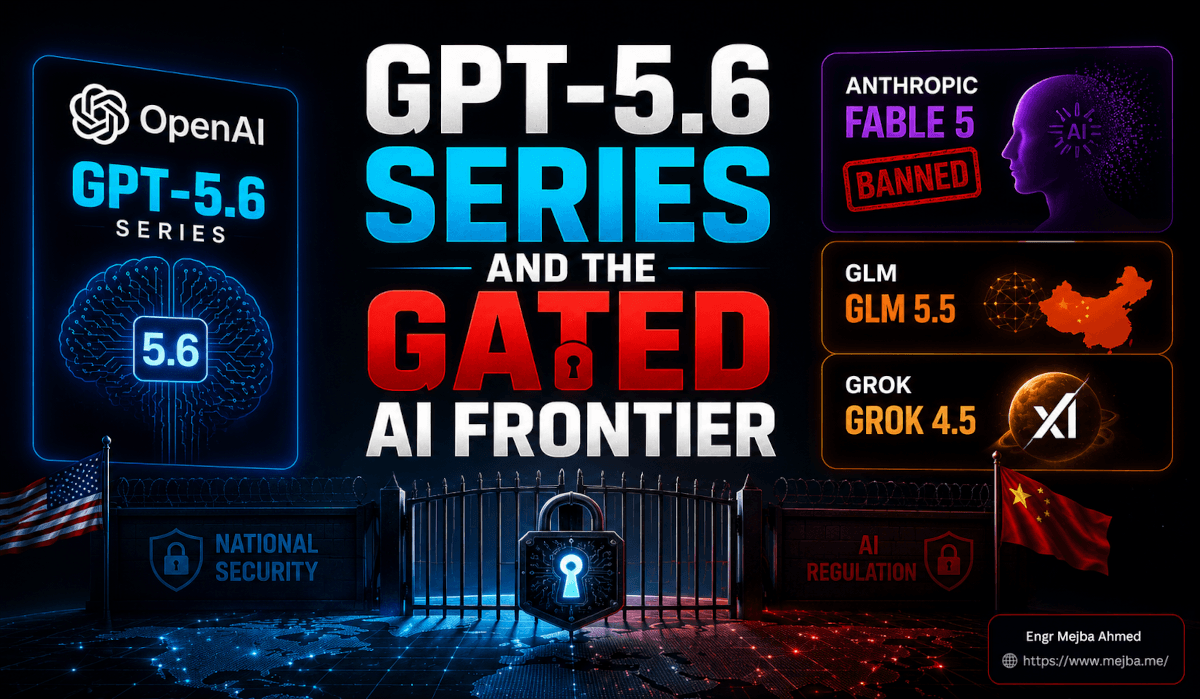
La serie GPT-5.6 et la frontiere IA verrouillee : la lecture d'un builder
Je rentre de deux semaines de voyage en m'attendant a rattraper un cycle d'actualites tranquille. Au lieu de ca, j'ouvre mon fil pour decouvrir qu'OpenAI a discretement previsualise toute une serie GPT-5.6 — Sol, Terra, Luna — deux jours avant que quiconque soit pret, et la reaction la plus bruyante ne portait pas sur les benchmarks. Elle portait sur qui a le droit d'y toucher.
Voici la partie qui a reorganise ma facon de penser tout ce moment. Pendant trois ans, un lancement de modele frontier voulait dire une seule chose : un billet de blog, un graphique de benchmark, et une cle API que vous pouviez coller dans votre terminal l'apres-midi meme. La serie GPT-5.6 a brise ce rituel. Le modele phare est verrouille derriere une autorisation du gouvernement americain. Le modele le plus capable d'Anthropic a ete purement et simplement banni pendant deux semaines. Et le prochain modele de codage chinois egalerait, selon les rapports, le meilleur modele cyber occidental sur la decouverte de vulnerabilites. La frontiere ne s'est pas seulement rendue plus intelligente ce mois-ci. Elle est devenue verrouillee.
Je veux etre franc avec vous avant d'aller plus loin, parce que la moitie des articles que vous lirez a ce sujet vont pretendre le contraire. Quand cette preview a fait surface, je n'avais pas fait tourner GPT-5.6 Sol — j'etais hors des Etats-Unis quand ca a atterri, et meme a l'interieur du pays, l'acces etait restreint a une courte liste de partenaires pre-approuves. (Ce verrou est tombe le 9 juillet 2026, quand OpenAI a ouvert Sol au public apres une autorisation gouvernementale large.) La personne qui a fait remonter la preview n'y avait pas non plus un acces complet. Ce n'est donc pas une revue pratique. C'est quelque chose que je trouve plus utile a ce stade : un builder qui prend chaque affirmation de la preview, separe ce qui est confirme de ce qui est rumeur, verifie les parties verifiables face aux vraies donnees, et degage le fil conducteur qui compte vraiment pour le reste d'entre nous.
Ce fil conducteur, le voici : le jeu a cesse d'etre « qui a le benchmark le plus eleve » pour devenir « qui a le droit d'utiliser le modele, ou il est autorise a tourner, et dans quel workflow il vit deja ». Laissez-moi vous faire faire le tour de tout ce qui a bouge, et pourquoi.
Qu'est-ce que la serie GPT-5.6 ? Decryptage des trois modeles
La serie GPT-5.6 est la premiere release frontier d'OpenAI qui se presente comme une famille de trois modeles hierarchises — Sol, Terra et Luna — plutot qu'un modele unique avec des interrupteurs de raisonnement, avec le modele phare verrouille derriere une approbation du gouvernement americain. C'est cette structure qui fait l'actualite, plus que n'importe quel chiffre isole.
Selon la preview, voici comment les trois se decoupent. Traitez les prix comme des chiffres previsualises, pas une grille tarifaire publiee — OpenAI n'avait pas publie de page de tarification officielle quand tout ceci a fait surface, donc je reporte les chiffres tels que declares en le signalant clairement.
Sol est le modele phare. La preview le presente comme un bond generationnel par rapport a GPT-5.5 — pas une version de finition, un vrai saut de generation. Prix rapporte : environ 5 $ par million de tokens en entree et 30 $ par million de tokens en sortie. Il introduit deux nouveaux niveaux de raisonnement au-dessus de l'echelle normale — un mode « max reasoning » et un mode « ultra » qui deploie plusieurs sous-agents sur une meme tache. C'est aussi le palier restreint. Partenaires autorises uniquement.
Terra est le cheval de trait equilibre. Ses performances sont estimees par la preview comme a peu pres comparables a GPT-5.5, orientees vers le travail quotidien efficace, a un prix catalogue reporte comme etant environ la moitie de celui de GPT-5.5. C'est celui vers lequel la plupart des equipes se tourneraient reellement au quotidien — si elles peuvent y acceder.
Luna est le pari du volume. Rapide, bon marche, modeste. Prix rapporte : environ 1 $ par million de tokens en entree et 6 $ par million de tokens en sortie. Construit pour les charges a haut debit et a enjeu plus faible ou vous vous souciez plus du cout par appel que de l'intelligence brute — classification, extraction en masse, la colonne vertebrale peu glamour de la plupart des IA en production.
Tous les trois partageraient une fenetre de contexte d'environ 1,5 million de tokens. Si ce chiffre tient, c'est un saut significatif, et cela place la serie GPT-5.6 dans le meme territoire de contexte long que celui que j'ai explore en testant la fenetre d'un million de tokens d'Opus 4.6 — le point ou « il suffit de mettre tout le codebase dans le prompt » cesse d'etre un tour de passe-passe et devient un workflow.
| Variante | Role | Entree / sortie rapportees | Notable | Disponibilite |
|---|---|---|---|---|
| Sol | Phare | ~5 $ / ~30 $ par M tokens | Raisonnement Max + Ultra, multi-sous-agents | Restreint — partenaires autorises |
| Terra | Quotidien equilibre | ~2x moins cher que GPT-5.5 | ~perf de GPT-5.5 | Large attendu |
| Luna | Fort volume | ~1 $ / ~6 $ par M tokens | Debit bon marche | GA attendu en premier |
Remarquez la strategie dans ce tableau. OpenAI n'expedie plus un modele. Il expedie une echelle : un modele intelligent, regule et cher au sommet pour un tout petit public autorise ; un intermediaire pragmatique ; et un moteur de debit bon marche en bas pour tous les autres. C'est une couverture deliberee, et on verra a la fin pourquoi c'est logique.
Mais la gamme n'est pas la partie inhabituelle. C'est la porte verrouillee.
Pourquoi GPT-5.6 Sol est reste verrouille au lancement
C'est ici que la serie GPT-5.6 cesse de ressembler a un lancement normal.
Le timing de la preview etait etrange — les attentes generales pointaient vers une sortie en juin ou juillet, et au lieu de ca, elle a surgi brusquement, avec seulement un acces limite via l'API et Codex, et uniquement pour un petit nombre de partenaires approuves par le gouvernement americain. OpenAI aurait renvoye les gens vers un dashboard pour verifier leur eligibilite, avec un acces plus large attendu dans deux a trois semaines. Sol lui-meme est deploye discretement aupres d'utilisateurs selectionnes plutot qu'annonce avec le tapage habituel.
Relisez cette sequence, parce que sa forme vous en dit plus que n'importe quel communique officiel. Un labo frontier a sorti son modele le plus capable plus tot que prevu, a une liste triee sur le volet, sous le genre de controles d'acces qu'on voit normalement autour du materiel soumis a controle a l'exportation, pas autour de modeles de chat. Ce n'est pas un choix marketing. C'est un modele qui se lance dans un environnement reglementaire qui a fondamentalement change.
J'ai couvert les premiers tremblements de tout ceci quand l'entree GPT-5.6 a fuite pour la premiere fois dans les logs de session Codex des semaines avant tout mot officiel, et quand la pression du controle a l'exportation a commence a redessiner qui peut expedier quoi. La fuite, c'etait la rumeur. La preview verrouillee, c'est la rumeur qui devient politique. Les modeles frontier sont maintenant traites, par le gouvernement americain et de plus en plus par les labos eux-memes, comme une technologie a double usage — la meme categorie que les puces qui les entrainent.
Pendant ses premieres semaines, si vous etiez un builder qui attendait de mettre Sol dans un vrai pipeline, l'implication pratique etait sans etat d'ame : vous ne pouviez pas planifier autour de lui. Ca a change le 9 juillet, quand Sol s'est ouvert au public — mais l'episode merite d'etre retenu, parce que le prochain modele phare ne sera peut-etre pas deverrouille aussi rapidement. Pour la dissection plus profonde des affirmations specifiques de Sol face a des donnees verifiables, je l'ai developpee dans mon analyse detaillee de la preview de GPT-5.6 Sol — ce billet-ci est la carte plus large.
Maintenant, qu'est-ce que Sol est cense faire qui lui a valu la boite verrouillee ?
Les capacites de GPT-5.6 Sol : confirmees vs. revendiquees
Version courte : OpenAI affirme que Sol est son modele le plus fort a ce jour, affichant un nouvel etat de l'art sur Terminal-Bench 2.1 et battant GPT-5.5, Claude Mythos 5, Claude Fable 5 et Gemini 3.1 Pro sur l'ensemble de sa suite de benchmarks — mais rien de tout cela n'est verifie de maniere independante pour le moment, parce que le modele est de fait hors ligne pour le public.
Laissez-moi separer les couches, parce que ca compte.
Ce qui est verifiable aujourd'hui : Terminal-Bench est reel, et c'est un benchmark serieux. Il est sorti du Laude Institute et a ete publie a ICLR 2026. Il place un agent dans un conteneur Docker avec une tache, une limite de temps et un ensemble de validations pytest — et c'est un score tout-ou-rien, sans credit partiel, sur 89 taches construites a la main couvrant l'ingenierie logicielle, la securite, l'administration systeme et la data science. La version 2.1 est la revision nettoyee qui a corrige les taches ambigues de la sortie 2.0. A la mi-juin 2026, le classement public affichait Codex associe a GPT-5.5 a 83,4 % et Claude Code avec Fable 5 juste derriere a 83,1 %. Donc quand la preview dit que Sol etablit un nouvel etat de l'art sur Terminal-Bench 2.1, je sais exactement quel chiffre elle pretend battre, et c'est un chiffre issu d'un harnais credible et reproductible. C'est la partie la plus solide de l'affirmation.
Ce qui est revendique mais non verifie : Tout le comparatif. « Bat Mythos 5, Fable 5, Gemini 3.1 Pro. » Peut-etre. Au moment de la preview, on ne pouvait pas verifier, parce que Sol n'etait pas accessible pour un benchmarking independant — il semblait entierement hors ligne, ce qui retardait precisement les tests publics qui confirmeraient ou perceraient les chiffres. Ce test n'est devenu possible qu'une fois Sol devenu public le 9 juillet. J'ai vu assez de lancements pour etre allergique a un benchmark qu'on ne peut pas reproduire. Classez ca sous « OpenAI affirme », pas « OpenAI a demontre ».
Les deux axes de capacite qui m'interessent vraiment :
D'abord, la cybersecurite et les sciences dures. La preview met en avant des gains majeurs en biologie et en cybersecurite, et une affirmation specifique verifiable en principe : Sol egalerait Mythos sur la recherche de vulnerabilites avancee tout en utilisant environ un tiers des tokens de sortie. Si ca tient, c'est enorme — pas seulement a cause de la capacite elle-meme, mais parce que l'efficacite en tokens sur des taches de securite offensive est precisement le genre de chose qui rend un modele a la fois plus utile et plus dangereux. Ce qui, non par hasard, est la raison pour laquelle il est verrouille.
Deuxiemement, les nouveaux modes de raisonnement. « Max reasoning » et « ultra » — ce dernier faisant tourner plusieurs sous-agents sur un meme probleme. La preview decrit aussi un budget de raisonnement interne plus grand aux niveaux de raisonnement plus eleves. Je veux signaler quelque chose honnetement ici : la source originale a lance un chiffre specifique de tokens pour ce budget qui ne resiste pas a l'examen — ca ressemble a un chiffre embrouille, donc je ne vais pas le repeter comme un fait. L'affirmation directionnelle est la partie credible : aux reglages de raisonnement plus eleves, Sol pense plus longtemps et plus fort, et « ultra » ressemble a OpenAI qui produitise le pattern d'orchestration multi-agents que, jusqu'ici, il fallait construire soi-meme. Si vous avez suivi comment les equipes d'agents se comportent reellement dans les vrais tests, vous savez que c'est la partie dure et precieuse — et l'integrer dans un interrupteur de raisonnement est une vraie manoeuvre.
Les affirmations sont bon marche, cela dit. La preview s'appuyait sur des demos. Regardons-les.
Les demos : impressionnantes, mais a lire avec attention
La preview a mis en avant une poignee de constructions en one-shot, et le resume honnete est : reellement impressionnant, clairement un bond par rapport a GPT-5.5, et pas aussi net que ce que le montage laisse entendre.
Les points saillants, tels que presentes :
- Un clone de type Minecraft en environ 90 minutes — page d'accueil, selecteurs de mode de jeu, biomes desertiques et mobs, animations de nuages et de casse de blocs, cycle jour/nuit. Le hic, indique dans la preview elle-meme : certaines interactions, comme ramasser des blocs, ne fonctionnaient pas pleinement. Plus realiste que ce que Fable a produit, mais la source etait franche sur le fait que ca ne surpassait pas Fable 5 en sophistication globale.
- Une simulation d'attrapage de propulseur SpaceX Starship — mecanique de pinces realiste et comprehension credible de la physique et de la robotique. La « capture aux baguettes » est une chose reellement difficile a simuler de facon convaincante, donc celle-la a attire mon attention.
- Un RPG de type Pokemon en environ 31 minutes — style emulateur, plusieurs arenes, huit badges, selection de starter, une Ligue de fin de jeu. Construit pour eviter les problemes de copyright.
- Un generateur de monde 3D voxel en environ 44,5 minutes.
La preview a decrit le saut de 5.5 a Sol comme « absurde », en particulier sur le codage, le front-end, le full-stack et le travail de simulation. Je crois a la direction. Je suis sceptique face au cadrage. Voici pourquoi cette ligne « certaines interactions ne fonctionnaient pas » compte plus que le vernis de la demo : un modele qui construit un magnifique clone de Minecraft ou vous ne pouvez pas ramasser de blocs est un modele qui est spectaculaire pour generer une structure plausible et encore imparfait pour boucler la boucle de la justesse interactive. C'est exactement l'ecart que je rencontre en permanence en faisant tourner de vraies boucles d'agent — la chose a l'air finie et ne l'est pas, et les derniers 10 % sont l'endroit ou vit la vraie ingenierie.
Donc ma lecture : la serie GPT-5.6 est un vrai bond de capacite, les demos sont directionnellement honnetes sur le fait de ne pas battre Fable 5, et quiconque vous dit que « Sol resout des applis de production en one-shot maintenant » vous vend la bande-annonce, pas le film. On ne saura pas tant que ce ne sera pas ouvert au test — et c'est verrouille aussi.
Ce qui nous amene au modele qui a ete verrouille le plus durement.
Le ban de Fable 5 : quand un modele devient un probleme de securite nationale
Fable 5 d'Anthropic a ete banni. Ni limite en debit, ni mis en liste d'attente — retire, pendant environ deux semaines, pour des raisons de securite nationale, apparemment a cause de sa capacite a repliquer un piratage des systemes de securite du gouvernement americain.
Prenez un instant pour mesurer a quel point c'est inhabituel. On a eu des modeles qui refusent des taches. On a eu des labos qui retardent des lancements. On n'a jamais, dans l'ere publique de l'IA frontier, eu un Etat qui ordonne effectivement le retrait d'un modele commercial phare a cause de ce qu'il pouvait faire dans de mauvaises mains. C'est une nouvelle categorie d'evenement, et c'est le signal le plus clair a ce jour que les modeles les plus capables sont maintenant gouvernes comme une technologie a proximite de l'armement plutot que comme des produits logiciels.
Voici ce qui est confirme par rapport a ce qui est rapporte, parce que la nuance est toute l'histoire :
Confirme (selon la declaration d'Anthropic elle-meme) : Depuis le 12 juin, Anthropic cooperait avec les responsables americains pour reactiver Mythos 5 et Fable 5. Mythos 5 a ete restaure a un groupe limite d'organisations d'infrastructures critiques — de l'ordre de 100 organisations, selon les rapports — avec un elargissement graduel de l'acces, pas un retour a l'ouverture. L'acces public reste fortement restreint, sous controles serres et protocoles de securite.
Rapporte / rumeur : Que l'administration Trump etait proche de restaurer un acces plus large apres la coupure d'environ deux semaines, possiblement dans cette semaine-la, avec des negociations proches de la resolution — et que le modele restaure serait probablement nerfe : securite plus stricte, capacite reduite dans les domaines de cybersecurite les plus sensibles. Traitez ca comme du reporting, pas comme un fait. L'affirmation directionnelle — « ca revient, mais plus serre » — est coherente d'une source a l'autre ; le timing specifique, c'est la partie molle.
J'ai retrace la mecanique par laquelle un modele frontier banni se fraye un chemin de retour vers un service limite dans mon analyse du retour de Fable 5, et le pattern y tient ici aussi : la restauration n'est pas un interrupteur, c'est une negociation, et le modele qui revient n'est pas le modele qui est parti. Si vous construisez sur le palier frontier d'Anthropic, c'est la realite operationnelle a interioriser — la capacite a ce niveau vient maintenant avec une couche de gouvernance que vous ne controlez pas.
Et non, ce n'est pas un CEO qui a convaincu le gouvernement de quoi que ce soit. Laissez-moi traiter cet argument directement, parce qu'il est partout.
Est-ce que Dario Amodei a « fait peur » pour verrouiller la frontiere ?
Il y a une narration bruyante en ligne selon laquelle le CEO d'Anthropic Dario Amodei aurait convaincu le gouvernement americain de restreindre les modeles frontier — que tout le cadrage securite nationale est de la peur agitee par un CEO qui beneficie de fosses reglementaires. Je n'y crois pas, et je veux exposer pourquoi aussi clairement que possible.
Le gouvernement americain ne bannit pas un modele sur la parole d'un seul dirigeant. Une decision comme retirer Fable 5 passe par plusieurs agences — la NSA, la communaute du renseignement, des experts en cybersecurite dedies — chacune faisant sa propre evaluation de risque independante. Quand un modele peut aider de maniere credible a compromettre les systemes gouvernementaux, ce n'est pas un ressenti qu'un CEO peut fabriquer dans un podcast. C'est un constat, evalue par des gens dont le travail entier consiste a evaluer exactement ce type de menace.
La motivation probable ne concerne meme pas d'abord le mesusage domestique. Elle concerne les adversaires — garder la capacite cyber offensive frontier hors des mains d'Etats rivaux, la Chine en premier. C'est un calcul strategique qui existe qu'un dirigeant d'IA prenne ou non la parole en public.
Il y aurait eu quelques ratages de communication du cote d'Anthropic tot dans l'episode — mais c'est une question operationnelle distincte, pas la cause du ban. Confondre « Anthropic a mal gere la communication » avec « Anthropic a orchestre la politique » est exactement le genre de raisonnement motive qui produit un bon engagement et une mauvaise analyse.
Je serai honnete sur ma position, parce que ce n'est pas un endroit confortable. Je veux un acces public large aux modeles frontier — c'est de la que vient l'innovation qui m'importe, ce sur quoi je construis mon travail. Et je reconnais aussi qu'un modele reellement capable d'attaquer des infrastructures critiques est un objet different d'un chatbot, et pretendre le contraire pour gagner une dispute en ligne n'aide personne. C'est moi qui lis les faits, pas qui choisis un camp politique. Les restrictions ressemblent au produit d'une vraie evaluation institutionnelle du risque, pas au lobbying d'un seul homme.
Si le but est de garder cette capacite hors de portee des adversaires, voici le probleme : les adversaires la construisent aussi.
GLM-5.2 de Chine : la course a la cybersecurite n'a pas de freins
Z.ai en Chine a sorti GLM-5.2 comme un modele open-weight sous licence MIT en juin 2026 — un jour apres que les controles a l'exportation aient touche Fable 5 — et l'affirmation qui compte est celle-ci : il egale Claude sur la decouverte de vulnerabilites. Ce n'est pas seulement la parole de Z.ai : le benchmark IDOR independant de Semgrep a note GLM-5.2 a 39 % F1, devant Claude a ~32 % — exactement la capacite qui a fait verrouiller les modeles frontier occidentaux en premier lieu.
Que cette affirmation tienne dans le monde reel ou seulement en benchmark, c'est reellement non verifie, et je veux le garder tel quel. « Egaler sur un benchmark » et « egaler dans un engagement en direct contre une cible durcie » sont des choses tres differentes, et l'ecart entre les deux est exactement l'endroit ou beaucoup de hype de modeles vient mourir. Donc : non confirme, a surveiller de pres.
Mais le signal est sans equivoque, que la revendication exacte de parite tienne ou non. La cybersecurite est devenue le champ de bataille central de la course a l'IA entre les Etats-Unis et la Chine, et il n'y a aucune preuve de ralentissement du cote chinois. Je suis la trajectoire de GLM depuis un moment — quand j'ai benchmarke GLM contre Qwen et Opus, la conclusion etait que les modeles open-weight chinois comblaient l'ecart plus vite que la narration confortable occidentale ne voulait l'admettre. GLM-5.2 atteignant une decouverte de vulnerabilites de classe frontier, si c'est reel, c'est cette tendance qui touche la capacite la plus strategiquement sensible qui soit.
Voici la boucle strategique inconfortable. Les Etats-Unis verrouillent Fable 5 pour empecher que la capacite cyber offensive parvienne a la Chine. La Chine sort GLM-5.2, open-weight et sous licence MIT, avec une capacite comparable testee de maniere independante quand meme. Le verrou protege les Etats-Unis d'accelerer un adversaire qu'ils ne peuvent peut-etre pas ralentir. Cette tension n'a pas de resolution nette, et toute analyse qui pretend le contraire n'est pas honnete avec vous. Pour l'analyse approfondie de pourquoi la capacite cyber en particulier est le point d'ignition, je l'ai decortique dans mon article sur Mythos et la cybersecurite.
Pendant que la frontiere se verrouille et se dispute, quelque chose de plus discret et sans doute plus important s'est produit dans le business en dessous.
La poussee entreprise d'Anthropic : le jeu s'est deplace vers les workflows
Voici le developpement autour duquel je pense que les builders devraient reellement se reorganiser : le business entreprise d'Anthropic a bondi de fin 2025 a debut 2026, et selon plusieurs mesures independantes, il a depasse OpenAI dans la partie du marche qui paie — les depenses des entreprises en outils de developpement IA.
Celui-ci, je peux l'etayer avec des donnees verifiables, et c'est frappant. Selon le suivi des depenses entreprises, Claude Code detient environ 54 % des depenses entreprises en codage en 2026 contre 21 % pour OpenAI — et le codage represente maintenant plus de la moitie de tout l'usage entreprise d'IA generative. L'AI Index de Ramp a montre Anthropic captant plus de 73 % des depenses parmi les entreprises achetant des outils IA pour la premiere fois. Et en avril 2026, l'adoption business a franchi une ligne qui ne l'avait pas ete auparavant : Anthropic a 34,4 % contre OpenAI a 32,3 % — la premiere fois qu'Anthropic devance OpenAI en adoption entreprise. Menlo Ventures a chiffre les depenses LLM entreprises a environ 40 % Anthropic contre 27 % OpenAI. Les sources ne s'accordent pas sur l'ampleur exacte. Elles s'accordent sur la direction.
Alors qu'est-ce qui a change ? La competition a cesse de porter sur quel labo a le meilleur modele et est devenue quel modele est integre dans le workflow quotidien. Je reviens sans arret a l'analogie Windows/Office des annees 1990. Microsoft n'a pas gagne parce qu'il expediait toujours la meilleure application individuelle — il a gagne parce que son logiciel est devenu la chose qu'on ouvre chaque matin sans y penser. Anthropic joue ce playbook aupres des equipes d'ingenierie : Claude Code vit dans le terminal, dans le cycle de revue, dans l'endroit ou le travail se fait vraiment. Une fois qu'un outil est porteur dans la boucle quotidienne d'une equipe, le cout de bascule — pas le score du benchmark — devient le facteur decisif.
C'est le vrai basculement dans lequel la serie GPT-5.6 se lance. La course a l'armement porte maintenant sur l'economie du workflow : reduction des frictions, gouvernance, integration et livraison de valeur prouvable — codage plus rapide, moins de bugs, cycles de revue de code plus courts — pas sur une bosse de deux points a une eval. Un modele que vous pouvez demontrer et un modele qui est tisse dans la memoire musculaire de dix mille ingenieurs sont des actifs tres differents, et le second est bien plus difficile a deloger.
Deux mises en garde honnetes, parce que la version triomphaliste de cette histoire est fausse. D'abord, une poussee n'est pas un couronnement — ce n'est pas la defaite d'OpenAI. OpenAI reste fortement competitif, en particulier sur la productivite plus large et sur le bas du marche en cout, ce qui est precisement pourquoi le palier Luna existe. Deuxiemement, le marche IA entreprise est complexe et segmente ; « Anthropic mene les depenses de codage » et « OpenAI mene la portee grand public » sont vrais simultanement. Quiconque aplatit ca en « X a gagne » vend une narration, pas ne decrit un marche.
Un autre entrant vient de poser le pied sur le terrain, et il porte un badge Tesla.
Grok 4.5 : le pari codage de Musk, en beta privee
Elon Musk affirme que Grok 4.5 est en beta privee au sein de SpaceX et Tesla, et approcherait le niveau de Claude Opus — meme si la version d'Opus dont il s'agit est reellement incertaine.
La revendication technique interessante : Grok 4.5 serait construit sur le modele fondamental « V9 » d'xAI, d'environ 1,5 trillion de parametres, puis entraine davantage avec les donnees de Cursor pour affuter le codage. Si ce detail est exact, c'est revelateur en termes de strategie — xAI ne fait pas que scaler un modele de base, il vise specifiquement le marche des agents de codage, en s'entrainant sur le type de vraies donnees d'edition qui rendent un modele bon dans la boucle que les developpeurs font tourner reellement. C'est un coup direct porte au segment qu'Anthropic domine actuellement.
Gardez le scepticisme calibre, cela dit. « En beta privee chez SpaceX et Tesla » signifie que les propres entreprises de Musk sont les testeurs, ce qui est a peu pres l'environnement d'evaluation le plus amical qui existe. « Approche du niveau d'Opus » avec un numero de version incertain est une affirmation molle enveloppee autour d'un chiffre de parametres qui sonne dur. Je mettrais Grok 4.5 fermement dans la colonne « regardez les benchmarks publics, ignorez les tweets du fondateur » tant qu'il n'y a rien de reproductible. Mais l'intention est claire et credible : xAI veut etre un concurrent serieux du codage, et il s'entraine specifiquement pour cette bataille.
Donc ou tout ceci laisse-t-il un builder qui essaie de prendre de vraies decisions ?
Ce qui compte vraiment ici (la lecture du builder)
Prenez du recul par rapport aux noms de modeles et aux revendications de benchmark, et trois choses sont vraies simultanement ce mois-ci — et les trois sont plus durables que n'importe quelle sortie individuelle.
Un : le sommet de la frontiere est gouverne par la securite nationale, et ce n'est pas un pepin temporaire. GPT-5.6 Sol lance d'abord a des partenaires autorises avant l'ouverture du 9 juillet, Fable 5 banni et partiellement restaure sous controles plus serres, Mythos 5 revenant au compte-gouttes vers ~100 organisations d'infrastructures critiques — ce ne sont pas des histoires separees. C'est la meme histoire. Les modeles les plus capables sont gouvernes comme une technologie strategique a double usage. Si votre roadmap suppose que vous obtiendrez un acces API le jour meme a ce qui est le plus fort, reconstruisez cette hypothese maintenant.
Deux : le jeu concurrentiel est passe de la supremacie des benchmarks a l'integration dans le workflow. Anthropic n'a pas depasse OpenAI dans les depenses entreprise en codage en gagnant un benchmark — il l'a fait en devenant l'outil que les ingenieurs ouvrent sans y penser. Pour ceux d'entre nous qui construisent des produits sur ces modeles, c'est la lecon a piquer : le fosse, ce n'est pas le modele, c'est a quel point votre chose vit profondement dans la boucle quotidienne de quelqu'un. J'ai defendu ca du cote de la construction dans mon point de vue sur devenir agent-native, et les donnees entreprise viennent de le confirmer avec de l'argent.
Trois : la geopolitique est maintenant une variable de selection de modele. Le fait que GLM-5.2 egalerait Mythos sur la decouverte de vulnerabilites signifie que le verrouillage qui protege les Etats-Unis peut ne pas reellement ralentir la propagation mondiale de la capacite. Pour les builders, cela se traduit par une realite pratique : quel modele vous pouvez utiliser, ou il peut legalement tourner et ce qu'il a le droit de faire deviennent aussi importants que son intelligence.
Si je devais compresser tout le mois en une phrase pour un ingenieur occupe : arretez d'optimiser purement pour le modele le plus intelligent, et commencez a optimiser pour le modele le plus intelligent que vous pouvez reellement deployer, dans votre juridiction, a l'interieur du workflow que vous possedez deja. C'est une phrase moins excitante que « Sol resout un clone de Minecraft en one-shot ». C'est aussi celle qui sera encore vraie au prochain trimestre.
Je suis rentre de deux semaines d'absence en pensant avoir rate une guerre de benchmarks. Ce dans quoi j'ai reellement mis les pieds, c'est le moment ou les regles ont change — quand la question a cesse d'etre a quel point le modele est bon et est devenue qui a le droit de l'utiliser, et fait-il deja partie de votre facon de travailler. Les labos qui gagneront l'annee prochaine ne seront pas ceux avec le chiffre le plus eleve sur un graphique que personne en dehors d'une liste de partenaires autorises ne peut reproduire. Ce seront ceux dont les modeles sont discretement porteurs dans votre journee avant meme que vous ne remarquiez que vous avez cesse de les choisir.
Alors voici la question sur laquelle je m'assiedrai ce soir, quoi que vous construisiez : si le modele le plus fort du monde se retrouve verrouille derriere une autorisation gouvernementale que vous n'aurez jamais, est-ce que votre produit est concu pour gagner sur l'intelligence brute — ou sur la profondeur avec laquelle il vit dans le travail ? Parce que l'un est desormais verrouille. L'autre est encore a votre portee.
Foire aux questions
Qu'est-ce que la serie GPT-5.6 ?
La serie GPT-5.6 est la sortie frontier hierarchisee d'OpenAI, composee de trois modeles — Sol (phare), Terra (equilibre) et Luna (fort volume) — chacun regle pour un point prix-performance different. Le palier phare Sol est restreint aux partenaires approuves par le gouvernement americain. Voir le decoupage complet dans la section sur les modeles ci-dessus.
Pourquoi Fable 5 d'Anthropic a-t-il ete banni ?
Fable 5 aurait ete retire pendant environ deux semaines pour des raisons de securite nationale, en raison de sa capacite a repliquer un piratage des systemes de securite du gouvernement americain. Selon la declaration d'Anthropic lui-meme, l'entreprise a coopere avec les responsables americains depuis le 12 juin pour reactiver Fable 5 et Mythos 5 sous controles plus serres et acces restreint.
GPT-5.6 Sol est-il disponible pour le public ?
Oui, depuis le 9 juillet 2026. Sol a passe ses premieres semaines en sortie limitee via l'API et Codex a des partenaires americains pre-approuves uniquement, mais le gouvernement americain a approuve une sortie large le 9 juillet et OpenAI a ouvert Sol au public aux cotes de Terra et Luna.
Anthropic a-t-il depasse OpenAI en entreprise ?
Selon plusieurs mesures independantes, oui — dans le segment des outils pour developpeurs. Les donnees entreprise 2026 montrent Claude Code detenant environ 54 % des depenses entreprise en codage contre 21 % pour OpenAI, et avril 2026 a marque le premier mois ou Anthropic devance OpenAI en adoption business globale. OpenAI reste fort sur la portee grand public et les paliers a plus bas cout.
GLM-5.2 de Chine est-il vraiment aussi capable que Claude en cybersecurite ?
Sur la decouverte de vulnerabilites, les tests independants disent oui : le benchmark IDOR de Semgrep a note GLM-5.2 open-weight a 39 % F1, devant les ~32 % de Claude. Les benchmarks ne racontent pas toute l'histoire, mais ce n'est pas seulement une affirmation du vendeur. Le signal plus large est clair quoi qu'il en soit : le developpement de l'IA frontier en Chine ne montre aucun ralentissement, avec la cybersecurite comme champ de bataille central.
Vous construisez sur une frontiere qui bouge sans cesse ?
Quand l'acces aux modeles, les prix et les regles d'exportation changent d'un mois a l'autre, la manoeuvre durable est une architecture qui peut echanger des modeles sans reecrire votre stack. Concevoir cette portabilite — et le routage et les garde-fous autour — c'est le travail que je prends en charge. Si c'est un probleme que vous prefereriez confier, voici ou me trouver.