El número que me detuvo la semana pasada no fue un benchmark. Fue 25.
Veinticinco grados de libertad, en una sola mano robótica, construida por una empresa llamada 1X. Yo iba por la tercera pestaña de las notas de lanzamiento de GPT-5.6 cuando un amigo soltó la hoja de especificaciones de la mano de Neo en nuestro chat, y cerré todo lo demás. Porque por primera vez en mucho tiempo, lo más interesante que estaba pasando en la IA no era un modelo. Era una pieza de hardware que por fin me hizo plantearme una pregunta que llevaba tiempo evitando: ¿de qué sirve un genio atrapado en una caja de texto?
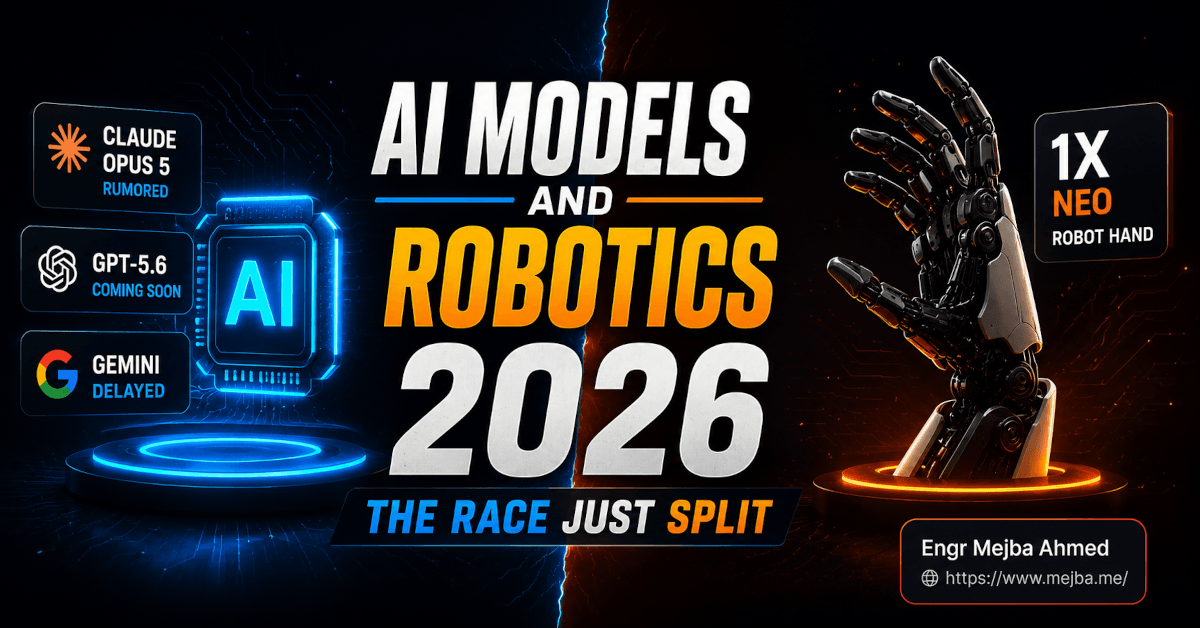
Ese es el cambio por el que quiero guiarte. Si has estado siguiendo los modelos de IA y la robótica en 2026 como lo hace la mayoría — refrescando tablas de benchmarks y discutiendo sobre qué modelo es "el más listo" — creo que ahora estás midiendo lo que no toca. La carrera no se volvió más rápida este año. Se dividió. Por un camino, los laboratorios pelean por cómo construir el próximo cerebro. Por el otro, un grupo mucho más pequeño se dio cuenta de que el cerebro nunca fue el cuello de botella. Lo eran las manos.
Déjame mostrarte ambos caminos, porque mediados de julio de 2026 es una de esas raras semanas en las que se puede ver todo el tablero de una vez.
Modelos de IA y robótica 2026: la carrera se dividió en dos frentes
El cambio mental más útil que puedes hacer este año es dejar de tratar los modelos de IA y la robótica de 2026 como una sola historia. Son dos. El primer frente es una pelea a cuchillo entre laboratorios por cómo construir el próximo cerebro — iterar rápido o profundizar los cimientos. El segundo frente es una contienda mucho más silenciosa por construir el cuerpo que permite a ese cerebro actuar. El primer frente se lleva los titulares. El segundo frente, como argumentaré al final, se lleva el futuro.
Dos formas de construir un modelo de frontera — y los laboratorios eligieron bandos opuestos
Esto es lo que nadie dice en voz alta en las fiestas de lanzamiento de modelos: ya no existe consenso sobre cómo se hace siquiera el progreso. En 2023 todos estaban de acuerdo — escalar, entrenar un modelo base más grande, lanzar un salto generacional limpio. De GPT-3 a GPT-4. Limpio. Legible. En 2026 ese consenso ha desaparecido, y los dos laboratorios más grandes están ejecutando experimentos opuestos en público.
OpenAI eligió la iteración implacable. Fíjate en la cadencia: el modelo que todos llamaban sin aliento "GPT-6" llegó el 23 de abril de 2026 — y se lanzó como GPT-5.5, no como una nueva generación. Después, GPT-5.6 se hizo público el 9 de julio de 2026, dividido en tres niveles con los nombres internos Luna, Terra y Sol, donde el buque insignia Sol habría registrado un 88,8% en Terminal-Bench 2.1. Tres lanzamientos "de punto" en menos de seis meses, cada uno absorbiendo discretamente funciones que el rumor había reservado alguna vez para un verdadero GPT-6. Sam Altman ha sido explícito en que un salto generacional real no está en el plan a corto plazo; los reportes más creíbles sitúan ahora GPT-6 en el cuarto trimestre de 2026, como muy pronto.
Anthropic está ejecutando el otro experimento. En lugar de una manguera de lanzamientos incrementales, ha mantenido una línea más estable — Opus 4.8 salió el 28 de mayo de 2026, y todo el arco 4.x de Opus ha consistido en profundizar unos cimientos en vez de perseguir un número de versión. En mi propio flujo de trabajo diario con Claude Code, esa contención es la razón por la que Opus sigue siendo mi opción por defecto para programación agéntica: el comportamiento es predecible entre versiones de punto, de una forma que importa más que una diferencia en la tabla de clasificación cuando tienes cinco agentes corriendo contra un repositorio real a la 1 de la madrugada.
Ninguna de las dos estrategias es obviamente la correcta. Eso es lo que lo hace interesante. El enfoque de OpenAI entrega valor a los usuarios más rápido y mantiene caliente el ciclo de noticias. El enfoque de Anthropic protege aquello por lo que los compradores empresariales realmente pagan — una fiabilidad sobre la que puedes construir un negocio. Mantén esa tensión en la cabeza, porque está a punto de chocar con una filtración.
¿Es real Claude Opus 5? Lo que la filtración realmente dice (y lo que no)
Respuesta corta: existe una filtración genuina, sin confirmar, que apunta a un Claude Opus de próxima generación, y Anthropic no ha anunciado oficialmente ninguna fecha de lanzamiento. Todo lo que viene después de esa frase es especulación, y voy a señalizarlo con fuerza, porque esta es exactamente la clase de historia en la que la credibilidad se quema cuando la gente reporta rumores como hechos.
Esto es lo que realmente circula a mediados de julio de 2026. Un modelo apareció brevemente bajo un nombre en clave de acceso anticipado — reportado como "Honeycomb" — antes de desaparecer. Junto a él llegaron rumores sobre una ventana de contexto de 1 millón de tokens en el próximo Opus, y un objetivo de lanzamiento para final de mes. Esa es la filtración. Ese es todo el núcleo sustanciado del asunto.
Ahora las advertencias, porque importan más que el bombo:
- Anthropic no ha confirmado nada de esto. Ni fecha, ni cifra de contexto, ni nombre. Trata "Opus 5" como un marcador de posición que inventó la comunidad, no como un producto.
- La cifra de 1M de contexto es un número reportado proveniente de rumores previos al lanzamiento, no de una hoja de especificaciones. He visto evaporarse suficientes "ventanas de contexto" filtradas como para no construir un plan alrededor de una.
- Anthropic históricamente ha preferido lanzamientos de punto (4.6, 4.7, 4.8) antes que saltos generacionales limpios. Un "5" repentino rompería ese patrón — lo cual es o bien una señal de que algo grande se acerca, o una señal de que la comunidad está encajando patrones con ilusión.
Si la ventana de 1M de tokens resulta ser real, cambia la forma de lo que puedo hacer en una sola ejecución de agente — meter una base de código completa de tamaño medio en el contexto en lugar de trocearla. Ese es un cambio genuino de capacidad, no una métrica de vanidad. Pero el si es cierto está cargando con un peso enorme en esa frase, y prefiero decirte honestamente que no lo sé antes que venderte un rumor con cara de seguridad. Profundicé en la versión anterior de esta filtración en mi desglose de la filtración del Claude de próxima generación de Anthropic, y la versión corta no ha cambiado: espera a la model card.
Por qué Google Gemini se estancó exactamente en el peor momento
Mientras los dos punteros discuten sobre cómo construir el futuro, Google pasó julio de 2026 explicando un retraso — y los retrasos son donde el impulso va a morir.
Gemini 3.5 Pro debía lanzarse en junio. En Google I/O, el 19 de mayo de 2026, Sundar Pichai se subió al escenario y prometió que llegaría "el mes que viene". Después, Google retrasó discretamente la disponibilidad general hasta julio, alegando la necesidad de incorporar más comentarios de los primeros probadores y de afinar el modelo en tareas agénticas de largo horizonte. Los reportes posteriores han apuntado a un objetivo del 17 de julio, presentado como una pasada arquitectónica más profunda.
Un lanzamiento retrasado es superable por sí solo. El problema es junto a qué aterrizó. En la misma ventana de diez días, ocurrieron dos cosas que convirtieron un retraso en una narrativa:
Primero, el talento. Surgieron reportes de que Noam Shazeer — vicepresidente de ingeniería de Gemini y coautor del paper de 2017 "Attention Is All You Need" que inició toda esta era — se marchaba, presuntamente a OpenAI. En la misma oleada, se reportó que John Jumper, el científico de DeepMind detrás de AlphaFold y parte del Premio Nobel de Química de 2024, se dirigía a Anthropic. Cuando las personas que inventaron el transformer supuestamente están saliendo por la puerta durante un lanzamiento retrasado, el mercado lo nota.
Segundo, el mercado efectivamente lo notó. El 22 de junio de 2026, las acciones de Alphabet cayeron aproximadamente un 5% en una sola sesión — unos 225.000 millones de dólares de valor de mercado esfumados, su caída diaria más pronunciada en más de un año. Y las cifras de uso subyacentes cuentan la verdadera historia. Según el State of AI Report 2026 de Sensor Tower, ChatGPT tenía el 46% del mercado global de asistentes de IA en mayo de 2026, Gemini el 28% y Claude el 10% — pero la cuota de Claude en Estados Unidos subió del 5% en diciembre pasado al 14% en mayo, impulsada casi por completo por la programación y la investigación profunda.
Lee esos números juntos y obtienes la verdad incómoda para Google: la distribución no es destino. Gemini viene incluido en los productos más usados del planeta y aun así está perdiendo cuota en los segmentos donde viven el dinero y la lealtad. Escribí sobre el intento anterior de Gemini de recuperar el impulso en mi análisis del regreso de Gemini 3.5 Pro — y este retraso es el contragolpe que ese regreso necesitaba evitar.
Los modelos de pesos abiertos que están reajustando en silencio el suelo de precios
Aquí hay un camino que no llega a portada, y es el que yo vigilaría con más atención si dirigiera una startup que depende de costes de API.
Mientras todos miran a los laboratorios de frontera estadounidenses, los modelos chinos de pesos abiertos siguieron lanzando — y ya no son "alternativas baratas", son contendientes. DeepSeek V4 se lanzó el 24 de abril de 2026 con variantes Pro y Flash, una ventana de contexto reportada de 1 millón de tokens, y una apuesta por el precio más el razonamiento algorítmico que reajustó el suelo de costes y lo situó cerca de la cima de los benchmarks de programación competitiva. Después llegó GLM-5.2 de Z.ai, el 13 de junio de 2026 — un modelo mixture-of-experts de 744.000 millones de parámetros que quedó cuarto en el Artificial Analysis Intelligence Index, por delante de todos los modelos que no puedes descargar, a aproximadamente una sexta parte del precio de los buques insignia propietarios.
Detente un segundo en eso. Un modelo de pesos abiertos que puedes ejecutar tú mismo, superando a modelos cerrados que solo puedes alquilar, en algunos benchmarks de programación de largo horizonte, a una sexta parte del coste.
Eso no es presumir de benchmark — es una presión estructural. Cada vez que un modelo de pesos abiertos cierra la brecha, limita lo que los laboratorios cerrados pueden cobrar por cualquier cosa que no sea verdadera capacidad de frontera. Para quienes realmente estamos lanzando productos, esa presión es un regalo: significa que el suelo sigue bajando mientras el techo sigue subiendo. Es la misma economía en la que profundicé cuando analicé cómo funciona el mercado gris de las suscripciones de IA — el poder de fijación de precios se está moviendo, y no se está moviendo hacia los incumbentes.
Una nota honesta sobre el ruido: muchos de los nombres de modelos que circulan ahora mismo llegan medio distorsionados en el relato — nombres en clave, traducciones erróneas y cambios de marca que colapsan unos sobre otros. Estoy nombrando deliberadamente solo los lanzamientos que pude verificar realmente, y omitiendo los que no. Si un modelo no está arriba, es porque no podía respaldarlo, no porque no exista.
Si estás intentando elegir un modelo sobre el que construir este trimestre y prefieres que alguien diseñe el stack contigo en lugar de adivinar, ese es el tipo de proyecto que asumo directamente — puedes ver mi trabajo en fiverr.com/s/EgxYmWD.
La rivalidad que no tiene nada que ver con la investigación
No todas las grandes noticias de IA de este año salieron de un laboratorio. Algunas salieron de un tribunal y de una discusión muy pública en X.
El 18 de mayo de 2026, un jurado de California tardó menos de dos horas en desestimar las reclamaciones de Elon Musk contra Sam Altman y OpenAI, al considerar que había presentado la demanda fuera del plazo de prescripción. Musk dijo que apelaría. Después, en julio, la disputa se reavivó en un nuevo frente: reportes de que Apple había demandado a OpenAI por presunto robo de secretos comerciales. Musk disparó un post de "Scam Altman ataca de nuevo"; Altman respondió que la señal más segura de que su nuevo modelo era bueno era que "elon está obsesionado conmigo otra vez". El 12 de julio, los dos se enzarzaban en X en tiempo real.
Puedes poner los ojos en blanco ante el drama — yo lo hice — pero hay una señal enterrada en el ruido. La frontera está ahora tan concurrida que la pelea se ha movido fuera del benchmark. Cuando los modelos están así de cerca, las ventajas duraderas son legales (quién posee los secretos comerciales), comerciales (quién posee la distribución) y sociales (quién posee la narrativa). Así se ve una industria que madura. La supremacía en investigación deja de ser todo el juego en el momento en que tres laboratorios pueden superar el mismo listón, y los ganadores empiezan a decidirse por fosos que no tienen nada que ver con una curva de pérdida.
Guarda ese marco — el foso se está moviendo del CI a todo lo que rodea al CI — porque es exactamente lo que hace que la historia de la robótica cobre sentido.
La mano Neo de 1X es una API para el mundo físico
Ahora la parte que me hizo cerrar todas las demás pestañas.
El 9 de julio de 2026, 1X presentó una nueva mano diestra para su robot humanoide Neo, y la hoja de especificaciones se lee como si alguien por fin se hubiera tomado en serio el mundo físico como un problema de interfaz. Esto es lo que realmente contiene:
- 25 grados de libertad en una sola mano — 22 totalmente actuados entre los dedos y la palma, más tres en la muñeca. Las manos humanas rondan los 27 DOF, así que esto está genuinamente en el vecindario de la biología.
- Un sistema de tendones cuasi-direct-drive (el "1X Tendon Drive") que funciona con relaciones de engranaje bajas de aproximadamente 5:1 a 15:1, frente al estándar de la industria de 100:1–200:1. El engranaje bajo es lo que hace que una mano sea retroimpulsable (backdrivable) — puede sentir el mundo y ceder ante él en lugar de aplastarlo a su paso.
- Par máximo de 3,5 Nm en el pulgar, 2,6 Nm en las articulaciones de los dedos, hasta 45 N de fuerza de flexión distal, 17,75 Nm en la muñeca, y una precisión de posicionamiento de ±0,2 mm.
- Sensado táctil en las yemas de los dedos y las superficies de la mano — presión, ubicación del contacto y cizalladura. Además de impermeabilización IP68 y materiales aptos para uso alimentario.
- 1X dice que tiene capacidad para fabricar 10.000 manos en 2026.
¿Qué es la mano Neo de 1X, en una línea?
La mano Neo de 1X es una mano robótica accionada por tendones con 25 grados de libertad y sensado táctil en toda su superficie, diseñada para dar a un robot humanoide una destreza casi humana, de modo que los modelos de IA puedan manipular objetos reales. Es el puente de hardware entre la decisión de un modelo y una acción física.
Y ese encuadre — un puente entre decisión y acción — es exactamente por lo que creo que la mano de Neo es el lanzamiento de IA más importante del mes, no los modelos. Piensa en todo el stack de lo que hemos construido. Pasamos tres años haciendo que el razonamiento fuera increíblemente bueno. Un modelo de frontera puede planear una cena, secuenciar los pasos, razonar sobre qué sartén usar y cuándo incorporar los huevos. Y entonces choca contra un muro, porque no tiene forma de coger la sartén. Toda esa inteligencia termina en una caja de texto.
La mano es el bus de E/S que faltaba. Si el modelo es la CPU — la cosa que piensa — entonces una mano diestra es la interfaz que convierte una decisión computada en fuerza aplicada al mundo real. Es, casi literalmente, una API para el mundo físico: la inteligencia entra como intención, la acción mecánica sale. Todo lo que hay aguas arriba — cada punto de benchmark, cada rumor de ventana de contexto, cada foso judicial — solo se materializa en la realidad física si algo puede agarrar, girar y colocar con la suficiente delicadeza como para no destruir lo que toca.
Por eso 25 DOF le ganaron a un 88,8% en Terminal-Bench por mi atención esta semana. Los modelos llevan dos años por delante del hardware. La mano de Neo es la primera vez que la interfaz parece que podría alcanzarlos.
Hablando claro: lo que realmente creo, y en qué probablemente me equivoco
Aquí te debo honestidad, sobre todo porque la mitad de este artículo está construida sobre filtraciones y hardware que nunca he tocado.
No he sostenido una mano de Neo. Nadie fuera de 1X tiene una sobre su escritorio todavía, así que cualquier cosa que diga sobre cómo rinde en el desordenado mundo real — no en un vídeo de demostración, sino en el mundo real de los platos en el fregadero — es análisis, no una reseña. Los vídeos de demos son marketing. Me he quemado suficientes veces como para reservarme el juicio hasta que manos independientes (el juego de palabras es intencionado) le pongan las manos encima. Un diseño accionado por tendones también es mecánicamente más difícil de mantener que los eslabones rígidos; los tendones se estiran y se desgastan. Si 1X puede mantener una precisión de ±0,2 mm después de diez mil ciclos es la pregunta que la hoja de especificaciones no responde.
Sobre los modelos: creo que la estrategia de iteración rápida de OpenAI gana los próximos dos trimestres en cuota de atención sin perder nada importante, mientras que la línea más estable de Anthropic gana las cuentas empresariales que realmente renuevan. Podría equivocarme — si la filtración de Opus 5 es real y esa ventana de contexto de 1M se lanza y mantiene la calidad, Anthropic reencuadra toda la conversación de la noche a la mañana. Pero no voy a apostar mi hoja de ruta a un nombre en clave que apareció y desapareció.
Y sobre Google: un retraso más un éxodo de talento más una caída de 225.000 millones de dólares no es una sentencia de muerte — es una empresa a la que pillaron con el pie cambiado en el momento exacto en que el mercado decidió preocuparse por la fiabilidad agéntica por encima de la escala bruta. Tienen la distribución para recuperarse. La pregunta es si las personas que podrían construir esa recuperación ya se fueron.
El hilo conductor de todo esto: deja de clasificar los laboratorios por benchmark y empieza a clasificarlos por el cuello de botella que realmente están atacando. Ese es el reencuadre con el que quiero que te vayas.
Lo que estaré vigilando el resto de 2026
Tres cosas, en concreto, para que puedas vigilar conmigo.
Vigila si la filtración de Opus 5 / contexto de 1M se convierte en una model card real antes de agosto. Si ocurre, el debate "iterar vs. profundizar" gana un punto de datos. Si no, archívala con todas las demás filtraciones que se evaporaron.
Vigila los benchmarks de pesos abiertos. El día que un modelo descargable venza de forma convincente a un buque insignia cerrado en un benchmark general — no solo en uno ajustado por coste — la conversación de precios de toda la industria cambia, y cambiará rápido.
Y vigila los desmontajes independientes de la mano de Neo. En el momento en que alguien fuera de 1X publique pruebas reales de manipulación — doblar la colada, cargar un lavavajillas, manejar algo frágil sin un guion — sabremos si la API del mundo físico es real o solo una hoja de especificaciones preciosa. Ese es el lanzamiento por el que sí lo detendré todo.
El número que todavía no me deja en paz
Abrí con 25 porque reorganizó mi forma de pensar sobre todo este campo, y quiero dejarte ahí también a ti.
Durante dos años medí el progreso de la IA como lo hace todo el mundo — por lo inteligente que se volvía el modelo. Más contexto, benchmarks más altos, razonamiento más limpio. Este mes una mano robótica me recordó en silencio que la inteligencia sin forma de tocar nada no es más que mecanografía muy sofisticada. Los modelos son ahora la parte fácil. La parte difícil — la parte que convierte a un genio en una caja en algo que cambia tu martes — es la interfaz con el mundo físico, y esa interfaz acaba de conseguir 25 grados de libertad.
Así que aquí va la pregunta con la que te dejo, la misma que cerró mis pestañas: si el razonamiento ya es lo bastante bueno, ¿qué sigues haciendo tú que un buen modelo más una buena mano no podrían hacer dentro de un año? Responde eso con honestidad, y ya no estarás siguiendo la carrera de la IA. Le estarás tomando la delantera.
Modelos de IA y Robótica 2026: Las Preguntas que Importan
¿Cuáles son los mayores avances en modelos de IA y robótica 2026?
Los mayores avances confirmados son GPT-5.6 de OpenAI (público desde el 9 de julio, con los niveles Luna, Terra y Sol), los sólidos cimientos de Opus 4.8 de Anthropic, el retraso de Gemini 3.5 Pro de Google hasta julio, y los potentes lanzamientos de pesos abiertos DeepSeek V4 y GLM-5.2. Un "Claude Opus 5" de próxima generación es rumoreado pero no está confirmado. Consulta las secciones anteriores para el desglose completo.
¿Está confirmado Claude Opus 5?
No. A mediados de julio de 2026, Anthropic no ha confirmado oficialmente Claude Opus 5, ni una fecha de lanzamiento, ni una ventana de contexto de 1M de tokens — todo eso proviene de una filtración sin verificar que involucra un nombre en clave de acceso anticipado, "Honeycomb". Trata cada detalle como especulación hasta que Anthropic publique una model card oficial.
¿Qué hace importante a la mano robótica Neo de 1X?
La mano Neo de 1X importa porque da a un robot humanoide una destreza casi humana — 25 grados de libertad y sensado táctil en toda su superficie — que es la interfaz de hardware que faltaba para que un modelo de IA convierta una decisión en acción física. Convierte la inteligencia digital en manipulación del mundo real, actuando como una API para el mundo físico.
¿Por qué se retrasó Google Gemini 3.5 Pro?
Google retrasó Gemini 3.5 Pro de junio a julio de 2026, alegando la necesidad de incorporar más comentarios de los primeros probadores y de mejorar el rendimiento en tareas agénticas de largo horizonte. El retraso coincidió con reportes de salidas de investigadores sénior y una caída de aproximadamente 225.000 millones de dólares en el valor de mercado de Alphabet en un solo día, el 22 de junio de 2026.
A Qué le Apuesto, y Dónde me Cubriría
La división es la historia: un frente compite en capacidad bruta de los modelos, otro compite por el mundo físico a través de manos como la Neo de 1X. Mi apuesta es que el segundo frente está más infravalorado que el primero — el razonamiento está cerca de ser lo bastante bueno, y el cuello de botella es cada vez más la interfaz con el mundo real, no el CI que hay detrás.
Podría equivocarme, y lo honesto es vigilar ambos frentes en lugar de elegir un equipo. Pero si el razonamiento realmente es lo bastante bueno, la pregunta que vale la pena rumiar es qué sigues haciendo a mano que un buen modelo más una buena mano no podrían hacer.
Si estás planificando en torno a hacia dónde van la IA y la robótica, ese es el tipo de trabajo de estrategia que hago a través de Ramlit. El análisis de arriba es mi instantánea para el resto de 2026.