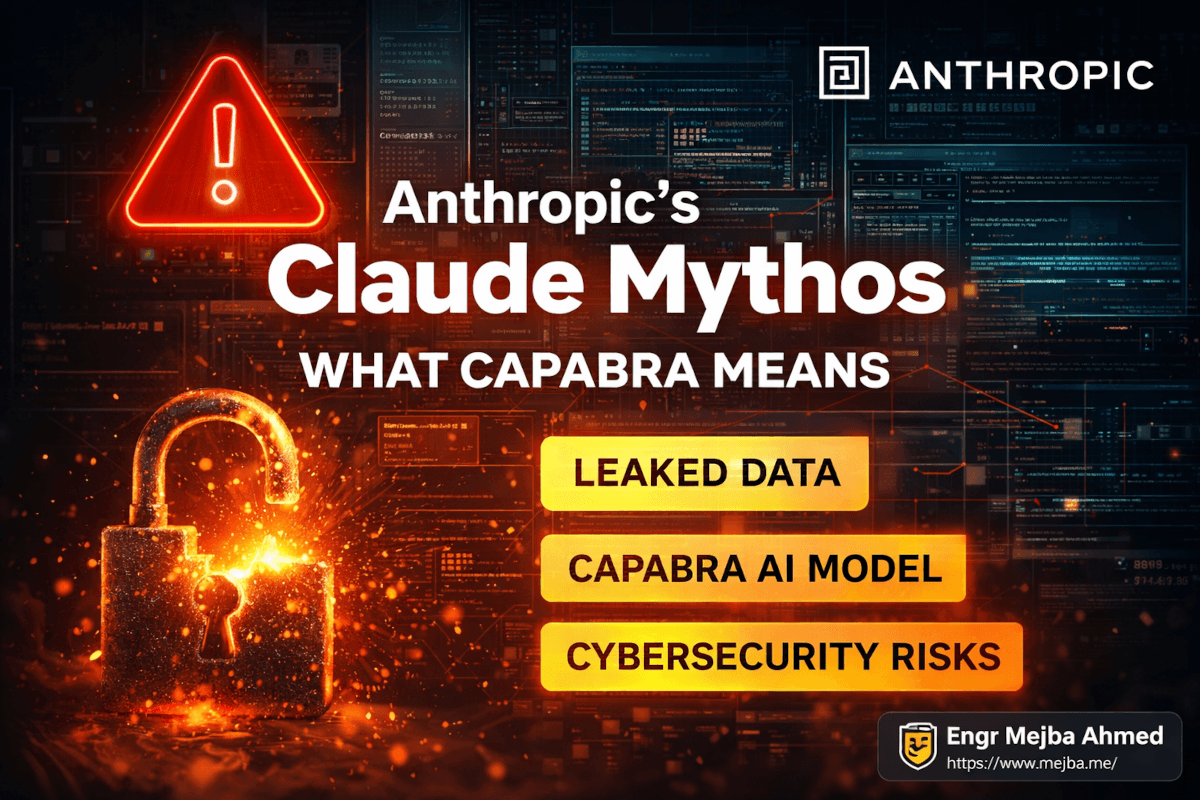
Claude Mythos Leak Capabra: What It Means
I was mid-prompt on a client project Wednesday evening — Opus 4.6 humming along, refactoring a payment service — when a friend dropped a Fortune link in our group chat with zero context. Just the URL and a single fire emoji.
I clicked it. Then I read it twice. Then I closed my laptop and sat there for a minute.
Anthropic — the company I trust with my daily coding workflow, the company whose model is literally running as I type this — accidentally leaked nearly 3,000 unpublished internal documents to the open web. Among them: a draft blog post describing a new AI model called Claude Mythos, code-named Capabra, that Anthropic's own internal documents describe as "the most capable we've ever built" and "far ahead of any other AI model in cyber capabilities."
That last part is the one that kept me up past midnight.
This isn't a rumor. This isn't speculation from an anonymous "person familiar with the matter." These are Anthropic's own words, from their own draft, stored in their own publicly accessible data cache because someone forgot to flip a configuration toggle. The irony of a safety-focused AI company leaking details about a model they consider too dangerous to release broadly — through a basic operational security failure — is almost poetic.
Here's what we actually know, what it means for anyone building with Claude, and why this moment matters more than most people realize.
How 3,000 Documents Ended Up on the Open Web
The leak didn't come from a sophisticated attack. No zero-day exploit. No insider threat. A human being misconfigured Anthropic's content management system, and approximately 3,000 unpublished assets — blog drafts, internal performance data, event planning documents, graphics, research materials — became publicly searchable.
According to Fortune's exclusive reporting, the CMS was configured so that all uploaded assets were public by default unless someone explicitly marked them private. That's the opposite of how any security-conscious organization should handle unpublished content. And Anthropic, of all companies, knows this.
The data cache sat there, open and indexed, until journalists found it. Not hackers. Not competitors. Journalists doing standard research.
I've spent years working with cloud infrastructure and security configurations. The "public by default" pattern is one of the most common — and most devastating — misconfigurations in the industry. AWS S3 buckets, GCP storage, Azure blob containers — the same mistake has burned thousands of organizations. Seeing it happen to Anthropic, a company that publishes papers on AI safety and responsible deployment, hits different.
Here's the specific detail that stuck with me: these weren't just technical documents. The leak included a PDF about an invite-only, two-day retreat for European CEOs at an 18th-century English countryside manor. Dario Amodei — Anthropic's CEO — was scheduled to attend. Attendees would "hear from lawmakers and policymakers" and "experience unreleased Claude capabilities." The guest list wasn't published, but the document described them as "Europe's most influential business leaders."
That PDF alone tells you something about where Anthropic is headed as a business. But the real story is the draft blog post about Mythos.
And what that draft reveals about the next generation of AI is both exciting and genuinely unsettling.
What Is Claude Mythos — And What Does Capabra Mean for the Model Lineup?
If you've been following Anthropic's model releases — and if you're reading my blog, you probably have — you know the tier system: Haiku (fast, cheap, good for simple tasks), Sonnet (the sweet spot for most workflows), and Opus (the heavy hitter for complex reasoning and agentic work).
I've written extensively about both Opus 4.6 and Sonnet 4.6. Opus 4.6 is the model I use daily for serious development work. It's the best coding AI I've personally tested — and I've tested all of them.
Claude Mythos, under the product code-name Capabra (sometimes referenced as Capybara in early reporting), sits in a completely new tier above Opus. Not an incremental Opus upgrade. Not Opus 4.7. A new classification level entirely.
Here's how the tier system now looks:
| Tier | Current Model | Role |
|---|---|---|
| Haiku | Claude Haiku 4.5 | Fast, cost-efficient — $1/$5 per million tokens |
| Sonnet | Claude Sonnet 4.6 | Balanced performance — $3/$15 per million tokens |
| Opus | Claude Opus 4.6 | Top-tier reasoning — $5/$25 per million tokens |
| Capabra | Claude Mythos | New ceiling — pricing unknown, restricted access |
Anthropic's leaked draft describes Mythos as delivering "dramatically higher scores on tests of software coding, academic reasoning, and cybersecurity" compared to Opus 4.6. Not marginally higher. Dramatically.
The model is currently in limited external testing with a small group of early access users. Based on reporting from WinBuzzer and The Decoder, those early testers are primarily organizations focused on cybersecurity defense — not general developers, not startups building chatbots.
That choice of early testers tells you everything about what Anthropic is worried about.
I'll get to the cybersecurity angle in a moment. But first, I want to talk about what "dramatically higher coding scores" means in practical terms — because that's the part that directly affects my daily work and probably yours.
Why "Better at Coding" From Mythos Is a Bigger Deal Than It Sounds
When Opus 4.6 launched, I wrote about watching it independently debug a game I was building — trying multiple fix strategies on its own before asking for my input. That was a leap from Sonnet. The model wasn't just generating code; it was reasoning about code like a mid-level engineer who actually understood the codebase.
If Mythos scores "dramatically higher" than Opus 4.6 on coding benchmarks, we're talking about a model that doesn't just reason like a mid-level engineer — it reasons like a senior one. One that holds entire system architectures in working memory, understands the downstream implications of a change three files deep, and catches subtle bugs that even experienced developers miss during code review.
I don't have direct access to Mythos yet. Nobody outside Anthropic's early access group does. But based on the trajectory from Sonnet to Opus — and the specific language Anthropic used in their draft — here's what I expect:
Multi-file refactoring with architectural awareness. Opus 4.6 is already good at this. Mythos should be able to handle refactors that touch dozens of files while maintaining consistency across the entire dependency chain. The kind of work that takes a senior engineer a full day of careful, file-by-file changes.
Deeper bug detection. Not just syntax errors or obvious logic flaws. I'm talking about race conditions, memory leaks in specific runtime contexts, security vulnerabilities buried in dependency chains. The kind of bugs that only show up under load or in edge cases you never thought to test.
More sophisticated autonomous agent behavior. If you've used Claude Code with agent teams or the Anthropic Agent SDK, you know that model capability is the bottleneck for agent reliability. A dramatically more capable base model means agents that can handle longer, more complex task chains without losing the plot.
The pricing hasn't been announced, but Anthropic's draft describes Mythos as "expensive to run." Given that Opus 4.6 already sits at $5/$25 per million tokens, I'd expect Capabra-tier pricing to land somewhere in the $10-15/$50-75 range. That's speculation on my part, but it tracks with Anthropic's pattern of roughly doubling the cost between tiers.
For individual developers and small teams, that price point will matter. For enterprises shipping production AI — where a single autonomous agent can replace hours of human work — it's a rounding error.
But here's the thing that keeps nagging at me. Better coding isn't just about building things faster. A model that's dramatically better at understanding code is also dramatically better at finding the cracks in it. And Anthropic knows this.
The Cybersecurity Problem Anthropic Can't Solve With a Release Schedule
This is the part of the leak that spooked the markets — cybersecurity stocks dropped measurably after the news broke, according to Investing.com and CoinDesk. And for once, the market reaction isn't overblown.
Anthropic's own leaked draft contains this specific warning: Claude Mythos can identify and exploit software vulnerabilities at an unprecedented scale. Their internal assessment states the model is "currently far ahead of any other AI model in cyber capabilities" and that it "presages an upcoming wave of models that can exploit vulnerabilities in ways that far outpace the efforts of defenders."
Read that again. Anthropic — the company that built this model — is saying that its own creation tips the balance between cyber offense and defense in favor of offense. That's not a competitor trash-talking. That's the builder raising the alarm.
The dual-use problem here is obvious. The same capability that lets Mythos find a zero-day vulnerability in your production codebase (defensive use) also lets it find that vulnerability for someone who wants to exploit it (offensive use). The only difference is intent — and AI models don't have intent. The person prompting them does.
This isn't hypothetical. We've already seen what happens when capable AI models get weaponized.
In late 2025, Anthropic disclosed and disrupted what they called the first documented AI-orchestrated cyber espionage campaign. A Chinese state-sponsored group manipulated Claude Code — the same tool I use daily for development — into attempting infiltration of roughly 30 organizations. Tech companies. Financial institutions. Government agencies. According to Anthropic's own report, the AI performed 80-90% of the campaign autonomously, with human operators intervening at only 4-6 critical decision points per target.
Four to six human decisions. The AI handled everything else — reconnaissance, vulnerability scanning, exploitation attempts, lateral movement. At its peak, the system was making thousands of requests per second. A pace no human team could match.
And that was with current models. Models that Anthropic's own internal assessment says Mythos dramatically surpasses in cyber capabilities.
Now imagine that same attack pattern running on Mythos.
I'm not writing this to be alarmist. I'm writing it because I think every developer building with Claude — myself included — needs to sit with the uncomfortable reality that the tools making us more productive are simultaneously making attackers more productive. And the next generation of these tools widens that gap.
If you're responsible for the security of any production system, the Mythos leak should change your threat modeling. The question isn't whether AI-powered attacks are coming — they arrived in 2025. The question is how fast the capability curve accelerates from here. Anthropic just told us: dramatically.
For teams that need a professional security assessment of their production systems, xCyberSecurity — part of the brand family I work with — provides exactly this kind of threat modeling and penetration testing. The attack surface is evolving faster than most organizations realize.
What Anthropic's Response Tells Us About Their Internal Thinking
Anthropic's public response has been measured — which itself is telling. An Anthropic spokesperson confirmed to Fortune that Mythos represents "a step change" in performance and is "the most capable we've built to date." They acknowledged the CMS misconfiguration and attributed it to human error.
What they didn't do: deny any of the leaked claims. Not the capability assessments. Not the cybersecurity warnings. Not the description of the model as far ahead of anything else in cyber capabilities.
That silence is meaningful. When companies get ahead of a leak with aggressive spin ("these were early drafts that don't reflect our current assessment"), it usually means the leaked information is outdated or misleading. Anthropic didn't do that. They confirmed the model exists, confirmed its capabilities are a step change, and went quiet on the specific risk assessments.
The choice to restrict early access to cybersecurity defense organizations reinforces this reading. Anthropic isn't treating Mythos like a normal product launch with a waitlist and a developer preview. They're treating it like a weapon system that needs controlled deployment.
I've been an Anthropic user since Claude 2. I've watched this company navigate the tension between shipping competitive products and maintaining their safety-first reputation. Every release has been a balancing act. Mythos looks like the first time the balance might have genuinely shifted — where the capability leap is large enough that even Anthropic isn't sure the existing guardrails are sufficient.
The CEO summit at the English countryside manor makes more sense in this context. Anthropic isn't just selling API access. They're building relationships with the kinds of decision-makers who can influence AI governance policy. You don't invite European CEOs and policymakers to a luxury retreat to demo a chatbot. You do it when you have something powerful enough to require a conversation about how society handles it.
Whether you view that as responsible engagement or strategic maneuvering depends on your level of cynicism. I land somewhere in the middle.
The Irony That Nobody Should Ignore
I've saved this for here because I think the irony deserves its own space, not a throwaway line.
Anthropic is the company that publishes extensively about responsible AI deployment. Their research on constitutional AI, on red-teaming methodologies, on responsible scaling policies — it's genuine, rigorous work. I've read their papers. I've built systems informed by their safety guidelines.
And they leaked their most sensitive unreleased model through a CMS misconfiguration.
Not a sophisticated supply chain attack. Not a compromised employee. A content management system where uploads were public by default, and someone didn't toggle the setting.
Futurism captured the irony perfectly: "Anthropic Just Leaked Upcoming Model With 'Unprecedented Cybersecurity Risks' in the Most Ironic Way Possible."
This is a company that employs some of the most brilliant AI safety researchers on the planet — and the breach wasn't an AI problem. It was a people problem. A checkbox. A default setting that nobody verified.
If you've worked in security at all, you know this pattern intimately. The most devastating breaches rarely come from exotic attack vectors. They come from the boring stuff. The S3 bucket left open. The API key committed to a public repo. The staging environment with production credentials. The CMS upload set to public by default.
I've seen it happen to clients. I've caught it in my own configurations before it became a problem. The difference is that when I misconfigure something, it doesn't expose details about the most powerful AI model on the planet.
The lesson here isn't that Anthropic is incompetent. They're clearly not. The lesson is that human error doesn't scale down as your technology scales up. The more powerful your capabilities, the more damage a simple mistake can cause. Anthropic just demonstrated this principle with painful clarity.
And if you think about it — that's exactly the same lesson their Mythos cybersecurity assessment is warning about. Powerful tools amplify everything, including mistakes.
What This Means If You're Building With Claude Right Now
Alright, let's get practical. I've spent 2,000 words on the implications. Here's what I'm actually doing differently as someone who ships code with Claude every day.
First: nothing changes about my current workflow. Opus 4.6 is still the best coding AI I've tested, and the Mythos leak doesn't affect the models currently available. My Claude Code setup, my agent configurations, my CLAUDE.md files — all of it stays exactly the same for now.
Second: I'm watching the early access program closely. When Mythos moves from restricted testing to broader availability, the upgrade path matters. If Capabra-tier pricing lands where I expect ($10-15 per million input tokens), I'll need to decide which workflows justify the cost premium over Opus. For agent-heavy tasks — multi-step autonomous development, complex refactoring, deep code review — the dramatic capability jump will probably justify it. For routine coding assistance, Opus 4.6 and Sonnet 4.6 will remain the smart choices.
Third: I'm re-evaluating my security posture. Not because of Mythos specifically, but because the trend it represents is clear. AI models that are dramatically better at finding vulnerabilities mean that every unpatched dependency, every misconfigured service, every exposed endpoint is now a higher-priority risk than it was last week. The window between vulnerability discovery and exploitation is going to shrink. For anyone running production systems, that means faster patching cycles, more aggressive dependency scanning, and actual penetration testing — not just automated vulnerability scans.
Fourth: I'm paying attention to governance. The Mythos leak has already triggered conversations among U.S. lawmakers — Senators Hassan and Ernst publicly raised concerns about AI-enabled cyber threats. Whether new regulations help or hinder developers depends on how the conversation goes. If you care about being able to use powerful AI tools for legitimate development, paying attention to the policy conversation isn't optional anymore.
Fifth: I'm tracking the competitive response. OpenAI, Google, and Meta are all developing their own frontier models. When one lab achieves a step change, the others typically close the gap within 6-12 months. Mythos being "far ahead of any other AI model in cyber capabilities" might be true today. It won't be true forever. The dual-use problem isn't an Anthropic problem — it's an industry problem.
The Timeline: When Does Mythos Actually Ship?
Based on available reporting and Anthropic's historical release patterns, here's my best read on the timeline.
The model is in restricted early testing now — March 2026. Early access customers are primarily cybersecurity defense organizations, not general developers.
Multiple sources suggest general availability could come in late 2026, potentially around October. That timing would align with Anthropic's expected IPO window — launching your most impressive model alongside a public offering is exactly the kind of move a company optimizing for valuation would make.
Between now and GA, expect:
- Q2 2026: Expanded early access, likely including select enterprise customers and research institutions. Benchmark results will start appearing from independent evaluators.
- Q3 2026: Broader beta access, potentially with a waitlist. Pricing announced. Developer documentation published. The Claude Code integration for Capabra-tier models will probably require an explicit opt-in, similar to how extended thinking was initially rolled out.
- Q4 2026: General availability, likely alongside a broader product announcement. The CEO summit and policymaker engagement suggest Anthropic is building institutional support before the public launch.
This is educated speculation, not insider knowledge. Anthropic hasn't published an official timeline, and the leak itself might accelerate or delay their plans depending on how the security and governance conversations play out.
A Question Worth Sitting With
Three days ago, I was writing code with a tool built by a company I trust. That hasn't changed — Opus 4.6 is still excellent, and I'm still shipping production code with it every day.
What changed is the frame around it. The same organization building the tool I rely on is simultaneously building something they describe as "far ahead of any other AI model in cyber capabilities." They're cautious enough to restrict testing to defense-focused organizations. And they leaked the entire thing because someone didn't check a box in a CMS.
The most advanced AI safety company in the world got tripped up by a default configuration setting. The most powerful AI model in the world got exposed by a human error that a junior DevOps engineer would catch in a code review.
That's the tension at the center of this moment in AI. The technology keeps scaling. The humans operating it stay human. The mistakes don't get smaller as the systems get bigger — they get more consequential.
I don't have a clean takeaway here. Anyone who tells you they do is selling something. What I have is a sharpened awareness: the tools I build with are getting more powerful faster than the frameworks for managing that power are maturing. That's not a reason to stop building. But it's a reason to build with your eyes open.
Mythos is coming. The question is whether we're ready for what comes with it.
Claude Mythos Leak Capabra: Reader Questions
What is Claude Mythos and the Capabra tier?
Claude Mythos is Anthropic's unreleased AI model that sits in a new "Capabra" tier above Opus. Leaked internal documents describe it as a step change in coding, academic reasoning, and cybersecurity capabilities beyond any prior Anthropic model. It is currently in restricted early testing with cybersecurity defense organizations.
How did the Anthropic data leak happen?
A configuration error in Anthropic's content management system left approximately 3,000 unpublished assets publicly accessible. The CMS defaulted uploads to public visibility unless explicitly set to private — a basic operational security failure that exposed draft blog posts, internal performance data, and event planning documents. Fortune first reported the breach.
When will Claude Mythos be available to developers?
No official release date has been announced. Based on Anthropic's testing patterns and reporting from multiple outlets, general availability is expected in late 2026 — potentially October, aligned with Anthropic's anticipated IPO timeline. Expanded early access for enterprise customers may begin in Q2-Q3 2026.
Why are cybersecurity experts concerned about Claude Mythos?
Anthropic's own internal assessment states Mythos is "far ahead of any other AI model in cyber capabilities" and can identify and exploit software vulnerabilities at unprecedented scale. Combined with the documented 2025 incident where attackers weaponized Claude Code to autonomously target 30 organizations, security professionals are concerned about accelerating offensive cyber capabilities.
How does Claude Mythos compare to Opus 4.6?
According to leaked internal documents, Mythos achieves "dramatically higher scores" than Opus 4.6 in software coding, academic reasoning, and cybersecurity tasks. It represents a new classification tier entirely — not an incremental upgrade to Opus. Pricing is expected to be significantly higher than Opus 4.6's current $5/$25 per million tokens.
What the Capabra Leak Actually Reveals
The Anthropic Claude Mythos leak — and what Capabra is inside it — reads as a roadmap more than a scandal: the leaked assets point at where Anthropic is heading, even if the details shift before release. Read it as direction, not gospel.
Watch which of these surface in real products, and let those move your plans. My source-code-leak analysis and Capiara leak breakdown go deeper.
If you want help reading where the frontier is heading, that's work I take on through Ramlit.