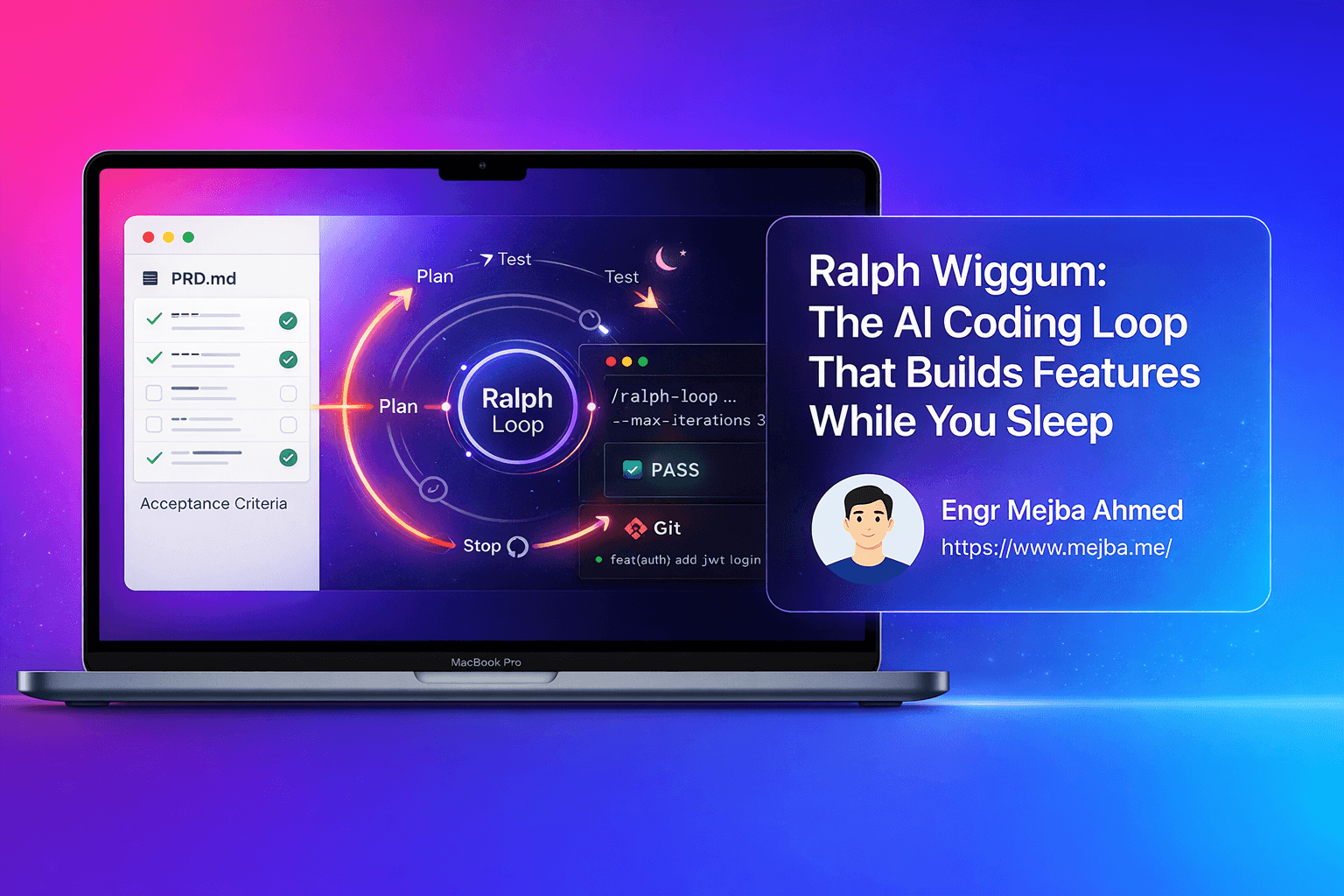
The Ralph Wiggum loop gets sold as magic: go to sleep, wake up to shipped features. Having run it and read its source, I will tell you what it actually is: a persistence mechanism. The loop itself is trivial. Everything that determines whether you wake up to a merged feature or a burned token budget lives in two places the marketing never mentions — the stop condition and the durable state. Get those right and the loop is genuinely useful. Get them wrong and you have built an expensive hamster wheel.
I have the Ralph Wiggum plugin installed in my own Claude Code setup, I have read through its Stop-hook implementation line by line, and I have shipped real production work with the underlying pattern — including a rewrite pipeline that processed 84 blog posts across multiple resumable sessions. This post is what I know from that, not from the hype cycle.
Where Ralph actually comes from
The technique is Geoffrey Huntley's. His original formulation is deliberately unimpressive: "Ralph is a Bash loop." A while true that feeds an AI agent the same prompt file over and over. The prompt never changes; the codebase does. Each fresh iteration reads the modified files and git history, sees what its past self accomplished, and continues. Huntley ran loops like this for extended stretches — his writeups describe a months-long loop building an entire programming language — and the name is the joke: Ralph Wiggum, persistently cheerful in the face of every setback.
Anthropic later packaged the idea as an official Claude Code plugin (ralph-wiggum in the claude-code repo), which is the version sitting in my ~/.claude/plugins cache. And here is the first thing worth knowing that most coverage skips: the plugin is not a Bash loop. It works differently from the original in a way that changes how you should use it.
How the plugin actually works, from the source
Because plugins are just files on disk, you can read exactly what /ralph-loop does. The mechanism is a Stop hook — a script Claude Code runs every time the session tries to end.
When you start a loop, the plugin writes a state file at .claude/ralph-loop.local.md with YAML frontmatter tracking three things: the current iteration, your max_iterations cap, and the completion_promise string. From then on, every time Claude tries to exit, the hook:
- Checks whether the state file exists. No file, no loop — exit proceeds.
- Validates the frontmatter. If the iteration counter is corrupted (say, you hand-edited the file), it deletes the state and stops rather than looping on garbage.
- Checks the iteration count against the cap. Hitting
max_iterationsremoves the state file and lets the session end. - Reads the session transcript and scans Claude's last output for the completion promise. Found it? Loop over. Not found? The hook blocks the exit and feeds the same prompt back in.
Two practical consequences fall out of reading this code. First, the state file is your dashboard and your kill switch: cat .claude/ralph-loop.local.md mid-run shows you the live iteration count, and /cancel-ralph (or deleting the file) ends the loop. Second, the completion promise is load-bearing. If Claude never emits the exact string, the loop only ends at max iterations. This is why the convention is an unmistakable token like <promise>COMPLETE</promise> — a phrase that could plausibly appear in normal output, like "done", will terminate your loop the first time Claude uses the word conversationally.
The plugin is not the original Ralph, and the difference matters
Huntley's bash loop starts a fresh agent process each iteration. Context resets; the only memory is the filesystem and git history. The plugin's Stop hook keeps everything in one session, so context accumulates across iterations.
Neither is strictly better. The single-session version iterates faster and remembers what it tried ten minutes ago without re-reading anything. But on long runs the accumulating context becomes the enemy — the session bloats, quality drifts, and you start paying for a huge conversation on every turn. The fresh-process version is slower per iteration but "deterministically bad" in Huntley's phrase: every iteration starts from the same clean state, and the only thing that persists is what got written to disk. For anything beyond a few dozen iterations, disk-state-plus-fresh-context is the more robust architecture. I covered the broader taxonomy of these patterns in loop engineering: agent loops explained.
The version of Ralph I actually run in production
My heaviest real use of this pattern was not overnight greenfield coding. It was content operations: a surgical SEO rewrite of 84 posts on this site, executed across many sessions and multiple days.
The architecture was pure Ralph, minus the branding. A durable manifest — REWRITE-STATUS.json — held every post ID with a status of PENDING or DONE. The instruction to each work session was effectively constant: pick the next PENDING batch, rewrite, verify, apply, then run mark_done.php to flip the statuses. The prompt never changed. The manifest did.
That project taught me the insight I would put on a poster:
The durable manifest is the real memory. The loop is just a delivery mechanism.
When a session crashed, hit a token ceiling, or I simply went to bed, nothing was lost — the next session read the manifest and resumed exactly where the last one stopped. Resume-after-failure came free, not as a feature I built but as a property of keeping state in a file instead of in the conversation. The corollary: every iteration must be idempotent. "Pick the next PENDING item and process it" survives crashes; "continue from where you were" does not, because "where you were" died with the context window.
The second hard-won lesson: put guards in the apply step, not the prompt. My apply script had an explicit ID-range check so a confused iteration could not touch rows outside its batch. Prompts drift; range checks do not. If your Ralph loop can write to anything important, the boundary belongs in code.
What I will not tell you
You have probably seen Ralph posts quoting overnight miracles: a full SaaS API for $3-something in tokens, a five-figure contract completed for a few hundred dollars in API costs. I am not going to give you numbers like that, because I do not have clean ones, and I have learned to distrust anyone whose case studies are that tidy. Loop runs vary wildly with model, codebase size, and how much context each iteration re-reads. My honest cost observation is directional: long single-session loops get more expensive per iteration as they go, and a loop that re-reads a fat manifest every cycle multiplies that. Trim what each iteration must load.
What I can tell you is where the pattern reliably works and where it reliably does not:
Ralph is good at: tasks with binary, machine-checkable completion — failing tests to make pass, a manifest of items to process, migrations with verifiable output. My rewrite pipeline fit because "is this post's status DONE" is a yes/no question a script can answer.
Ralph is bad at: anything requiring judgment the loop cannot test. Aesthetic decisions, ambiguous requirements, "make it better." The loop will happily iterate forever, each pass confidently different, none of them converging — because nothing in the system can tell it when it has arrived.
Setting up a first loop that will not embarrass you
If you want to try it, the honest starter configuration looks like this:
/ralph-loop "Read TASKS.md. Pick the first unchecked task, implement it,
run the test command listed for it, and check it off only if tests pass.
If stuck on one task after 3 attempts, note the blocker in TASKS.md and
move on. Output <promise>ALL_DONE</promise> when every task is checked."
--completion-promise "ALL_DONE" --max-iterations 15
Three deliberate choices in there. The state lives in a file (TASKS.md), so progress survives anything. The completion promise is a string that cannot occur by accident. And --max-iterations 15 is the safety net — never run without it, because an unreachable promise plus no cap equals an open-ended bill. Watch the first two or three iterations before you walk away; a loop that starts wrong compounds wrong.
For scheduled rather than blocking loops — checks that should run every morning instead of continuously — the cron-style approach fits better; I wrote up my setup in Claude Code loops and cron scheduling and a concrete application in automating SEO checks with routines. And when work has to span sessions with a human in between, a handoff document beats a loop entirely — that pattern is in my handoff skill writeup.
The loop amplifies your prep, not your hopes
After running this pattern across code and content, my conclusion is unglamorous: Ralph is a forcing function for engineering discipline you should have anyway. Machine-checkable acceptance criteria. Durable, idempotent state. Guards in code instead of vibes in prompts. A hard budget. Teams that have those things get compounding value from loops. Teams that do not get to discover their missing discipline at token prices.
The technique deserves its moment — persistent iteration against a fixed spec is genuinely how a lot of unglamorous software gets built, and automating the persistence is real leverage. Just know what you are buying: not an autonomous developer, but a very stubborn one that only stops when your tests say so.
Write the spec and the failing test before you write the loop; everything Ralph does after that is just persistence applied to whatever you handed it. The scheduling and handoff skills I run alongside my own loops are published on my agent skills marketplace, ready to fork.