📝 AI Agents

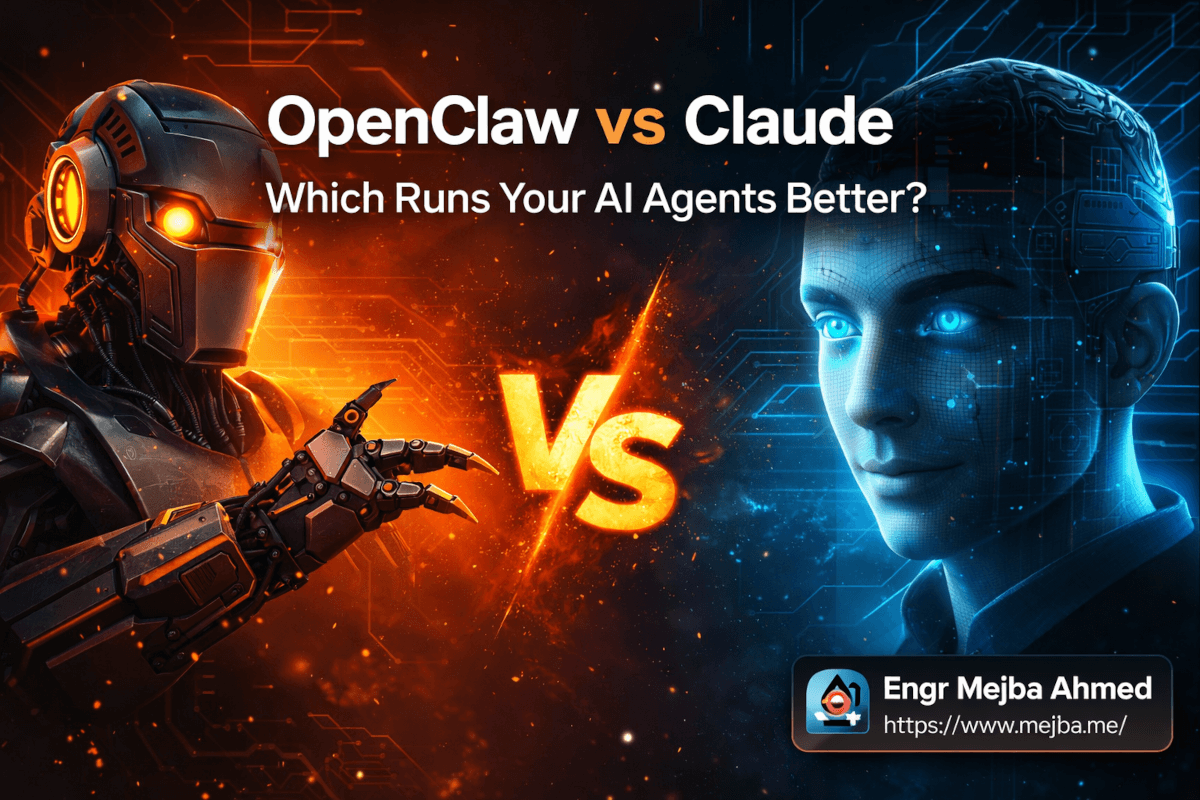
OpenClaw vs Claude: Which Runs Your AI Agents Better?

OpenClaw vs Claude: Which Runs Your AI Agents Better? Three weeks ago, I handed a recurring content workflow to an OpenClaw agent and walked away. No...

21 min

Read time

4,144

Words

Mar 06, 2026

Published

Engr Mejba Ahmed

Written by

Engr Mejba Ahmed

Share Article

OpenClaw vs Claude: Which Runs Your AI Agents Better?

OpenClaw vs Claude: Which Runs Your AI Agents Better?

Three weeks ago, I handed a recurring content workflow to an OpenClaw agent and walked away. No check-ins, no babysitting, no "hey, are you still running?" anxiety. The agent picked up its task on Monday morning, pulled context from a synced markdown file, drafted a content brief, posted a progress update to my Slack channel, and linked me to the finished document — all before I'd poured my second cup of coffee.

That same week, I tried replicating the workflow in Claude's ecosystem. Claude Co-work, Claude Code, the whole suite. The output quality was noticeably better. The writing had more nuance, the strategic suggestions were sharper, and the overall polish felt like working with a senior teammate rather than a junior contractor.

But here's what kept nagging at me: I had to be there. My machine had to be awake. I had to initiate the session. I had to move context between Claude and Claude Code manually because the interoperability just isn't seamless yet.

So I found myself stuck with a question I couldn't answer cleanly — and honestly, it's one I think every builder working with AI agents right now is wrestling with: do you pick the platform that runs autonomously but feels rough around the edges, or the one that produces brilliant work but needs you in the room?

I spent the last month stress-testing both ecosystems across real business workflows. What I found surprised me — because the answer isn't what either fan camp wants to hear.

The Real Problem Nobody's Talking About

Most conversations about AI agent platforms focus on model quality. Which one writes better code? Which one reasons more clearly? Those questions matter, but they miss the actual bottleneck for anyone trying to build an AI-driven business.

The bottleneck is delegation.

Not the kind where you type a prompt and get a response. I mean real delegation — the kind where you define a job once, hand it off, and trust that it gets done on a recurring basis without you touching it again. The same way you'd delegate to a human team member who owns a process end-to-end.

When I started building my content pipeline, code review workflows, and creative asset generation systems, I realized that model intelligence and delegation capability are two completely different axes. A platform can have the smartest model on earth, but if it can't run a job at 6 AM on Tuesday without me clicking "start," it's not really an autonomous agent. It's a very smart chatbot.

That distinction — chatbot versus agent — is where OpenClaw and the Claude ecosystem diverge most sharply. And understanding that divergence is what's going to save you months of wasted setup time.

But before I break down both platforms, there's a concept you need to understand first. It's the thing that makes your choice of platform almost irrelevant in the long run.

Skills: The Secret Weapon That Changed My Entire Approach

When Claude introduced the concept of "skills" last year, I thought it was a nice organizational feature. Markdown-based, step-by-step process definitions that tell an agent exactly how to do a specific job. Cool. Useful. But I didn't grasp how important it would become.

Here's what I missed: skills aren't just instructions. They're portable process definitions that work across platforms.

I wrote a skill for my weekly content development workflow. It's a markdown file that defines every step — from topic research to outline generation to draft creation to formatting for WordPress. That same skill file runs on OpenClaw. It runs on Claude. It runs on Cursor. It even runs on Codec. One process definition, multiple execution environments.

Why does this matter? Because it means I'm not locked into any single platform. If OpenClaw becomes the dominant agent runner in 2027, great — my skills work there. If Claude closes its autonomy gap and becomes the clear winner, perfect — my skills work there too. I'm betting on my process, not on someone else's platform.

This realization fundamentally changed how I evaluate OpenClaw versus Claude. Instead of asking "which platform is better," I started asking "which platform runs my skills better for each type of job?"

That's a much more useful question. And it leads to very different answers depending on the job.

OpenClaw: The Scrappy Workhorse That Actually Shows Up

I'm going to be honest — my first experience with OpenClaw was rough. The setup process felt like assembling IKEA furniture with instructions translated through three languages. The UI is functional but not pretty. Documentation has gaps. There were moments where I wanted to close my laptop and walk away.

But I didn't. Because underneath that rough exterior, OpenClaw does something that no other platform in this space does as well: it lets agents truly own recurring jobs.

Here's my actual OpenClaw setup, because I think the specifics matter more than vague descriptions.

The Infrastructure

Each of my agents runs on a dedicated machine I control. Not a shared cloud instance, not someone else's infrastructure — my hardware, my rules. This matters for security (I'm paranoid about business data flowing through third-party agent platforms) and for reliability (no surprise rate limits or platform outages killing a scheduled job).

The Task Management System

I built a custom dashboard — nothing fancy, just a web interface — that manages tasks through markdown files. Each task is a markdown document with structured frontmatter: task name, schedule, assigned agent, skill reference, input sources, output destinations.

These markdown files sync across my devices using Dropbox. Dead simple. No proprietary database, no vendor lock-in, no complex API integrations. When I want to modify a recurring task, I edit a markdown file. When I want to see what's running, I check the dashboard. When I want to add a new job, I create a new file.

The Communication Layer

My agents report through Slack and Telegram. When an agent starts a job, it posts a status update. When it hits a decision point it can't resolve, it pings me. When it finishes, it drops a link to the output document.

Last Tuesday, I woke up to this Slack message from my content agent: "Weekly content brief completed. 3 topic outlines generated. Draft started for priority topic. Document linked below." I clicked the link, reviewed the work, made two small edits, and published. Total time investment from me: 12 minutes for a workflow that used to eat 3 hours every week.

The Recurring Task Engine

This is where OpenClaw genuinely shines. I set up templates for recurring jobs — content development every Monday, code activity tracking every day, creative asset review every Friday. The agents pick up these jobs on schedule, pull the relevant skill file, execute it step by step, and deliver results.

No human in the loop unless something breaks. No "start session" button to click. No machine that needs to stay awake. The agents just... work. Like employees who show up on time and follow the playbook.

That level of hands-off autonomy is transformative when you actually experience it. It's the difference between having a tool and having a teammate.

But — and this is a big but — the quality ceiling is real. OpenClaw's output is competent. It gets the job done. It follows instructions well. What it doesn't do is surprise you with insight. It won't reframe a problem in a way you hadn't considered. It won't push back on a brief that's heading in the wrong direction.

For execution-heavy jobs with clear processes, that's perfectly fine. For work that requires creative thinking, strategic reasoning, or nuanced judgment? That's where I reach for something else entirely.

The Claude Ecosystem: Brilliant Collaborator, Frustrating Teammate

Working with Claude feels different from working with any other AI platform. I don't say that as marketing — I say it as someone who uses Claude, GPT, Gemini, and half a dozen other models daily. There's a quality to Claude's reasoning, especially around writing, strategy, and creative problem-solving, that consistently impresses me.

When I ask Claude to analyze a business problem, it doesn't just list options. It thinks through trade-offs, considers second-order effects, and sometimes challenges my assumptions in ways that genuinely improve my thinking. That's rare. That's valuable.

Claude Code takes this further for technical work. I've used it to architect systems, debug gnarly production issues, and generate code that I'd actually want to maintain six months later. The code quality gap between Claude Code and most alternatives is significant enough that I've restructured my development workflow around it.

And then there's Claude Co-work, which recently added scheduled tasks. On paper, this should give Claude everything OpenClaw offers. Scheduled execution, recurring jobs, autonomous delegation.

On paper.

Where the Ecosystem Fractures

Here's what actually happens when you try to run Claude as an autonomous agent platform in early 2026.

The awake-machine problem. Claude Co-work's scheduled tasks need your local machine running. I travel frequently. My laptop sleeps. Tasks get missed. For a platform positioning itself around productivity and delegation, requiring a human's laptop to be physically open and awake is a significant limitation.

The interoperability gap. Claude, Claude Code, and Claude Co-work feel like three products built by three teams who occasionally eat lunch together. Moving work between them requires manual effort. I can't start a strategic analysis in Claude, hand the technical implementation to Claude Code, and have Claude Co-work schedule the recurring execution — not smoothly, anyway. Each handoff introduces friction, lost context, and wasted time.

The mobile limitation. I define my processes as skills — markdown files with step-by-step instructions. On my desktop, Claude can access and execute these skills perfectly. On my phone? Nope. Skills aren't accessible on mobile. So if I'm away from my desk and need to trigger or modify a workflow, I'm stuck. For a system that's supposed to reduce my operational involvement, requiring me to be at a specific device is a contradiction.

The remote feature — promising but incomplete. Claude Code's new remote capability allows cloud handoff, which is a step in the right direction. But it still depends on local session initiation. You have to start the session from your machine before it can run in the cloud. It's like having a self-driving car that requires you to physically turn the key before it can drive itself.

I'm not saying these problems are permanent. Anthropic ships improvements fast, and I genuinely expect most of these gaps to close by late 2026. The foundation is there. The model quality is there. The execution infrastructure just hasn't caught up yet.

But today? Right now? If you need an agent that shows up at 6 AM and does its job without you, Claude isn't it. Not yet.

The Head-to-Head: Five Real Workflows I Tested

Theory is nice. Let me show you what happened when I ran identical workflows on both platforms over four weeks.

Workflow 1: Weekly Content Brief Generation

The job: Every Monday, analyze trending topics in my niche, generate three content briefs with outlines, and draft the first 500 words of the highest-priority piece.

OpenClaw result: Delivered on time every Monday. Briefs were solid — well-structured, relevant topics, usable outlines. The draft quality was functional but flat. I'd describe it as "competent first draft that needs personality injected."

Claude result: When I manually triggered it (because scheduling was unreliable), the output was noticeably superior. Better topic selection, more creative angles, drafts that actually sounded like me. But I had to remember to trigger it. I had to be at my desk. Two of the four Mondays, I forgot or was traveling.

Winner: OpenClaw for reliability. Claude for quality. Combined approach for best results — OpenClaw runs the recurring brief generation, I hand the best topics to Claude for the actual drafting.

Workflow 2: Daily Code Activity Tracking

The job: Monitor my GitHub repositories, summarize commits and PRs from the last 24 hours, flag anything that needs attention, and post a daily digest.

OpenClaw result: Flawless execution. Every morning at 7 AM, I had a clean summary in my Slack channel. The agent correctly identified PRs that needed review, flagged failed CI runs, and even noticed when a contributor's PR had been sitting without review for more than 48 hours.

Claude result: Claude Code handled the analysis better when I ran it manually — more contextual understanding of code changes, better assessment of PR quality. But the "when I ran it manually" part is doing a lot of heavy lifting in that sentence.

Winner: OpenClaw. Decisively. This is a pure execution job where showing up every day matters more than having slightly better analysis.

Workflow 3: Creative Asset Review

The job: Review new design submissions against brand guidelines, provide structured feedback, and categorize assets for the team.

OpenClaw result: Applied the checklist accurately. Caught obvious brand guideline violations. Feedback was mechanical — technically correct but lacking design intuition.

Claude result: This is where Claude's quality advantage became impossible to ignore. The feedback felt like it came from a creative director, not a checklist robot. Claude noticed subtle issues — a color combination that was technically on-brand but emotionally wrong for the campaign context, a layout that met specifications but would perform poorly on mobile. Insights OpenClaw would never generate.

Winner: Claude. For creative and judgment-heavy work, the quality gap is too large to compensate with automation.

Workflow 4: Security Scan Reporting

The job: Run weekly security scan summaries across client environments, compile findings into structured reports, and flag critical items.

OpenClaw result: Reliable weekly delivery. Clean report formatting. Accurate severity classifications. Solid work.

Claude result: Better narrative quality in reports. Stronger risk contextualization — Claude would explain not just what the vulnerability was, but why it mattered for that specific client's business context. More useful for presenting to non-technical stakeholders.

Winner: Tie. Both produced usable reports. OpenClaw won on reliability, Claude won on report quality. For client-facing reports, I use Claude for the final polish.

Workflow 5: Recurring Client Check-in Preparation

The job: Before each weekly client meeting, compile project updates, flag risks, generate talking points, and prepare a one-page brief.

OpenClaw result: Gathered the data, compiled updates, produced a functional brief. But the talking points felt generic — they could have applied to any project.

Claude result: The briefs felt personalized. Claude would reference previous meeting notes, notice patterns in project velocity, and suggest conversation topics that addressed emerging concerns before the client raised them. Working with Claude's output felt like having a sharp chief of staff.

Winner: Claude. Client-facing preparation is strategic work where quality directly impacts business relationships.

The Pattern That Emerged (And Why It Matters)

After four weeks of parallel testing, a clear pattern crystallized. It's not complicated, but it took me running the experiment to see it clearly.

OpenClaw wins execution jobs. Anything with a clear process, defined inputs and outputs, and a schedule. Content briefs, code monitoring, data compilation, report generation. Jobs where showing up consistently matters more than being brilliant.

Claude wins thinking jobs. Anything requiring judgment, creativity, strategic reasoning, or nuanced communication. Creative feedback, client preparation, strategic analysis, anything client-facing. Jobs where quality of thought is the differentiator.

This isn't a knock on either platform. It's recognizing that "autonomous delegation" and "intelligent collaboration" are different capabilities, and in early 2026, no single platform excels at both.

The builders who understand this are running hybrid setups. The ones who don't are either frustrated with OpenClaw's output quality or frustrated with Claude's scheduling limitations.

How I Actually Set Up My Hybrid System

Alright, here's the practical part. If you want to run a hybrid OpenClaw-Claude setup for your business, here's the architecture I landed on after a month of iteration.

Step 1: Audit Your Recurring Workflows

Before touching any platform, list every recurring task in your business. Every weekly report, every daily check, every monthly review. Be exhaustive.

For each task, answer two questions:

  • Does this job require creative judgment or strategic thinking? (Judgment scale: 1-5)
  • How critical is reliable, scheduled execution? (Reliability scale: 1-5)

Jobs scoring high on reliability and low on judgment go to OpenClaw. Jobs scoring high on judgment go to Claude with manual or semi-automated triggering. Jobs scoring high on both get a hybrid treatment — OpenClaw handles the data gathering and scheduling, Claude handles the analysis and output.

Step 2: Write Your Skills as Platform-Agnostic Markdown

This is the most important step, and it's where most people cut corners. Your skill files should be detailed enough that any agent platform can execute them.

Here's the structure I use:

# Skill: Weekly Content Brief Generation

## Trigger
Every Monday at 6:00 AM UTC

## Context
- Brand: mejba.me
- Content focus: AI development, automation, developer tools
- Tone: First-person, conversational, technically credible

## Inputs
- Trending topics from [sources]
- Previous content performance data from [location]
- Editorial calendar from [file path]

## Process
1. Pull trending topics from defined sources
2. Cross-reference against existing content to avoid duplication
3. Score topics on: search volume estimate, brand relevance, personal expertise match
4. Select top 3 topics
5. For each topic, generate:
   - Working title (under 60 characters)
   - Target keyword
   - 5-point outline with key arguments
   - Unique angle that differentiates from existing content
6. Draft first 500 words of highest-priority topic

## Output
- Markdown file saved to [path]
- Slack notification to [channel] with summary and link
- Flag any topics that need human input before proceeding

## Quality Checks
- No topic should overlap with content published in last 90 days
- All outlines must include at least one contrarian or unique angle
- Draft must match brand voice guidelines in [file]

Notice what's not in this skill: any platform-specific syntax. No OpenClaw API calls, no Claude-specific formatting. Pure process definition. This file works on any agent platform that can read markdown, and that's every major platform right now.

Step 3: Set Up OpenClaw for Execution Jobs

Deploy your agents on dedicated machines. I use small cloud instances — nothing expensive. Each agent gets its skill files, access to the communication channels (Slack and Telegram), and a connection to the synced file system where tasks and outputs live.

Configure your custom dashboard or use OpenClaw's built-in task management to set schedules. Map each recurring job to its skill file. Test each job manually before enabling the schedule.

Pro tip: start with one agent running one job for a full week before scaling up. You'll catch configuration issues early when the blast radius is small.

Step 4: Set Up Claude for Thinking Jobs

For jobs requiring Claude's reasoning quality, I use a semi-automated approach. OpenClaw agents handle the data gathering and preparation on schedule. The prepared context gets saved to a shared location. Then I trigger Claude (either manually or through Claude Co-work when my machine is available) with the pre-gathered context.

This hybrid handoff gives me the best of both worlds: reliable data gathering on a schedule (OpenClaw) plus high-quality analysis and output (Claude).

For purely creative work — content writing, strategic planning, client communication — I go directly to Claude without the OpenClaw layer. Some jobs don't need automation; they need intelligence.

Step 5: Build Your Monitoring Layer

You need visibility into what your agents are doing. My setup includes:

  • Slack channels for agent status updates (one channel per workflow category)
  • A simple dashboard showing task completion rates, failure counts, and output timestamps
  • Weekly self-review where I spot-check agent outputs against quality standards
  • Monthly skill refinement where I update process definitions based on what I've learned

The monitoring layer is boring to build but critical to maintain. Without it, you'll have agents silently producing mediocre work for weeks before you notice.

The Honest Trade-Offs Nobody Mentions

I want to be straight about the downsides of this approach, because too many "AI automation" posts paint an unrealistically rosy picture.

Setup time is significant. Getting this hybrid system running took me roughly three weeks of part-time work. Writing skills, configuring agents, building the dashboard, testing workflows, debugging failures. If you're expecting to go from zero to fully automated in a weekend, recalibrate your expectations.

Maintenance is ongoing. Skills need updates as your business evolves. Agents occasionally fail for weird reasons — API changes, file sync issues, unexpected input formats. I spend about 2-3 hours per week maintaining and improving my agent workflows. That's dramatically less than doing the work manually, but it's not zero.

Quality control can't be fully automated. I still review agent outputs, especially for client-facing work. The goal isn't to remove humans from the loop entirely — it's to reduce human involvement to the highest-leverage activities: reviewing, refining, and deciding.

OpenClaw's rough edges are real. I've lost work to configuration issues. I've had agents silently fail without notification. I've spent frustrating evenings debugging problems that better documentation would have prevented. If you have low tolerance for janky tools, OpenClaw will test your patience.

Claude's limitations are real too. The awake-machine requirement for Co-work has caused me to miss scheduled tasks multiple times. The lack of mobile skill access has forced me to defer time-sensitive decisions. The interoperability friction between Claude products has made me question whether the ecosystem label is earned yet.

I'm sharing these because I want you to go in with accurate expectations. The upside is genuinely transformative — I've reclaimed roughly 15 hours per week of repetitive work. But the path to get there isn't smooth.

Where Both Platforms Are Heading

I keep close tabs on both roadmaps, and here's my read on where things stand heading into mid-2026.

Claude's trajectory: Anthropic is clearly working on closing the autonomy gap. The remote feature in Claude Code, the scheduled tasks in Co-work — these are stepping stones toward full autonomous delegation. My prediction: by Q4 2026, Claude's ecosystem will offer seamless interoperability between its products and reliable scheduled execution without requiring a local machine. When that happens, the calculus shifts dramatically in Claude's favor because you'd get best-in-class reasoning AND autonomous execution in one ecosystem.

OpenClaw's trajectory: The platform is improving its polish and stability with each release. The core architecture — agents on dedicated machines with markdown-based task management — is sound. Where OpenClaw needs to grow is in model quality and output sophistication. If they can integrate stronger models while maintaining their autonomous execution advantage, they'll remain competitive even after Claude closes its gaps.

The skills standard: The most important trend isn't about either platform. It's the emergence of skills as a cross-platform standard. Markdown-based process definitions that work on OpenClaw, Claude, Cursor, Codec, and whatever comes next. This portability is the real insurance policy for any business investing in AI agent workflows.

My bet is that 18 months from now, the platform choice will matter less than the quality of your skills. The businesses that invested in designing excellent processes — clear, detailed, well-tested skill files — will be able to migrate between platforms effortlessly. The ones that built their workflows around platform-specific features will face painful migrations.

Bet on your process. Not on anyone else's platform.

What I'd Do If I Were Starting From Scratch Today

If I were building an AI-agent-driven business automation system from zero in March 2026, here's the exact sequence I'd follow.

First, I'd spend a full week just documenting my recurring workflows in plain language. No tools, no platforms. Just markdown files describing what I do, how I do it, and how often. This becomes my skills library.

Second, I'd pick my two highest-volume, lowest-judgment recurring tasks and set them up on OpenClaw. Get the execution engine running. Feel the relief of waking up to completed work you didn't have to touch.

Third, I'd identify my two highest-judgment, most-valuable workflows and run them through Claude. Experience the quality difference. Understand what "intelligent collaboration" actually feels like versus "autonomous execution."

Fourth, I'd build the hybrid handoff for any workflow that needs both reliability and intelligence. OpenClaw gathers and prepares; Claude analyzes and produces.

Fifth, I'd resist the urge to automate everything at once. Scale one workflow at a time. Let each one stabilize before adding the next. The compound efficiency gains come from consistency, not from launching ten agents on day one and watching them all break simultaneously.

The game here isn't about choosing OpenClaw or Claude. It's about designing jobs — complete, well-defined processes wrapped in portable skills — and matching each job to the platform that runs it best. Today, that means a hybrid approach. Tomorrow, the platforms will converge. Either way, your skills travel with you.

So here's my challenge: pick one recurring task you did this week that felt repetitive. Write a skill file for it tonight. Just the markdown — the steps, the inputs, the outputs, the quality checks. Don't worry about which platform will run it yet. That skill file is the first brick of your AI-agent-driven business, and it'll still be valuable regardless of which platform leads the market two years from now.

What's the first job you're going to hand off?


Let's Work Together

Looking to build AI systems, automate workflows, or scale your tech infrastructure? I'd love to help.

Coffee cup

Enjoyed this article?

Your support helps me create more in-depth technical content, open-source tools, and free resources for the developer community.

Related Topics

Engr Mejba Ahmed

About the Author

Engr Mejba Ahmed

Engr. Mejba Ahmed builds AI-powered applications and secure cloud systems for businesses worldwide. With 10+ years shipping production software in Laravel, Python, and AWS, he's helped companies automate workflows, reduce infrastructure costs, and scale without security headaches. He writes about practical AI integration, cloud architecture, and developer productivity.

Discussion

Comments

0

No comments yet

Be the first to share your thoughts

Leave a Comment

Your email won't be published

8  x  5  =  ?

Continue Learning

Related Articles

Browse All

Comments

Leave a Comment

Comments are moderated before appearing.