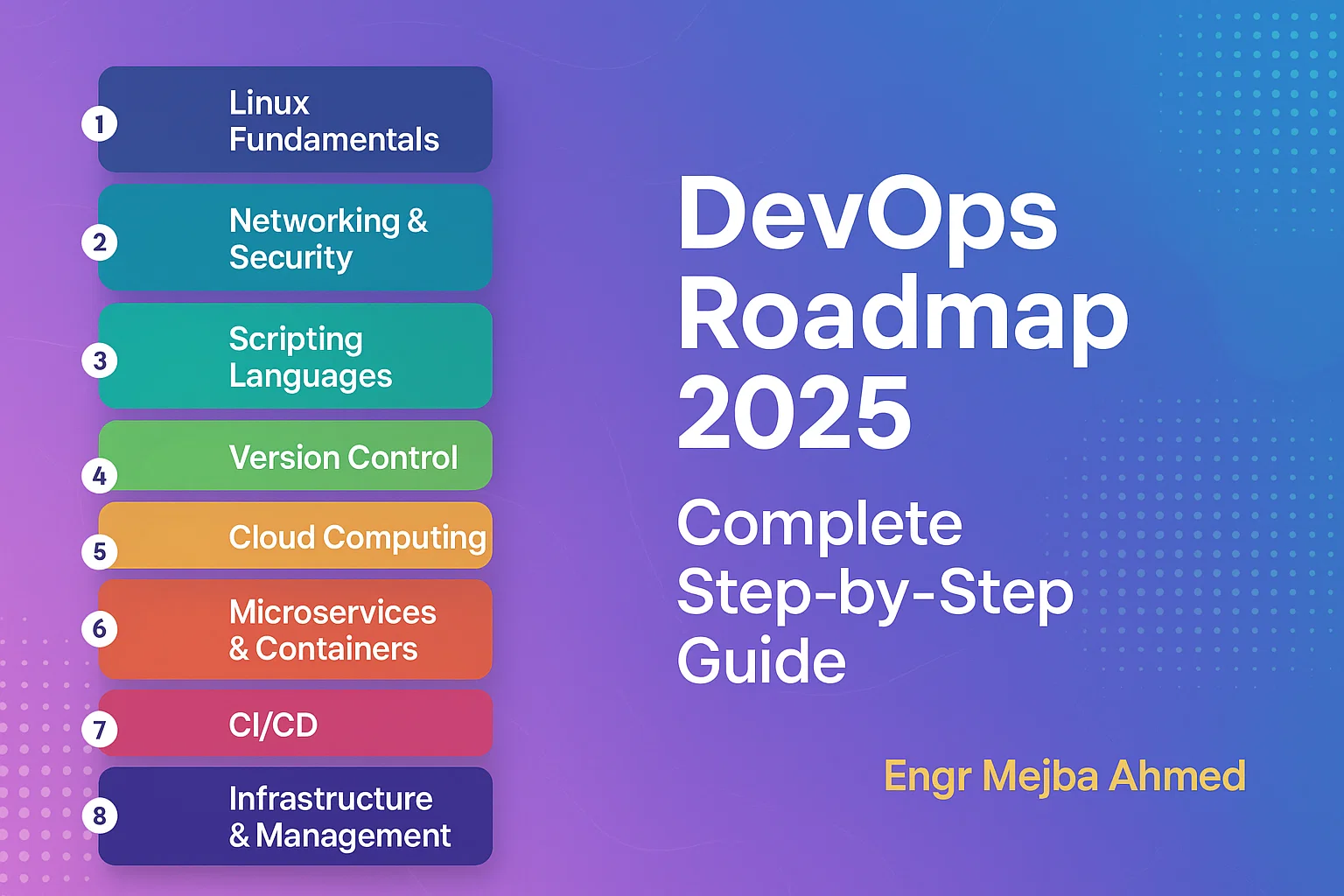
DevOps combines software development (Dev) and IT operations (Ops), enhancing the delivery speed and quality of software products. In this complete DevOps guide for 2025, you'll gain a clear, detailed roadmap to mastering modern DevOps practices and tools.
Step 1: Linux Fundamentals
- CLI (Bash)
- Process & permissions (
ps,kill,chmod) - Package management (
apt,yum) - Text editors (
vim)
Step 2: Networking & Security Concepts
- OSI and TCP/IP models
- Protocols: HTTP, HTTPS, SSH
- IP addressing, subnetting, DNS
- Network troubleshooting (Wireshark)
- Firewalls and proxy servers
Step 3: Scripting Languages
- Python, Ruby, Golang
- Syntax & fundamentals
- Useful libraries
- File handling
- Automation scripting
Step 4: Version Control (Git)
- Git commands:
init,clone,add,commit,push,pull,merge,rebase - Branching concepts
- Merge conflicts and resolutions
- Remote repository management
Step 5: Cloud Computing
- AWS, Azure, GCP
- Managing servers & data (EC2, S3, RDS)
- IAM (users, groups, roles)
- VPC configuration and management
Step 6: Microservices & Containers
- Docker basics
- Containerization and virtualization
- Dockerfile writing
- Docker Compose usage
Step 7: CI/CD
- Jenkins, GitHub Actions, GitLab CI, CircleCI, Travis CI
- Automating builds and deployments
- Pipeline setup and management
Step 8: Infrastructure as Code (IaC)
- Provisioning: Terraform, Pulumi
- Configuration management: Ansible, Puppet, Chef
Step 9: Orchestration & Management
- Kubernetes fundamentals
- Cluster creation and management
- Application deployment and management (
apply,build,delete)
Step 10: Monitoring & Logging
- Prometheus, Grafana
- ELK Stack, Fluentd, AWS CloudWatch
- Real-time monitoring and alerts
Conclusion
This DevOps roadmap equips you with essential skills and knowledge for a successful DevOps career in 2025. Embrace continuous learning and practical application to achieve mastery and stay ahead in the evolving tech landscape.
How to Use This Roadmap Without Drowning
The list above is a map, not a to-do list — nobody learns twelve domains in parallel. Work in the order given, because each stage assumes the last: Linux fluency makes networking labs possible, networking makes cloud services legible, version control underpins every automation step after it. Give each stage a project before moving on. Linux earns a home server or a hardened VPS; scripting earns a backup automation you actually rely on; CI/CD earns a pipeline that deploys a real app on push. The project is the proof — and the portfolio.
The Stages Where People Quit
Two spots claim most dropouts. The first is Kubernetes: it arrives with its own vocabulary and punishes memorization-first learning. Beat it by running a tiny cluster locally and breaking it on purpose — delete pods, kill nodes, watch the system heal. Understanding arrives through repair, not reading. The second is the infinite-tools trap: HashiCorp this, service mesh that, four monitoring stacks. The cure is remembering that companies hire for depth in one chain — one cloud, one IaC tool, one CI system, one orchestrator — plus the proven ability to learn the next thing. Depth in a chain beats acquaintance with a catalog every single interview.
What Employers Actually Test
Interviews probe three layers: can you debug a Linux box under pressure, can you explain a system you built and the trade-offs you chose, and do you think in automation by default. A candidate who says "I wrote a script for that" to every repetitive scenario reads as DevOps-native; a candidate reciting tool features reads as a course graduate. Frame every project write-up around a problem, the decision, and the measured result — that structure survives any interview format.
A Twelve-Month Cadence That Works
Months one through three: Linux, networking, Git, and scripting daily. Four through six: one cloud provider deeply plus containers, ending with a containerized app deployed on managed infrastructure. Seven through nine: IaC and CI/CD, ending with the one-command environment build. Ten through twelve: orchestration, monitoring, and one deliberate incident-response drill on your own stack. Ten focused hours weekly makes that timeline honest — and leaves you with four portfolio projects that answer interview questions before they're asked.
The Skills That Outlive the Tools
Every tool on this roadmap will be replaced eventually; four abilities won't. Reading logs calmly under pressure — most debugging is literacy plus patience. Explaining infrastructure decisions in plain language — the engineers who advance are the ones product managers understand. Estimating blast radius before a change — the instinct that separates seniors from juniors more than any certification. And writing things down — runbooks, postmortems, decision records — because documented knowledge is the only kind that scales past your own calendar. Practice these deliberately alongside the technical stages and the roadmap produces an engineer, not just a résumé.
Free Resources Worth Your Hours
For every stage, prefer official documentation plus one hands-on course over tutorial roulette. Linux Journey and OverTheWire for foundations; the vendor's own skill-builder paths for cloud; the official Docker and Kubernetes tutorials — genuinely excellent — for containers; and public postmortems from major outages for the operational mindset no course teaches. The pattern that works: read one authoritative source, build immediately, and let errors drive the second reading. Curation beats accumulation — three finished resources outperform thirty bookmarked ones. Start the first stage tonight — momentum is the only prerequisite this roadmap actually has.
Walking the Roadmap for Real
The DevOps roadmap 2025 path is walked in projects, not bookmarks — automate one deployment end to end and you've learned more than a month of videos teaches. My the AI engineer roadmap and a real CI/CD build go deeper.
If you want a DevOps learning plan tailored to you, that's work I take on through Ramlit.