
Claude Fable 5 arrived in my API console as a boring dropdown entry — claude-fable-5, sitting under Opus 4.8 like it had always been there. No keynote. What made the release genuinely interesting was not the benchmark sheet; it was the product decision behind it. Anthropic took one frontier model and shipped it as two products: Fable 5, which anyone can call, and Mythos 5, which almost nobody can. I have run Fable 5 as my daily model in Claude Code since launch, and this is the evergreen version of what it is, how the split actually works, and when the 2x price is worth paying.

One model, two doors
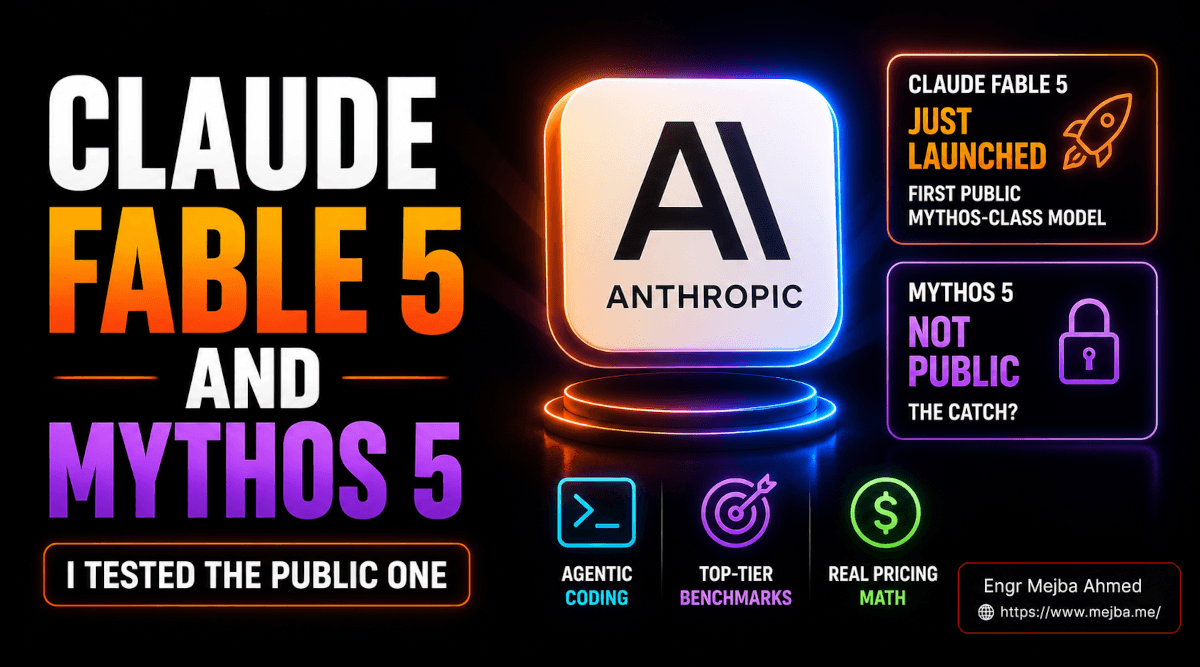
Fable 5 and Mythos 5 launched on June 9, 2026, and they are, per Anthropic, the same underlying model. The entire difference is the safety layer wrapped around it.
Fable 5 is the public one — generally available on the Claude API, inside Claude Code, and on Amazon Bedrock, Google Vertex AI, and Microsoft Foundry, at $10 per million input tokens and $50 per million output. That is double Opus 4.8's $5/$25, and less than half what the April Mythos Preview cost.
Mythos 5 is restricted to Project Glasswing, Anthropic's program for vetted cyberdefenders and critical-infrastructure providers. Same brain, with specific cybersecurity safeguards lifted so security teams can work in genuinely dangerous territory. You almost certainly cannot use it, and neither can I — that gate is the point.
This matters for how you read the coverage. A lot of "Mythos is public now" commentary is technically true and practically misleading: the famous cyber capability is precisely the thing the public model refuses to give you. Fable 5 is Mythos with the most dangerous door locked.
The safety net is a different model entirely
Fable 5 does something I had not seen before it shipped. When a session trips a safety classifier — offensive cybersecurity, most biology and chemistry requests, and model-distillation attempts are the flagged zones — the request is not refused. It is silently answered by Claude Opus 4.8 instead. You are still talking to a model; just not the frontier one, for that turn.
Anthropic's own figure is that more than 95% of Fable sessions involve no fallback at all, and my experience matches: months of Laravel refactors, agent orchestration, and content pipelines without a single detectable handoff, because nothing about ordinary engineering work resembles the gated zones. The design is clever — near-zero friction for the harmless majority — and slightly unsettling, because the capability is still in there. Fable 5 is not a weaker model that cannot do the dangerous thing. It is the dangerous model with a bouncer at one specific door.
If your work genuinely lives near those zones, learn what the handoff feels like on purpose: ask a pointed gated-zone question once and watch the response quality shift. Recognizing when you have silently dropped off the frontier model mid-session is worth one deliberate test.
What you're actually paying 2x for
Anthropic's launch claims were broad — top scores on frontier coding and finance evals, the first model past 90% on its internal analytics benchmark — but launch charts are vendor claims, mine included when I repeat them. What I can report from daily use is narrower and more useful: duration. Fable 5's real pitch is staying coherent across very long, autonomous, multi-step work.
Everyone who runs long agent sessions knows the old failure mode. The model starts strong, then a few hours in it begins re-litigating decisions it already made, forgetting a constraint you set at the top, or declaring a half-finished job complete. Opus 4.8 fixed a lot of that quiet drift. Fable 5 fixed more. On the kind of work I actually do — multi-file refactors with test gates, batch content jobs spanning dozens of database rows, long-running agent loops — the practical difference is how many times I have to interrupt my own day to keep the agent honest. With Fable 5 that number is noticeably closer to zero, and the gap widens as tasks get longer, which matches Anthropic's own framing that the model's lead grows with task length and complexity.
The second thing worth budgeting around is token efficiency. Anthropic's launch example — a physics task where Fable 5 used roughly a third of the reasoning tokens of its competitor to reach a comparable result — points at the honest way to evaluate the price: per finished task, not per token. Double the rate card can still be the cheaper model if it burns dramatically fewer tokens getting there. Run that math on your own workload before deciding; the sticker comparison alone will mislead you.
The pricing story, minus the launch drama
The launch period was chaotic in a way worth recording once and then moving past. Fable 5 shipped included at no extra cost on Pro, Max, Team, and seat-based Enterprise plans. Days later, a US export-control directive forced Anthropic to suspend both Fable 5 and Mythos 5 entirely — for roughly two and a half weeks the most capable model Anthropic had ever shipped publicly was simply not callable. Access was restored around July 1, and the included window was extended to July 12 to compensate before converting to usage credits at the $10/$50 API rate.
The durable lesson from that mess is not any particular date. It is that frontier access now ships as a config toggle that a classifier can reroute and a government directive can pause. Do not architect your workflows around a specific model being permanently available on a specific plan; architect them so the model id is one line you can change.
Two cost disciplines matter more than the rate card:
Prompt caching first. Anthropic discounts cached input tokens by up to 90%, and long agentic runs re-send the same large context every turn. People who skip caching and then complain about the Fable 5 bill are measuring the wrong thing. My working notes on this are in Claude Code token management.
Budget ceilings on autonomous runs. Longer unsupervised sessions at 2x pricing mean token consumption is now your main risk surface, not capability. An agent that runs six hours can quietly spend real money; hard stops and context hygiene are the skill, not getting it to run long.
Who should switch — and who shouldn't
Switch if you run long, autonomous, high-stakes coding work — large migrations, multi-day agent sessions, anything where a model losing the thread costs you real hours. This is the model for people tired of babysitting agents. Switch too if your work leans on heavy multi-step analysis; the capability gains are not just coding-shaped.
Don't switch your default for quick edits, short conversations, and routine generation that Opus 4.8 already nails. You would be paying double for headroom you never use — my Opus benchmarks breakdown covers where the cheaper tiers remain the right call.
Don't assume you are getting Mythos. If you need the lifted-safeguard cyber capability, the only door is Project Glasswing, and it is closed to almost everyone reading this.
The only test that survives every pricing change
Every availability and pricing detail in this model line has already changed at least once, so the evaluation method has to be independent of all of it. Here is mine, and it holds no matter what Anthropic does to the plans next:
- Pin the model id explicitly —
claude-fable-5in the API, the picker in Claude Code. Never a "latest" alias; know what you are billing. - Re-run a real task you already did on Opus 4.8 with the same prompt and effort setting. Not a toy — something you can judge instantly. Watch answer quality and tokens burned, because the efficiency story only matters if it shows up on your work.
- Test the long-horizon claim directly. Give it something genuinely big with a token budget attached, and watch the spots where the older model would have drifted.
That sequence gives you a real opinion in an afternoon. The frontier showed up quietly this time — a dropdown, a billing line, a two-week disappearing act — and the only honest way to know what it is worth on your work is to point it at your hardest task and watch the meter run.
Is the deep door worth 2x on the work you actually get paid for? No launch thread can answer that and neither can a benchmark chart — the pick, pin, measure, bound-the-spend method that does answer it is taught in order in my AI School.