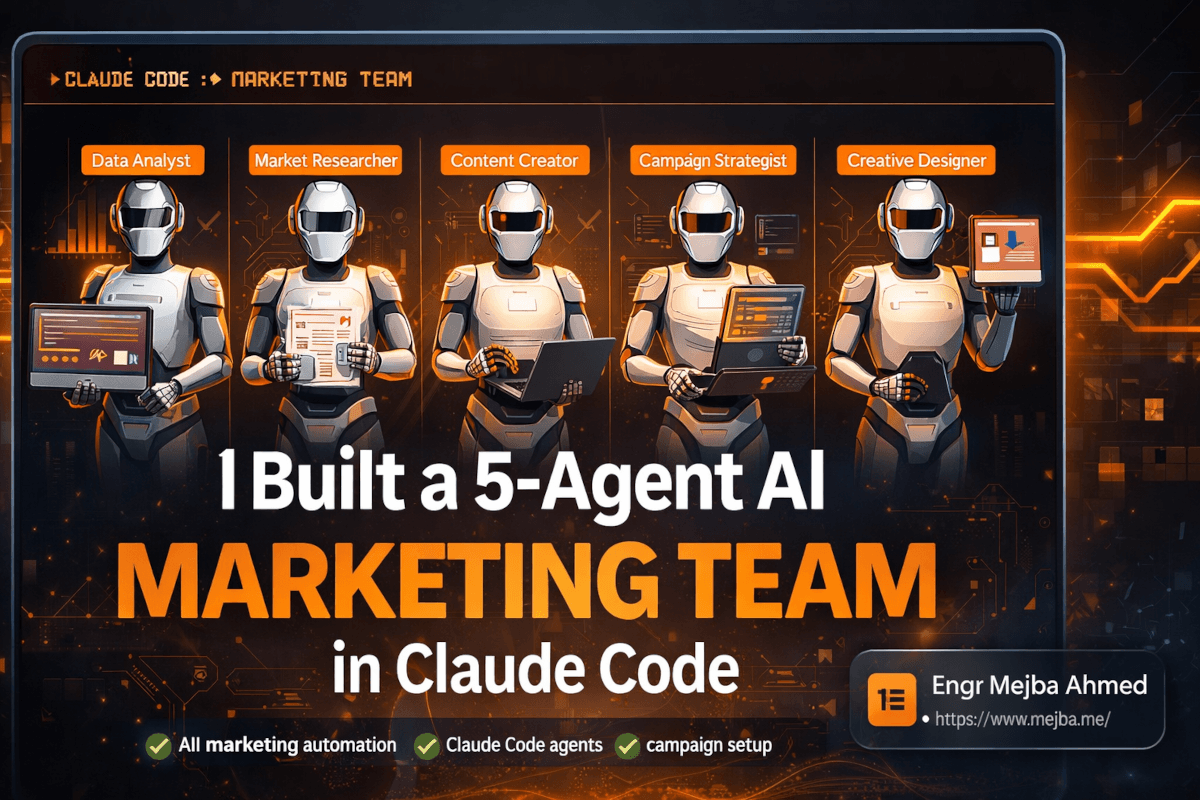
Marketing for four brands used to mean four hats I wore badly on alternating days. Ramlit needs client-facing content, ColorPark needs product marketing, xCyberSecurity needs technical authority pieces, and this site needs a constant publishing cadence. The system that made this survivable is a five-agent team inside Claude Code, and the single most important thing I can tell you about building one is this: the architecture matters more than the agents. Five focused agents with clean routing beat one genius agent every time, and I know because I built the genius agent first and watched it fail.
Why the mega-agent fails
My first attempt was the obvious one: a single agent definition stuffed with every marketing capability. Research methodology, brand voice, data analysis rules, design guidance, all piled into one system prompt that grew past 4,000 words. The result was an agent that was mediocre at everything, because instructions for data visualization were competing for attention with instructions for copywriting tone. I tested the same brief through it twice and got a social post written like a data report and a data report written like a social post. The wires crossed because the wires were all in one bundle.
The fix is the same one that works in human organizations: specialization with clear handoffs. That led to a four-step framework I now use for any multi-agent build, marketing or otherwise.
The four-step framework
Step 1: Map the actual tasks. Not categories. Tasks. My list had twelve entries, things like "pull campaign performance from CSV exports," "draft SEO blog posts," "design carousel posts to brand guidelines," "update the task board." If your mapping is vague, everything downstream inherits the vagueness.
Step 2: One task, one skill. Each task becomes a skill definition with three parts: a trigger (when it activates), a methodology (your actual step-by-step process, not generic best practice), and context references (which files it needs). The methodology part is where the leverage lives. Encoding your process is the difference between the agent guessing and the agent following, and the output gap is not subtle. This is the same skills-first thinking I laid out in my decoded guide to Claude skills.
Step 3: Group skills into agents. Cluster by shared context and by cognitive mode. My five: a Data Analyst (metrics, charts, executive reporting), a Content Creator (long-form, lead magnets, SEO), a Market Researcher (competitors, trends, briefs), a Creative Designer (visual assets against the style library), and a Campaign Strategist (assembly, landing pages, task management). The grouping rule I didn't appreciate until I tested it: separating analytical work from creative work into different agents improves both, because neither mode contaminates the other's instructions.
Step 4: Wire the connections. Vertical connections give each agent its skills. Horizontal connections let output flow between agents: research feeds content, analysis feeds strategy, design assets feed assembly. The horizontal wiring is what turns five agents into a team, and it lives in your routing rules.
The folder structure that carries the whole system
marketing-team/
├── .claude/agents/
│   ├── data-analyst.md
│   ├── content-creator.md
│   ├── market-researcher.md
│   ├── creative-designer.md
│   └── campaign-strategist.md
├── context/
│   ├── brand-voice.md
│   ├── product-offerings.md
│   ├── visual-style-guide.md
│   └── target-audience.md
├── templates/
├── creative-library/style-references/
├── working/
│   ├── campaigns/  reports/  social-posts/  landing-pages/
├── data/campaigns/
├── .mcp.json
└── CLAUDE.md
Two categories matter. System folders (context/, templates/, creative-library/) hold institutional knowledge; working folders hold deliverables, one subfolder per output type, so you always know where an agent's work landed.
The highest-leverage file in the entire tree is context/brand-voice.md, and the counterintuitive lesson from running this across four brands is that shorter is better. My first voice guide was 3,000 words and the agents applied it inconsistently, nailing tone in one paragraph and losing it in the next. Cut to roughly 800 words with three calibration paragraphs at different intensity levels, consistency jumped immediately. Context files should be dense, not comprehensive. Give the model calibration points, not an encyclopedia.
One complete agent definition
Here's my Data Analyst, which is the pattern all five follow:
---
name: Data Analyst
trigger: analyzing campaign data, creating reports,
  generating charts or performance dashboards
---
You are the Data Analyst on the marketing team.

## Skills
1. Campaign data processing from CSV exports
2. Branded chart and dashboard generation
3. Executive reporting with recommendations

## Context files
- context/visual-style-guide.md
- templates/report-template.md

## Process
1. Load the dataset from data/campaigns/
2. Identify headline metrics; flag anomalies >15%
   from the prior period
3. Break down by channel, audience, creative
4. Chart to the visual style guide
5. Summarize: Situation → Finding → Recommendation
6. Save to working/reports/

## Standards
- Recommendations tie to a specific next action
- Summaries stay under 500 words
- Every claim cites its metric and period
Fifteen to twenty minutes per agent, and most of that time is translating "how I actually do this" into steps. Build one, test it against real work, refine it, then replicate. I built all five in one weekend the first time and spent the next week debugging interconnection issues that incremental testing would have caught in minutes. Don't repeat that.
Routing rules and the task-board loop
The CLAUDE.md at the project root is the traffic controller. Mine routes by task type (data work to the analyst, visual work to the designer, and so on) and defines the multi-step campaign flow: researcher first, since everything depends on the brief; content and design in parallel from that brief; strategist assembles; analyst sets up tracking. The parallel phase is a genuine wall-clock win, since the writer and designer genuinely don't need each other, a pattern I've pushed much further in my agent teams setup guide.
The piece that turns this from demo into operations is the task board integration over MCP. Tasks tagged for the AI team get read in priority order, routed to the right agent, and updated with status and an output file path when done. My end of the loop is review: open the deliverable, approve or redirect. On days when I'm away from the desk, I run that loop from my phone against the live session, which I described in my remote-control workflow. Queue tasks during the day, process them in batches from anywhere.
For my own brands, the heaviest real usage isn't campaign theater, it's the unglamorous recurring work: performance summaries from ad and analytics exports, SEO content production against a keyword plan, and social derivatives of long-form posts, the pipeline I detailed in automating SEO and social with Claude. The agents' first drafts land at maybe 80 percent, and my review time per deliverable runs 10 to 45 minutes depending on type. The honest economics: the system replaces the blank page, not the judgment. Replacing the blank page is most of the time cost anyway.
The mistakes worth stealing from
Four things I got wrong so you don't have to. Overlong context files, covered above. Undefined output formats, which let the analyst produce a different report shape every run until I pinned templates into the skill definitions. Building all five agents before testing any. And underinvesting in the style reference library: with three reference images the designer's output wandered off-brand constantly; with fifteen covering each content type it holds the line well enough that I'm editing rather than regenerating.
If I started over, I'd spend the entire first day on context files alone. Their quality is the ceiling for every agent's output, and I rushed past them to get to the fun part. The fun part inherited the rot.
Where to start
Two hours gets you a working single-agent version: build the folder structure, write an 800-word brand voice file, define your highest-pain agent, encode one skill, and run it against a real task. Add one agent per session after that, and only wire the routing once each works alone.
The split happening in marketing right now is between teams that treat AI as a content button and teams that treat it as an operational layer with roles, shared context, and structured workflows. The first group saves a few hours a week. The second group changes what one person can run. Four brands on one keyboard is my proof.
Building a system like this for a business with real brand constraints is work I do professionally; if you'd rather commission the operational layer than assemble it, start at my services page.