AI Industry Updates April 2026: What Just Broke and Why
I was mid-session in Claude Code on a Thursday night — shipping a feature for a client project, Opus 4.6 humming along like it had for weeks — when the responses started going sideways. Not catastrophically. Subtly. The kind of drift where you're three prompts deep before you realize the model has been hallucinating function parameters that don't exist. I double-checked. Restarted the session. Same thing. The model I'd been praising two weeks earlier felt like it had been lobotomized overnight.
Turns out I wasn't imagining it. And that was just the beginning of what became the most chaotic week in AI this year.
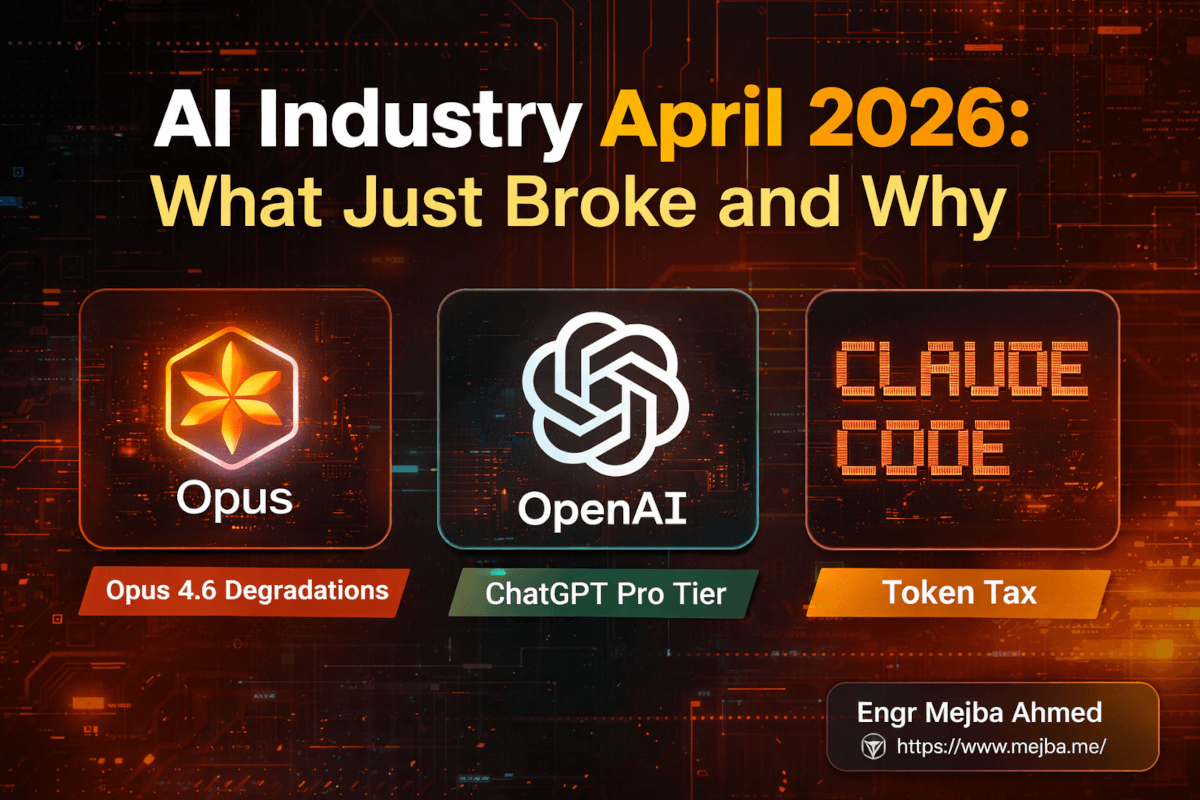
April 2026 hit the AI industry like a pressure wave. Opus 4.6 quality reports went off a cliff. OpenAI dropped a new pricing tier designed to poach frustrated Anthropic users at the exact moment those users were most frustrated. A hidden "token tax" in Claude Code started eating through rate limits faster than anyone expected. MiniMax shipped a model they called "open source" that... isn't really open source. And Anthropic — in the middle of all this chaos — quietly started building a developer ecosystem that looks like it wants to be the next Google AI Studio.
I spent the past week tracking every major development, testing what I could, and talking to other developers in the trenches. Here's my honest breakdown of what happened, what it means, and what you should actually do about it.
Opus 4.6 Hit a Wall — And the Numbers Are Ugly
Let me be direct about this because the community is split between "it's fine, you're imagining things" and "the model is completely broken." The truth lives somewhere more nuanced, and I have the data to back it up.
Starting around early April, developers began reporting quality degradation in Opus 4.6 on GitHub issues, Reddit threads, and Discord channels. Responses felt less sharp. Reasoning chains that used to be airtight started showing gaps. And the hallucinations — the confident, specific, wrong answers — spiked noticeably.
Then came the Bridgebench numbers, and the picture got a lot harder to ignore.
Bridgebench is a hallucination accuracy benchmark that tracks how often models generate plausible-sounding but factually incorrect claims. Opus 4.6's score dropped from 83.3% to 68.3% — a 15-point fall in a single week. Its ranking plummeted from 2nd place to 10th. That's not a minor fluctuation. That's a model behaving measurably worse on a metric Anthropic's own marketing highlights as a strength.
I noticed it most during iterative coding tasks. The kind of work where you're building something complex across twenty or thirty exchanges. Opus 4.6 used to hold context beautifully through those long sessions — I praised exactly that capability in my hands-on review. Now? By exchange fifteen, the model starts losing track of architectural decisions made in exchange three. Function signatures drift. Variable names change without explanation. It's like talking to someone who keeps forgetting what you discussed five minutes ago.
Is Anthropic Deliberately Nerfing Opus?
Here's where the speculation gets interesting — and where I need to be honest about what's confirmed versus what's theory.
The community hypothesis gaining traction is that Anthropic is "distilling" Opus 4.6, effectively running a cheaper, lighter version of the model while calling it the same name. The motivation would be straightforward: reduce compute costs, manage capacity, and maybe — some argue — build artificial dissatisfaction that makes the eventual Opus 4.7 launch look more impressive by comparison.
I want to be careful here. There's no smoking gun proving deliberate degradation. What we do know is that Opus 4.7 has been spotted in leaked Claude Code source files alongside references to Sonnet 4.8 and an unreleased model codenamed "Mythos." A March 2026 source code leak revealed internal references to these models, suggesting they're actively in testing. So Anthropic absolutely has a successor in the pipeline.
Could they be throttling the current model to manage costs while preparing the next one? It's plausible. Have they confirmed it? Absolutely not. Anthropic's official response points to heavier reasoning-by-default as one factor, and they've acknowledged "incidents" affecting performance.
What I can tell you from my own testing: the degradation is real, it's measurable, and it's worst on exactly the tasks that power users care about most — long-context coding, multi-step reasoning, and iterative problem-solving.
The Rate Limit Squeeze
Making matters worse, Max Plan subscribers are reporting more restrictive rate limits. You're paying $100 or $200 a month for a model that's simultaneously getting worse and harder to use at volume. That's a bad combination, and it's pushing developers to look at alternatives in a way they weren't three weeks ago.
Which brings us to a timing coincidence that's almost too perfect.
OpenAI Smells Blood: The $100 ChatGPT Pro Tier
On April 9, 2026 — right in the middle of Opus 4.6's quality crisis — OpenAI launched a new $100/month ChatGPT Pro tier. The timing wasn't accidental. CNBC's reporting made it explicit: OpenAI designed this tier to challenge Anthropic directly, targeting developers facing rate limits elsewhere.
Here's what the Pro tier includes. Five times the Codex usage compared to the $20/month Plus plan. That's significant — Codex is OpenAI's AI coding agent, their direct competitor to Claude Code. And through May 31st, they're running a promotion: 10x the Codex usage of the Plus plan. Temporary, sure. But temporary generosity at the exact moment your competitor's users are frustrated is strategic brilliance.
The pricing ladder now looks like this: $20/month Plus, $100/month Pro, $200/month Pro with a 20x usage allowance. OpenAI carved out a middle tier that matches Anthropic's Max plan price point while offering dramatically more Codex access during the promotional period.
I haven't fully switched. But I'm testing. And the fact that I'm even testing tells you something about how badly the Opus degradation shook my confidence. Two weeks ago, I would have laughed at the idea of going back to OpenAI for coding work. Opus 4.6 was that good. Now I'm running parallel workflows to see if Codex can handle what Opus is currently struggling with.
The honest verdict so far: Codex is better at short, well-scoped tasks. Opus — even degraded — is still superior for complex, multi-step architectural work when it's having a good session. The problem is that "when it's having a good session" used to be "always," and now it's more like "60% of the time."
That unreliability is the real damage. I can work with a model that's consistently slower. I can't efficiently work with one that's unpredictably worse.
The Claude Code Token Tax Nobody Told You About
This one flew under the radar while everyone was arguing about model quality, and it might affect your daily workflow more than any benchmark shift.
Developers have been reporting that Claude Code sessions are burning through rate limits faster than expected — significantly faster. The community has been calling it a "token tax": roughly 20,000 extra build tokens injected per request, server-side, before your actual prompt even gets processed.
Where do these phantom tokens come from? When you use Claude Code with tools enabled — web search, code execution, MCP connectors — Anthropic automatically includes system prompts that enable those capabilities. These system prompts consume input tokens. And they're added to every single request, whether you're actively using those tools in that particular message or not.
The practical impact is brutal. If you have web search, code execution, and a few MCP tools enabled, you could be burning 20,000+ tokens of overhead per request just in system prompt infrastructure. Across a heavy coding session — fifty, sixty requests — that's over a million tokens of overhead you never asked for and never saw.
Here's the workaround the community has found: you can downgrade to an older Claude Code version. Specifically, running npx [email protected] reportedly avoids the inflated token usage. The trade-off is obvious — you lose whatever improvements came in newer versions. But if you're hitting rate limits halfway through your workday, it's worth testing.
I should note: Anthropic hasn't officially acknowledged this as a problem. The token overhead from tool system prompts is documented behavior, but the magnitude — and the fact that it scales with every enabled tool regardless of usage — feels like an implementation issue, not a deliberate design choice. My advice: if you're on a Max plan and your rate limits feel tighter than they should, disable tools you're not actively using. It won't eliminate the overhead, but it'll reduce it meaningfully.
Anthropic's Bigger Play: From Model Company to Platform Company
While the Opus quality drama dominates Twitter discourse, something much more strategically significant is happening at Anthropic. They're building a developer platform — and it's more ambitious than most people realize.
Think about what Anthropic was eighteen months ago: a company that made models. Good models, but just models. You accessed them through an API, or through Claude.ai's chat interface, and that was basically it.
Look at what they're building now.
Claude Code isn't just a CLI anymore — it's a VS Code extension with inline diffs, plan review, and conversation history. Claude Cowork hit general availability on macOS and Windows with enterprise-grade analytics, OpenTelemetry support, and role-based access controls. They've shipped plugin marketplaces — Knowledge Work Plugins covering eleven categories, Financial Services Plugins with 41 specialized skills. MCP connectors are turning Claude from a chatbot into an integration hub.
And now there's talk of a full AI studio platform — something akin to Google AI Studio — for building complete applications with Claude as the backbone. Multi-repository management in Claude Code Desktop. The infrastructure for full-stack development where Claude isn't assisting your workflow, it IS the workflow.
This is the real story of April 2026, hidden behind the flashier headlines about model degradation. Anthropic is executing a platform strategy. They don't just want you using their model — they want you building your entire development pipeline inside their ecosystem. Plugin marketplaces, desktop apps, enterprise connectors, office integrations. That's a moat. Even if Opus 4.6 has a rough month, the switching cost of leaving Anthropic's ecosystem gets higher every week.
Whether that's exciting or alarming depends on how much you trust a single company to own your development infrastructure. I lean toward excited — but with my eyes wide open about the lock-in implications.
Claude for Word: Anthropic's Bold Enterprise Move
Speaking of ecosystem expansion — Claude for Word dropped in beta on April 10, 2026, and the enterprise world immediately took notice.
The integration is more sophisticated than I expected. Claude lives in a persistent sidebar inside Microsoft Word, and it can draft, edit, and revise documents while preserving native formatting. The key feature that separates this from "just paste it into ChatGPT": every AI-generated edit surfaces as Microsoft Word's tracked changes. For anyone working in legal, compliance, or regulated industries, that's not a nice-to-have — it's a requirement. You need an audit trail. Claude for Word provides one natively.
It gets better. Claude can work through comment threads — reading the anchored text, making edits, and replying with what it changed. If you've ever left a comment saying "this paragraph needs to be clearer" and wished someone would just fix it, that's exactly what this does.
Currently available for Team and Enterprise plans. Enterprise deployments can route through Amazon Bedrock, Google Cloud Vertex AI, or Microsoft Azure — meaning organizations can use the add-in without a standalone Claude account. That's smart. It removes the biggest enterprise objection: "we can't add another vendor."
The market reaction was telling. When the initial Claude for Office integrations rolled out earlier this year, Thomson Reuters dropped 16%, RELX fell 14%, and Wolters Kluwer lost 13% in a single trading session. An estimated $285 billion in market value wiped from software and legal tech companies. That's not hype — that's the market pricing in a genuine competitive threat.
And the integration spans beyond Word. Claude for Word connects with Claude for Excel and Claude for PowerPoint, so a single conversation thread can span all three open documents. Build the analysis in Excel, write the report in Word, create the presentation in PowerPoint — all within one Claude session.
MiniMax M2.7: "Open Source" Deserves Quotation Marks
MiniMax dropped M2.7 in early April and immediately called it "fully open source." The Hugging Face community called foul within hours.
Here's what M2.7 actually is: a 230-billion parameter Mixture-of-Experts model with only 10 billion parameters active per token, 256 experts, and support for 200K context length. The weights are on Hugging Face. You can download them. So far, sounds open source.
Except the license restricts commercial use without authorization from MiniMax. That's not open source. That's source-available with a commercial restriction. The Open Source Initiative has been crystal clear about this distinction for decades, and slapping "open source" on a model with commercial restrictions is — at best — misleading marketing.
The performance numbers are genuinely interesting, though. On SWE-Pro, which covers multiple programming languages, M2.7 scored 56.22% — matching GPT-5.3 Codex. That's remarkable for a model outside the big three providers. And the self-evolution capability is wild: M2.7 ran an autonomous improvement loop for over 100 rounds, discovering effective optimizations on its own and achieving a 30% performance improvement on internal evaluations. A model that can meaningfully improve itself is a different kind of thing than a model that just answers questions.
The catch — and there's always a catch — is the hardware requirement. Running M2.7 locally requires serious iron. We're talking 4x DGX Sparks or equivalent setups. BF16 weights at 200K context isn't something your MacBook Pro is handling, no matter how much RAM you've got. This is a model for organizations with compute budgets, not indie developers experimenting on weekends.
For anyone running it via the API, the licensing question matters less. But if you're planning to self-host for commercial applications, read the license carefully before building anything on top of it. "Open source" this is not.
Gem Opus 426B: Open Source Distillation Gets Scary Good
While MiniMax plays fast and loose with licensing terms, the open-source community is doing something genuinely remarkable with Google's Gemma 4 architecture.
Gem Opus — technically "Gemma 4 26B A4B x Claude Opus 4.6" — is a fine-tuned version of Google's Gemma 4 that's been trained on reasoning distillation from Claude Opus 4.6 interactions. The core idea: take a smaller, open model and teach it to think like Opus by feeding it datasets where the reasoning effort was explicitly set to high.
The results are mixed in a fascinating way. On data reasoning and analytical tasks, Gem Opus punches dramatically above its weight class. The reasoning chains feel qualitatively different from base Gemma 4 — more structured, more thorough, more willing to explore edge cases before committing to an answer.
On long coding and debugging tasks? It falls apart. The distillation captured Opus's reasoning patterns but not its ability to hold complex multi-file codebases in working memory. Which makes sense — you can teach a smaller model how to think, but you can't easily give it the raw capacity to juggle as much information simultaneously.
The hardware story is much more accessible than MiniMax's offering. Gemma 4 26B A4B has 25.2 billion total parameters but only 3.8 billion active per token, with a 256K context window. Community members are running it on dual 3090 GPUs. That's expensive for a hobbyist, sure — but it's a setup you can actually build at home. The gap between "what the big labs produce" and "what you can run on your own hardware" keeps shrinking, and Gem Opus is one of the most interesting data points in that trend.
My take: if your use case is analytical — data processing, report generation, research synthesis — Gem Opus is worth testing as a cost-effective alternative to API-based models. If you need long-session coding support, it's not there yet.
GPT Image Gen 2: The Leak That Became a Soft Launch
OpenAI's next-generation image model has been hiding in plain sight.
Three anonymous models appeared on the Arena AI evaluation platform under codenames straight out of a hardware store: Masking Tape Alpha, Gaffer Tape Alpha, and Packing Tape Alpha. Community testers immediately noticed something unusual. These models rendered text in images with near-perfect accuracy — company logos, handwritten notes, even the correct time displayed on a watch face. Text rendering has been the Achilles' heel of AI image generation since DALL-E first shipped. These "tape" models cracked it.
As of mid-April 2026, bloggers and early testers report that ChatGPT is already rolling out GPT Image 2 to a subset of users in a gradual release. No official announcement yet. No press release. Just quiet availability expanding day by day.
What we know from the testing: significantly improved prompt adherence (it generates what you actually asked for, not its interpretation of what you meant), realistic details that don't fall into uncanny valley territory, and consistency across multiple generations from the same prompt. That last point matters for anyone doing production design work — you need to be able to iterate, and iteration requires consistency.
The timing makes strategic sense. Sora — OpenAI's video generation model — shut down in March 2026, freeing up compute resources. Redirecting that capacity toward image generation improvements is a logical allocation. Industry analysts expect a formal announcement between April and June 2026.
For creators and designers, this is probably the most practically impactful announcement of the month. Model quality debates and pricing tier reshuffles affect developers. Better image generation affects everyone who communicates visually — which, in 2026, is everyone.
The Story Nobody Wants to Talk About: Human Bodies Training Robot AI
I need to shift gears here because this story is uncomfortable and important and most AI coverage is ignoring it.
Across facilities in India and Nigeria, hundreds of workers are strapping iPhones and head-mounted cameras to their foreheads and spending hours performing repetitive tasks: folding towels, stacking boxes, manipulating everyday objects. Every finger flex, every arm reach, captured in granular video detail. These recordings ship to AI labs in the United States, where neural networks dissect every nuance to teach humanoid robots how to interact with the physical world.
MIT Technology Review covered this in detail — it's become a significant gig economy segment. The compensation in India's data farms hovers around $230-250 per month for full-time shifts of repetitive motion capture. That's roughly 19,000-21,000 rupees.
The ethical dimension is impossible to ignore. These workers are training systems designed to perform the exact physical tasks they're being paid to demonstrate. They're recording the precise movements that, if the robotics companies succeed, will make their labor unnecessary. It's a more visceral version of the same dynamic affecting knowledge workers — your expertise is being used to build the system that replaces you.
The data ownership questions are equally thorny. Who owns the specific motion data from a worker's precise finger movements? The worker? The contracting company? The AI lab that processes it? These videos inadvertently capture faces, homes, and personal details, feeding into datasets with minimal regulatory oversight.
The AI training data market is projected to hit $8 billion by 2030, with India as a linchpin of the supply chain. Over $6 billion was invested in humanoid robots in 2025 alone.
I don't have a clean answer here. I use AI tools daily. The models I rely on were trained on human-generated data, much of it produced by underpaid workers in developing countries. Pretending this isn't part of the supply chain would be dishonest. But acknowledging it without doing anything about it isn't much better.
At minimum, I think everyone building with AI should understand what the full production pipeline looks like — not just the API endpoint, but the human labor at the other end. The choices we make about which companies to support with our spending implicitly endorse their labor practices. That deserves more scrutiny than it's getting.
What's Coming Next: Google I/O and DeepSeek V4
Two events on the horizon could reshape everything I've just described.
Google I/O kicks off May 19, 2026. The expected announcements include Gemini 3.5 (or possibly Gemini 4 — the naming isn't confirmed), plus Android 17 and new AI features across Google's product suite. Leaks suggest Gemini 3.5 shows meaningful improvements in instruction-following and creative tasks, though visual output consistency reportedly remains inconsistent. If Google ships a model that genuinely competes with Opus 4.6 at its peak — emphasis on peak, not its current degraded state — that changes the competitive math entirely.
DeepSeek V4 is the wildcard. Rumors put the release somewhere around late April or early May 2026. DeepSeek V4 Lite has already appeared through unofficial channels, reportedly outperforming Gemini 3.1 on certain benchmarks. DeepSeek's track record of delivering genuine performance at lower cost makes V4 worth watching closely — especially if you're frustrated with the pricing-and-quality dynamics at Anthropic and OpenAI.
Between Google I/O, DeepSeek V4, the potential Opus 4.7 launch, and whatever OpenAI does next, May 2026 might make April look calm by comparison. The competitive pressure is doing what competition always does — forcing everyone to ship faster and price more aggressively. For developers, that's ultimately a win. The short-term chaos is the price of long-term progress.
My Honest Scorecard: What to Actually Do This Week
Here's where I land after tracking all of this for the past seven days.
If you're on Anthropic's Max Plan and hitting quality issues: Don't rage-quit, but do start a parallel evaluation. Open a ChatGPT Pro trial if you haven't. Test your specific workflows — not benchmarks, YOUR actual tasks — against Codex. The promotional 10x usage through May 31st gives you plenty of room to run a real comparison.
If you're burning through Claude Code rate limits: Check how many tools you have enabled. Disable anything you're not actively using in the current session. Consider testing npx [email protected] if the token overhead is killing your workflow. Monitor whether the next Claude Code update addresses this.
If you work in an enterprise with document-heavy workflows: Get on the Claude for Word beta waitlist immediately. The tracked changes integration alone is worth it for legal, compliance, and editorial teams. The cross-application threading with Excel and PowerPoint is the kind of productivity multiplier that justifies the enterprise pricing.
If you're evaluating open models: Gem Opus (Gemma 4 26B fine-tuned) is the most interesting option for analytical tasks. MiniMax M2.7 is powerful but read the license before you build on it. Neither replaces API-based models for serious coding work — yet.
If you care about the industry's ethical trajectory: Follow the MIT Technology Review reporting on AI training labor. Ask the companies you support about their data sourcing. It's not comfortable, but it's necessary.
The headline for April 2026 isn't any single development. It's that the AI industry is moving too fast for any single provider to hold a comfortable lead. Anthropic's Opus was untouchable three weeks ago. Now it's beatable. OpenAI was struggling to compete in coding. Now they're price-competitive and improving. Open-source models that would have been jokes eighteen months ago are matching proprietary benchmarks.
The uncomfortable truth — and the exciting one — is that reliability has replaced capability as the thing that matters most. We have enough raw intelligence in these models. What we don't have is consistency. The team that solves reliability first doesn't just win the current race. They redefine what AI tools can be trusted to do.
And trust, once earned, is the hardest competitive advantage to replicate.
AI Industry Updates April 2026: Reader Questions
Is Opus 4.6 actually getting worse or am I imagining it?
You're not imagining it. Bridgebench hallucination accuracy dropped from 83.3% to 68.3% in one week, and GitHub issues confirm widespread quality degradation on iterative coding tasks. Anthropic has acknowledged contributing factors including heavier default reasoning. For a deeper look at what changed, see the Opus 4.6 quality section above.
What is the Claude Code token tax and how do I avoid it?
Claude Code injects roughly 20,000 extra system prompt tokens per request when tools are enabled, consuming your rate limit faster. Disable unused tools to reduce overhead, or downgrade to version 2.1.98 via npx [email protected] to avoid inflated usage. See the token tax section above for the full breakdown.
Is the new ChatGPT Pro $100 plan worth switching to from Claude Max?
The Pro plan offers 5x Codex usage versus Plus, with a temporary 10x promotion through May 31, 2026. It's strongest for well-scoped coding tasks, while Opus remains better for complex multi-step work when performing well. Run a parallel evaluation on your specific workflows before committing.
When is Opus 4.7 expected to release?
Opus 4.7 was spotted in leaked Claude Code source files alongside Sonnet 4.8 and a model codenamed "Mythos." No official release date exists. Community speculation points to either a near-term launch or a bundled Claude 5 release in May-June 2026.
Is MiniMax M2.7 truly open source?
No. Despite marketing claims, the license restricts commercial use without authorization from MiniMax. The weights are publicly available on Hugging Face, making it source-available, but the commercial restriction disqualifies it from the Open Source Initiative's definition.
What April's Shakeup Means for Builders
Opus 4.6's hallucination spike, OpenAI's $100 Pro plan, and Claude Code's hidden token tax aren't isolated — they're the market repricing itself as capability and cost both move fast. The lesson isn't panic; it's to watch your own bills and outputs, not the headlines.
Audit what you actually spend and what you actually get this month. That's where the real story of April shows up. My Opus 4.6 hands-on review goes deeper on the regression.
If you want help reading where the market is heading for your roadmap, that's work I take on through Ramlit.