
Autoankauf Zürich — Laravel Vehicle Enquiry Website
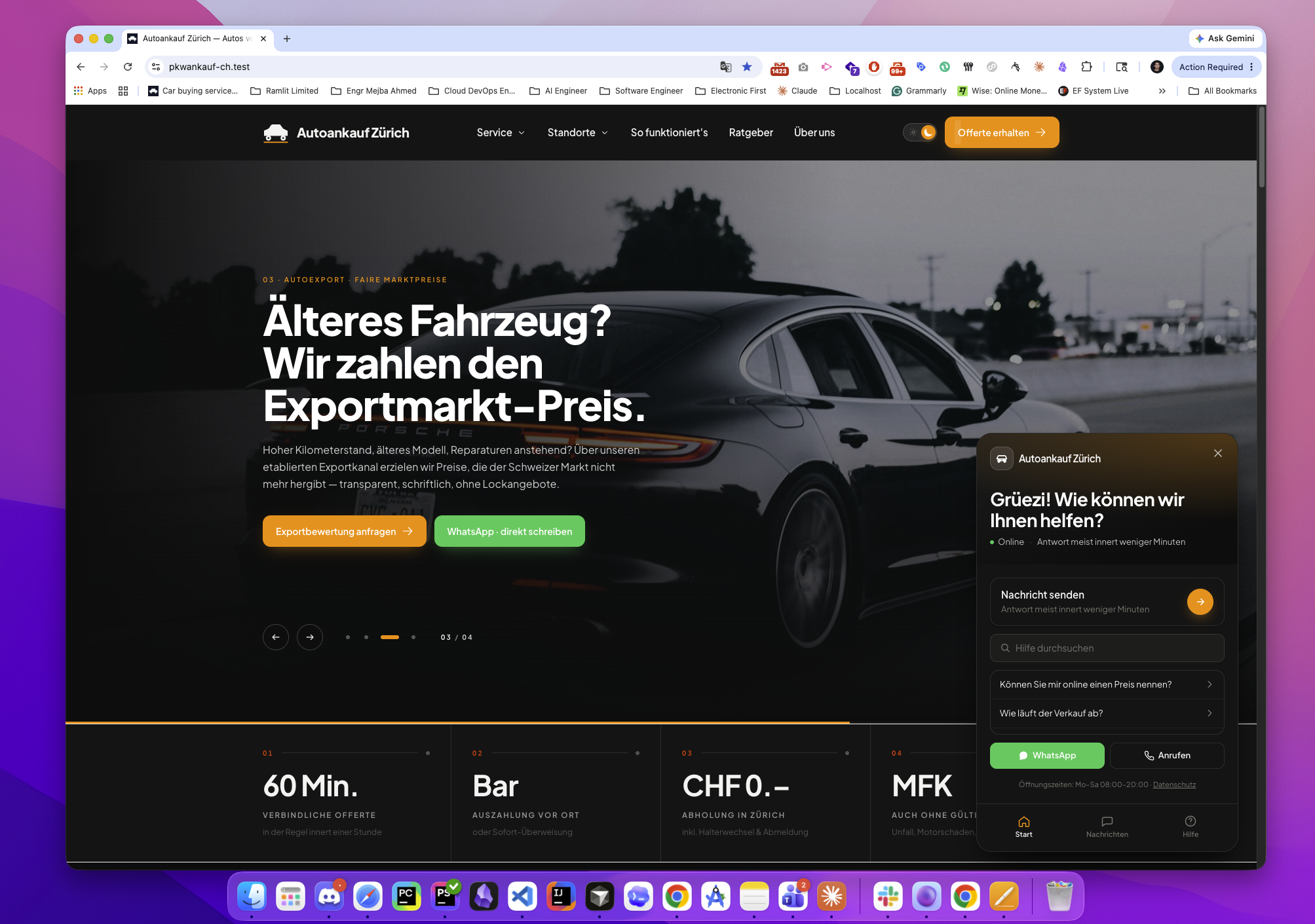
Visual Showcase
Click any image to explore the gallery in full screen
About This Project
Autoankauf Zürich is a Laravel website for collecting vehicle-sale enquiries in the Zürich region. I built the public website and its connected administration panel, bringing service information, local landing pages, seller contact options, and lead follow-up into one application.
The customer-facing site is available at pkwankauf.ch. This case study explains the website implementation; the lead-management dashboard case study documents the operational backend separately.
A clear route from research to enquiry
A vehicle seller may arrive with a damaged car, a high-mileage vehicle, or questions about the selling process. The site groups those needs into service pages, location pages, FAQs, and a vehicle-selling guide section. Each route offers a next step through the enquiry form, telephone, or WhatsApp.
The homepage combines a vehicle-focused hero, process explanation, specialty-service cards, location navigation, FAQs, and recent articles. The purpose is to help visitors understand the service before starting a conversation, rather than requiring them to explore an admin interface or create an account.
The live enquiry form
The current public form asks for make, model, year, mileage, contact details, an optional price expectation, and further notes in one screen. Its Livewire component validates the input, creates a referenced lead, and records the source page and available campaign attribution. It includes a honeypot and an IP-based submission rate limit.
The implementation saves the lead before attempting administrator and customer email notifications. That ordering keeps the enquiry record available if email delivery fails. Follow-up then belongs in the connected lead-management panel.
The gallery documents an earlier three-step form and other development views. The current live form is simpler and does not display that earlier photo-upload flow. A submitted enquiry requests a human response; it does not generate an instant vehicle valuation, confirm a purchase, or guarantee a response time.
Local content with separate page purposes
Service pages address vehicle-specific needs such as accident damage, engine damage, export, company vehicles, classic cars, leasing, and vehicle disposal. Location pages provide a separate route for geographic enquiries. The earlier gallery shows Zürich district pages; the live navigation now includes municipalities across the region.
The templates support page-specific titles, descriptions, canonical URLs, breadcrumbs, and structured data. The sitemap includes published service, location, and blog entries. Server-rendered Blade pages make the main content available in the initial HTML, while Livewire and Alpine.js handle interactive elements.
This structure supplies a technical basis for discovery. Each location or service page still needs accurate, distinct content that answers a real user's question; a template or schema block alone does not establish search rankings.
Website editing and support
Filament provides the connected editors for pages, services, locations, FAQs, blog content, slides, and website settings. A separate chat component uses administrator-managed knowledge and OpenAI through Prism. Operators can maintain website information and review enquiries without changing Blade templates for every routine content update.
The interface includes light and dark presentations and mobile navigation. The ten gallery images show desktop and phone layouts, the earlier form, chat interface, service and location examples, the blog archive, and an article view. They are development evidence; business statistics and review claims visible in those images are not independently verified project results.
Stack and project boundaries
The reviewed source uses PHP 8.4 requirements, Laravel 13, Filament 5, and Livewire 4, with Spatie media and permission packages. The dependency lockfile confirms those framework versions. The public site and administration panel serve different audiences but share the application's content and lead models.
This case study does not report measured Core Web Vitals, organic-traffic gains, or a conversion uplift. Those outcomes need dated performance tests and analytics rather than assumptions based on the design. Business promises, customer reviews, and legal claims on the linked website require the operator's own verification.
Plan a service website with lead capture
For a similar build, the useful starting point is your service scope, geographic coverage, enquiry fields, follow-up process, and evidence supporting your public claims. Discuss your website requirements, or browse other software projects.
Project Details

Enjoyed this project breakdown?
A coffee fuels more open-source work, tutorials, and detailed case studies like this one.
Like What You See?
Check out more projects or let's discuss how I can bring your vision to life with the same attention to detail.