AI Business OS — Local Agent Orchestration with Human Approvals
Visual Showcase
Click any image to explore the gallery in full screen
About This Project
AI Business OS is a local-first multi-agent platform for turning business ideas into reviewable tasks, with a Claude-powered Integrator, execution budgets, and a human approval queue. I built the Phase 1 platform around a practical question: how can an owner delegate work to AI agents while retaining control over the changes they make?
Project scope and operating workflow
The public repository contains the Integrator core, task-agent spawning, standing role agents, an idea composer, an approval queue, and a dashboard. This case study covers that Phase 1 implementation. External business connectors, web research, and approval-gated email or Slack outreach are documented as later phases.
An owner enters an idea in the composer. The Integrator breaks it into subtasks and proposes staffing, tool requirements, and a cost ceiling for review. After approval, specialised task agents can work within defined limits. The agent console exposes the spawn tree and each agent's turn, token, and spending budget, so delegation remains inspectable.
Standing agents are tied to responsibilities in an accountability chart. Their charters must be approved before activation. The platform also supports an EOS-style operating cadence: quarterly priorities called Rocks, a weekly Scorecard, an Issues list, and a structured Level 10 meeting agenda. These screens connect agent activity with the business owner's existing planning and review process.
Approval controls enforced in application code
The implementation separates routine updates from consequential changes. The action gate applies actions classified as safe, routes consequential proposals to the approval queue, and blocks forbidden actions. These decisions are handled by application code rather than relying only on an instruction in a prompt.
The spawn policy limits concurrency, nesting depth, and agent budgets. A child agent cannot receive tools beyond its parent's allowed set. Together, the budget controls and approval queue make it possible to review a plan before execution and inspect what happened afterwards.
What local-first means here
The orchestrator and dashboard run as separate processes bound to localhost. SQLite stores operational records and persistent memory on the host machine. The memory implementation recalls records by global, seat, agent, and idea scopes; this is scoped database memory, not a claim of a vector-search system.
Local storage does not make the platform an offline AI system. Selected business context and recalled memories are assembled into prompts for the external Claude API. A deployment therefore needs an explicit decision about which business information is appropriate to send to the model provider.
Implementation and visible evidence
The stack includes Node.js, TypeScript, Fastify, WebSockets, SQLite with Drizzle ORM, and a Next.js 15 dashboard using React, Tailwind CSS, and Framer Motion. The repository provides native and Docker startup paths, a seeded demonstration dataset, and test tooling.
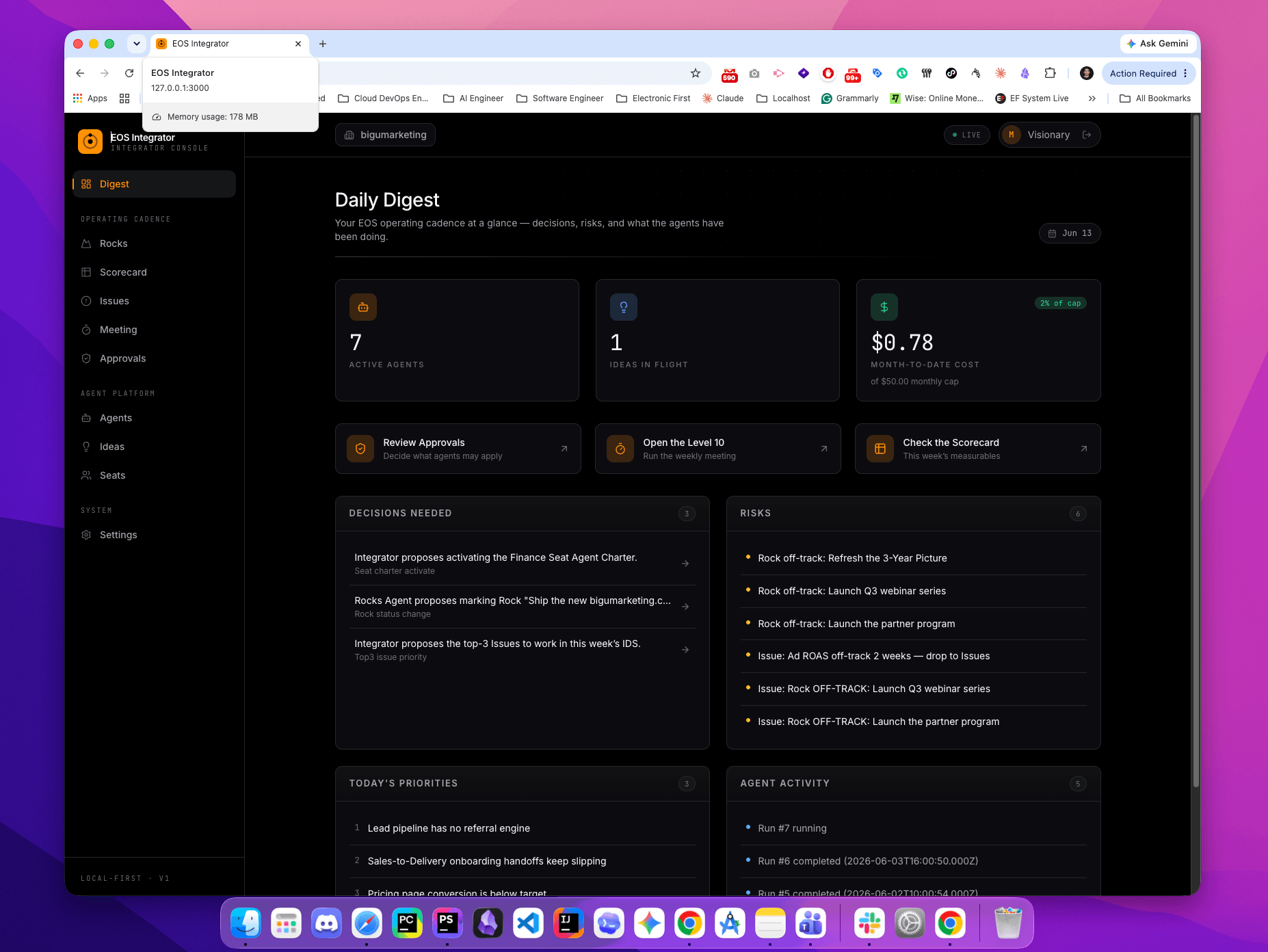
The gallery shows the local dashboard's daily digest, sign-in screen, approvals, agent console, ideas, meeting agenda, Rocks, seats, and settings. Figures displayed in these screenshots belong to the demonstration; they are not evidence of client revenue, productivity improvements, or deployment-scale performance. Review the source repository for implementation details and the documented phase boundaries.
Discuss a similar AI operations system
A useful starting scope is one repeatable workflow, the data it needs, the tools an agent may use, and the decisions a person must approve. Explore my AI systems services or contact me with that workflow to discuss an implementation suited to your business. You can also browse other portfolio projects.
Project Details

Enjoyed this project breakdown?
A coffee fuels more open-source work, tutorials, and detailed case studies like this one.
Like What You See?
Check out more projects or let's discuss how I can bring your vision to life with the same attention to detail.