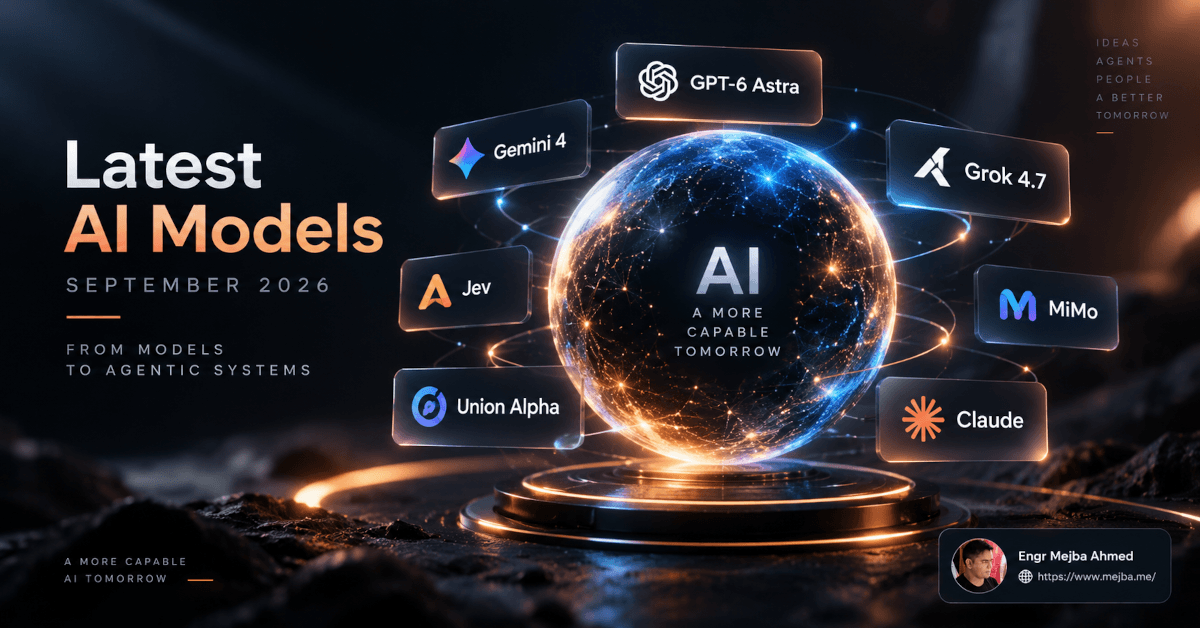
The most interesting AI developments in September 2026 are not simply about which company has the highest benchmark score.
The bigger change is architectural.
Frontier models are becoming better at using computers, operating tools, maintaining long contexts, executing multi-step workflows, generating structured artifacts, and coordinating agentic work. At the same time, a new class of specialized systems is emerging that does not try to compete with general-purpose language models at everything.
Some of the names circulating online, however, mix released products, unreleased checkpoints, community speculation, and outright naming confusion.
So before comparing the latest AI models in 2026, it is important to separate what is publicly available from what is still being tested.
What Is Actually Confirmed as of September 19, 2026?
Here is the clearest current picture:
| Model or System | Current Status | What Is Confirmed |
|---|---|---|
| GPT-6 Astra | Released | OpenAI's current flagship model |
| GPT-5.6 Sol | Released | Lower-cost OpenAI flagship-tier model |
| Gemini 4 | In development | Google has officially confirmed pre-training |
| "Gemini 4 Pro" checkpoint | Unconfirmed | Community reports suggest Arena testing, but Google has not announced it |
| Grok 4.7 | Not publicly released | xAI's current officially released flagship remains Grok 4.6 |
| Jev | Early access | TypeSafe AI's decision-focused System One model |
| Union Alpha | Public stealth preview | Free anonymous multimodal model on OpenRouter |
| MiMo-V2.6 | Training | Xiaomi is publicly streaming reinforcement-learning runs |
| Dream-RSI | Research | Framework for improving agent exploration policies without changing base-model weights |
This distinction matters because several impressive screenshots circulating online currently come from alleged checkpoints rather than documented public releases.
GPT-6 Astra Is OpenAI's Current Frontier Model
One of the biggest corrections to circulating AI discussions is the model name.
There is no official OpenAI model called "GBT6 Soul" or "GPT-6 Soul."
OpenAI's current frontier model is GPT-6 Astra, while GPT-5.6 Sol remains part of the previous generation and is still available for professional workloads. OpenAI's current API documentation positions GPT-6 Astra as its most capable model for complex reasoning, coding, computer use, research, and other end-to-end professional work.
GPT-6 Astra supports a 1.05 million-token context window, up to 128,000 output tokens, image input, function calling, web search, file search, computer use, code execution, MCP integration, and other agent-oriented tools. API pricing is currently listed at $10 per million input tokens and $50 per million output tokens.
This makes Astra interesting for a reason that goes beyond raw reasoning benchmarks: it is designed around completing workflows.
OpenAI describes capabilities such as computer operation, browser interaction, document generation, software engineering, research, and multi-step professional tasks as core parts of the model rather than optional add-ons.
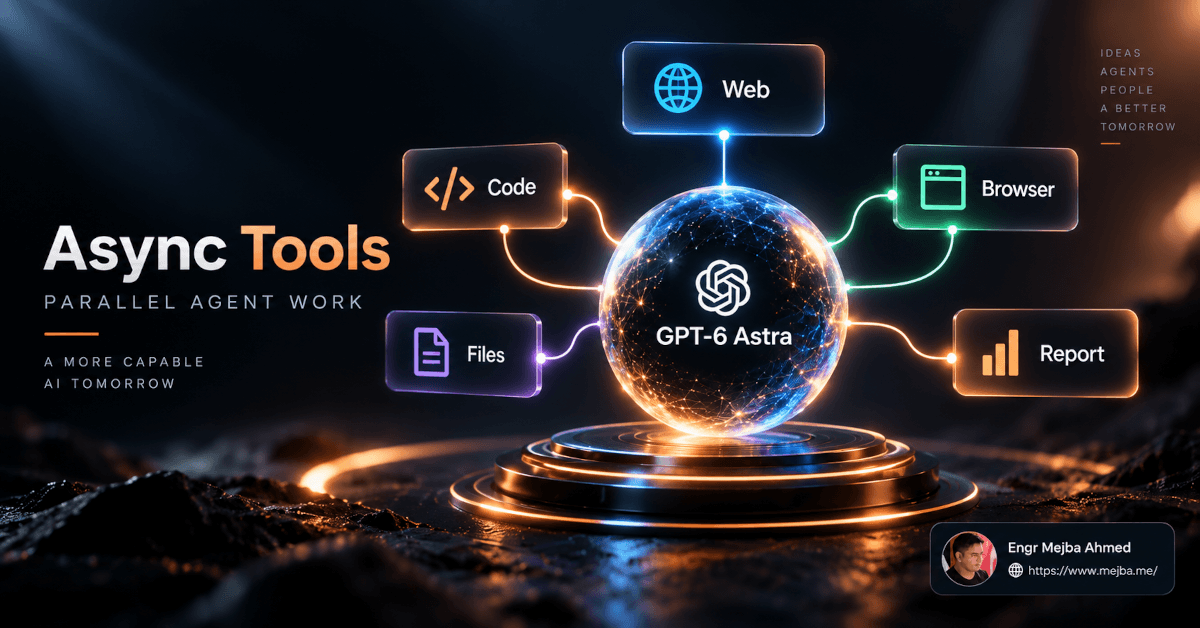
Async Tools Change How Agents Can Work

One particularly useful development is asynchronous tool calling.
Traditionally, an AI agent calls a tool, waits for that tool to finish, receives the result, and then continues reasoning.
GPT-6 Astra can instead continue reasoning or work on independent parts of a task while an asynchronous tool call is still running. OpenAI also supports mid-turn steering, allowing developers to send updated instructions while the model is working.
That matters for real production agents.
Consider a research system that needs to:
- search several databases;
- execute code;
- analyze uploaded files;
- browse multiple websites;
- generate a report.
Waiting sequentially for every operation wastes time. Asynchronous execution makes parallel agent workflows more practical.
GPT-5.6 Sol Still Matters
A new flagship does not automatically make the previous generation irrelevant.
GPT-5.6 Sol currently costs $4 per million input tokens and $20 per million output tokens, considerably below GPT-6 Astra's per-token pricing. Both models support context windows of approximately 1.05 million tokens in the API.
That creates a practical model-routing strategy.
Routine coding, content analysis, data processing, classification, and moderate reasoning workloads may not require the most expensive model available. Applications can reserve Astra for tasks where stronger reasoning, computer use, or complex multi-step execution materially improves the outcome.
This is increasingly how serious AI systems are being designed: not one model for every request, but a collection of models selected according to difficulty, latency, cost, and reliability.
Gemini 4 Is Real — but Gemini 4 Pro Is Not Yet an Official Release
Google has officially confirmed that Gemini 4 is under development.
During Alphabet's July 2026 earnings update, Google said it had started its most ambitious pre-training run yet for Gemini 4. Google made the same statement when introducing Gemini 3.6 Flash and other models.
That part is confirmed.
The current excitement around "Gemini 4 Pro," however, requires more caution.
During September, users reported encountering unusually capable Gemini checkpoints in model-evaluation environments. Some reports claim that a model appearing under a Gemini 3.8 Flash label is actually an early Gemini 4 Pro checkpoint.
The reported outputs include unusually detailed SVG illustrations, interfaces, vehicles, and other code-generated visual artifacts. Community posts have compared some of these outputs with GPT-6 Astra.
But Google has not officially confirmed that these Arena models are Gemini 4 Pro.
That makes the correct description:
There are promising reports of an unreleased Google checkpoint with unusually strong visual-code generation, but its identity as Gemini 4 Pro remains unverified.
This distinction is especially important for benchmark coverage.
A polished SVG screenshot is interesting evidence of a model's ability to translate spatial concepts into structured vector code. It is not enough to establish that one model is broadly superior in reasoning, coding, agentic work, or multimodal understanding.
Why the SVG Results Are Still Interesting
Even with that limitation, SVG generation provides a useful stress test.
Producing a complicated SVG involves coordinating:
- geometry;
- relative positioning;
- XML structure;
- paths and shapes;
- color relationships;
- spatial reasoning;
- visual hierarchy;
- code correctness.
A model that can reliably produce sophisticated vector graphics directly from code is doing more than simply generating an image.
The practical implications extend to frontend development, diagrams, data visualization, interactive interfaces, CAD-like workflows, and programmatic design systems.
So the reported Gemini checkpoint is worth watching—but not treating as a released product yet.
Grok 4.7 Is Coming, but Grok 4.6 Remains the Verified Model
Another model surrounded by premature claims is Grok 4.7.
xAI officially released Grok 4.6 on August 12, 2026. The company describes it as a model focused on long-running agents, coding, knowledge work, and visual and interactive projects. It offers a 500,000-token context window and configurable reasoning levels.
Grok 4.6 is also available through multiple enterprise platforms, including Amazon Bedrock, Microsoft Foundry, GitHub Copilot, and Google's Gemini Enterprise Agent Platform.
Grok 4.7 has been discussed publicly and is clearly attracting attention, but as of September 19, xAI's own news feed still identifies Grok 4.6 as its released flagship and contains no official Grok 4.7 launch announcement.
That means leaked benchmarks, parameter counts, context-window claims, and cloud references should not yet be treated as final specifications.
Until xAI publishes a model card, API identifier, pricing information, and official evaluation results, comparing Grok 4.7 directly against released models risks comparing production systems with pre-release speculation.
Jev May Be More Important Than Another Chatbot
TypeSafe AI's Jev is one of the more unusual AI releases this month because it is deliberately not trying to become another general-purpose chatbot.
TypeSafe describes Jev as its first System One Model: a model optimized for fast, structured decisions that software can consume directly.
Instead of asking:
"Write a detailed explanation of which department should handle this customer ticket."
an application could ask Jev to choose directly from:
sales
billing
technical_support
fraud
other
The output can include a typed decision and probability rather than a long natural-language response.
This changes the economics of certain AI workloads.
Where Decision Models Make Sense
Large generative models are excellent when the output itself needs to be generated: writing code, explaining a concept, creating documentation, conducting research, or communicating with a user.
But many software systems need AI for much narrower operations:
Should this transaction be reviewed?

Which tool should this agent call?

Which queue should receive this ticket?

Does this document match the policy?

Which product category applies?

Should the workflow continue automatically or escalate to a human?
Generating hundreds of tokens to answer those questions can be unnecessarily expensive.
Jev instead returns structured probabilistic decisions. TypeSafe says the architecture uses a training approach called Reinforcement Learning for Calibrated Decisions (RLCD).
TypeSafe currently advertises Jev at $42 per billion input tokens, or $0.042 per million.
The more important idea, however, is architectural rather than pricing-related.
Future AI applications may use a powerful frontier model for difficult reasoning while delegating thousands of small routing and classification decisions to specialized decision models.
That could produce systems that are faster and significantly cheaper than sending every operation through a frontier LLM.
Jev's probabilistic output also does not mean decisions are automatically correct. Confidence thresholds, human escalation, evaluation datasets, and production monitoring remain necessary.
Union Alpha Shows Why Stealth Models Need Careful Reporting
Union Alpha appeared on OpenRouter on September 16 as an anonymous stealth model.
The facts that can currently be verified are straightforward.
OpenRouter lists Union Alpha as a multimodal model supporting text and image input, text output, tool calling, structured responses, and a 262,144-token context window. It is currently available at no token cost during the stealth preview.
What cannot yet be stated confidently is who built it.
The provider remains anonymous.
Several community investigations have proposed that Union Alpha may actually be a routing or cascade system combining several models rather than one conventional monolithic model. One investigation subsequently corrected its original attribution and reported evidence pointing toward a multi-model routing architecture—but also acknowledged that the key source used to establish the model membership could no longer be independently verified.
For now, the responsible conclusion is therefore narrower:
Union Alpha is a real, publicly accessible stealth endpoint with a large context window and agentic capabilities. Its underlying architecture and developer identity remain unconfirmed.
That uncertainty is part of what makes stealth-model evaluation difficult.
Benchmark performance alone does not necessarily tell you whether you are evaluating a single foundation model, a fine-tuned model, a mixture-of-experts architecture, a routing system, or an agentic cascade.
Xiaomi Is Letting People Watch MiMo-V2.6 Train
Xiaomi's MiMo project is taking a very different approach to transparency.
The MiMo team is publicly streaming reinforcement-learning metrics for two unreleased models:
- MiMo-V2.6-Pro
- MiMo-V2.6-Flash
The public dashboard exposes training metrics from the runs while they are still underway. Reporting around the project says the team is exploring how far reinforcement learning can scale across compute, agent environments, harnesses, and grading systems.
This does not mean MiMo-V2.6 is currently available.
There is no finalized public model card, production API specification, confirmed pricing, or completed benchmark profile for V2.6 yet.
Xiaomi's existing documentation does, however, show how quickly the MiMo line has expanded. MiMo-V2.5-Pro, released earlier in 2026, uses a trillion-parameter architecture and supports a one-million-token context window.
The V2.6 experiment is worth watching not simply for the final benchmark scores, but because the training process itself is becoming part of the public product story.
Dream-RSI Shows a More Practical Form of Recursive Self-Improvement
"Recursive self-improvement" can easily become an exaggerated term.
Current research does not demonstrate an unconstrained AI system repeatedly redesigning itself into ever-more-intelligent successors without human infrastructure.
A more concrete development is Dream-RSI, a research framework involving researchers affiliated with Google, Google DeepMind, the University of Maryland, and the University of Virginia.
The important detail is that Dream-RSI does not continuously retrain the base model.
Instead, it improves the way an agent explores a problem.
The system records previous exploration as a discovery tree. That history becomes a replay environment in which alternative exploration policies can be evaluated cheaply. Better policies are then deployed into the real environment, creating additional history that can be used for another improvement cycle.
The loop looks roughly like this:
Explore
   ↓
Record discovery history
   ↓
Replay previous search paths
   ↓
Test alternative exploration policies
   ↓
Select a better policy
   ↓
Explore again
This is important because improvement happens in the agent scaffold and search policy, not necessarily in the neural-network weights.
That distinction could become increasingly relevant for coding agents, mathematical search systems, optimization agents, scientific discovery tools, and automated model-development workflows.
Claude Is Moving Toward Persistent and Parallel Agent Work
Claude's evolution also demonstrates that model capability is increasingly inseparable from workflow design.
Claude Projects itself is not a brand-new 2026 feature—it originally launched in 2024. Projects provide self-contained workspaces containing project knowledge, instructions, files, and multiple conversations. Anthropic notes that context is shared between chats through project knowledge rather than every conversation automatically sharing its entire history.
The newer development that more closely matches persistent parallel work is Claude Tag.
Anthropic introduced Claude Tag in June 2026 as a way for teams to delegate work to Claude from environments such as Slack. Anthropic says Claude Tag can work asynchronously, follow up on tasks, use connected tools, and allow teams to delegate work to multiple Claude instances in parallel.
This points toward a broader change in AI interfaces.
The classic pattern was:
User → Prompt → Model → Response
The emerging pattern looks more like:
User
  ↓
AI workspace
  ├── Research agent
  ├── Coding agent
  ├── Browser agent
  ├── Data agent
  └── Review agent
       ↓
Persistent tools, files, memory and applications
The model remains important, but the surrounding execution environment increasingly determines what the system can accomplish.
The Context-Window Race Is Becoming Less Interesting on Its Own
Large context windows remain useful.
GPT-6 Astra and GPT-5.6 Sol support approximately 1.05 million tokens through the OpenAI API, Union Alpha provides roughly 262K, Grok 4.6 provides 500K, and Xiaomi has already documented one-million-token context for MiMo-V2.5-Pro.
But maximum context size should no longer be treated as a proxy for intelligence.
What matters is how effectively a model can:
- retrieve relevant information;
- ignore irrelevant information;
- preserve instructions;
- reason across distant pieces of context;
- manage memory;
- use external tools;
- compress previous work;
- maintain consistency during long-running tasks.
A million-token window that causes poor retrieval or excessive inference cost may be less useful than a smaller system with better memory management and retrieval.
AI Development Is Moving From Models to Systems
The common thread connecting these developments is not simply "models are getting smarter."
The architecture of AI applications is changing.
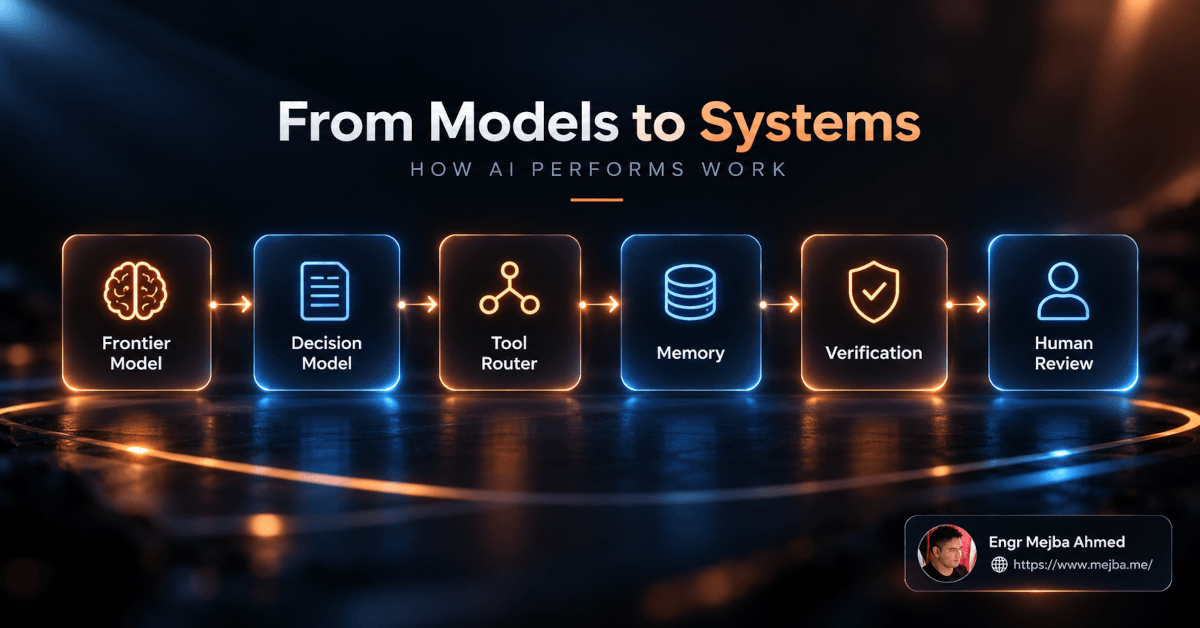
A modern production workflow may combine:
Frontier reasoning model
        ↓
Decision model
        ↓
Tool router
        ↓
Search / browser / APIs
        ↓
Specialized coding agent
        ↓
Persistent memory
        ↓
Verification model
        ↓
Human escalation when needed
GPT-6 Astra represents increasingly capable general-purpose agentic intelligence.
Jev represents specialized decision intelligence.
Dream-RSI represents improvement of an agent's exploration strategy.
Union Alpha raises the possibility—still unconfirmed in this specific case—that model routing itself can become a competitive architecture.
Claude Tag moves AI toward persistent asynchronous work.
MiMo-V2.6 demonstrates large-scale reinforcement learning becoming more visible during development.
And Gemini 4 shows that major labs continue to invest heavily in the underlying frontier models powering these systems.
What Developers Should Pay Attention to Next
For builders, the most useful question is no longer:
"Which AI model is number one?"
A better set of questions is:
- How reliably can the model complete my actual workflow?
- Can it use the tools my application requires?
- How much does a successful task cost rather than a single token?
- Does it maintain context across long-running work?
- Can cheaper models handle routine steps?
- Can decisions be parallelized?
- How easily can outputs be verified?
- What happens when confidence is low?
- Can humans intervene during execution?
- How well does the model work inside an agentic system rather than an isolated benchmark?
Those questions are increasingly more useful than comparing one headline benchmark.
The Most Important AI Trend of 2026
The most important shift in the latest AI models of 2026 is the movement from AI that produces responses toward AI that performs work.
That work may involve browsing, coding, operating software, making structured decisions, researching, generating artifacts, running tools, delegating subtasks, maintaining memory, or improving an agent's own search strategy.
The frontier is also becoming harder to summarize with a single leaderboard.
GPT-6 Astra is already publicly available.
Gemini 4 is officially being trained, while the impressive "Gemini 4 Pro" checkpoint reports remain unverified.
Grok 4.7 is anticipated but not yet a documented public release.
Jev challenges the assumption that every intelligent model needs to generate text.
Union Alpha demonstrates how quickly anonymous models can attract serious usage before their origins are even known.
Xiaomi is exposing parts of the reinforcement-learning process itself.
And self-improving agent research such as Dream-RSI suggests that some of the largest future gains may come from improving how models search, evaluate, remember, and coordinate—not only from scaling the foundation model underneath them.
For developers and businesses, that creates a practical opportunity.
The next generation of useful AI applications will probably not depend on selecting one model and sending everything to it. They will increasingly combine the right model, decision engine, tools, memory system, evaluator, and human controls for each part of the workflow.
That systems-level shift may ultimately matter more than whichever model temporarily sits at the top of a benchmark.