Nvidia NemoClaw: The Security Layer OpenClaw Needed
Jensen Huang called it the most important software Nvidia has ever released. Not CUDA. Not the drivers that launched a trillion-dollar GPU empire. Not the inference stack that powers half the AI industry.
A security wrapper for an open-source AI agent.
I almost scrolled past the announcement. Another corporate keynote, another bold claim about "the future of AI." But then I looked at what NemoClaw actually does — and more importantly, why Nvidia built it — and something clicked. This isn't just a product launch. This is Nvidia running the exact same playbook that turned them from a graphics card company into the backbone of modern AI. Except this time, the target isn't training clusters or data centers. It's the AI agent sitting on your desk.
I've been running OpenClaw agents for weeks now. I wrote about setting it up as a 24/7 AI agent and separately dug into the real security risks lurking under the surface. So when Nvidia dropped NemoClaw on March 16, 2026, I wasn't just watching from the sidelines. I had skin in the game. My agents were already running. The question was whether NemoClaw could fix the problems I'd been patching with duct tape and paranoia.
Here's what I found after pulling apart the architecture, reading the GitHub repos, and stress-testing the claims against what I know about Linux security internals.
Why OpenClaw's Success Created an Urgent Problem
The numbers are almost absurd. OpenClaw hit 250,000 GitHub stars in 60 days — faster than React accumulated in a decade. Twenty-seven million monthly visitors to the site. Over a million contributors shipping code every week. The growth curve looked less like a software project and more like a social media platform going viral.
But here's the thing nobody celebrating those numbers wanted to talk about: OpenClaw gave an autonomous AI agent full access to your file system, your network connections, your API keys, and your calendar. And it did this on purpose. That's the whole point — an agent that acts, not just chats.
I covered this tension in my deep dive on OpenClaw's security risks. The short version: 30,000 live instances sitting on the public internet with default ports and plaintext credentials. A critical vulnerability in January 2026 that let any malicious webpage hijack authentication tokens through a missing WebSocket origin check. A coordinated malware campaign that seeded the plugin marketplace with data-stealing extensions targeting crypto keys and agent credentials. Meta banned the tool internally.
The architecture was genuinely impressive. The security posture was genuinely terrifying.
And that gap — between "this is the most exciting AI tool in years" and "this is an enterprise liability waiting to happen" — is exactly where Nvidia saw its opening.
What NemoClaw Actually Is (Not What the Press Release Says)
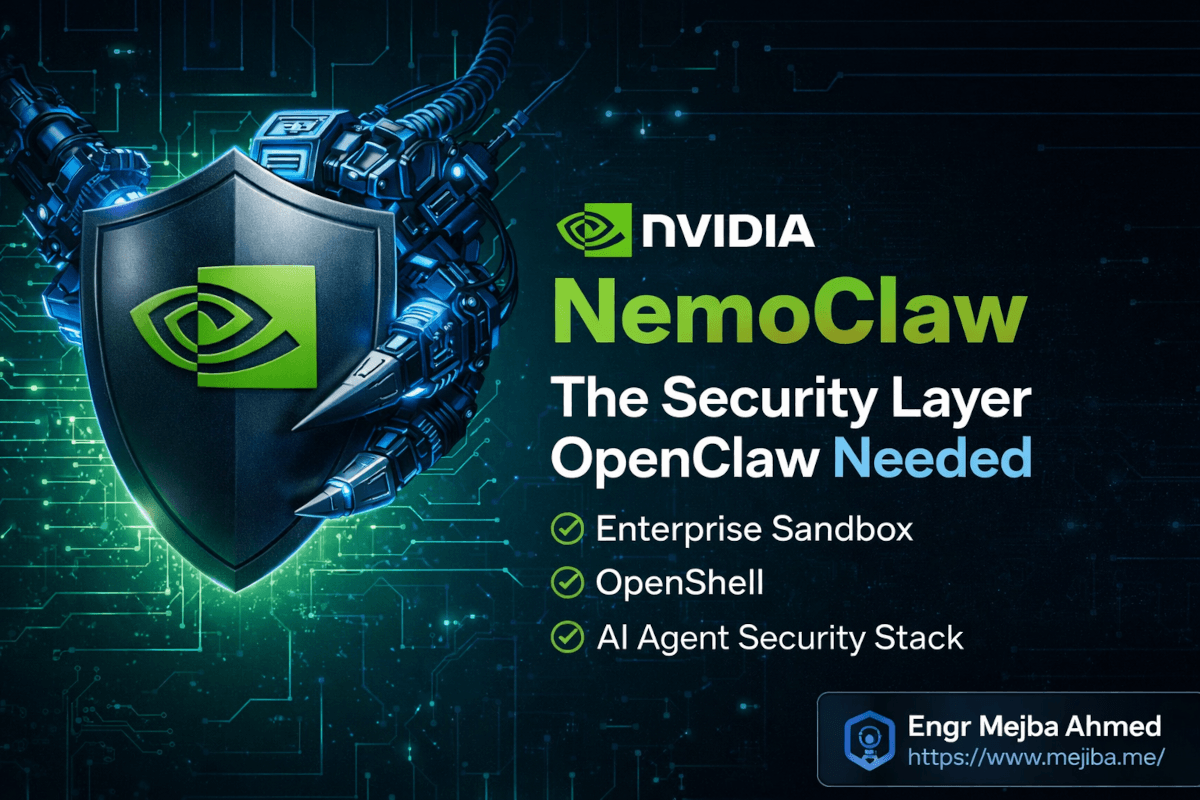
Strip away the marketing language and NemoClaw is three things packaged into one installable stack:
OpenShell — a kernel-level sandbox runtime that wraps around your OpenClaw agent and enforces security policies at the operating system level. Not through prompts. Not through application-level guards. At the OS level, using Linux security primitives that the agent literally cannot override.
Nemotron integration — Nvidia's own language models that run locally on your hardware, so sensitive data never leaves your machine.
Privacy Router — an intelligent traffic controller that decides which data gets processed locally and which can safely travel to cloud models.
One command installs the whole thing. That's the pitch, anyway. The reality is a bit more nuanced — you need Ubuntu 22.04 LTS or later, Docker, Node.js 20+, at least 8GB of RAM, and 20GB of free disk space for the sandbox image (roughly 2.4GB compressed). Not exactly a one-click affair if you're starting from a fresh machine. But if you're already running OpenClaw on Linux, the NemoClaw layer drops in cleanly.
The part that made me sit up and pay attention wasn't any single component. It was the design philosophy: security enforcement happens outside the agent's reach. The agent can't disable its own sandbox any more than a Docker container can modify the host kernel. That's a fundamentally different approach from the "add safety prompts to the system message" strategy that most AI security tools rely on — and that prompt injection attacks routinely bypass.
OpenShell: Where the Real Engineering Lives
I've spent enough time with Linux security to know that most "sandbox" products are marketing wrappers around basic containerization. OpenShell is something different. Not because it invented new security primitives — it didn't — but because it packages existing ones in a way that's specifically designed for AI agent behavior patterns.
Here's what OpenShell actually uses under the hood:
Landlock — a Linux security module that restricts filesystem access at the kernel level. When OpenShell creates a sandbox, it uses Landlock to define exactly which directories and files the agent can read and write. Not at the application level where a clever prompt injection could bypass it. At the kernel level, where the rules are baked in at sandbox creation and cannot be modified from inside.
seccomp — short for "secure computing mode." This filters which system calls the agent's process can make. Want to prevent the agent from spawning child processes, loading kernel modules, or escalating privileges? seccomp makes those operations physically impossible, not just discouraged.
Network namespaces — Linux's built-in network isolation. Each agent runs in its own network namespace, meaning it has no access to the host's network interfaces by default. OpenShell then punches specific, policy-defined holes for approved connections only.
None of these technologies are new. Landlock has been in the Linux kernel since version 5.13. seccomp has existed since 2005. Network namespaces have been around for over a decade. What OpenShell does — and this is the genuinely clever part — is compose them into a coherent security posture specifically calibrated for how AI agents behave.
Because AI agents aren't like normal applications. A web server makes predictable network requests. A database reads and writes to known paths. An AI agent? It might decide at runtime to browse a website, create a file in a new directory, call an API it's never called before, and execute code it just wrote. Traditional sandboxing rules that work for deterministic software break down when the software's behavior is fundamentally unpredictable.
OpenShell handles this through four policy domains that I think are worth understanding in detail.
The Four Policy Domains
File System Policies — You define which paths the agent can access, and the restrictions are locked at sandbox creation. The agent can read /home/user/projects/ but can't touch /etc/ or ~/.ssh/. Simple in concept, but the enforcement at the Landlock level means a compromised agent can't escape its filesystem boundaries even if an attacker gains code execution within the agent's process.
Network Policies — These control outbound connections. By default, the sandbox blocks everything. You whitelist specific domains and ports. The clever design choice here: network policies are hot-reloadable at runtime. You can tighten or loosen network access without restarting the agent. This matters for long-running agents where your policy needs might evolve over days or weeks.
Syscall Policies — seccomp filters that block dangerous system calls. Privilege escalation, kernel module loading, raw socket creation — all blocked at sandbox creation. Unlike network policies, these are immutable once the sandbox starts. There's no runtime override because there shouldn't be one.
Inference Routing Policies — This is the novel one. OpenShell controls where the agent's model API calls actually go. You can force all inference to stay local (using Nemotron models on your hardware), allow specific calls to route to cloud providers, or set up conditional routing based on data sensitivity classification. These policies are also hot-reloadable.
The split between locked policies (filesystem, syscall) and hot-reloadable ones (network, inference routing) tells you something about how Nvidia's security team thinks. Some boundaries should never change while an agent is running. Others need operational flexibility. That distinction is thoughtful.
If you want to apply this kind of thinking to your own agent deployments, I walked through practical containment strategies in my guide on securely onboarding AI agents — the NemoClaw approach formalizes many of the same principles I was implementing manually.
The Privacy Router: Smarter Than It Sounds
Most people hear "privacy router" and think "VPN" or "data anonymizer." NemoClaw's Privacy Router is something more interesting.
It sits between your agent and the outside world, making real-time decisions about where inference requests should go. The logic works like this: when your agent generates a prompt that includes sensitive data — customer names, financial figures, personal health information, whatever your policies define as sensitive — the Privacy Router intercepts the request and routes it to a local Nemotron model running on your own hardware. The data never leaves your machine.
When the prompt contains only non-sensitive information — generic coding questions, public data lookups, creative writing tasks — the router can send it to a more powerful cloud model for better results.
This is where the hardware play becomes obvious. Nvidia isn't just selling NemoClaw. They're selling the DGX Spark — a desktop AI supercomputer powered by the GB10 chip that can run models up to 200 billion parameters locally. Originally priced at $3,999, it recently jumped to $4,699 due to memory supply constraints (which tells you something about demand). The Privacy Router makes the DGX Spark the natural home for enterprise NemoClaw deployments. Your sensitive data stays on Nvidia hardware. Your non-sensitive requests flow to whatever cloud model you prefer.
It's a clean business model. Nvidia gives away the security software. The software works best on Nvidia hardware. Enterprises buy the hardware to run the software safely.
I've seen this movie before. It's called CUDA.
The CUDA Playbook, Agent Edition
Here's what most of the coverage about NemoClaw misses. This isn't primarily a security product. It's a platform play, and Nvidia is executing the same strategy that turned them into the most valuable company on Earth.
Step 1: Identify an emerging compute paradigm. In 2007, it was GPU-accelerated computing. In 2026, it's autonomous AI agents.
Step 2: Build the enabling software layer. CUDA made GPUs programmable for general-purpose computing. NemoClaw makes AI agents deployable in enterprise environments.
Step 3: Open-source it. Remove the barrier to adoption. Let developers build on your platform without licensing friction.
Step 4: Optimize it for your hardware. CUDA runs anywhere in theory. It runs best on Nvidia GPUs in practice. NemoClaw is hardware-agnostic in theory. It runs best on Nvidia's DGX Spark and DGX Station in practice — especially when the Privacy Router is sending sensitive inference to local Nemotron models on the GB10 chip.
Step 5: Build the ecosystem. CUDA has millions of developers. NemoClaw launched with integration partnerships from Adobe, Salesforce, SAP, CrowdStrike, Dell, Cisco, and Microsoft Security. That's not a product launch. That's an ecosystem birth.
The genius — and I don't use that word casually — is the model-agnostic positioning. NemoClaw works with any LLM. OpenAI models, Anthropic models, open-source models, Nvidia's own Nemotron. This matters because Nvidia faces zero conflicts of interest in the agent space. Google can't build a truly model-agnostic agent security platform because they're competing with OpenAI and Anthropic. OpenAI can't do it because they'd be incentivizing agents that use competitor models. Nvidia doesn't care which model you use. They care which hardware you run it on.
That neutrality is the moat. Not the sandbox technology. Not the security features. The fact that Nvidia is the only major player that can credibly secure every model without competing against any of them.
What the Security Integration Partners Actually Mean
Let me spend a minute on the partnership list because it's more significant than it appears.
CrowdStrike announced a "Secure-by-Design AI Blueprint" that embeds their Falcon platform directly into NemoClaw agent architectures. This means enterprises already paying for CrowdStrike get native threat detection inside their AI agent sandboxes. No additional security tool to buy. No custom integration to build.
Cisco AI Defense is building guardrails specifically for OpenShell — controlling and monitoring agent actions using Cisco's existing enterprise security infrastructure.
Microsoft Security is in the partnership group, which is notable given that Microsoft has its own competing agent ecosystem (Copilot). Their participation signals that even competitors recognize NemoClaw might become the default security layer.
For mid-sized companies without large platform engineering teams, this is the real value proposition. You don't need to build custom security infrastructure for your AI agents. You install NemoClaw, and it plugs into whatever security stack you already run. CrowdStrike customer? Done. Cisco shop? Done. Microsoft security ecosystem? Done.
That plug-and-play integration with existing enterprise security tools is what makes NemoClaw difficult to replicate. Any company can build a sandbox. Building a sandbox that works seamlessly with CrowdStrike, Cisco, Microsoft, Google Security, and TrendAI simultaneously? That takes the kind of ecosystem leverage that Nvidia has spent decades accumulating.
If you're running agents for business operations — the kind of autonomous workflows I described in my piece about how OpenClaw agents can replace entire employee functions — this integration layer is what moves agents from "interesting experiment" to "deployable in production."
What I'd Actually Deploy Today (And What I Wouldn't)
Here's where I put on my practitioner hat and tell you what I actually think about running NemoClaw in production.
What works right now:
The OpenShell sandbox is solid. The underlying Linux security primitives are battle-tested. The composition is thoughtful. If you're running OpenClaw agents on Linux and you want a significant security upgrade with minimal friction, NemoClaw delivers. The one-command install (once you meet the prerequisites) genuinely works, and the policy configuration is YAML-based and readable.
The policy domain split — locked vs. hot-reloadable — shows real operational thinking. Being able to adjust network policies without restarting a long-running agent is a practical feature, not a theoretical one.
What needs more time:
The Privacy Router is the weakest link right now. Data sensitivity classification is only as good as the policies you write, and most organizations haven't thought carefully about what counts as "sensitive" in the context of AI agent prompts. A customer name embedded in a code review comment — sensitive or not? A revenue figure discussed in a planning context — should that stay local? These are policy decisions that NemoClaw can enforce but can't make for you.
The Nemotron models that run locally are capable but not frontier-class. For most enterprise tasks, they're sufficient. For complex reasoning, multi-step coding, or nuanced creative work, you'll feel the gap compared to Claude Opus or GPT-5. The Privacy Router's value depends entirely on whether the local models are good enough for your sensitive workloads.
What I wouldn't do yet:
I wouldn't deploy NemoClaw in a regulated industry (healthcare, financial services, legal) without a thorough security audit by your own team. It's early alpha. Open source. The codebase is moving fast — over a thousand contributors shipping code every week. That pace of change is great for features and terrible for security auditing. The Landlock and seccomp foundations are solid, but the orchestration layer that ties them together is new code that hasn't been battle-tested under adversarial conditions.
I also wouldn't assume NemoClaw eliminates the need for your existing security practices. It's a layer, not a replacement. You still need network segmentation, credential rotation, monitoring, and incident response plans. NemoClaw makes agent deployment safer. It doesn't make it safe in an absolute sense. Nothing does.
The Honest Assessment: What NemoClaw Gets Right and Wrong
What it gets right:
The enforcement-at-the-OS-level approach is correct. Prompt-based safety is a speed bump. Kernel-level enforcement is a wall. NemoClaw chose the wall. This single architectural decision puts it ahead of every other AI agent security solution I've evaluated.
The model-agnostic positioning is strategically brilliant and practically useful. I shouldn't have to switch security tools when I switch models. NemoClaw agrees.
The ecosystem integration play is the real competitive advantage. Building a sandbox is table stakes. Building a sandbox that Fortune 500 security teams can plug into their existing CrowdStrike or Cisco infrastructure without custom work? That's the moat.
What it gets wrong — or at least, what it hasn't solved yet:
Plugin security is still an open problem. NemoClaw can sandbox the agent, but it can't guarantee that a community-built plugin doesn't contain malicious code. The sandbox limits the blast radius, but a compromised plugin running inside the sandbox still has access to whatever the policy allows. If your policy grants access to /home/user/documents/ and a malicious plugin runs inside that sandbox, your documents are exposed.
The Linux-only requirement is a real limitation. Most developers work on macOS. Most enterprise deployments run on Linux servers. There's a gap in the middle — developer experience and testing — where NemoClaw doesn't have an answer yet. You can run it in Docker on macOS, but that adds a layer of abstraction that complicates debugging.
The DGX Spark dependency for optimal Privacy Router usage creates a $4,699 entry barrier. That's reasonable for enterprise. It's steep for individual developers and small teams who want the full security story. Nvidia would benefit from publishing performance benchmarks for NemoClaw running on standard Linux hardware without the GB10 chip, so developers can make informed decisions about whether the Spark is worth it for their use case.
Where This Is Actually Heading
I've been watching Nvidia's platform plays for years. CUDA didn't become the default GPU programming framework overnight. It took five years of steady investment, developer advocacy, and ecosystem building. But once it crossed the adoption threshold, it became nearly impossible to dislodge.
NemoClaw is at the beginning of that curve. Early alpha. Rough edges. Limited platform support. But the strategic positioning is clear: Nvidia wants NemoClaw to be for AI agents what Kubernetes became for containers. The default orchestration and security layer that everyone uses because the alternatives require too much custom work.
The pieces are already in place. The launch partners (Adobe, Salesforce, SAP, CrowdStrike, Dell) provide instant enterprise credibility. The open-source model removes licensing friction. The DGX Spark hardware creates a natural revenue path. The model-agnostic approach prevents the ecosystem fragmentation that killed previous attempts at agent standardization.
Will it work? I think the odds are better than most people realize. The AI agent space is where containers were in 2014 — explosively popular, wildly insecure, and desperately in need of a standardization layer. Docker solved packaging. Kubernetes solved orchestration. NemoClaw is trying to solve agent security. And Nvidia has something Docker and Google never had: neutrality across the entire model ecosystem combined with hardware leverage that makes the solution work better on their silicon.
The question isn't whether AI agents need a security standard. They obviously do. The question is whether Nvidia moves fast enough to establish NemoClaw before the hyperscalers build their own walled-garden alternatives. Based on the partnership list and the adoption velocity, I'd bet on Nvidia.
But I've been wrong before. And I've learned the hard way that betting on any single technology in the AI space is a good way to look foolish six months later. So here's what I'm actually doing: I'm running NemoClaw on my OpenClaw instances today, writing strict policies, and treating it as the best available option while keeping my eyes open for what comes next.
That's the only honest position. The technology is promising. The strategy is sound. The execution is early. And the AI agent security problem is too important to wait for perfection.
If you're running OpenClaw agents right now — and given those 250,000 GitHub stars, many of you are — NemoClaw is worth your Saturday afternoon. Install it. Write policies. Test the boundaries. Break something in a controlled environment. Because the alternative is running an autonomous AI agent with access to your files, your network, and your credentials, with nothing between you and catastrophe except a system prompt and hope.
I know which option I'm choosing.
FAQ
Frequently Asked Questions
Everything you need to know about this topic
NemoClaw is Nvidia's open-source security stack that wraps OpenClaw agents in OS-level sandboxing using OpenShell, a Privacy Router for data flow control, and local Nemotron model integration. It enforces file, network, syscall, and inference routing policies at the Linux kernel level using Landlock, seccomp, and network namespaces — making them impossible for the agent to override.
NemoClaw is fully model-agnostic. It supports OpenAI, Anthropic, open-source models, and Nvidia's own Nemotron family. The Privacy Router can direct sensitive queries to local Nemotron models while routing non-sensitive requests to any cloud provider. For a deeper look at running multiple models, see my OpenClaw setup guide.
Minimum requirements are Ubuntu 22.04 LTS, Docker, Node.js 20+, 8GB RAM, and 20GB free disk space. NemoClaw runs on any Linux hardware, but the full Privacy Router experience — with local inference on 200-billion-parameter models — requires Nvidia's DGX Spark ($4,699) or equivalent GB10-powered hardware.
NemoClaw is in early alpha as of March 2026. The underlying security primitives (Landlock, seccomp, network namespaces) are battle-tested Linux technologies, but the orchestration layer is new. For regulated industries like healthcare or finance, conduct an independent security audit before production deployment.
Docker provides container-level isolation but doesn't enforce AI-agent-specific policies like inference routing, fine-grained file path restrictions, or hot-reloadable network rules. NemoClaw's OpenShell adds four targeted policy domains designed specifically for autonomous agent behavior — plus native integration with enterprise security tools like CrowdStrike Falcon and Cisco AI Defense.
Let's Work Together
Looking to build AI systems, automate workflows, or scale your tech infrastructure? I'd love to help.
- Fiverr (custom builds & integrations): fiverr.com/s/EgxYmWD
- Portfolio: mejba.me
- Ramlit Limited (enterprise solutions): ramlit.com
- ColorPark (design & branding): colorpark.io
- xCyberSecurity (security services): xcybersecurity.io