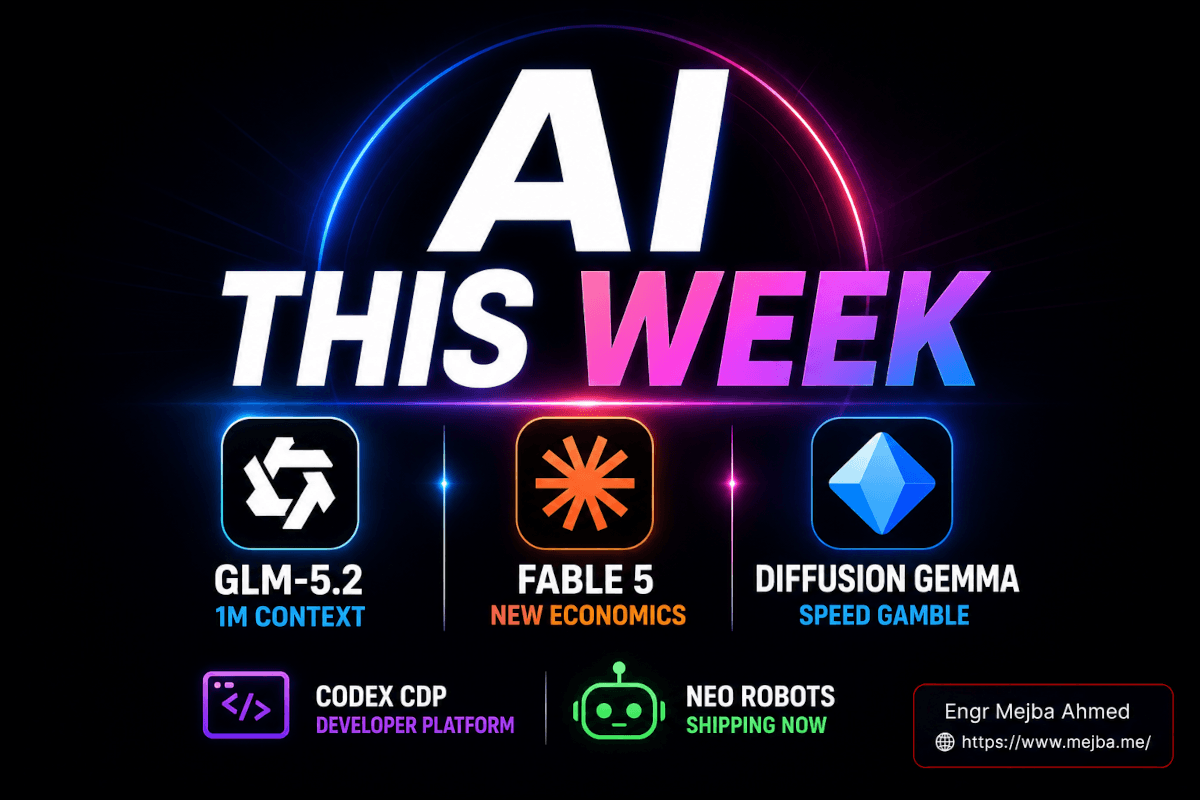
AI This Week: GLM-5.2, Fable 5, Diffusion Gemma
Three things landed in my inbox within about 72 hours, and each one quietly broke an assumption I'd been carrying for months.
A Chinese lab shipped a one-million-token context window with the weights coming under an MIT license. Google released a language model that doesn't generate text one token at a time. And a humanoid robot factory in California stopped being a render and started being a building with 200 people in it. Any one of those would headline a normal week. This AI weekly roundup is my attempt to make sense of all of them at once — not as a press-release relay, but as a working engineer sorting out which of these actually changes my Monday and which is noise dressed up as signal.
I'll be straight with you about what I tested versus what I read. Some of this week's releases I could put hands on. Some of them — like GLM-5.2's open weights — literally aren't downloadable yet as I write this. I'll flag which is which every time, because the fastest way to lose your trust is to pretend I benchmarked something I only read the spec sheet for. Let's go through the week the way I actually processed it: in order of how much it shifted my thinking.
GLM-5.2 and the 1M Context Window Nobody Saw Coming
Start with the one that made me re-read the announcement twice.
On June 13, 2026, Z.ai (the Zhipu AI spinout) announced GLM-5.2 with a one-million-token usable context window — a 5x jump over GLM-5.1's 200K. The word "usable" is doing real work in that sentence, and I'll come back to why. The model went live immediately for GLM Coding Plan users, with API access, a chatbot, and MIT-licensed open weights all promised for "next week."
Sit with the license for a second. MIT. Not a custom community license with a revenue clause. Not "open weights, restricted commercial use." MIT — the same permissive license your favorite npm package ships under. A frontier-adjacent model with a million-token window, free to download, modify, and deploy commercially, with the lab eating the training cost. That arrangement didn't exist in open source eighteen months ago. It barely existed eighteen days ago.
Here's why the context window specifically matters, and why I'm cautious about the headline number at the same time. Most "long context" claims are a magic trick. The model accepts a huge input but stops genuinely attending to the middle of it — you paste 400 pages, ask about page 230, and it answers based on page 12 with total confidence. I covered this exact failure mode in my first look at MiniMax M3, which also claims a 1M window. The interesting thing about GLM-5.2's framing is that Z.ai is explicitly claiming retention across the full window, not just acceptance — and they say they trained it with a new asynchronous agent reinforcement-learning algorithm across more than 10,000 verifiable environments in nine programming languages.
That training detail is the part I actually believe will hold up, more than any single benchmark. Long-horizon agent work — the kind where the model runs for an hour, makes a hundred tool calls, and has to remember what it decided in step 4 by the time it reaches step 90 — lives and dies on context retention. If GLM-5.2 genuinely holds comprehension across the window, that's the unlock, not the raw token count.
The demos circulating this week leaned on web development and, of all things, a Minecraft clone with infinite terrain generation from a single prompt. I'll admit infinite-terrain demos make me skeptical by reflex — they're visually impressive and easy to cherry-pick. But the procedural-generation logic in a working voxel sandbox is a genuinely hard agentic coding task: state management, chunk loading, coordinate math that has to stay consistent. It's not nothing.
What I'm withholding judgment on until the weights drop: real multimodality (there's no native vision at launch), and how the two "thinking intensity" settings behave under load. Two reasoning-depth levels is a smart product decision — most of my prompts don't need deep reasoning, and paying the latency tax on all of them is wasteful — but I want to see whether the lighter setting stays coherent or just gets fast and sloppy.
Here's the open loop I'll resolve later in this roundup: GLM-5.2 going MIT is one of three moves this week that all point at the same shift in who controls frontier capability. Hold that thought.
Claude Fable 5: The Benchmark Is a Tie, the Bill Isn't
This is the one I have the most actual hands-on time with, because I've been living in Fable 5 for coding work since it launched.
If you've read my build log on autonomous video production with Fable 5 or my Clay connector outreach build, you already know I think it's the strongest agentic coding model I've used. This week the benchmark numbers caught up to that gut feeling, and one comparison in particular is worth staring at.
On SWE-bench Pro — Anthropic's harder agentic-coding benchmark, not the friendlier Verified set — Fable 5 posts 80.3%, the top score of any model tested, ahead of Opus 4.8's 69.2%. On SWE-bench Verified it hits 95.0%. Those are real, independently reported numbers, not Anthropic's marketing deck.
But the framing from the source that kicked off this roundup is what I keep coming back to. On a deep software-engineering benchmark for genuinely complex tasks, Fable 5 lands roughly even with the top GPT-5.5-class model — same success rate — at a wildly different cost per task. We're talking the difference between roughly ten dollars and several hundred dollars to resolve the same task. Even if you treat the exact dollar figures as approximate (per-task cost swings with token usage, so I won't hang my hat on a precise number), the order-of-magnitude gap is the story.
Let me translate that into a decision you'll actually face. When two models tie on capability, the entire choice collapses to economics and ergonomics. Fable 5 is priced at $10 per million input tokens and $50 per million output — double Opus 4.8's $5/$25, and not cheap in absolute terms. So this isn't "Fable 5 is the budget option." It's subtler: on the hardest tasks, where a failed autonomous run wastes more money in burned tokens than the price delta, the more capable model is the cheaper one. A model that one-shots your overnight refactor at $10 beats a model that needs three $4 attempts and still hands you something broken.
That's the mental model I want you to leave this section with: on frontier-difficulty work, capability is a cost-control feature. Failed runs are the real expense, and they're invisible until you tally a month of them.
If you're trying to pick a coding model right now, here's the compact version: use the cheaper model for routine edits where a retry costs nothing, and reserve Fable 5 for large refactors, overnight autonomous runs, and frontier-difficulty bugs where a wrong answer cascades. The price-per-token comparison is a trap; the price-per-completed-task comparison is the truth.
One more update worth flagging, because it's a values decision disguised as a feature. Fable 5 got an update that makes its safeguards visible — when the model declines or falls back on a request, you now see the fallback event instead of getting silent, mysterious behavior. I genuinely like this. The number of hours I've lost to "why did the model suddenly get worse at this" only to discover an invisible guardrail kicked in… transparency there is a real quality-of-life win. The honest trade-off: visible safeguards probably mean more visible false positives. You'll see it decline things it didn't need to. I'd rather see the false positive than debug a ghost. Your tolerance may differ, and that's a legitimate disagreement.
If you'd rather have someone build out an agentic coding workflow around models like this rather than tune it yourself, that's the kind of integration work I take on — you can see what I've shipped at fiverr.com/s/EgxYmWD.
DiffusionGemma: Google Built a Model That Doesn't Write Left to Right
Now the architecturally weird one, which I find more interesting than anything else this week even though I can't fully run it yet.
On June 10, 2026, Google DeepMind released DiffusionGemma under Apache 2.0, with weights on Hugging Face. The reason it matters has nothing to do with benchmarks and everything to do with how it generates text. Every GPT-style model you've used writes one token at a time, left to right, each token conditioned on the last. DiffusionGemma doesn't. It uses discrete diffusion — denoising blocks of 256 tokens in parallel, the same family of technique that powers image generators, applied to language.
Why does diffusion-based text generation matter?
Diffusion-based text generation produces multiple tokens simultaneously instead of one at a time, which is why DiffusionGemma can hit speeds an autoregressive model structurally can't reach. Google reports over 1,000 tokens per second on a single Nvidia H100 — up to 4x faster than comparable autoregressive models — and 700+ tokens per second on a consumer RTX 5090. The model is a 26B mixture-of-experts that activates only 3.8B parameters at inference, so it quantizes down to fit inside an 18GB VRAM budget.
Read that last sentence again, because it's the part that should make you sit up: a model this fast, running on a card a serious hobbyist can actually own.
Here's where I have to be honest rather than hype it. I have not gotten DiffusionGemma running locally, and the reason is instructive: the custom drafter module it needs for local inference doesn't exist in any public runtime yet. Not in mlx-lm, not in LM Studio. As of this week it's effectively unrunnable on most consumer setups despite the weights being public. So when you see breathless "run a 1000 tok/s model on your gaming PC tonight" posts, that's aspirational, not actual. I expect the runtime support to land — there's too much demand for it not to — but today the speed is a spec, not an experience I can verify for you.
And there's a real cost to the speed, baked into the architecture. Diffusion text generation trades accuracy for throughput. DiffusionGemma hallucinates more than standard Gemma 4. Google's own positioning is refreshingly blunt about this: use it for speed-critical, non-factual tasks — code editing, text reformatting, bulk transformation — and don't use it where factual precision matters. I respect a launch that tells you what its model is bad at. If you run local models, you already know this calculus from setting up tools like Gemma 4 in LM Studio — picking the right model for the right job beats chasing one model that does everything mediocrely.
My honest take: DiffusionGemma is the most important architectural release of the week and the least immediately useful product of the week, simultaneously. It's a research statement that the autoregressive monopoly on language generation has a crack in it. The first time a diffusion language model is both fast and accurate enough for general use, the whole inference-cost conversation resets. That day isn't today. But it's now visibly on the calendar.
OpenAI Codex Got a Debugging Superpower (and a Loyalty Program)
Two Codex updates this week, and they're aimed at completely different parts of your brain — one technical, one behavioral.
The technical one I'm genuinely excited about. Codex added a developer mode that gives it controlled Chrome DevTools Protocol (CDP) access. In plain terms: Codex can now reach into a live Chrome session and read network traffic, console output, runtime errors, DOM state, and applied styles — the exact things you'd inspect by hand when a front-end bug refuses to make sense. It's off by default (Settings → Browser → "Enable full CDP access" under Developer mode), which is the correct default for something this powerful.
Why this is a bigger deal than it sounds: front-end debugging has been the soft underbelly of AI coding agents. A model can write a React component beautifully and then be useless at figuring out why it renders blank in the browser, because the failure lives in runtime state the model can't see. CDP access closes that loop. The agent can now observe the symptom — the actual console error, the actual failed network request — instead of guessing from source code alone. That's the difference between an agent that writes code and an agent that debugs it.
The behavioral update is craftier. OpenAI rolled out rate-limit reset banking: Plus and Pro users get resets they can stockpile and spend whenever they want (banked resets last 30 days), plus a referral program — invite up to three friends between June 11 and June 24, and when a friend sends their first Codex message, you both get a banked reset.
I'll say the quiet part out loud, because pretending not to notice it would be dishonest. The referral mechanic is ecosystem stickiness engineering. Banked resets are a smart, genuinely user-friendly feature — control over when you burn your capacity is real value, especially if you batch heavy work. But layering a friend-referral loyalty loop on top of a developer tool is a retention play borrowed straight from consumer apps. It's not bad. It's just worth seeing clearly: the model labs are now competing on switching costs, not only on capability. The CDP debugging is the moat; the referral program is the fence.
Two Updates That Quietly Change How Agents Operate
A pattern I keep noticing in 2026: the most consequential changes aren't new models, they're new permission structures around the models. Two this week.
First, autonomous coding got safer-by-default. Claude Code's auto mode and Cursor's auto-review classifier are converging on the same design: pre-approve the safe actions, gate the risky ones. Instead of either babysitting every command or YOLO-approving everything, the tooling now triages — read a file, run a test, format code? Go ahead. Delete a directory, hit a production endpoint, rewrite a migration? Stop and ask. I've written before about why going agent-native in 2026 is mostly about getting this exact gradient right. An agent you have to approve constantly isn't autonomous; an agent you can't stop is dangerous. The classifier layer is the compromise, and it's maturing fast.
Second — and this is the unsexy infrastructure story that I think will matter most in a year — AI agent authentication is becoming a real product category. Descope shipped Agentic Identity Hub 2.5 this week (the 2.0 release was back in January), and it's solving a problem most people building agents haven't hit yet but absolutely will: how does an autonomous agent prove who it is and what it's allowed to do, without you handing it a human's credentials?
That last bit is the crux. Right now, a depressing number of agent setups work by giving the agent a human's API token and hoping for the best. That's a security disaster waiting to happen — no scoping, no audit trail, no way to revoke just the agent's access. Descope's pitch is agents as first-class identities: OAuth 2.1, tool-level scopes, policy enforcement on which MCP servers an agent can touch, and human-in-the-loop approval flows for sensitive actions. Magic links and one-time-password flows give you fine-grained control over what an agent can do on a user's behalf.
I won't pretend I've deployed it in production. But I've felt the absence of exactly this. Every time I've wired an agent into a system with real permissions, the auth story has been the part I hacked together and felt bad about. A purpose-built control plane for non-human identity is the kind of boring, load-bearing infrastructure that agentic AI has been missing — and it's a topic that sits squarely at the intersection of AI and security, which is exactly the kind of work my colleagues at xCyberSecurity handle for teams deploying agents against sensitive data.
The Two Frontier Bets: Interaction Models and Humanoid Robots at Scale
Now zoom out, because two developments this week aren't about this quarter — they're about where the whole thing is heading.
The first is Thinking Machines Lab's interaction models. Mira Murati's lab (she's the former OpenAI CTO) put out a research preview of TML-Interaction-Small, and the architecture is a genuine departure from the chatbot pattern we've all internalized. Instead of the request-response loop — you talk, it waits, it responds — the model processes audio, video, and text in 200-millisecond micro-turns, continuously, the way two people actually collaborate. It can speak while you're speaking, react to what it sees before you finish a sentence, and call tools mid-conversation.
The clever structural bit: it splits into two models that share full context. A fast interaction model stays live with you for instant responses, while a background model handles the slow, deep reasoning and tool use asynchronously. That's a real architectural answer to the central tension in conversational AI — you want both snappiness and depth, and those usually trade off against each other. It's a 276B-parameter mixture-of-experts with 12B active, and it's in limited research preview with no public API yet, so temper expectations. But the idea — collaboration instead of query-response — is the most interesting reframe of human-AI interaction I've seen this year.
The second is concrete in the most literal sense. 1X Technologies began mass production of its Neo humanoid robot at a 58,000-square-foot factory in Hayward, California. The facility currently employs 200+ people and has capacity for 10,000 robots a year, scaling toward 100,000+ units by 2027. The first-year run reportedly sold out within days. These aren't only factory-floor logistics bots, either — Neo is positioned heavily as a home robot, with customer shipments planned for 2026.
I have complicated feelings here, and I'll share them honestly rather than cheerleading. The transition from a demo on a stage to a vertically integrated factory — 1X builds its own motors, batteries, sensors, and transmissions in-house — is the single hardest leap in robotics, and most companies never make it. That part deserves real respect. The skeptic in me also remembers that "shipping" and "useful in your kitchen" are very different milestones, and humanoid robotics has a long history of dazzling demos that fold under the messiness of real environments. But a factory with a 10,000-unit annual line is not a render. Something is actually being built. We'll find out in 2026 whether what ships is a genuine helper or a very expensive proof of concept.
What This Week Actually Means (the Open Loop, Resolved)
Remember the thread I asked you to hold near the top — that GLM-5.2 going MIT was one of three moves all pointing the same direction? Here's the resolution.
Look at the pattern across the whole week. GLM-5.2 putting a 1M-context frontier model under MIT. DiffusionGemma handing out a genuinely novel architecture under Apache 2.0. Even Descope building open standards (OAuth 2.1, MCP) for agent identity. The center of gravity in AI is sliding from renting closed intelligence toward owning and controlling open intelligence. Not completely — the absolute frontier still lives in closed labs, and Fable 5's benchmark dominance proves the proprietary leaders aren't standing still. But the gap between "the best closed model" and "the best model you can actually download and own" is the narrowest it has ever been.
That changes the question you should be asking. Eighteen months ago the question was "which API do I rent?" Increasingly, the real question is "which capabilities do I need to own — for cost, for privacy, for control — and which can I keep renting?" The teams that get rich answering that question correctly will be the ones who stopped treating open and closed as a loyalty test and started treating it as a portfolio decision.
So here's your one concrete action for this week. Pick the single AI dependency in your stack that would hurt the most if its price tripled or its terms changed overnight. Just one. Then go find the closest open-weight model that could replace it — GLM-5.2 when the weights drop, or whatever fits your task — and spend an afternoon actually testing it on your real workload, not a toy prompt. You don't have to migrate. You just need to know the door exists before someone else closes it for you. That's the difference, this year, between being a renter and being an owner.
FAQ
Frequently Asked Questions
Everything you need to know about this topic
GLM-5.2 has a one-million-token usable context window, a 5x increase over GLM-5.1's 200K. Z.ai claims the model retains comprehension across the full window rather than just accepting the input, and MIT-licensed open weights are scheduled to release shortly after the June 13, 2026 announcement.
Claude Fable 5 is worth it for frontier-difficulty tasks where a failed run wastes more in burned tokens than the price premium. It tops SWE-bench Pro at 80.3% and ties top GPT-5.5-class models on hard benchmarks at a fraction of the per-task cost. For routine edits, a cheaper model is usually the smarter pick. See the Fable 5 section above for the full breakdown.
DiffusionGemma generates text using discrete diffusion — denoising 256-token blocks in parallel — instead of one token at a time, reaching over 1,000 tokens per second versus standard autoregressive models. The trade-off is higher hallucination rates, so Google recommends it only for speed-critical, non-factual tasks like code editing and text formatting.
DiffusionGemma is designed to fit in 18GB of VRAM and reportedly hits 700+ tokens per second on an RTX 5090, but as of June 2026 the custom drafter module it needs for local inference isn't supported in any public runtime like LM Studio or mlx-lm, making it effectively unrunnable on most consumer setups today.
1X Technologies began mass production at its Hayward, California factory with customer shipments planned for 2026. The facility can produce 10,000 units annually, scaling toward 100,000+ by 2027, and the first production run reportedly sold out within days of launch.
Let's Work Together
Looking to build AI systems, automate workflows, or scale your tech infrastructure? I'd love to help.
- Fiverr (custom builds & integrations): fiverr.com/s/EgxYmWD
- Portfolio: mejba.me
- Ramlit Limited (enterprise solutions): ramlit.com
- ColorPark (design & branding): colorpark.io
- xCyberSecurity (security services): xcybersecurity.io