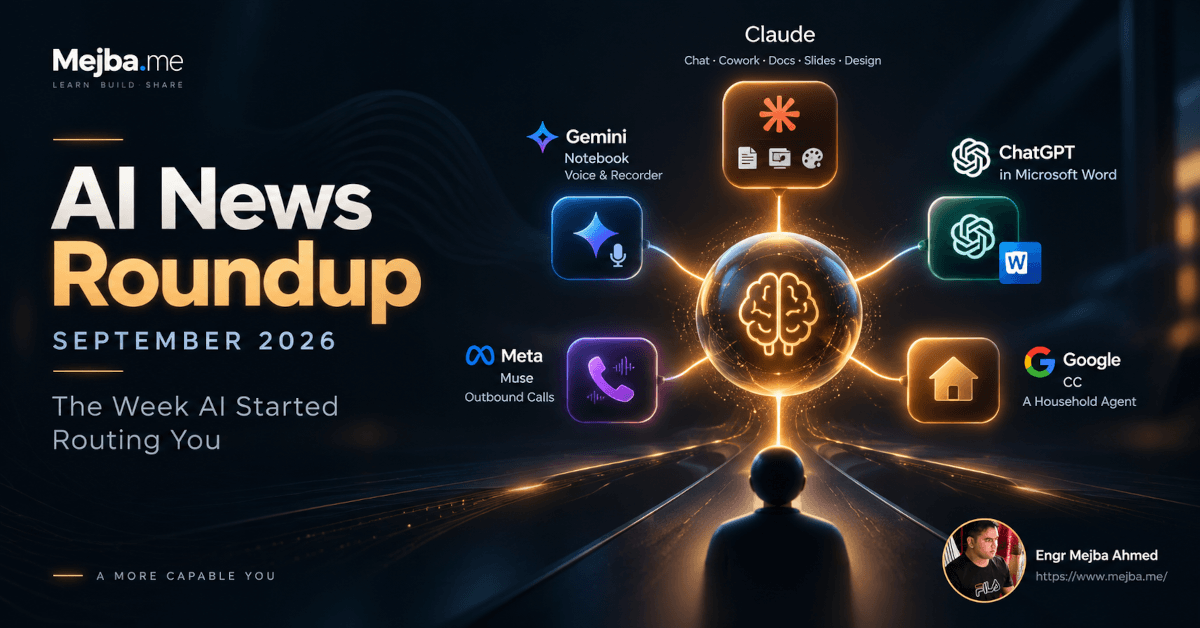
Between September 8 and September 19, 2026, nine products shipped updates that share one mechanic: each one takes a decision you used to make and makes it for you. Anthropic merged Claude chat and Cowork so you stop picking a tab. Google gave a family agent its own Google account so it can sort six people's mail. OpenAI put ChatGPT inside Word and will switch it on by default October 1. Meta's Muse started placing outbound phone calls. That's the through-line of this AI news roundup September 2026 edition — not capability, delegation.
Two weeks ago the story was different. The August 21 roundup was about read permissions — what these tools were newly allowed to see. This fortnight is about what they're newly allowed to decide. Related, but not the same question, and the second one is harder to audit because the evidence disappears. A permission you granted sits in a settings screen. A routing decision made on your behalf leaves nothing behind.
Let me draw the line between what I've run and what I've read, because that line is doing real work in this piece. I run Claude Cowork daily across mejba.me, Ramlit, ColorPark, and xCyberSecurity — that's been my publishing spine for months. The unified Claude interface has not reached my account yet; Anthropic is staging it to Pro and Max over several weeks, and I'm not going to pretend I've used something I'm still waiting on. Everything below traces to a dated first-party announcement or the primary documentation, and where something is a promo, a preview, or a third-party claim, I say so in the sentence rather than in a footnote.
AI News Roundup September 2026: What Shipped Between September 8 and 19
The whole fortnight on one screen. The right column is the one I care about.
| Date | Who | What shipped | The decision it removes |
|---|---|---|---|
| Sep 8 | Meta | Muse personal agent launches, $20 / $100 tiers | Which assistant app you open |
| Sep 10 | Flow arrives on iOS with camera-roll access | Which device you create on | |
| Sep 11 | OpenAI | ChatGPT Sites: co-editing, private invites, custom domains | Where a built site lives |
| Sep 15 | Gemini Notebook: real-time voice, recorder, Learning Overviews | Whether you type or talk | |
| Sep 15 | Gemini 3.8 Live + Live Extended Thinking | When an agent stops to think | |
| Sep 16 | Anthropic | Claude chat + Cowork + Artifacts + Design unified | Which tab runs your task |
| Sep 17 | CC becomes a six-person household agent with its own account | Who reads the school email | |
| Sep 17 | OpenAI | ChatGPT for Word ships; Excel (May) and PowerPoint (July) already live | Which model drafts your doc |
| Sep 17 | Meta | Muse enables outbound calls to U.S. businesses | Who talks to the cable company |
| Sep 17–18 | xAI | Grok Bot voice rolls out to desktop and mobile | Whether you read or listen |
Ten rows. Nine of them delete a choice. Read the right column top to bottom and the week stops looking like ten unrelated press releases and starts looking like a single product decision made ten times by five companies who don't coordinate.
Here's why that matters more than any individual feature: a deleted choice is never actually deleted. It moves. Somebody still decides which model handles your document, which files the task can reach, whose inbox the agent reads. This fortnight, that somebody stopped being you.
Now the stories, roughly in ascending order of how much they take off your hands.
Why Did Anthropic Merge Claude Chat and Cowork?

Anthropic unified Claude chat, Cowork, Artifacts, and Claude Design into one window on September 16, 2026, because users were picking the wrong tab for the task. The company's own framing was blunt — customers "often struggled to choose the right tab for the right task." So Claude now routes the request itself, with no tab switch, and Claude Docs and Claude Slides landed in the same release.
The feature list is genuinely good. Docs lets you draft inside a conversation, comment on finished sections, and export to Google Docs or Microsoft Word. Slides builds and edits a deck in the same window and exports to PowerPoint or PDF. Both are shareable by link and editable on mobile, so you can kick off a document at your desk and keep working on it from your phone. Claude Design, which shipped as a standalone in April for sites and prototypes, now works anywhere inside Claude. Rollout is Pro and Max first across web, desktop, and mobile over the coming weeks; Team and Free follow.
Collaborative document editing coming back is the part I'm actually happy about. It's the difference between an assistant that hands you a finished block of text and one you can argue with paragraph by paragraph.
But I've spent months inside this product, and there's a thing the coverage missed.
The merge hides a boundary that was already confusing people — and it's the boundary that breaks work.
Cowork on desktop and Cowork in the cloud are not the same engine wearing different skins. Desktop reaches your local files and your browser. Web and mobile execute server-side, which is exactly why a task can finish with your laptop shut, and exactly why it can't open the folder sitting on your desk. I wrote that split up in detail when people first hit it, in what Cowork's cloud tasks can and can't touch, and the failure mode was always the same: a task that worked yesterday returns an empty result today and nothing tells you why.
With a visible tab, you at least knew which mode you were in. A misrouted task announced itself. With automatic routing, the mode becomes an inference — and when the inference is wrong, the symptom isn't an error. It's a plausible answer built on files the model never actually read.
That's not an argument against the merge. Auto-routing is the correct default for the ninety percent of requests where mode doesn't matter. It's an argument for one habit: when a task depends on local files, say so in the prompt, and check the output against something you can verify. Treat "which mode am I in" as a question you now ask explicitly, because the interface stopped answering it for you.
One more note for anyone running Cowork on a schedule — if your tasks already live in the cloud the way my mobile Cowork setup does, the merge changes your chat surface, not your task execution. Scheduled work keeps running the way it ran last week.
Gemini Notebook Learned to Listen — and to Talk Back
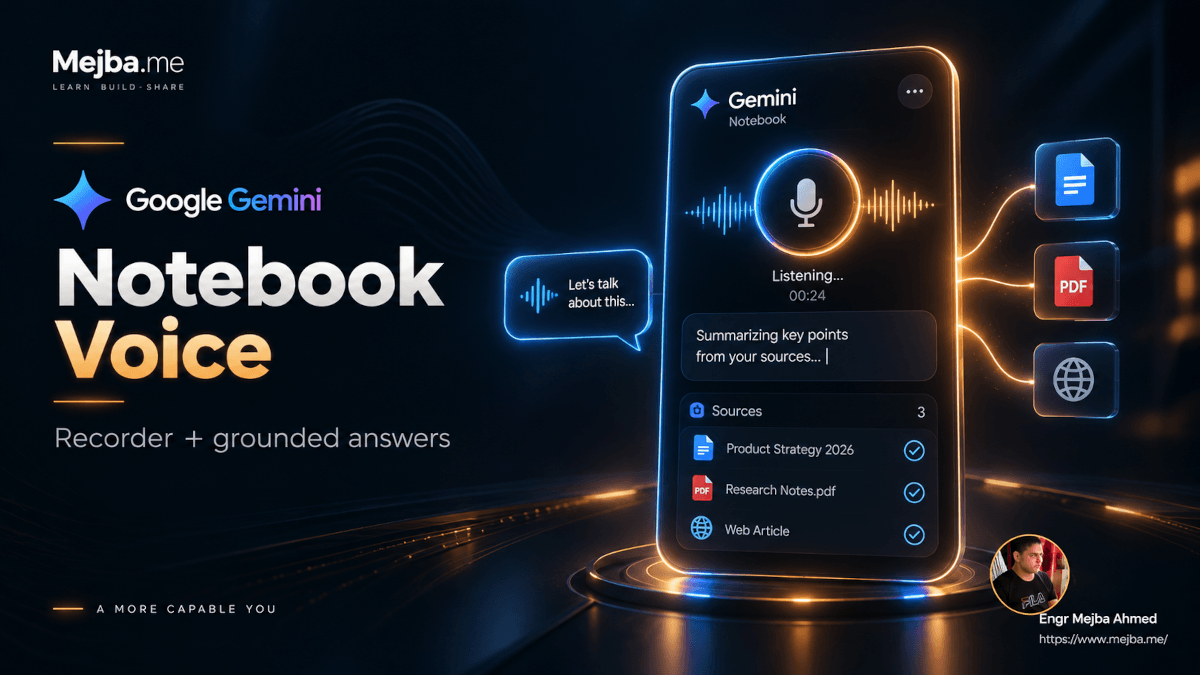
Google shipped five features to Gemini Notebook on September 15, and two of them change the shape of the tool rather than its feature count.
The first is real-time voice conversation in nearly 100 languages. You ask a question out loud, ask for a step-by-step explanation, interrupt halfway through and redirect — the way you'd do it with a person who knows the material. The constraint that makes this useful rather than a party trick: every answer stays tied to the documents in the notebook. It doesn't wander onto the open web and it doesn't improvise on topics your sources don't cover. That's the same grounding discipline that made Notebook worth using in the first place, which I got into when Notebook LM rewired my research process.
The second is an audio recorder inside the mobile app — lectures, meetings, your own thinking out loud, captured directly into the notebook. Google flagged it as rolling out the week after announcement, English output only at launch. So the voice conversation is multilingual and the recorder isn't, at least for now. Worth knowing before you promise a non-English team that this solves their meeting-notes problem.
Google also added interactive Learning Overviews under Reports — summaries, infographics, quizzes, and flashcards bundled together — and 60-second Short Video Overviews in more than 80 languages.
Here's the routing decision buried in the recorder. Capture used to be a deliberate act: you decided something was worth writing down, and the act of deciding did half the thinking. A recorder that runs for a 50-minute lecture removes that filter entirely. You get everything, which means the synthesis job moves from you to the model. That's a real trade, and it cuts both ways depending on whether you're capturing a lecture you'll never revisit or a client call where the exact phrasing of a scope change is the whole ballgame.
Gemini 3.8 Live: The Half of the Voice Story Developers Should Read
The consumer feature above has a developer-facing twin that shipped the same day. Google released Gemini 3.8 Live and 3.8 Live Extended Thinking on September 15, 2026 — native speech-to-speech models built for voice agents, supporting 97 languages with mid-conversation switching, asynchronous tool calls, and visual context grounding.
Three things in that list matter if you build agents.
Native speech-to-speech replaces the cascade. The standard voice pipeline has been speech in, text model in the middle, speech out. Three hops, three places for latency and meaning to leak. Native speech-to-speech collapses that, which is why interruption handling stops feeling like a bolted-on feature.
Async tool calls mean the agent keeps talking while the tool runs. Every voice agent I've built or tested has the same tell: it goes silent the moment it calls a function, and the silence is what makes callers hang up. Removing the dead air is a bigger usability win than another point of benchmark accuracy.
Mid-turn language switching across 97 languages is the feature nobody in a monolingual market will notice and everybody building for a bilingual one will. If you're shipping to users who code-switch mid-sentence — which describes most of South Asia, most of the Gulf, plenty of Europe — this is the difference between a demo and a product.
Test the interruption path before you ship anything on it. Users change instructions while the agent is mid-sentence and while a tool call is still in flight, and that's precisely where cascaded pipelines used to fall apart. The new architecture is supposed to handle it. Supposed to is a thing you verify with your own traffic.
Google's CC Now Runs Your Household — With Its Own Google Account
This is the one I keep thinking about.
On September 17, Google Labs expanded CC — the agent that started in December as a single-user daily email briefing, then moved into the Gemini app in May as Daily Brief — into a shared household agent. Up to six family members can work with it. And CC now has its own Google account.
Each member chooses what the agent is allowed to see. CC sorts through all of it and produces a shared morning brief called "Your Day Ahead," plus calendar entries and a running task list. School notices, practice schedules, vet reminders — the material that normally sits in exactly one parent's inbox and becomes a single point of failure for the entire household. It can open a registration form, pull live drive times from Google Maps between back-to-back activities, and create a shared Doc or Sheet. It's running on web and mobile in the U.S. for people 18 and older with a personal Google account, existing users get an upgrade email, everyone else waits on a list.
The coordination problem it solves is real and nobody has solved it. I'm not being dismissive when I say the design here is the most interesting thing Google shipped this fortnight.
Now the part that deserves more attention than it got: an agent with its own Google account and read access to six people's mail is an identity in your household, not a feature in an app. The per-member permission model is the right architecture — it means consent is granular instead of one person opting the whole family in. But the security question it raises is one every engineer will recognize immediately. That account is a service account with human-grade inbox access, it isn't tied to any single person's session, and the blast radius if it's compromised is six people's schedules, addresses, school affiliations, and children's routines.
I'd run it. I'd also treat that account like production infrastructure: its own strong credential, hardware-backed two-factor, and a deliberate review of what each member actually shares — not the defaults. The instinct that says "this is a family convenience app" and the instinct that says "this is a privileged identity" are both correct, and only one of them shows up in the onboarding flow.
ChatGPT Sites Grew Up: Co-Editing, Private Invites, Custom Domains
When I first took ChatGPT Sites apart in my breakdown of what it builds and where it breaks, the honest verdict was that it built real things and then stranded them at a generic address with no way to let a colleague touch the result. Both of those got fixed on September 11.
What shipped:
- Build Together — invite people to edit, save, and publish changes to the same Site themselves
- Private sharing — invite named people by email without publishing publicly; invited visitors sign in with the account that received access
- Custom domains — connect a domain you already own and can set DNS on; not available in Enterprise workspaces at launch
- Database inspection — ChatGPT can inspect the database connected to your Site, and other editors can view that data
- Speed — OpenAI says prompt-to-deployment time is cut in half
The number that reframes this: more than 5 million Sites created in the three months since launch. That's not a side experiment.
Two things to plan around. Custom domains missing from Enterprise at launch is an odd gap, and it's the exact tier most likely to have domain policy requirements — check before you promise a client anything. And database inspection visible to every editor means "invite a collaborator" and "grant read access to connected data" are now the same action. On a Site wired to anything real, that's a permission decision wearing a collaboration label.
If you'd rather have someone design and wire this properly — auth, data boundaries, a domain that doesn't leak your stack — that's the kind of build I take on through my Fiverr workspace.
ChatGPT Is Inside Word Now, and Default-On From October 1

OpenAI shipped the ChatGPT add-in for Microsoft Word on September 17, 2026. Excel landed in May, PowerPoint in July. One plugin, installed once, working across all three. Draft, revise, proofread, summarize, and format from a sidebar without leaving the document.
Availability is the aggressive part: all plans, including Free, with usage limits varying by tier. And starting October 1, 2026, ChatGPT for Word is enabled by default in workspaces. That's the sentence IT teams should read twice.
There's also a free preview running September 17 through September 30 for Business and Enterprise customers to use GPT-5.6 Sol inside Word, with preview usage excluded from normal limits.
Sol is worth understanding as the pricing story underneath all of this. It runs $4 per million input tokens and $20 per million output tokens after OpenAI cut prices in late August — roughly 20% off input and 33% off output — with promotional pricing running at least through November 21, 2026. That positions Sol as the capable-and-affordable default rather than the premium tier, which is where most real work actually lives. I traced how this tier fits the rest of the family in the GPT-5.6 Soul preview breakdown, and the short version hasn't changed: the interesting competition in this generation is happening at the middle of the lineup, not the top.
The routing decision here is the quietest one in the entire fortnight. When ChatGPT is a sidebar in Word and switched on by default, "which model drafts this document" stops being a question anyone asks. The default wins, because defaults always win. That's how a model becomes infrastructure — not by being chosen, but by being already there when you open the file.
Meta's Muse Is Placing Phone Calls Now
Meta launched Muse on September 8, 2026. It hit No. 2 on the U.S. App Store within two days and No. 1 by September 18, above ChatGPT, Gemini, and Claude. Pricing is Free, Power at $20/month, and Maximum at $100/month, metered in tokens — roughly 100M tokens/week free, 500M on Power, 3B on Maximum. Reporting notes the web tiers run about 20% cheaper than iOS for identical allowances, which is the App Store commission showing through the pricing page.
There's also an invite-code promotion circulating that grants a large one-time token grant when entered within 48 hours of account creation. Those codes come from third parties, not from Meta's own announcement, so treat the specific numbers accordingly.
Then September 17 happened. Meta quietly enabled outbound phone calls to U.S. businesses — booking restaurants, canceling subscriptions, disputing a bill with a telecom company. On the phone. On your behalf.
This is the far end of the ladder this whole fortnight has been climbing. Claude routes your request to the right mode. CC routes your family's schedule. Word routes your drafting to a default model. Muse routes your voice to a stranger. Every prior step delegated a decision inside a product. This one delegates a decision to someone outside it — a human on the other end of a call who has no way to know they're negotiating with software, and no way to verify what it was authorized to agree to.
I'm not going to pretend the utility isn't obvious. I've spent real hours of my life in hold queues that added nothing to anyone. But the trust boundary here is genuinely new, and the scrutiny it's drawing — including around what an agent should be permitted to ask for mid-call — is the correct reaction rather than a moral panic. My rule for the moment is narrow and boring: an agent may make calls that cost nothing and commit to nothing. Anything that moves money, changes an account, or creates an obligation stays on my side of the line until the audit trail is something I can actually read afterward. For context on what the underlying model family can and can't do, I went through that in my Muse Spark review.
Also Shipped: Grok Bot Talks, Flow Lands on iOS
Two smaller items that fit the pattern.
Grok Bot got voice. xAI's Grok Bot account posted a demo on September 17 and voice rolled out across desktop and mobile in the days after. The underlying stack is Grok Voice Think Fast 2.0, announced July 29, 2026, which xAI reports as roughly 1.4x faster than its predecessor with 1.5–2x better transcription accuracy against benchmarks including Deepgram Nova 3 and ElevenLabs Scribe v2. Those are the vendor's own figures — useful as a direction, not as an independent result.
Google Flow came to iOS on September 10 — free with in-app purchases, with camera-roll access and cross-device project syncing, so a video started on your phone continues on your desktop. Flow absorbed Whisk and ImageFX back in February, so image and video generation now share one workspace. The routing decision: which device you create on stops being a decision at all.
The One Rule I'm Taking Out of This AI News Roundup September 2026
Three of these I'd turn on Monday without much thought: Gemini Notebook's voice mode, ChatGPT Sites' custom domains, Flow on iOS. Low stakes, immediate payoff, nothing irreversible.
Two need a decision rather than a default. ChatGPT for Word going default-on October 1 is a workspace-wide policy change disguised as a convenience update — if you administer a tenant with any confidentiality obligation, that date belongs on a calendar this week, not in an inbox next month. And CC's household account is worth running, with the credential hygiene you'd give any privileged identity.
The rest of it comes down to one question I've started asking before enabling anything from this fortnight: when this routes wrong, will I find out?
That's the actual cost of a deleted choice, and it's why this fortnight is harder to evaluate than the metering week back in August, where every trade-off eventually showed up on an invoice. Cost is self-reporting. Routing isn't. A task that silently ran in the wrong mode, a model that silently drafted your document, an agent that silently handled a call — those produce output that looks exactly like success. The failure mode of an interface that never asks you anything is that it also never tells you anything.
So build the check in yourself. For anything where the answer matters, keep one verifiable artifact — the file it actually read, the transcript of what it actually said, the model name in the response header. Not because these products are untrustworthy. Because "I couldn't tell it went wrong" is a worse position to be in than "it went wrong."
Ten products this fortnight decided you were spending too much time choosing. They were mostly right. Make sure you still know what got chosen.
FAQ
Frequently Asked Questions
Everything you need to know about this topic
The five that change daily workflows most: Anthropic unified Claude chat, Cowork, Artifacts, and Design into one interface on September 16; Gemini Notebook added real-time voice and an in-app recorder on September 15; ChatGPT shipped a Word add-in on September 17; Google's CC became a six-person household agent; and Meta's Muse began placing outbound phone calls.
No. Cowork's capabilities move inside the unified Claude interface rather than disappearing — Claude now routes requests automatically instead of asking you to pick a tab. Scheduled and cloud tasks keep running as before. See the section on Anthropic's merge above for the local-versus-cloud file access detail that still applies.
GPT-5.6 Sol is priced at $4 per million input tokens and $20 per million output tokens following OpenAI's late-August cut of roughly 20% on input and 33% on output. That promotional pricing runs at least through November 21, 2026.
October 1, 2026. OpenAI's Word add-in shipped September 17 and becomes enabled by default in workspaces on October 1. Excel arrived in May and PowerPoint in July, all sharing one plugin across every ChatGPT plan including Free.
Yes. Meta enabled outbound calls to U.S. businesses on September 17, 2026 — booking, canceling, and disputing charges by voice. Treat it as a capability with a new trust boundary: keep it to calls that commit to nothing until the audit trail is something you can review.
Let's Work Together
Looking to build AI systems, automate workflows, or scale your tech infrastructure? I'd love to help.
- Fiverr (custom builds & integrations): fiverr.com/s/EgxYmWD
- Portfolio: mejba.me
- Ramlit Limited (enterprise solutions): ramlit.com
- ColorPark (design & branding): colorpark.io
- xCyberSecurity (security services): xcybersecurity.io