


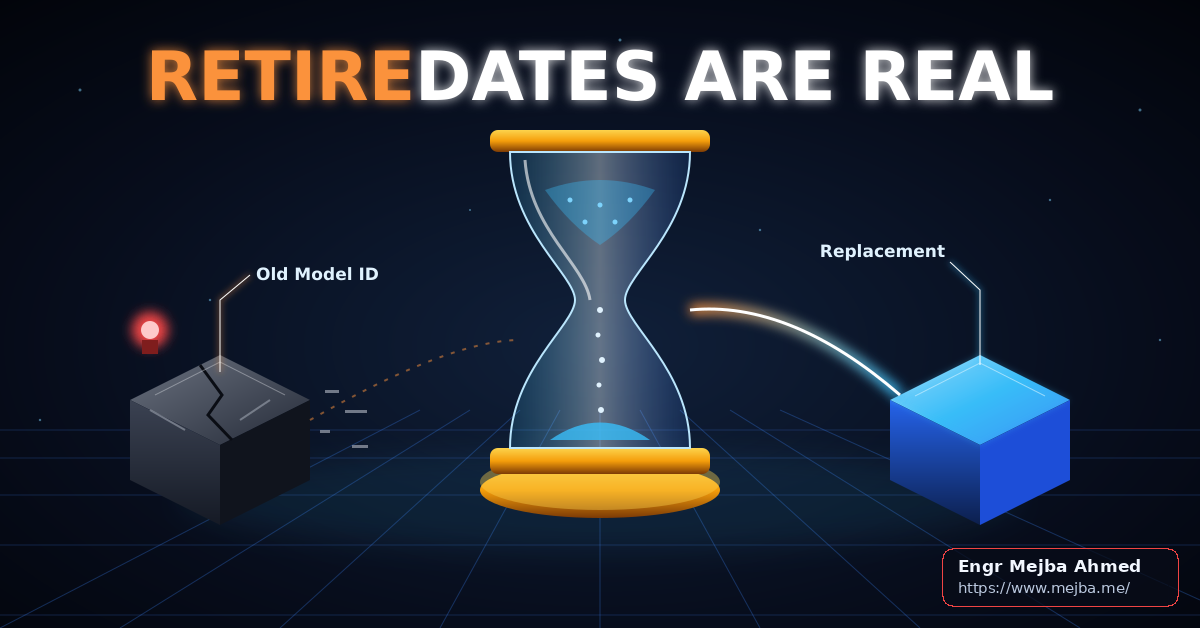
When a Claude model your product depends on shows up on Anthropic's deprecations page, every hard-coded model ID becomes a future production outage with a date attached. This guide gives you a repeatable runbook. You will learn how to read a deprecation entry, inventory every model ID in your systems, decide how to handle snapshots and aliases, run a regression eval against the recommended replacement, and schedule the cutover before requests start failing.
The deadline is close for some teams. As of November 25, 2026, the model deprecations page lists Claude Sonnet 4.5 for retirement on the Claude API on November 30, 2026, and Claude Opus 4.5 on January 22, 2027.
What a deprecation entry actually commits you to
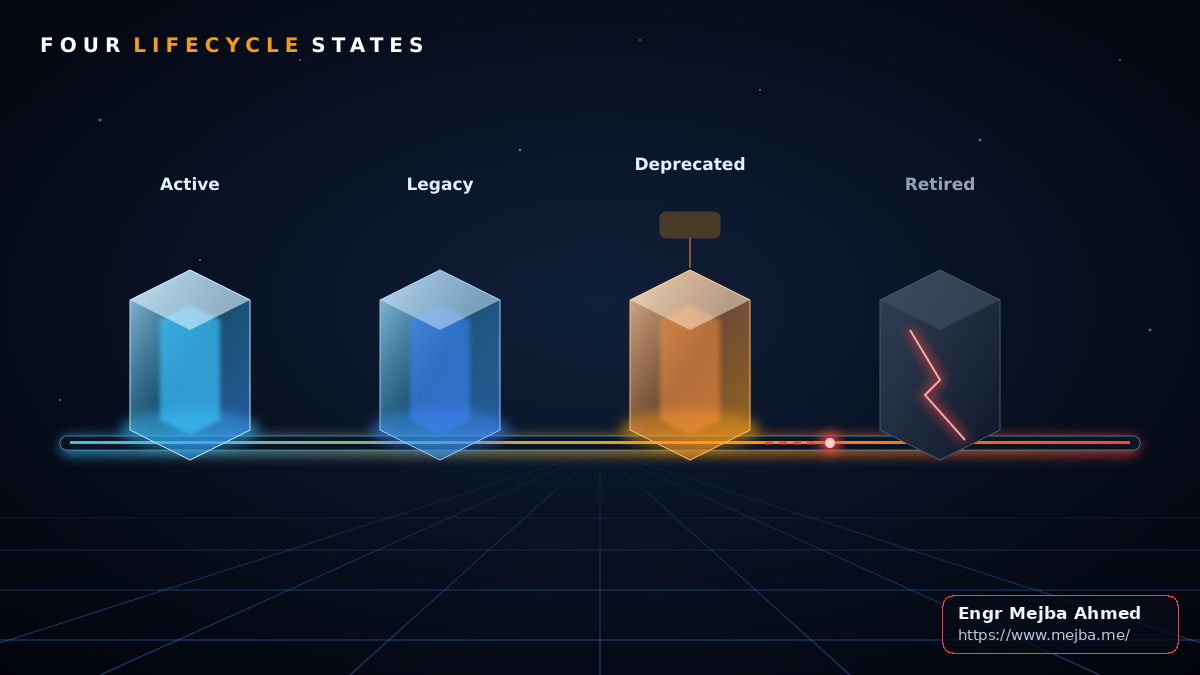
Anthropic's model deprecations page describes four lifecycle states:
- Active: fully supported and recommended.
- Legacy: no longer receiving updates and might be deprecated in the future.
- Deprecated: still functional but no longer recommended. Anthropic names a recommended replacement and assigns a retirement date.
- Retired: no longer available. Requests fail.
The failure mode is specific. Once a model is retired, the Messages API on the Claude API returns a 404 not_found_error. That signature is the thing to alert on, because it is what your users will hit if migration slips.
Anthropic commits to at least 60 days' notice before retiring publicly released models, sent to customers with active deployments. The same page also says deprecated models are likely to be less reliable than active models. Waiting until the last week therefore costs you reliability as well as schedule slack.
The dates are platform-specific. They apply to Anthropic-operated platforms: the Claude API, Claude Platform on AWS, Claude Models on Google Cloud (Anthropic managed), and Microsoft Foundry. Amazon Bedrock and Claude Models on Google Cloud (Google managed) set their own retirement schedules, so status and dates can differ. If you run on more than one platform, check each platform's model table separately.
The two current entries look like this:
| Deprecated model | Retirement date (Claude API) | Recommended replacement |
|---|---|---|
claude-sonnet-4-5-20250929 |
November 30, 2026 | claude-sonnet-5-5 |
claude-opus-4-5-20251101 |
January 22, 2027 | claude-opus-5-5 |
Both entries state that the retirement includes the same model's ID without a date (claude-sonnet-4-5 and claude-opus-4-5). The retirement date is a hard deadline, but your own migration deadline should come well before it. You need time for the eval, a canary period, and rollback. For a team still on Sonnet 4.5 today, that buffer is already gone, so compress the steps below rather than skip them.
Inventory every model ID before you touch code
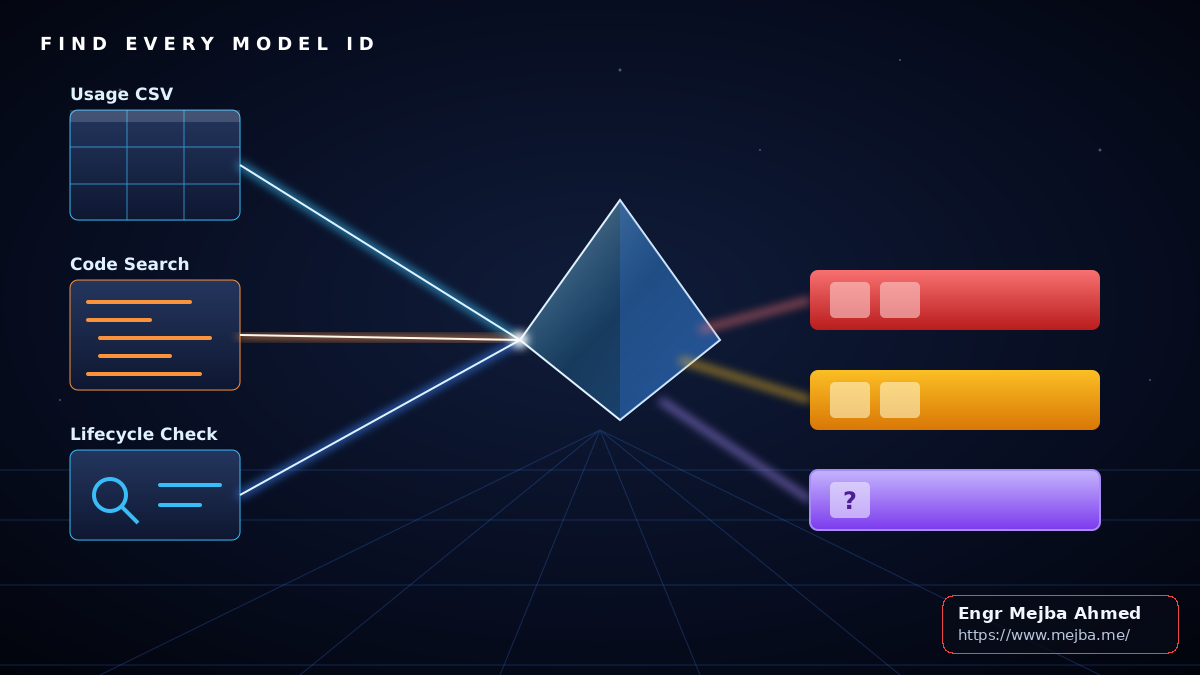
You cannot migrate what you cannot find. Combine two sources: what your systems are actually calling, and what your repositories say they call.
Observed usage. The deprecations page documents an audit path. Go to the Usage page in Claude Console, click Export, and review the downloaded CSV. It breaks usage down by API key and model. This catches calls from services nobody remembers owning, such as a batch job behind an old API key.
Declared usage. Search code, config files, infrastructure-as-code, environment variables, and secrets stores for model ID strings. Search for the dated and undated forms, and for platform-specific formats. The models overview shows that IDs differ by platform. Amazon Bedrock uses IDs such as anthropic.claude-sonnet-5-5, while the Claude API uses claude-sonnet-5-5. A grep for only the Claude API form will miss Bedrock deployments.
Authoritative status. The List Models endpoint returns a lifecycle field for each model: active, deprecated, or retired. Two details matter. First, when you omit the lifecycle filter, the response contains only active and deprecated models. Retired models appear only when you request retired explicitly. Second, lifecycle is the retirement signal, not retires_at. The docs state that a past retires_at on a deprecated model means retirement is overdue, not that it has occurred.
The following decision logic (an original design, not an Anthropic API) takes the IDs you found by grepping plus the model records from List Models, fetched with all three lifecycle values requested:
def classify(configured_ids, models):
    by_id = {m["id"]: m for m in models}
    report = {"retired": [], "deprecated": [], "unknown": []}
    for model_id in sorted(set(configured_ids)):
        info = by_id.get(model_id)
        if info is None:
            report["unknown"].append(model_id)
        elif info["lifecycle"] == "retired":
            report["retired"].append(model_id)
        elif info["lifecycle"] == "deprecated":
            report["deprecated"].append((model_id, info["retires_at"]))
    return report
Read the buckets this way. Anything in retired is already broken. Anything in deprecated needs a migration ticket with its retires_at date attached. The unknown bucket is the one teams tend to ignore, and it deserves the most care. An unknown ID might be a Bedrock or Google-managed ID, an undated ID, or a typo that has been failing silently. Resolve each one by hand against the deprecations table and the relevant platform's model table.
Design recommendation: run this check in CI and fail the build when the retired bucket is non-empty. Then a new hard-coded ID cannot reintroduce the problem after you migrate.
Snapshot or alias: what retirement means for each
A common assumption is that using an undated ID protects you from retirements. The deprecations page contradicts that for the current entries. The Sonnet 4.5 retirement includes claude-sonnet-4-5 and the Opus 4.5 retirement includes claude-opus-4-5. An undated ID does not silently forward to the replacement. It stops working on the same date as the dated snapshot.
The newer models in the overview list a single undated Claude API ID, such as claude-sonnet-5-5 and claude-opus-5-5, with retirement listed as "Not sooner than" a date in late 2027. That is a floor, not a schedule, so the same exercise will come around again. To understand how IDs, aliases, and snapshots work in general, read Anthropic's Model IDs and versioning page before you set a policy.
Do not infer a model's family from its ID string. The List Models response includes a line field (haiku, sonnet, opus, fable, mythos), and the docs say not to infer a line from the ID. Use that field if your code branches on model family.
Design recommendation:
- Keep the model ID in exactly one config value per platform per use case.
- Record the replacement mapping from the deprecations table next to it, with the retirement date.
- Never construct model IDs by string concatenation.
The tradeoff is a layer of indirection. Engineers reading a call site see a config key, not a model name. In exchange, cutover becomes a config change you can stage, canary, and roll back, instead of a code change spread across services.
Behavior can shift between generations even when the API call is identical. For background, see Claude Opus 5 Prompting: Delete Before You Write.
Run a regression eval against the recommended replacement
Anthropic's guidance on the deprecations page is to test your applications with newer models well before the retirement date. Its guide to developing tests gives the shape of a practical eval: be task-specific, include edge cases, automate grading where possible, and prefer more automatically graded questions over fewer hand-graded ones.
Before running anything, check what changed besides quality:
- Limits. The overview lists Claude Sonnet 4.5 and Claude Opus 4.5 at a 200K-token context window and 64K max output. Their replacements,
claude-sonnet-5-5andclaude-opus-5-5, are listed at 1M tokens and 128K max output. Any code that clampsmax_tokensor truncates input based on old limits should be reviewed. - Price. Sonnet 4.5 is listed at $3 per input MTok and $15 per output MTok. Confirm the replacement's pricing in the overview and rerun your cost model, because the replacement is not guaranteed to cost the same.
- Parameters. The deprecations page lists
temperature,top_pandtop_kas removed in API version2026-10-21, where they return a 400 error. Earlier API versions return that error when they are set to a non-default value on Claude 4.7 and later models. If your migration also bumps the API version, remove these parameters and use prompting to guide behavior instead.
For the eval itself, exact-match grading suits tasks with categorical answers. The develop-tests guide describes it as comparing output to a predefined answer, typically after normalizing whitespace and case. The gate below (an original design) runs the same cases through the current and replacement IDs:
def regression_gate(cases, run, current_id, replacement_id):
    def norm(text):
        return " ".join(text.split()).lower()

    results = {}
    for model_id in (current_id, replacement_id):
        results[model_id] = [
            norm(run(model_id, c["input"])) == norm(c["expected"])
            for c in cases
        ]

    old, new = results[current_id], results[replacement_id]
    regressed = [c["name"] for c, o, n in zip(cases, old, new) if o and not n]
    blocking = [c["name"] for c, n in zip(cases, new) if c.get("must_pass") and not n]

    return {
        "pass_rate": {m: sum(r) / len(cases) for m, r in results.items()},
        "regressed": regressed,
        "blocking": blocking,
        "ship": not blocking,
    }
The rule is simple: ship only when every case marked must_pass passes on the replacement. The regressed list shows cases the old model got right and the new one got wrong. Review those even when the gate passes, because a higher overall pass rate can hide a regression on an important input. If a must-pass case fails on both models, the gate blocks, which is intended: you are about to depend on a behavior neither model delivers.
This gate has a clear failure case. Exact match is wrong for open-ended outputs such as summaries or code. For those, the develop-tests guide lists code-graded and LLM-graded options. Running the current model also only works while it is still callable, so capture its outputs as a baseline now if retirement is days away.
Replacement models can also expose different reasoning settings; the overview lists adaptive thinking and a default effort per model. For background, see Claude Code Effort Levels: What Max Actually Buys You.
FAQ
What happens to requests after a model retires?
They fail. On the Claude API, the Messages API returns a 404 not_found_error.
Will the undated ID keep working after the dated snapshot retires?
Not for the current entries. The Sonnet 4.5 and Opus 4.5 retirements explicitly include claude-sonnet-4-5 and claude-opus-4-5.
Do Amazon Bedrock and Google Cloud follow the same dates? The page's dates apply to Anthropic-operated platforms, including Claude Models on Google Cloud (Anthropic managed). Amazon Bedrock and Claude Models on Google Cloud (Google managed) set their own schedules, so check their model tables.
Does a past retires_at mean the model is gone?
No. On a deprecated model, a past retires_at means retirement is overdue. The lifecycle field is the retirement signal.
Can I still start using a deprecated model for a new feature? The List Models docs say deprecated models remain callable for organizations with existing access but are closed to new adopters. Build new features on an active model.
Book your cutover before November 30: five steps for this week
- Export the Console usage CSV today and list every API key still calling
claude-sonnet-4-5-20250929,claude-opus-4-5-20251101, or their undated IDs. - Run the classifier against IDs from code, config, infrastructure and environment variables, with List Models results that include retired models. Resolve every unknown ID by hand.
- Run the regression gate against
claude-sonnet-5-5orclaude-opus-5-5, after removing deprecated sampling parameters and reviewing token limits and cost. - Flip the config in staging, then canary in production (design recommendation). Send a small share of traffic to the replacement and keep the old ID as rollback only until its retirement date.
- Alert on
404 not_found_errorfrom the Messages API, so any missed call site surfaces in minutes rather than through user reports.
Need a hand implementing this? See Claude AI consulting.