

The foggy-mountain analogy
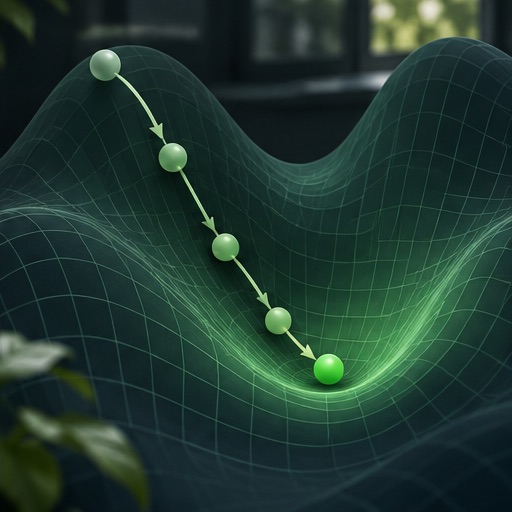
Imagine standing on a foggy mountain at night. You cannot see the valley, but you can feel the slope under your feet. The fastest way down is: take a small step in the steepest downhill direction, feel again, step again. Eventually you bottom out somewhere flat.
Gradient descent is that algorithm, run on the loss landscape — a high-dimensional surface where height = how wrong the model is. Each step nudges every parameter a tiny amount in the direction that lowers the loss the most.
The basic update rule
w_new = w_old − learning_rate × gradient
That is the entire idea. Backprop computes the gradient. The optimiser uses it to move every parameter a step opposite the steepest ascent. Smaller steps = stable but slow. Bigger steps = fast but risk overshoot.
Stochastic vs batch
- Batch GD — average gradient over the whole dataset, then step. Smooth but expensive.
- Stochastic (SGD) — gradient on one example, step. Noisy but cheap.
- Mini-batch SGD — gradient on 32–1024 examples. The sweet spot. Used by everything in practice.
The noise from mini-batches is not a bug — it acts like a temperature, helping the optimiser escape shallow local minima.
Momentum, RMSProp, Adam
Plain gradient descent zigzags in narrow valleys. Modern optimisers add memory:
- Momentum — keep a running average of past gradients, like a marble that has built up speed. Smooths the path.
- RMSProp — scale each parameter's step by its recent gradient magnitude. Tames "fast" parameters and accelerates "slow" ones.
- Adam / AdamW — combine momentum + RMSProp. Default optimiser for most of deep learning today.
The loss landscape is bumpy
For a deep network the loss surface has:
- Local minima — bottoms that are not the global bottom. In practice, usually fine; many local minima have similar loss.
- Saddle points — flat in some directions, downhill in others. More common than local minima in high dimensions; momentum helps you push through.
- Plateaus — long flat stretches where gradients are tiny. Learning rate schedules (warmup + decay) help here.
You almost never find the global minimum. You find a good enough basin.
What can go wrong
- Diverging loss (going up, becoming NaN) — learning rate too high, no gradient clipping.
- Stagnant loss — learning rate too low, or gradient vanishing in deep layers.
- Spiky loss — bad batch (unusual examples), or unstable layer norm. Smooth with EMA, gradient clipping, or larger effective batches.
In practice
You will rarely write the optimiser. You will tune:
- Learning rate (the single most important hyperparameter).
- Schedule (warmup steps, decay shape).
- Batch size (within memory limits).
- Weight decay (regularisation pulling weights toward zero).
Get those four right and a competent architecture trains itself.
AI Integration for Your App — ChatGPT, Claude & RAG
Your product already works. The goal here is to make it smarter, deflect repetitive support, turn your own content and data into answers, and automate the manual steps, without rebuilding from scratch...