Open Code Desktop App Review: Why I Switched
I have a problem. I keep installing AI coding tools. Claude Code, Cursor, Codeex, Gemini CLI — at one point I had five different AI assistants fighting for space in my workflow, each one locked to its own model provider, each one demanding I commit to its ecosystem before it'd show me what it could really do.
So when Open Code dropped a desktop app last week — built in Rust, open source, connects to over seventy-five models from any provider — I almost didn't try it. Another tool. Another setup. Another thirty minutes I'd never get back.
I installed it anyway. And now I'm writing this post because something happened that hasn't happened with any of the other tools: I actually stopped reaching for the alternatives.
Not because Open Code is the best at any single thing. It isn't. But because it solved a frustration I didn't fully realize I had until it was gone. The frustration of being locked into one model, one provider, one way of working — and having to switch entire applications when that model wasn't the right fit for the task in front of me.
Let me walk you through what the desktop app actually does, where it genuinely shines, where it's still rough, and why I think the model-agnostic approach matters more than most developers realize right now.
What Open Code Actually Is (For Those Who Haven't Heard of It)
Open Code started as a CLI tool — a terminal-based AI coding agent that lets you write, refactor, and debug code with AI assistance directly from your command line. Think of it as Claude Code's open-source cousin. Same general concept: you describe what you want, the AI reads your codebase, writes or modifies files, and you review the changes.
The key differentiator from day one was provider flexibility. Where Claude Code requires Anthropic's API and Gemini CLI requires Google's, Open Code connects to whatever you want. Claude, GPT-4o, Gemini, Mistral, DeepSeek, Llama — if there's an API endpoint or an Ollama instance running locally, Open Code can talk to it.
The new desktop app wraps that CLI foundation in a proper graphical interface. Built with Rust and the Tauri framework, which means it's fast and lightweight — none of the Electron bloat that makes some desktop apps feel like they're running inside three layers of browser chrome.
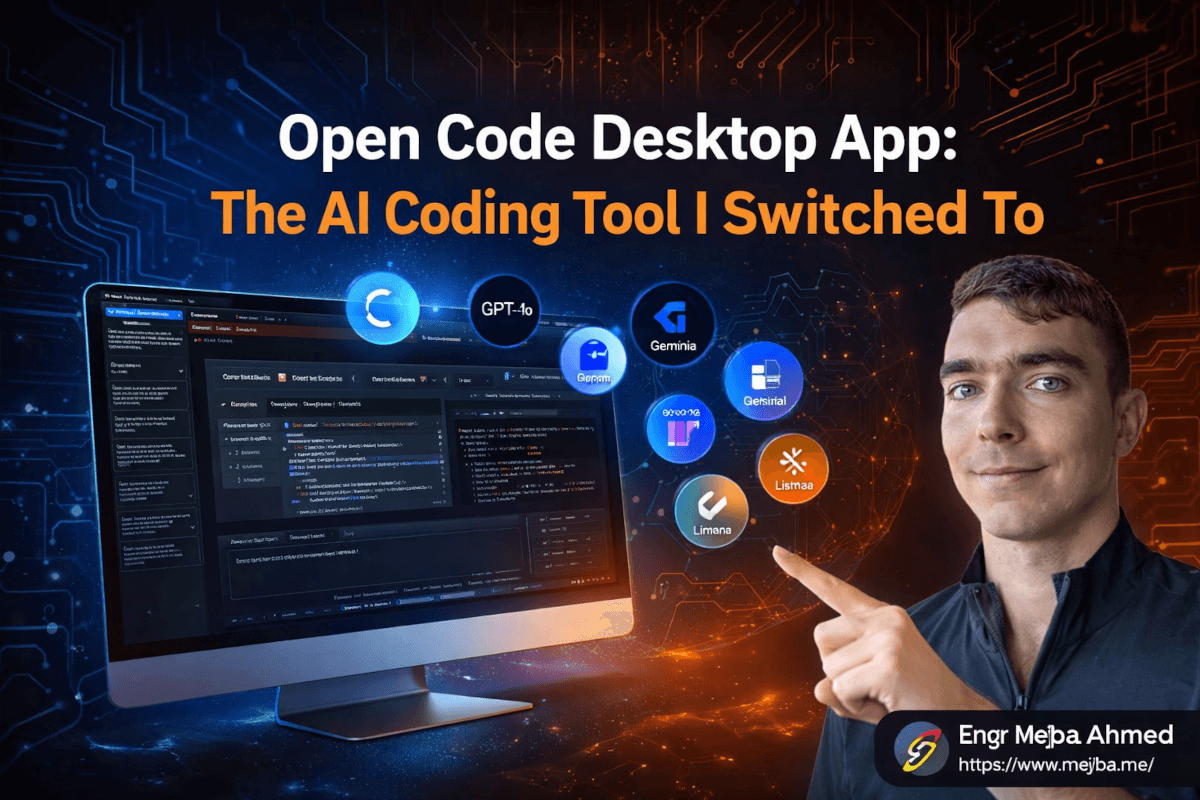
But calling it a "GUI wrapper" undersells what they built. The desktop app adds capabilities that the CLI never had: multiple sessions running in parallel, workspace management for juggling several projects, a clean diff viewer with inline commenting, integrated terminal tabs, and one-click handoff to external editors like VS Code or Cursor.
The architecture decision to use Rust and Tauri is worth noting if you care about performance. Every interaction feels snappy. File scanning, model switching, diff rendering — there's no perceptible lag on any of it. Coming from Electron-based tools where typing can sometimes feel like wading through honey, the responsiveness is immediately noticeable.
Here's what the app looks like in practice. You open a project, select your model (more on this in a minute), and start a conversation. You can plan first — describing what you want built and letting the AI ask clarifying questions — then switch to build mode where it actually writes files. Every change shows up in a diff view where you can comment inline, accept or reject individual changes, and run the result in an integrated terminal without ever leaving the app.
That workflow sounds straightforward on paper. The real test is whether it holds up when you're building something real. I tested it on two projects over the past week, and the results told me more than any feature list could.
Test One: Building a Data Analysis App From Scratch
My first test was deliberate. I wanted to see how Open Code handled a greenfield project — no existing codebase, no context, just a blank directory and a description.
The task: build a web application that lets users upload CSV files, processes the data, extracts insights, and generates interactive visualizations. Not trivial, but not enterprise-grade either. The kind of thing a developer might prototype in an afternoon.
I started in plan mode with Claude Sonnet 4.6 connected through my Anthropic API key. The AI asked smart clarifying questions right away — preferred tech stack, chart library preference, how I wanted CSV parsing handled (client-side or server-side). That question-asking behavior varies by model, which I'll come back to, but with Sonnet it felt like pair programming with a thoughtful colleague.
Plan mode produced a clear scope document: file structure, technology choices (vanilla HTML/JS for speed, Chart.js for visualizations, Papa Parse for CSV handling), and a step-by-step implementation order. Good enough. Time to build.
Here's where I hit my first beta-era friction point. The app didn't automatically transition from plan mode to build mode. I had to manually switch. Minor inconvenience, but it breaks the flow when you expect the AI to say "okay, let me start coding" and instead it keeps planning. This is a known limitation — the team is working on it — but it's worth mentioning because competing tools like Claude Code handle this transition seamlessly.
Once in build mode, the AI generated files quickly. HTML skeleton, JavaScript modules for CSV parsing and chart rendering, CSS for a clean layout. Each file appeared in the app's file viewer with full syntax highlighting, and the diff view showed exactly what was being created.
The result: a functional web app that handled CSV uploads, displayed data summaries (row counts, column types, basic statistics), and generated four chart types — bar, line, pie, and histogram. All from a conversation that took about twelve minutes.
Was it production-ready? No. The error handling was minimal, the UI was functional but not polished, and there was no input validation worth mentioning. But as a working prototype that I could iterate on? Solid. I've seen junior developers take longer to produce less.
I did encounter a UI bug — the to-do list the AI generated to track its own tasks rendered twice, overlapping in the sidebar. Beta software being beta software. The functionality wasn't affected, just the display. I mention it because if you're evaluating the tool right now, expect this kind of roughness. It's being actively fixed, but it exists today.
The more interesting observation: I could have switched models mid-project. Started the planning with Claude, switched to GPT-4o for the implementation, then used a local Llama model for quick refactoring questions that didn't justify API costs. No other desktop coding tool I've used lets me do that in a single session. That flexibility turned out to matter more in my second test.
Test Two: Adding Features to an Existing Next.js Project
The real test of any AI coding tool isn't greenfield work — it's navigating an existing codebase with established patterns, dependencies, and constraints.
I opened one of my active projects: a personal finance tracker built with Next.js, Tailwind CSS, Drizzle ORM, and SQLite. The codebase has about forty files across twelve directories, with established patterns for routing, data access, and component structure.
The task: build a goals page with full CRUD functionality — create, read, update, and delete financial goals, with a progress tracker showing savings toward each goal.
For this test, I deliberately chose a different model. I connected to Kimi K2.5, partly because I wanted to test a free option and partly because I wanted to see how well Open Code's model-switching actually works in practice.
Switching models took about ten seconds. Open the settings, select the provider, choose the model, done. No reconfiguration, no restart, no losing my project context. The session continued with the new model as if nothing had changed. That seamlessness is something I didn't appreciate until I experienced it — previously, switching models meant switching tools entirely.
Kimi K2.5 handled the task differently than Claude would have. It spent more time scanning existing files before proposing changes — reading the route structure, the existing database schema, the component patterns I'd established. Then it generated a to-do list of implementation steps and started working through them.
The AI created a new goals table in the database schema, added API routes following the existing pattern, built a React component for the goals page with a form for creating/editing goals and a progress visualization, and wired everything together with the existing navigation.
I watched this happen across Open Code's diff view, which showed each file modification with Git-style highlighting. Green lines for additions, red for removals, and — this is the feature that sold me — inline comment bubbles where I could ask questions or request changes to specific sections without interrupting the overall flow.
"Why did you use useState here instead of the useReducer pattern I use in the transactions page?" I wrote in an inline comment on the goals component. The AI read the comment, checked the transactions page code, and refactored to match my existing pattern. That interaction — targeted, contextual, non-disruptive — felt more natural than any chat-based coding review I've done with other tools.
While Kimi K2.5 was working on the finance app, I switched to my other session — the data analysis project — and continued iterating. Two projects, two different AI models, running in parallel sessions within the same application. Each session maintained its own context, its own conversation history, its own file state.
This is where the multiple sessions feature stops being a bullet point and starts being a workflow advantage. I code across three to four projects in any given week. Having all of them accessible in a single application, each with its own AI context and potentially its own model choice, eliminates the constant tool-switching that fragments my attention.
The goals page worked on the first test. Not perfectly — the delete confirmation dialog was missing, and the progress bar had a CSS overflow issue — but functionally complete. Two inline comments and about ninety seconds of AI refinement later, both issues were fixed.
Total time from opening the project to a working, tested goals page: about twenty-two minutes. With a free model. On a codebase the AI had never seen before.
That's not a miracle. A good developer who knows the codebase could do it faster. But a good developer who knows the codebase is me, and I'd rather spend those twenty-two minutes on architecture decisions while the AI handles the implementation scaffolding.
The Model-Agnostic Advantage (And Why It Matters More Than You Think)
Let me make the case for why Open Code's provider flexibility isn't just a nice-to-have feature — it's a fundamental architectural advantage that will matter more over the next twelve months, not less.
Right now, the AI model landscape changes every few weeks. A new model drops, benchmarks shift, pricing changes, rate limits get adjusted, capabilities evolve. If your coding tool is locked to one provider, you're locked to that provider's pace of improvement and pricing decisions.
I've experienced this directly. Claude is my preferred model for complex architectural reasoning and nuanced code review. But for straightforward boilerplate generation — CRUD endpoints, component scaffolding, test file creation — GPT-4o is faster and cheaper. For quick questions while debugging, a local Llama model running through Ollama costs literally nothing and responds in milliseconds with no network latency.
Before Open Code, using the right model for the right task meant switching between three different applications. Now it means clicking a dropdown.
The economics add up faster than you'd expect. My API spend dropped by roughly 40% in the first week of using Open Code, not because I was coding less but because I was routing simple tasks to cheaper (or free) models instead of burning premium Claude tokens on work that didn't need that level of reasoning.
Here's a rough breakdown of how I now allocate model usage:
Complex architecture and refactoring — Claude Sonnet or Opus. The reasoning depth justifies the cost. Maybe 25% of my AI coding interactions.
Standard implementation tasks — GPT-4o or Gemini. Fast, capable, cheaper per token. About 45% of interactions.
Quick questions, syntax lookups, simple refactors — Local Llama 3 via Ollama. Free, instant, private. About 30% of interactions.
That distribution is only possible with a model-agnostic tool. And as the model landscape continues to fragment — new providers, new pricing tiers, specialized models for different tasks — the value of flexibility will only increase.
There's a privacy angle here too. Running a local model through Ollama means your code never leaves your machine. For client projects with strict confidentiality requirements, or for proprietary codebases where sending code to a cloud API feels uncomfortable, local model support isn't a feature — it's a requirement. Open Code handles it natively. Most competitors don't even acknowledge the use case.
What's Still Missing (And It's Not Nothing)
I've been genuinely positive so far, so let me be equally genuine about the gaps. Open Code's desktop app is in beta, and it shows in specific, practical ways.
No built-in Git integration. This is the biggest missing piece. You can't commit, push, pull, or manage branches from within the app. Every Git operation requires switching to the integrated terminal or an external tool. Claude Code handles Git operations natively — you say "commit these changes" and it does. Open Code makes you type git add . && git commit -m "message" yourself.
For a tool designed around developer productivity, the absence of Git integration feels like a missing wall in an otherwise well-built house. You can work around it. But you shouldn't have to.
No automatic mode switching. I mentioned this earlier, but it bears repeating. The app has a plan mode and a build mode, and the AI can't transition between them autonomously. You have to manually switch. In practice, this means you'll occasionally find yourself in a conversation where the AI has finished planning and is clearly ready to code, but keeps generating plan-related text because it can't flip the switch itself.
It's a small friction, but it occurs at the exact moment where momentum matters most — the transition from "I know what to build" to "let me build it." Breaking that momentum with a manual mode switch feels like downshifting on a highway.
No automation pipelines. Codeex, one of Open Code's competitors, supports automated workflows — run tests after generating code, automatically lint, trigger builds. Open Code has none of that. Every post-generation step is manual.
Beta-quality UI bugs. Duplicated elements, occasional rendering glitches in the diff view, and one instance where a session's file tree didn't update after the AI created new files (fixed by switching sessions and switching back). Nothing data-destroying. But enough to remind you that this is pre-release software.
Documentation gaps. The app is moving faster than the docs. Some configuration options aren't documented yet, and the setup process for certain model providers involves guesswork or community forum searches. This will improve, but right now, expect some self-directed troubleshooting.
I list these not to discourage you but because every other review I've seen either ignores the limitations or buries them in a footnote. If you're going to try this tool — and I think you should — you deserve to know what you're walking into.
How It Compares to What I Use Daily
I use Claude Code every single day. It's deeply integrated into my workflow, handles Git operations, understands complex multi-file refactoring, and produces consistently high-quality code. After testing Open Code for a week, am I switching? Let me be specific about the comparison.
Where Claude Code wins: Git integration, automatic mode transitions, deeper reasoning on complex architectural problems, more polished and stable interface, better error recovery when things go wrong mid-generation.
Where Open Code wins: Model flexibility (by a mile), multiple simultaneous sessions, lighter resource footprint, inline commenting on diffs, the ability to use free or local models for work that doesn't justify API costs, and open-source transparency.
Where they're roughly equal: Code quality for standard implementation tasks, codebase comprehension, file generation speed, and the overall "pair programming" feel of the interaction.
My honest recommendation: if you work exclusively with Anthropic's models and value stability and deep integration, Claude Code is still the better daily driver. If you work across multiple models, care about cost optimization, handle multiple projects simultaneously, or want the flexibility of open source, Open Code deserves serious evaluation.
I'm currently running both. Claude Code for my most complex projects and tasks requiring deep reasoning chains. Open Code for everything else — which, it turns out, is a lot of everything else. About 60% of my AI coding interactions over the past week happened in Open Code, mostly because the model flexibility and parallel sessions make it better suited for the varied, multi-project reality of my workdays.
What This Signals About AI Coding Tools in General
Step back from the specific features for a moment. Open Code's desktop app represents something broader happening in the AI coding tool space that I think most developers aren't paying enough attention to.
The first wave of AI coding tools was proprietary. Each tool locked to one provider, one model, one ecosystem. That made sense when there were only two or three models worth using. It doesn't make sense anymore.
We're entering a phase where the model you want to use depends on the task, the budget, the privacy requirements, and which model happens to be strongest this month. A tool that locks you into one model is a tool that will increasingly feel like a constraint rather than an enabler.
Open Code isn't the only project moving in this direction, but it's one of the most polished implementations of the model-agnostic philosophy. And the fact that it's open source means the development pace is driven by the community of developers who actually use it, not by a company's product roadmap.
I've contributed two bug reports in the past week. Both got responses within twenty-four hours. One is already patched in the latest build. Try getting that turnaround from a proprietary tool's support team.
The desktop app is beta software. It has rough edges. It's missing features that competitors have had for months. And despite all of that, I'm using it more than I expected, for more tasks than I predicted, with better results than I assumed.
That trajectory — rough but valuable on day one, improving visibly every week — is exactly what convinced me to adopt Claude Code early, back when it was far less polished than it is now. I'm seeing the same pattern with Open Code.
The tool isn't finished. But the foundation is right. And in the AI tooling space right now, getting the foundation right matters more than getting the polish right. The polish always comes. The architectural decisions are much harder to change.
If you've been waiting for a model-agnostic AI coding tool that doesn't require living in the terminal, the wait is over. It's rough around the edges. It'll crash occasionally. The Git integration will annoy you.
And you'll keep opening it anyway. Because once you experience the freedom of choosing the right model for every task instead of the right model for every tool — that freedom is hard to give back.
What would you build if your coding assistant could use any AI model that exists? That's not a hypothetical question anymore. It's a configuration setting.
Whether Switching Makes Sense
This Open Code Desktop app review reduces to fit: if your work lives in the terminal, stay there; if you juggle projects visually, the desktop app earns its window. My the Claude desktop review and Anti-Gravity IDE go deeper.
If you want your AI coding environment chosen well, that's work I take on through Ramlit.